

PageGroup’s DEI Promise Meets The “Don’t Freak Out” Discrimination Email
Standfirst: On the website, PageGroup is a cathedral of inclusion. Bonuses tied to DEI. Shadow Boards. Voices amplified. In the paperwork, a disabled candidate complains of discrimination and the first move is not empathy. It is a “don’t freak out” email, a quick Google, and an attempt to keep the small client as “sole respondent”. The Tribunal, naturally, is more interested in my tone than their instincts.
The Gospel According To PageGroup
Read their “Diversity, equity & inclusion promise” and you would think PageGroup is running the United Nations of recruitment. From The Hague.
Inclusion “embedded in every facet of operations”. Managing directors with bonuses tied to inclusion goals. Candidate journeys soaked in belonging. A Shadow Board feeding diverse views into the main one. Moral imperative plus business imperative. All very LinkedIn, all very on trend.
On paper they do not just understand disability, they monetise it. Inclusion as pipeline. Belonging as product. Every individual “feels their uniqueness is valued from start to finish”.
Now park the brochure and look at what actually happens when a real disabled candidate complains about discrimination.
Spoiler: the uniqueness they valued was the keyword “tribunal”.
The Panic Email They Redacted To Hell
Buried in my DSAR is an internal PageGroup email chain with a subject line that does more honest work than the whole DEI page.
“Discrimination case by candidate”.
In one email a Page employee forwards the chain to a colleague and tells them not to “freak out” because it looks like the candidate might be someone who does “this regularly”. No interest in what actually happened, no curiosity about adjustments or process. The first impulse is to profile and to minimise. All sounding very inclusive and accountable so far. then.
Another email in the same chain asks legal for next steps and calmly admits that Page introduced me to the client. Then the mask slips properly.
They say they have Googled me and my previous company and that it appears I went through an employment tribunal.
There it is. The real risk register. Not disability, not fairness, not whether the client handled anything properly. Reputation. History. Optics. DEI on the homepage, “I Googled him” in the inbox. Well I googled you too and it didn’t flash up “bigoted dickheads” but as long as I’m around I’ll make sure it happens.
If you ever wanted a live example of how corporate DEI talk evaporates the second risk management walks into the room, that little thread should be on a slide at every HR conference in the country.
Sole Respondent, Until The Shit Gets Real
Page’s internal summary also leans hard on the line that the client is the “sole respondent”. That phrase shows up in the DSAR like a nervous tic.
When the case is just an awkward complaint that might be batted away, the client is sole respondent. Page is the innocent conduit, the neutral postman.
Then December hits. A further email shows a Page employee asking for urgent help to get legal on a call because they have “been cited as a co respondent”. The sort of panic of an innocent party, right?
So which version are we supposed to believe?
The one where the client alone is on the hook while Page cashes the fee. Or the one where Page suddenly remembers it was in the room the whole time the moment its own name appears on tribunal paperwork?
Structurally, Page lives in the space between those two stories. All the upside of being the gatekeeper. All the frantic backpedalling when the gate is implicated.
Cepac’s ET3: We Didn’t Know, Except For The Bit Where We Obviously Did
This is where it gets properly stupid.
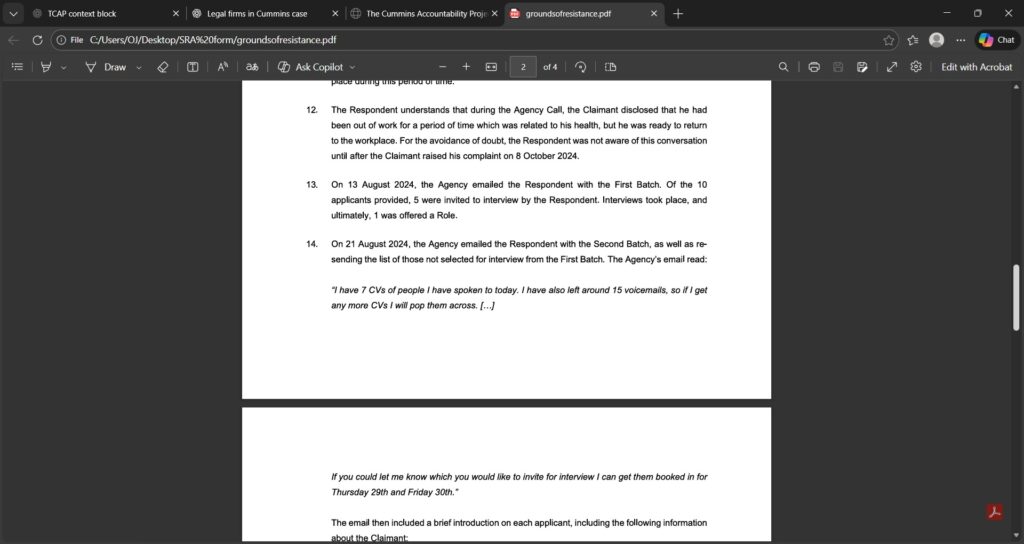
Cepac’s ET3 tries to pretend it did not know about any health context until I raised a complaint on 8 October. That is the line. No knowledge. Nothing disability related in play when decisions were made.
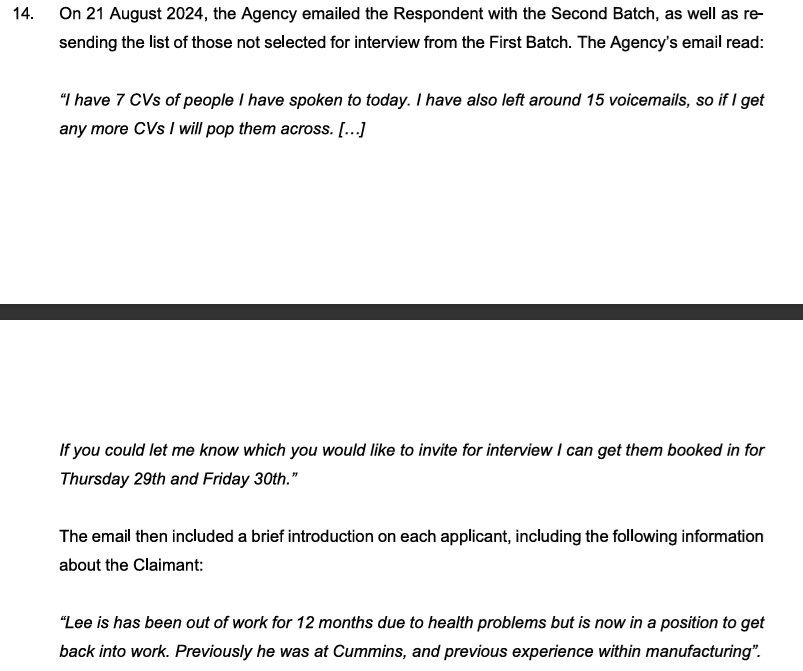
Then the same ET3 happily quotes Page’s “brief introduction” about me, reeling off the bit that says I have been out of work for 12 months due to health problems but am now in a position to get back into work.
You do not get to run both paragraphs.
Either health context is floating around the recruitment pipeline or it is not. You cannot deny knowledge in para 12 then parade the health line from the agency intro in para 14. We already know it sat on a separate document and my CV anyway. They are trying to wall off the bit that hurts while still using it as colour when it suits them.
Aggression was their only route because the paperwork is a self own. Hence the five figure costs threats, the short notice hearings, the “serial litigant” story, the GP fishing trip, and the manufactured outrage about my email volume.
You lean on a disabled litigant until they blow a gasket, then you cry “vexatious conduct”. Textbook.
When Inclusion Means ‘Google Him And Panic’
PageGroup’s DEI promise bangs on about “diversity of thought in decision making”. The DSAR shows you what that actually looks like when nobody expects a disabled claimant to see the emails.
Diversity of thought here means someone whose first instinct is to search my name and my former employer and draw their own conclusions from a tribunal result. It means seeing a complaint not as a signal that something went wrong in the process, but as a red flag that this is a man who “does this regularly”. They even include someone with my name, not me, as a litigant such is their desperation. That’s correct, I’m not the only L Thompson to have see a tribunal and Chubbier Max Branning double, representing Horsfield Menzies for Cepac, presented a case that wasn’t mine to the tribunal and called me a serial litigant. That was before he admitted to calling my GP surgery – without consent and who’s name he procured from my private medical files submitted with the scope to prove disability – to try and discredit the honest legal submission I’d made the the court, by claiming I could actually, if I was inclined, able to get an appointment slightly sooner than I’d claimed. What lengths to go to to discredit an honest Claimant. Agree, Sam Butler?
The court’s appetite to investigate this behaviour? None, of course, I was already the villain. A recurring theme throughout that has lead to HMCTS complaints and communications with my local MP office.
The label moves fast. Candidate to problem. Problem to risk. Risk to story that needs managing.
You can shout “belonging” in a PDF all day long. If your internal reflex to a discrimination complaint is “don’t freak out, he’s probably serial”, you are not running an inclusive culture. You are running a gate that slams shut the second anyone disabled walks up with paperwork.
The Tribunal Helps By Policing My Tone
Touched on above, into this waddles the Employment Tribunal, which has decided the real story here is not Page’s Googling and Cepac’s ET3 contradiction. It is my conduct.
Short notice hearings. Refused requested adjustment to defer short notice hearing (despite disability). An anxiety condition on record. Predictable dysregulation, now medically recorded. Medical files showing ambulance call-outs just a week or two before the January hearing. And the large law firm on the other side harvesting the fallout like trophies and stapling “vexatious” on top. All whilst acting with complete impunity.
The judge’s latest order literally says the April hearing will be about my conduct, not the respondents’, and that the Page DSAR material is “not relevant” to that question. So it might not be worth exploring if the disgusting discrimination I suffered caused a mental health deterioration, then?
So the corporate that Googled and profiled and tried to keep the client as sole respondent gets its instincts quarantined off as context. The disabled bloke who reacted badly to being ambushed gets a public conduct trial.
Whatever that is, it is not equality. It is procedural respectability politics. The side with the QC and the reputation budget gets its worst impulses treated as incidental. The side with the PIP award and an LCWRA letter gets every outburst dissected.
Two Risk Profiles One Outcome
Cepac is a small paper outfit with big man syndrome (linked by another blogger to 9/11 funding). It can pretend this is all just one more niggly claim to be crushed and forgotten.
PageGroup is FTSE level. It sells itself on values. It has DEI goals tied to bonuses. It has a brand to defend in markets, not just in Darlington. A sustained story about a recruitment giant Googling disabled candidates and muttering “serial” behind the scenes is not low value. It is a governance question. And if I can’t score a fair tribunal, I’ll start sending out the receipts myself. You haven’t read enough if you don’t think I’ve the balls to do it. I will turn these discriminatory bastards brand into battery acid. I’d have preferred a judge to do it through the appropriate channels. But if they think I’m going to sit and get grilled by these smug lying bastards and their child-rape acquittal barrister, then they’re mistaken.
That is why co respondent status matters. Cepac’s appetite for a street fight does not necessarily match Page’s appetite for being called out as the recruitment agent that panics when “discrimination” hits the subject line.
One of them will eventually clock that this cannot be killed cleanly. A strike out in a room does not remove a DSAR from the internet. It does not un-write ET3 paragraphs. It does not undelete what my followers have already screenshot.
Knife Edge, Your Call
So here we are.
PageGroup can keep the DEI promise on the site and hope nobody ever reads the emails that show how they behave when the lights are off.
Cepac can keep pretending para 12 and para 14 are not fighting each other in the same document.
The Tribunal can keep insisting this is all about my tone, while refusing to look too closely at the paperwork that might make that position uncomfortable.
Or they can accept the basic reality.
You cannot call someone “serial” in private and expect saintlike composure in public.
You cannot claim not to know about health and then quote “health problems” like colour commentary.
You cannot redact half the page on a discrimination thread and still pretend you are the grown up in the room.
You can win in a room or you can explain yourselves in public. Either suits me, but it won’t happen in a setting where I’m the villain.
So yeah, go ahead, pick one. See how it turns out.
Lee Thompson – Founder with disclosed health problems, The Cummins Accountability Project
Sources
- PageGroup – Diversity, equity & inclusion promise
- DSAR bundle extracts being prepared. Will update shortly.