
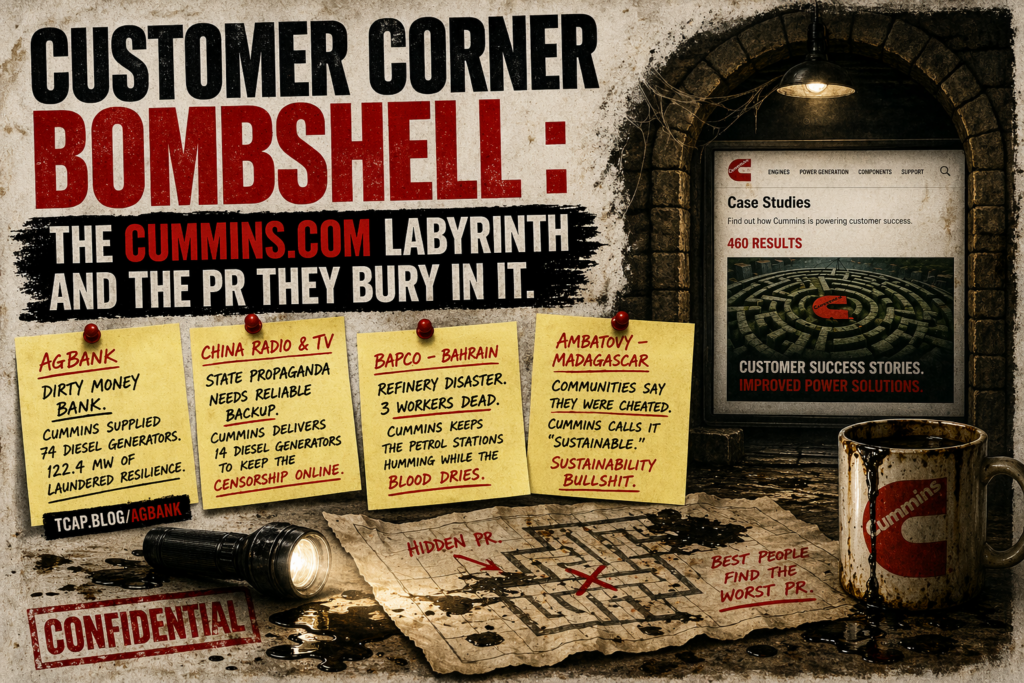
Cummins.com is not a website so much as a fucking labyrinth. A maze of tabs, mirrors, regional dead ends and submenu sludge where only the best people find the very worst PR. We are probably nowhere near the middle of it yet. God knows what other little horrors are tucked away in the crawlspaces. But today? Today we found this.
The Maze Is The Tactic
Buried inside Cummins.com sits a vault called Case Studies. Not two or three harmless little customer testimonials. Four hundred and sixty of the bastards. A whole hidden showroom of advertorial relics, polished just enough for buyers and buried just deep enough to keep the smell off the front hallway.
That is the tactic.
The halo pieces stay upstairs where the tourists wander. The ethics fog stays near the entrance. The people stories get the nice lighting. But the more revealing commercial bragging, the stuff that tells you who Cummins is genuinely proud to power and what kind of institutions it is happy to weld itself to, gets shoved deeper into the maze. Out of the casual flow. Out of sight of the average critic. Out of sight, for that matter, of plenty of ordinary users who would never think to go potholing through Cummins’ web architecture like some diesel archaeologist with a bad attitude.
That is not accidental site clutter. That is curation by concealment.
Cummins wants the warm sermon in the front room and the dirtier customer boasts in the cellar.
The Customer List Is The Story
The point is not merely that Cummins sells engines, generators, standby systems and all the rest of the old industrial furniture. We know that. The point is who it is so pleased to be doing it for.
Because once you start pulling names off the wall, the case studies stop looking like case studies and start looking like buried confessions.
Banks with anti-money-laundering grime on them.
State media infrastructure in a censorship machine.
Oil outfits with fresh fatalities on the books.
Mining giants wrapped in sustainability language while communities say they were left with the shit end of the stick.
This is why the page is hidden. Not because the content is boring, but because the customer list is politically uglier than the marketing department would like to admit.
The front of the house says transition, resilience and innovation.
The cellar says: we will happily power anything, anywhere, for anyone, if the cheque clears and the branding can be cleaned up afterwards.
AgBank Was Already A Stink Bomb
We already pulled one of these threads on Tuesday, and the bastards led us straight back into the wall.
The Inner Mongolia case study is not some vague little “financial sector” note. Cummins names Agricultural Bank of China and boasts about supplying 74 high-voltage diesel generator sets with an installed capacity of 122.4 MW for phase one of its Horinger data-centre project. Seventy-four. One hundred and twenty-two point four megawatts. That is not backup power. That is an industrial vow.
And AgBank is not some pristine little choirboy institution either. Back in 2016, New York’s Department of Financial Services fined Agricultural Bank of China $215 million for anti-money-laundering violations and said the investigation uncovered actions to obscure suspicious transactions. Which means Cummins, in its little hidden showroom, is proudly advertising giant diesel resilience for a bank with a proper AML stain already on the family portrait.
We already took a crowbar to that one in Greedy Genset Giants: AgBank, China And The Diesel That Keeps The Filth Online.
So fine. AgBank stays on the wall as Exhibit A. But the real value of the maze is that it keeps giving.
Diesel For The State Megaphone
Then there is China Radio and Television Group.
Cummins’ April 2026 case study says it supplied 14 high-voltage diesel generator sets for a major China Radio and Television data-centre complex in Zhongwei, Ningxia, part of a development corridor billed as a national digital hub with more than 10 billion RMB in planned investment. Lovely. More “zero downtime” language. More mission-critical chest-beating. More smooth little corporate prose about reliability and growth.
And what is it actually describing?
Cummins supplying diesel-backed resilience into the infrastructure of a state broadcasting apparatus inside one of the most tightly controlled media environments on earth.
You do not need to start foaming at the mouth to see the filth in that. China’s media system is not exactly famous for free expression, robust dissent or a healthy tolerance for awkward truths. Yet here is Cummins, deep in the maze, proudly helping keep that machine humming and calling it progress.
That is what makes this page so useful. It strips the soft language off the front of the company and shows you the wiring underneath. Not just what Cummins sells, but what kinds of systems it is comfortable reinforcing.
Forecourts, Fatalities And Filthy Timing
Then the maze coughs up BAPCO.
Cummins has a Bahrain case study about installing “robust backup systems” at BAPCO fuel retail sites so the kingdom’s petrol stations can keep running through power issues. Fair enough, on one level. Fuel sites want power. Cummins sells power. Capitalism slobbers into a napkin and gets on with it.
But timing matters. Context matters. And BAPCO is not a neutral little customer profile tucked away in some antiseptic vacuum.
In May 2025, Bapco Energies confirmed that a worker critically injured in a refining-complex incident had died, taking the death toll from that incident to three. So while Cummins is busy in the cellar writing little hymns to reliable forecourt continuity, the wider BAPCO orbit is carrying a fresh industrial-death stain and all the accountability questions that trail behind one.
Again, the point is not that Cummins caused the deaths. Don’t be stupid. The point is that this is the kind of customer relationship the company is perfectly content to shine up and stash in the hidden gallery without a second thought. Robust backup systems. Smooth operations. Keep the pumps humming. Keep the copy clean. Nothing to see here except dependable power for a state oil player with blood still drying on the floorboards.
That is what the hidden showroom is for. To make the room smell better than the customer list deserves.
Sustainability Sludge At The Super-Mine
And then, because God has a sense of humour and Cummins has none, along comes Ambatovy.
The Ambatovy case study reads like a mining brochure written by a sustainability consultant who has never had mud on his boots. Landmark development. Economic opportunity. Responsible frameworks. You can almost hear the soft piano under it.
Meanwhile, outside Cummins’ curated little reliquary, Ambatovy has faced long-running criticism over the impact of the project on affected families and communities. The Business & Human Rights Resource Centre covered reporting on families who say they were effectively cheated, their conditions worsened over time, and the giant nickel project left them carrying the cost of someone else’s shiny development story.
And there you have the classic Cummins move again.
Take a mega-project with real controversy hanging around it. Strip out the conflict. Strip out the anger. Strip out the people on the shit end of the arrangement. Leave only the machine, the output, the reliability, the polished language, the little smell of global progress.
It is not PR as information. It is PR as taxidermy.
The dead thing has been posed nicely. Please admire the finish.
The Hidden Showroom Is The Confession
This is why the case-studies page matters more than another newsroom sermon about purpose, women in engineering or how deeply somebody cherishes flexibility in Columbus.
The hidden pages tell you what the company actually wants to brag about once the halo crowd has gone home.
Not the values.
Not the posters.
Not the mental-health waffle.
Not the nice internal culture incense.
The customer list.
The buried sales trophies.
The relationships that make the machine purr.
And once you start pulling at those, the contradiction becomes embarrassingly obvious. Cummins would like to be read upstairs as a transition company with a conscience. Down in the maze, it reads like what it has always been: a hard-nosed industrial supplier happy to sit inside dodgy, dirty or compromised systems so long as the contract looks healthy and the copy can be sanded smooth.
The architecture of the site does half the work for them. Put the soft-focus bullshit where the crowd walks. Put the revealing customer bragging where only a determined bastard is likely to dig.
Well. Dug.
They Buried It Because It Stinks
That is the whole thing in one line.
They buried it because it stinks.
Not enough to stop doing it. God no. Cummins is clearly proud enough of these jobs to write them up and catalogue them like little brass plaques on a bunker wall. But just enough that the company would rather not lead with them when it is trying to sell itself as a clean, ethical, future-facing corporate citizen to the broader public.
So the labyrinth does its quiet work.
The halo lives upstairs.
The filth goes below.
The customer list waits in the dark.
Until somebody with enough time, enough spite and a strong enough torch crawls in and starts reading the names.
Cummins can keep the front room. We’ve been in the walls now. We’ve seen the hidden showroom, the buried customer boasts and the grubby little truth they were trying to keep one level deeper than the sermon.
The maze was never built to inform.
It was built to conceal. Well, sell us an excavator engine. Then watch us exhume the bodies.
Lee Thompson – Founder, The Cummins Accountability Project
Sources
- Case Studies | Cummins Inc.
- Inner Mongolia Data Center Banks On Cummins Standby Power
- Secure Power For A Major New Data Center In China’s Digital Hub
- Standby Power That Goes The Distance For Bahrain Petrol Stations
- STAMFORD P7 Alternators Power Madagascar’s Ambatovy Super-Mine
- DFS Fines Agricultural Bank Of China $215 Million For Violating Anti-Money Laundering Laws
- World Report 2025: China | Human Rights Watch
- China | Reporters Without Borders
- Updates: Bapco Refining Incident (May 2, 2025)
- Madagascar: Des Familles Impactées Par La Mine D’Ambatovy S’Estiment Flouées