TCAP will eat a Festive Bake regardless. Oscar will scrounge one regardless. But who is filling the rolls at the food-on-the-go giant? Greggs sells Britain the warm-carbs fantasy: sausage rolls, steak bakes, breakfast deals, value, community, and a brand voice so cuddly it could make beige pastry sound like a public service. Then the packaging trail coughs up Cepac, the tribunal receipts start flaking onto the counter, and suddenly the question is not whether Greggs can make a funny tweet. It is whether the company’s “better business” sermon survives contact with race discrimination findings, disability humiliation, supplier standards, reputational history, and a packaging chain with a disabled claimant crushed somewhere under the packaging.
The Pastry Brand With A Supplier Problem
Greggs is very good at being Greggs. That sounds obvious, but it matters. The company has built a national comfort machine out of pastry, value, humour and working-day hunger. Its brand voice feels like a mate who knows you are skint, cold, mildly hungover and not emotionally ready for quinoa.
Fine.
TCAP is not pretending to be above a steak bake. Nobody needs that level of dishonesty before lunch.
But this is The Cepac Files, not a Greggs review. The question is not whether Greggs can sell sausage rolls. It is whether Greggs’ responsible-business language reaches the packaging chain, or stops the second the wrapper looks clean enough for the shelf.
Unite’s Cepac strike coverage put Greggs in the frame. The union warned that food and drink packaging shortages could affect major brands including Greggs, Costa, Subway and Pret after workers at Cepac in Darlington began strike action over pay and conditions. Unite also described Cepac as a corrugated packaging producer, with clients including HBCP, whose customers include Greggs, Costa, Subway and Pret A Manger.
That is the route.
Cepac. Packaging. Greggs.
The pastry bag starts rustling.
Better Business, Worse Questions
Greggs’ own corporate language is exactly what you would expect: values, people, better business, responsible sourcing, diversity, inclusion and all the usual boardroom seasoning sprinkled over a warm public image.
The company says it wants to be an inclusive employer. It says it is strengthening diversity and inclusion. It says its people are valuable. Its Better Business page says Greggs sets high standards for what it purchases and works with suppliers so they “raise their game too”.
Beautiful.
There is the hook.
If Greggs expects suppliers to raise their game, what does it expect from a packaging chain linked to Cepac?
Because Cepac is not just a neutral cardboard name sitting quietly in the background. It is a company facing disability discrimination allegations, with an ET3 that appears to raise a very specific knowledge problem, and a reported legal spend of around £50,000 pursuing a disabled claimant after he raised a complaint.
That is not supplier-code small print.
That is the cardboard starting to sweat through the bag.
The ET3 Question Travels With The Wrapper
Cepac’s disability problem does not vanish because the product moves into another company’s supply chain. That is the whole point of supply-chain accountability. Responsibility is not supposed to dissolve the second the packaging leaves the factory.
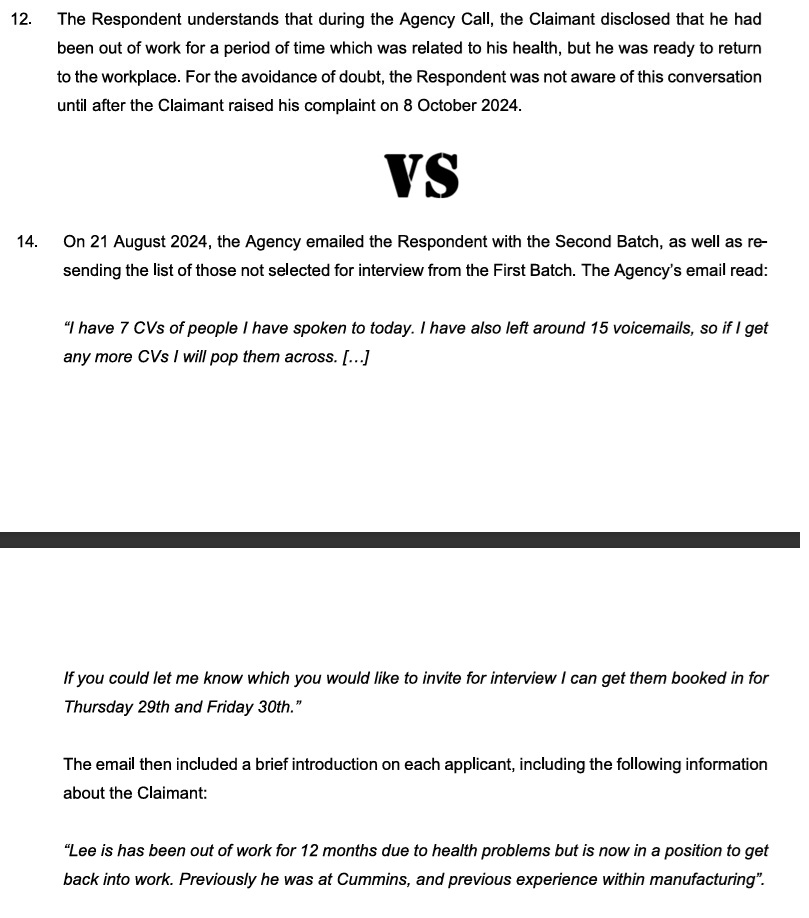
The company is facing disability discrimination allegations in a case where its own ET3 appears to raise serious questions about knowledge. Paragraph 12 distances Cepac from awareness of the health-related background. Paragraph 14 then appears to put the work-gap explanation back in the frame, with the agency email referring to time out of work due to health problems.
That is not decorative paperwork.
It is the kind of contradiction a responsible customer should hate.
Disability discrimination often turns on knowledge. What was said matters. What was passed on matters. The agency’s understanding matters. Cepac’s understanding matters. Any information received before the recruitment door closed matters.
So here is the Greggs question.
If the company claims to set high standards for what it purchases, does that include asking why a packaging-linked supplier has a disability discrimination knowledge issue sitting in its own pleaded defence?
Or does the standard stop at whether the pastry fits in the bag?
The £50,000 Filling
The ET3 question is bad enough. The money makes it uglier.
Cepac appears to have spent around £50,000 through Horsfield Menzies pursuing a disabled claimant through procedural warfare after he had the audacity to raise a complaint.
This is not the clean version of corporate defence where a company calmly denies discrimination and then proves the treatment was spotless. The allegation is nastier. The machinery turned on the disabled person who complained. Distress became the problem. Pressure, bullying, legal aggression and procedural ambush were pushed into the background while the claimant’s reaction was repackaged as scandal.
That is a very neat trick.
A disabled person complains. The pressure cooker gets hotter. Steam appears. Management points at the steam and asks the tribunal to call it unreasonable.
That is not inclusion.
It is a meat grinder with a supplier code taped to the side.
If Greggs’ “better business” language means anything beyond pastry PR, the company should want to know why a packaging-linked business in its orbit is accused of using that playbook.
The Race Receipts Behind The Counter
Greggs does not get to approach this as a spotless inclusion saint carrying a tray of vegan sausage rolls and moral authority.
Its own employment record has race discrimination receipts.
In Kahsay and others v Greggs PLC, three former workers won unfair dismissal claims, and one claimant succeeded in a race harassment claim. Reporting on the case recorded a manager threatening words to the effect of “if you want to take this higher you will be in big trouble” after concerns had been raised about how race-related issues were being handled. The tribunal material also involved dismissal decisions later found unfair.
That is not a good look for a company selling colleague value by the tray-load.
Then there is the 2025 “ganja man” case. A Black supervisor of Ghanaian heritage, described in reporting as having a Rastafarian appearance, won claims for race discrimination and unfair dismissal after being nicknamed “ganja man” and dismissed following allegations including giving away food and drug-related claims. Reporting on the tribunal said the nickname was linked to his appearance as a Black African man of Rastafarian appearance, and that race was found to be at least a factor in drug-related allegations.
Again, to keep the frame clean. These are not Cepac cases. They are Greggs receipts.
They matter because a company with its own inclusion stains should be especially alert when a supplier-linked chain starts carrying discrimination smoke.
The Disabled Toilet Lesson
Greggs’ disability problem is not only theoretical.
In 2025, national reporting described a woman with Fowler’s syndrome being denied access to a Greggs disabled toilet until she showed staff her catheter bag. She described the experience as humiliating. Greggs apologised.
That detail is grim because it is exactly where inclusion either exists or dies. Not in an annual report. Or in a values page. Not in a corporate pledge. In the moment a disabled customer needs a toilet and is apparently asked to perform proof of disability like a medical exhibit before being allowed through the door.
Greggs can support disability initiatives. It can talk about inclusion. It can tell the world it values people. All of that may be true in parts.
But when a disabled person says she had to show a catheter bag to access a disabled toilet, the warmth drains out of the pastry cabinet fast.
That is why the Cepac question belongs here. There is also a tidy argument for this to fold into the Cummins debacle, because TCAP has seen the same disabled-person-becomes-the-problem routine before. But this is Greggs’ series, so we will not crash the pastry party. The point is narrower and nastier: a company with a live disability humiliation receipt should not need a seminar on why disabled people should not be processed, doubted, pressured or turned into the problem.
The Sunflower And The Steam
Greggs is also listed by the Valuable 500 with commitments around disability inclusion, including supported hours for colleagues with disabilities who need additional support. It has talked about diversity, inclusion, colleague networks and National Equality Standard accreditation.
Good.
Now test it.
Disability inclusion is not proved by the badge. It is proved by what happens when the disabled person is inconvenient. When they need time. Or support. When they need a toilet. Or when they complain. When their distress is messy. When their reaction is not brochure-friendly.
This is where corporate inclusion so often reveals itself as steam in a paper bag.
Warm for a second.
Gone when handled.
If Greggs wants the public benefit of disability inclusion language, it can take the supply-chain question that comes with it. Does its responsible sourcing standard reach packaging companies linked to disability discrimination allegations, or only the edible bit?
The Stain Travels With The Name
Greggs also knows what reputational contamination looks like.
Colin Gregg, son of the company’s founder John Gregg, was convicted of nine counts of indecent assault against boys and jailed for 13-and-a-half years. Reporting described the sentencing judge calling him a “sophisticated, predatory” offender, with the court hearing that he had helped build the family business and used wealth, privilege and social standing as a cloak of respectability.
That is not a Cepac point, and TCAP is not pretending otherwise.
It is a brand-history point.
Greggs understands better than most that reputation is not protected by saying “that sits somewhere else”. Sometimes the stain travels with the name. Sometimes the public does not file moral contamination neatly into the department where corporate lawyers would prefer it to live.
So when Greggs sits in a packaging trail with Cepac, while selling Better Business, supplier standards, inclusion and public warmth, the question is fair.
How much dirt can sit near the brand before the pastry stops smelling innocent?
Supplier Standards With Pastry Crumbs On
Greggs says it wants suppliers to raise their game. That is not TCAP’s wording. That is Greggs’ own corporate pitch.
So raise it.
Ask Cepac what happened.
Enquire as to why a disabled claimant says the company and its lawyers turned his reaction into the issue.
Ask why the ET3 appears to wobble between paragraph 12 and paragraph 14 on the knowledge question.
And ask whether spending around £50,000 to frame a disabled claimant’s reaction and avoid a merits claim is what Greggs expects from the kind of chain that helps keep Britain wrapped in breakfast rolls, steak bake bags and beige corporate warmth.
Or do not ask.
That is also an answer.
Because supplier responsibility that only works when the supplier is easy to defend is not responsibility. It is branding with crumbs on.
The Packaging Does Not Stay Neutral
Greggs is not being accused here of directing Cepac’s conduct. That would be too easy, too lazy and too blunt.
The question is better than that.
Greggs sits in the public packaging trail. Its own corporate language says it cares about people, inclusion, responsible purchasing and supplier standards. Its own record includes race discrimination findings, unfair dismissal findings, a disability toilet humiliation story, public disability-inclusion commitments, and a brand history that proves stains do not always stay where public relations teams would like them.
Underneath that warm brand glow sits a packaging-linked company facing disability discrimination allegations and an ET3 knowledge problem.
That is the hit.
Not “Greggs caused Cepac”.
Something colder.
Greggs benefits from the clean wrapper. So does it care what is on the hands that made it?
The Inclusion Flake
This is why Greggs belongs in The Cepac Files. Unless Greggs thinks this is nothing, in which case The Greggs Files can land next.
Not because sausage rolls are evil. Orbecause every bakery-chain controversy belongs in the same oven. Not because TCAP needs to pretend a race case, a toilet incident, a historic brand stain and a packaging dispute are all the same thing.
Greggs belongs here because it is a values brand with a supplier-chain question.
It sells warmth, ordinary and going good. Then it tells the public it treats people well and expects suppliers to raise their game. Meanwhile, the public trail puts Greggs in the packaging-shortage frame around Cepac, and Cepac has a disability discrimination problem that does not stop smelling because someone wrapped a bake around it.
So here is the Greggs question.
Does “better business” reach the packaging chain?
As part of “responsible sourcing! does that include disability discrimination risk?
Does inclusion survive contact with a disabled claimant who complains and then gets framed as the problem?
Or does Greggs keep serving the warm brand while the cardboard underneath carries the cold bit nobody wants to touch?
Because in this supply chain, the pastry is not the only thing flaking.
So is the story.
Lee Thompson – Founder, The Cummins Accountability Project
Sources
- Unite The Union – Greggs, Costa, Subway And Pret Facing Packaging Crisis As Darlington Cepac Print Workers Announce Four Weeks Of Strikes
- Unite Live – Cepac Print Workers To Strike
- Prolific North – Unite Union Threatens Legal Action In Pay Dispute At Greggs And Asda Packaging Supplier
- Cepac – UK’s Leading Corrugated Packaging Company
- Greggs Corporate – Better Business
- Greggs Corporate – NES Diversity And Inclusion Accreditation
- Greggs – Valuable 500
- GOV.UK – Mr S Kahsay And Others v Greggs PLC – Judgment
- GOV.UK – Mr S Kahsay And Others v Greggs PLC – Reasons
- The HR Director – Greggs Worker Wins Race Harassment Claim After Manager Threatens “If You Want To Take This Higher You Will Be In Big Trouble”
- Personnel Today – Greggs Worker Nicknamed “Ganja Man” Wins Racism Claim
- The Voice – Black Greggs Supervisor Nicknamed “Ganja Man” Wins Discrimination Case
- The Independent – Woman, 29, Barred From Greggs Toilet “Until She Showed Catheter Bag”
- Sky News – “Predatory” Paedophile Son Of Greggs Founder Jailed For Indecent Assaults