
Page says it celebrates difference. Cepac says “Together we achieve more”. Then a disabled candidate asked why an interview vanished after mental health entered the room, and the paperwork started sweating like a guilty line cook under strip lighting. Redactions, panic calls, legal help, Google searches and a wrong-Lee data spill followed. By the end, the recruitment machine had coughed up its own autopsy and still expected applause.
The Candidate Was Good Enough To Send
The Cepac file does not begin with a lawsuit. It begins with recruitment, which is usually where the clean napkin goes over the dirty table. Page Outsourcing had a Production Operator role. Cepac needed bodies for Darlington. That job advert came dressed in factory romance: packaging, gluing, machines, safety checks, Kiwi transactions, BRC hygiene checks, continuous improvement, “can do” attitude, production bonus, pension, BUPA after probation, and the full laminated buffet of shift-work bait.
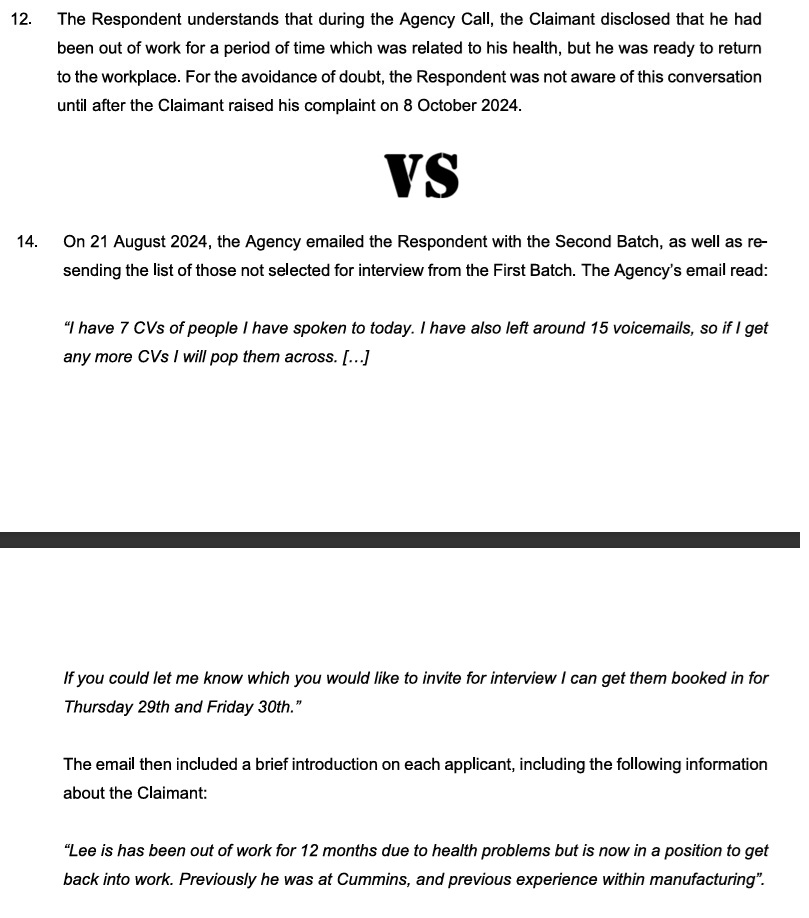
Page contacted me. We spoke. Its own records say I had been out of work for 12 months due to health problems but had now reached a position to get back into work. Previously Cummins. Manufacturing experience. Suitable enough to process, useful enough to call, and solid enough for the system to move.
Then came the Right to Represent email, followed by the CV, and soon enough Cepac had my name in the pile.
The File Started Bleeding
That matters because Page and Cepac cannot now pretend I was some random crank banging on the window after closing time. Page put me into the recruitment machine, took the call, recorded the health context, sent the CV, handled the gate, and became the filter between a disabled candidate and a client that later developed industrial amnesia with a legal department attached.
In other words, the candidate was good enough to send.
Afterwards, the file started bleeding.
Health Entered The Room
The whole dispute sits on a simple, ugly hinge. I say Page called me and offered an interview. The timing would fall after the August bank holiday, with a follow-up call the next week to arrange a suitable slot. During that call, I explained I had taken an extended break from employment due to health and recovery. When asked to elaborate, I said I had received treatment for a mental health condition.
Then the phone did not ring back.
That is the fucking hinge. Before the disclosure, the process looked alive. Once health entered the room, it went cold. Cepac later said its recruiting manager did not know about the mental health issues discussed with the agency recruiter when he selected his shortlist. Page’s internal email later says the candidate had cited that Cepac rejected him after he mentioned a mental health condition once he had been told he would have an interview.
Elsewhere, the file says Page understood he had stayed out of work pre-application for 12 months (incorrect, it was longer, but no big deal) due to “medical reasons”, had confirmed he could work, and did not need adjustments. Take a look for yourselves. Is this a discrimination-proving fuck-up, or just a minor 2 month error? They couldn’t even lie straight within 2 paragraphs of a court submission.
The Obvious Question
Fine. Put their version on the table.
However, Page was the agency. Its people were the screen. The company knew about the health-based gap. Their process sent the CV to Cepac. Later, that same outfit started building the paper trail after the discrimination complaint landed.
So when Cepac says the manager would not have known, the obvious question is not “how dare the disabled candidate complain?”
Instead, the obvious question is: what exactly did Page tell Cepac, when, through whom, in what wording, and why does the disclosed file now look like somebody dropped a black marker into a panic attack?
Cepac Blamed The Agency
Cepac’s response to my discrimination email was a little masterpiece of corporate pass-the-parcel. It said the company outsourced recruitment through an agency. That agency, Cepac explained, did the initial telephone screen and sent potential CVs to the recruiting manager for final shortlisting. Candidates apparently heard from that agency when interviews were expected if they succeeded. According to Cepac, my CV had gone over with a group of potential candidates, but I did not make the shortlist.
High volume. Small number of positions. Manager not aware of mental health. Agency should have updated me better. Future confusion. Apply again, maybe.
Lovely. And there it is. The agency did it. Manager did not know. Volume was high. Positions were few. Confusion happened. A disabled candidate stood in the doorway holding the smell while the furniture quietly moved around him. They didn’t name the agency, seemingly omitting their name from the ET3 response.
The Agency Was Page
That kind of email always arrives wearing sensible shoes. Nobody has to scream. Corporate language just turns the lights down, shifts blame three feet to the left, and hopes the reader does not notice the blood under the filing cabinet.
But Page’s records make the agency lane unavoidable. It was not an innocent passer-by. Page held the notes, had the call history, sent the CV, tracked the candidate, discussed the complaint internally, reached for advice, Googled me, and got pulled into the legal orbit.
Cepac blamed the agency.
Unfortunately for Page, the agency was Page.
And God bless the useless bastards, they kept receipts.
Page Reached For The Black Marker
When I made my DSAR, I did not ask Page for office gossip, team-building photos, or the recruitment equivalent of a Christmas cracker joke. I asked for my personal data about the Cepac application: internal notes, suitability assessments, screening notes, emails, discussions inside Page, documents exchanged with Cepac, call logs, notes about the interview offer, records of when and how Cepac responded, anything about my mental health condition or reasonable adjustments, and reasons for not proceeding with the interview.
That was not a vague fishing expedition. It was the factual spine of a disability discrimination claim.
Page’s response said it had removed personal data not related to me under Article 15(4). Its cover letter said it had included emails related to me with third-party information redacted. Fine. Nobody sensible wants random people’s private details thrown into the road. Collateral damage is not the point.
The Redaction Ballet
What came back, though, was a huge pile of redacted shit around the exact material that mattered. Names gone. Then email blocks gone. After that, internal chains chopped into black rectangles. Page buried sender and recipient detail. The file looked less like transparency and more like a crime scene where the chalk outline had received brand-safe redactions.
Meanwhile, in the middle of this grand compliance ballet, Page also managed to include the wrong Lee Thompson material.
That is the bit that will not stop stinking. When the material might expose who knew what about a disability discrimination complaint, Page had black ink for days. As soon as another man’s private candidate data wandered into my disclosure pack, the same redaction machine apparently went out for a fucking cigarette.
Redacted Lee.
Exposed Lee.
Protected Page.
Protected Cepac, unbeknown they would later hint that “the agency” was culpable.
Wrong candidate.
Not merely sloppy, then, but the whole rotten culture in one administrative accident.
Don’t Call Him
The internal email trail after my complaint reads like panic trying to wear a tie. One message says “Don’t call him – we need to get our internal team to advise – I’ll call you shortly”.
There it is. Not “let’s clarify”. Definitely not “let’s check whether we got this wrong”. Nothing like “let’s make sure the disabled candidate has a proper explanation”. Just don’t call him. Get internal advice.
At that point, the corridor changes temperature. Before the complaint, Page could call, text, leave voicemails, screen, process, send CVs, reject on the system, and keep the recruitment machine clattering along. Once the word “discrimination” landed, the phone became radioactive.
Don’t call him.
Those three words do a lot of work. They tell you exactly when the people-machine stops pretending to be about people and becomes about containment. The candidate is no longer a candidate. Now he is a risk item, a live wire, something to route through advice before anyone touches the handle.
The Disabled Candidate They Googled
Next comes the part where the mask slips so hard it cracks the floor.
A Page email says they had Googled me and my previous company and found the Cummins employment tribunal decision. In the same ugly little neighbourhood, another line says it “looks like this candidate may one that does this regularly but will see!”
Read that again slowly.
A disabled candidate complains that an interview disappeared after mental health entered the recruitment process. The response inside Page is not just process review. Nor is it merely “check the notes”. Instead, the machinery turns towards character work: Google him. Find his last tribunal. Frame him.
That is not recruitment administration. It is claimant management with a search bar.
Character Work With A Search Bar
The phrase “may one that does this regularly” is the kind of dirty little line that tells you more than the author probably meant to confess. It turns a discrimination complaint into a personality defect. Focus shifts from “what happened?” to “what sort of person is he?” Then the disabled claimant’s audacity becomes part of the evidence soup.
This is how corporate paperwork does violence without raising its voice. It does not need to call you a liar outright. The file just places the stink nearby.
He complains. He has tribunal history. He posts online. Maybe he does this regularly.
Meanwhile, Page calls this inclusion.
Panic Calls And Legal Help
By December, the disclosed trail says Cepac’s solicitor had asked Page for evidence about what Page did with the candidate. Another email says Cepac needed information because there was a tribunal date and a request to add Page as co-respondent. Someone at Page then wanted help getting a legal call that day. Quality Care had apparently said legal would pick it up, but they needed a call because the legal-department email might not get a quick response.
That is not calm. More importantly, it is not “nothing to see here”. The paper trail is sweating through its shirt.
Page had introduced the candidate. Its systems held the notes. The company had the calls, emails, medical-reasons line, internal discrimination trail, Google search, “don’t call him” advice point, redactions, and wrong-Lee cock-up.
So when Cepac came asking for evidence, Page did not sound like a company with clean hands and a tidy folder. It sounded like a company trying to find the mop before the floorboards started talking.
The Timeline They Wanted
The timeline Page passed around is neat. Too neat. That is usually the problem with timelines built after the fire starts.
21 August: response from Indeed, call with candidate, candidate form, Right to Represent, CV sent if happy.
Same day: Right to Represent replied.
Later that day: CV sent to Cepac.
Around 23 August: candidate called and advised unsuccessful due to volume of applications. (Never happened) – contemporaneous Whatsapp message exists of me telling a friend of the interview. Friend has provided witness statement.
On 8 October, the discrimination email arrived.
Later, Page tried to call, left a message, and recorded no return.
Finally: no further contact.
Basically, horseshit.
The Missing Meat
There is your little corporate altar. Dates. Steps. Process. Nice and clean. Wipe it down and it almost looks like a normal recruitment file.
Except the living dispute sits in the missing meat.
What exactly was said on the call about the interview? Which words were used about health? Who knew what at Page? How did the “health problems” note move through the process? Did the health context travel to Cepac? If not, how exactly did Page isolate it? And if yes, who saw it?
More importantly, why did the process die where it died? Why was “high volume” apparently enough for the rejected-candidate version, while the internal version needed legal advice, Google searches and “candidate may one that does this regularly” energy?
The timeline is not the answer.
It is the napkin under the spill.#
The Wrong Lee Walked Through The Door
Then, because Page apparently wanted to turn a discrimination dispute into a full clown-car data incident, the wrong Lee Thompson material showed up in the disclosure pack.
Different Lee. A different profile. Another career lane. Still in my DSAR.
I am not here to put that man’s details on display. This is Page’s fuck-up, not his. He is collateral in a mess he did not choose and should never have been dragged into.
However, the point has to be made because it is the whole rotten asymmetry again.
Page Tried to Protect Page
Page could redact its own internal machinery. Black boxes covered names, routes, senders, recipients and chunks of correspondence. The company knew how to hide who was saying what around a disability discrimination claim.
Somehow, another man’s candidate material still ended up in my file.
That is not just “wrong Lee”. No, it is a recruitment company proving, inside one disclosure pack, that it knows how to protect itself better than it knows how to protect candidates.
The wrong man walked through the door because Page left it open.
Meanwhile, the right questions stayed behind black ink because Page knew exactly where the door was.
Inclusion For The Trophy Wall
Page’s corporate language keeps coming back like a bad taste. “At PageGroup we don’t just accept difference – we celebrate it”. That line appears under emails in the same disclosure universe where the disabled candidate gets a discrimination complaint file, internal advice, Google treatment, legal panic and redacted sludge.
Almost too perfect, that.
When disability is marketable, Page celebrates it. Once disability makes a good case study, Page frames it. If the subject can be packaged as workplace inclusion, the company turns it into a trophy, a campaign, a clean little paragraph for the website.
But when disability sits inside an actual recruitment dispute, when a real candidate says “my interview disappeared after I disclosed mental health”, the machinery changes shape.
The Rainbow Sticker
Suddenly, it is not celebration.
Now, it is containment.
Do not call him. Get advice. Google him. Discuss his tribunal history. Refer to social media. Send the evidence. Speak to legal. Redact the trail. Pretend to explain “high volume”. Apologise for “confusion”. Hope the room moves on.
That is not inclusion.
It is a fucking sorting system with a rainbow sticker on it.
Cepac’s Part In The Machine
Cepac does not get to float above this like a clean brand logo on a dirty email footer either. It outsourced the recruitment. The CVs went over. Cepac’s email told me its recruiting manager would not have known about the mental health issues discussed with the agency recruiter. Then the company said I was not shortlisted, high volume appeared again, and the agency supposedly would not have sent my CV if it believed I was unsuitable. Just 16 years in similar roles, but fake-excluded by volume was their schtick.
According to the disclosed Page emails, Cepac later asked Page for information through its solicitor because the tribunal response deadline was coming.
Therefore, Cepac cannot have it both ways. It cannot lean on Page as the recruitment filter when convenient, push blame back to Page when challenged, and then treat Page’s internal trail as some unrelated admin swamp.
Cepac and Page were in the same corridor. One held the client end. Another held the agency end. A disabled candidate stood in the middle while the paperwork started rearranging itself.
Together we achieve more, apparently.
In this case, together they achieved a discrimination claim.
The File Comes Home
This is why the DSAR matters. Not because every redaction is automatically sinister. No serious person says every black box proves wrongdoing. Nor does Page have to hand over strangers’ private data just because a claimant asks questions.
Instead, the argument is that the whole pattern is rotten.
The disclosed material shows a recruitment process where health was noted, a CV was sent, an interview expectation was disputed, a rejection explanation shifted into “high volume”, a discrimination complaint triggered internal advice, someone stopped a call, Page Googled a disabled claimant, tribunal history circulated, legal help entered the room, co-respondent risk became an issue, Page redacted third-party data, and the wrong man’s material still found its way into the pack.
That is not a tidy file.
It is a fucking casserole of panic, compliance and arrogance.
Page Partners Comes Home
Page wants the benefit of its inclusion language. Cepac wants the benefit of its outsourced recruitment defence. Both would probably prefer the paperwork to sit quietly and behave.
Unfortunately, the paperwork has started making noises in the walls, and TCAP has a stethoscope.
This one is different from the usual Page Partners hit. Normally, TCAP takes Page’s glossy client trophy, proves the link, then checks the stain underneath: tobacco, data, ransomware, cartels, bribery, pharma labs, or whatever corporate kitchen Page chose to smile beside that week.
By contrast, Cepac is nastier because Page is not merely standing near the stain.
Here, Page is in the stain. Half of it at least.
It handled the candidate, sent the CV, held the health note, received the complaint, told people not to call, Googled the claimant, discussed whether he was one that does this regularly, reached for legal, produced the DSAR, redacted the trail, and exposed the wrong Lee.
The Black Marker And The Phone
In the end, the whole thing reduces to two images: the black marker and the phone that nobody was supposed to use.
A black marker sits over the discrimination trail, covering the machinery while pretending to be compliance. Nearby, the phone sits there after the complaint, suddenly dangerous, suddenly something that needs internal advice before anyone touches it.
Between those two objects, you can see the shape of the entire corporate reflex: hide the trail, control the contact, frame the claimant, call legal, protect the company, and then print “we celebrate difference” under the email.
The Complaint Became The Crime
Page Partners: Cepac is not about one missed call. This is not about one admin slip, one bad line, or one “future confusion” apology. Nor is it about “high volume” or any of the soft little phrases companies use when they want a disabled person to swallow the smell and move on.
The story is what happened when disability stopped being a brochure word and became a live complaint.
Page and Cepac had a recruitment process. Then health entered the file. An interview disappeared. After that, an explanation arrived. The complaint landed. Calls started. Suddenly, the calls stopped. Advice arrived. Legal appeared. Google came out. The Cummins tribunal link moved through the email chain. A DSAR came back redacted. The wrong Lee came with it.
A disabled candidate asked what happened. Page Googled him. Cepac blamed the agency. Then the agency panicked. The file came back looking like it had been buried, dug up, blacked out, and stapled to the wrong man.
Unredacted
So here is the bit they did not manage to hide.
The black marker did not kill the story. Instead, it drew the outline. Those panic calls did not bury the file. They gave it a pulse. That Google search did not expose me. It exposed them. Even the wrong Lee did not confuse the ending. He proved the point. I told him. He claimed Page didn’t even inform him that his data had been breached. Reassuring, job candidates.
Page redacted the trail it did not want explained, then handed over the thing that should never have left the room. That is not data protection. It is corporate self-preservation with a hole in its pocket.
Unredacted.
Lee Thompson – Founder, The Cummins Accountability Project
N.B – Sources withheld due to senstive information and a lot of black triangles.