

Anxiety is a Lidl less trivial than some employers, lawyers and tribunals like to pretend. Lidl has already seen what happens when management treats disability-linked behaviour as misconduct. So why is TCAP asking Lidl what it is doing about Cepac Ltd, a packaging supplier accused by TCAP of disability discrimination, litigation bullying and using a disabled claimant’s reactions as the escape route from the merits? The ongoing Cepac Lidl supplier problem raises crucial questions about accountability and corporate responsibility.
Anxiety is a Lidl less trivial than some employers, lawyers and tribunals like to pretend. That is not really a joke. It is the little pun at the top of a much uglier file, because one of the great dirty habits in employment disputes is pretending disability only counts when it arrives in a neat, polite, pre-approved format.
Quiet disability. Manageable disability. Disability with a laminated badge, a clean diagnosis, a tidy workplace adjustment and no emotional residue on the carpet. That is the kind of disability institutions like, because it lets them perform inclusion without having to deal with the actual human being.
Real disability does not behave that nicely. Sometimes it appears as anxiety. Sometimes it comes out as overwhelm, emotional dysregulation, paralysis, defensive tone, panic, mistrust, rejection sensitivity, spiralling or shutdown. Under pressure, a disabled person may sound harder to manage because the process has already set fire to their nervous system.
That is where the dirty trick begins. The employer, lawyer or tribunal stops looking at the trigger and starts staring at the reaction. The institution stops asking what happened to the disabled person and starts asking why the disabled person did not react in a tone more convenient to the people applying the pressure.
That is the disability conduct trap.
Lidl Knows This Terrain
Lidl should understand this better than most. A former Lidl manager, Ryan Toghill, reportedly won £45,147 after successfully suing Lidl for unfair dismissal. According to reporting, he had recently received an ADHD diagnosis, Lidl dismissed him after a disciplinary process, and the tribunal found Lidl failed to properly account for how ADHD affected his behaviour.
The details matter because they are not some abstract HR training example. The tribunal reportedly heard about anxiety, rejection sensitivity, difficulty processing questions, ADHD paralysis and conduct that Lidl interpreted as deceptive or lacking remorse. In other words, management read behaviour as attitude while disability sat underneath the surface like a live wire nobody wanted to touch properly.
That is the point. Disabled people do not always present as convenient. A disabled person under pressure does not always sound like a softly spoken equality brochure. Accuse, corner, doubt or discipline someone whose disability affects emotional regulation, and you may get a reaction shaped by the very condition the process has activated.
Lidl has already had that lesson served in public. So when TCAP talks about disability-linked reactions being turned into conduct theatre, Lidl does not get to pretend this is some strange foreign concept from the far side of employment law. It knows the map. It has already been dragged across part of it.
The Trap Is Always The Same
The disability conduct trap has a pattern. First, something happens to the disabled person. Then the disabled person reacts. After that, the institution makes the reaction the case.
The original act drifts backwards. The trigger becomes background noise. The distress turns inconvenient. The tone becomes the headline. The paperwork starts circling the person who reacted, not the people who created the conditions.
By the end, the institution has performed its favourite little trick. It has turned a disabled person into the problem. Not the process. The pressure? Nope. Not the conduct that triggered the reaction. The disabled person.
TCAP says Cepac Ltd used the same machinery.
Now Add Cepac
TCAP identifies Lidl in Cepac’s customer trail from retained customer-source material. Lidl may dispute, explain, review or clarify that position if it wishes. That is exactly the point of putting the question publicly.
Because The Cepac Files does not treat Cepac Ltd as just another packaging supplier. TCAP accuses Cepac of disability discrimination, litigation bullying, and helping turn a disabled claimant’s disability-linked reactions into the story until the underlying discrimination allegations never reached a merits hearing.
TCAP says Cepac did not merely defend a claim. It bullied a disabled claimant through the process, helped manufacture a conduct narrative from disability-linked reactions, and then benefited when that narrative became the route away from the merits.
That is not robust litigation. That is a dirty supplier problem with a legal bill attached. And once Lidl is put on notice of that allegation, Lidl becomes part of the supplier question.
Why Did The Merits Matter?
This is the question Cepac’s customers should ask. Why did the case move away from the merits? How come the disabled claimant’s reaction, tone, conduct and public commentary become so useful? Why did the disability discrimination allegations never receive proper testing?
According to TCAP, Cepac’s own pleaded defence contained a contradiction that went to the heart of the case. Look at the Grounds of Resistance. Look at sections 12 and 14. TCAP says the contradiction goes to what Cepac knew, when it knew it, and why the case should have gone to a merits hearing instead of being smothered under conduct theatre.
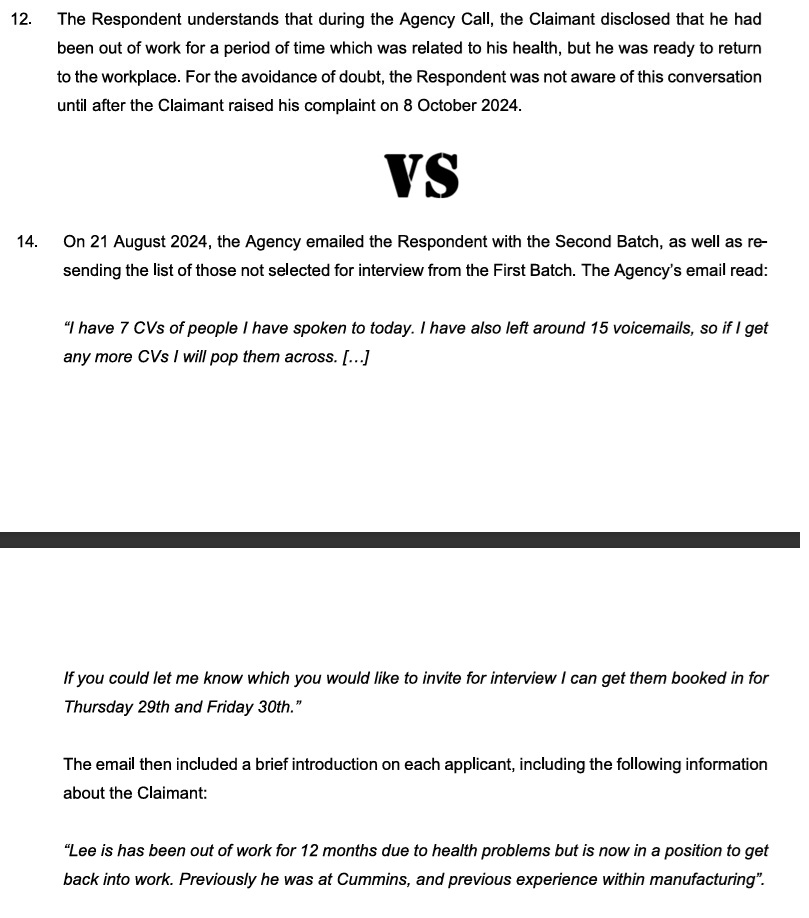
Cepac Ltd Grounds of Resistance, sections 12 and 14. TCAP says this contradiction should have been tested at a merits hearing.
This is the exhibit Lidl is now on notice of. TCAP is not saying Lidl wrote Cepac’s defence. And we are not saying is not saying that Lidl bullied the claimant. TCAP is saying Lidl has now been asked a clean supplier question: is it comfortable doing business with a packaging supplier accused of disability discrimination, litigation bullying and using conduct theatre to keep the merits out of daylight?
That is why Lidl matters. Lidl’s own public tribunal embarrassment shows that employers can misunderstand disability-linked behaviour, punish it and dress it up as misconduct. Lidl cannot credibly pretend this concept sits beyond its understanding.
Maybe Lidl Did Not Know
Let us be generous for one paragraph. Maybe Lidl did not know.
Nobody in procurement may have asked. Nobody in supplier compliance may have looked. Cepac may have sat there as just another packaging supplier in a spreadsheet, clean enough on paper, useful enough in the chain, cheap enough to avoid awkward questions.
Fine. That excuse has now expired.
Lidl knows now. Or it will once this lands in front of it. Once a brand knows its supplier faces accusations of disability discrimination and litigation bullying, silence becomes a decision. Continued use becomes a decision. Funding that supplier becomes a decision.
You do not get to sell cheap groceries with one hand and buy expensive silence with the other.
The Question For Lidl
TCAP does not allege that Lidl bullied the claimant. TCAP says Lidl appears in Cepac’s customer trail from retained source material, and TCAP accuses Cepac of doing the bullying. That distinction matters. But it does not make the question disappear. It makes the question cleaner.
What will Lidl do about Cepac? Will it ask for an explanation? Will it review the relationship? Even suspend the supplier? Will it publish a position? Or will it carry on buying the packaging and hope disabled customers, disabled workers and disabled applicants do not notice what sits behind the shelf?
The line is simple now. If Lidl uses Cepac, Lidl funds Cepac. If Lidl funds Cepac after TCAP puts it on notice, Lidl helps sustain a company TCAP accuses of disability discrimination, litigation bullying and using conduct theatre to avoid a merits hearing.
That is not neutral procurement. That is disability discrimination in the supply chain.
Cheap Ethics, Expensive Damage
Lidl can sell cheap groceries all it wants. It does not get to sell cheap ethics.
Disability is not trivial when it belongs to the worker in the disciplinary chair. Anxiety is not trivial when it changes how someone responds under pressure. ADHD is not trivial when it affects processing, tone, fear, delay or apparent disengagement. And a disabled claimant’s reaction to litigation bullying is not trivial when the respondent finds that reaction more useful than the truth.
Lidl should already know that. So here is TCAP’s second question in The Cepac Files.
Lidl: now you know about Cepac Ltd. What are you going to do about the dirty supplier in your packaging trail?
The Lidl Files Can Always Be Born
Lidl can choose to treat this as a supplier issue and deal with it properly. Or Lidl can ignore it. That is its call. But TCAP has a simple rule: when a company chooses to ignore inclusion, keep using a dirty supplier after being put on notice, and choose silence over accountability, the file does not close. It grows.
Morrisons got The Cepac Files, we await their response. Lidl can still avoid The Lidl Files. But if Lidl wants to pretend disability discrimination in its packaging trail is just someone else’s problem, that choice may cause the birth of something much more specific.
The public does not just buy groceries from Lidl. Disabled people do too. Disabtcled workers do too. Disabled applicants do too. And once a supermarket has been told that its supplier is accused of disability discrimination, litigation bullying and burying the merits behind conduct theatre, there is only one question left.
Lidl: are you reviewing Cepac, or are you funding the problem?
Lee Thompson – Founder, The Cummins Accountability Project
Sources
- Ex-Lidl manager with ‘fear of rejection sparked by ADHD’ wins £45k payout after suing for unfair dismissal
- Cepac Ltd Grounds of Resistance, sections 12 and 14, reproduced above
- Cepac customer-source material identifying Lidl, held by TCAP