
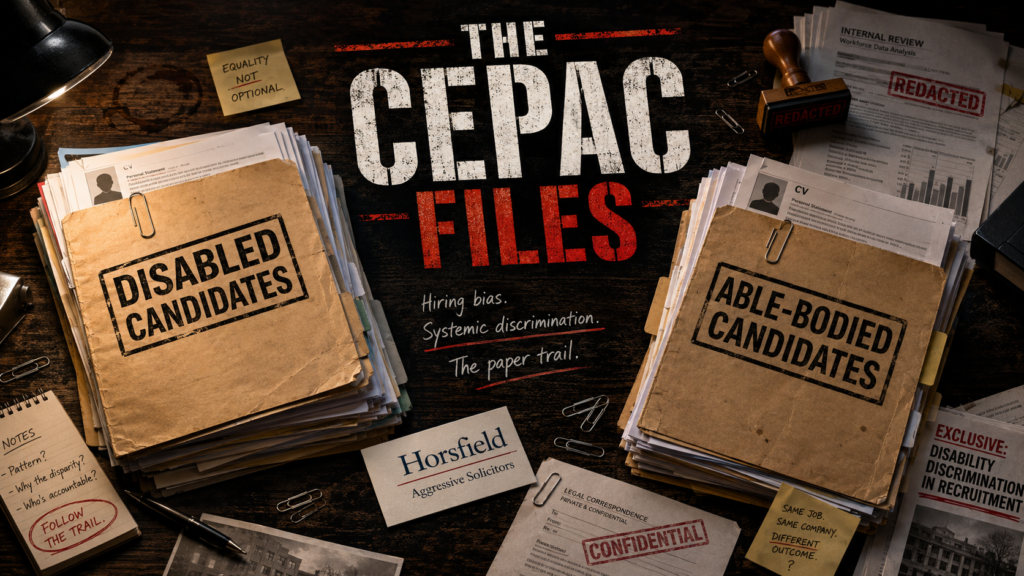
Asda inclusion checkout Cepac is the latest stop in The Cepac Files. Asda sells value by the pallet. Rollbacks. Yellow labels. Family baskets. Cheap dinners. Inclusive shopping. Colleague networks. Supplier standards. Human rights language stacked neatly beside the groceries like ethics on special offer. Then the packaging chain coughs up Cepac, the disability receipts start scanning at the till, and suddenly the question is not whether Asda can write a supplier policy. It is whether Asda tolerates disability rot in the chain because, frankly, its own inclusion checkout has been beeping for years.
Asda Inclusion Checkout Cepac
Asda knows the language. Of course it does. It talks about equity, diversity and inclusion. It talks about colleagues being warmly welcomed. It talks about inclusive shopping environments. It talks about customers with different needs. It talks about supplier transparency, responsible sourcing and human rights.
Lovely.
The whole supermarket conscience kit is there, polished enough to reflect a procurement director’s vacant little smile.
But The Cepac Files is not interested in soft wording. TCAP is interested in where the wording stops. Because responsible sourcing is easy when it sits in a PDF. Inclusion is easy when it is a web page. Human rights are easy when nobody awkward is asking what they mean in the supply chain.
Then comes the cardboard.
The public Cepac trail puts Asda in the frame through C&D Foods. Prolific North reported that Cepac produces corrugated packaging, with clients including C&D Foods Group, whose customers include Aldi, Tesco, Morrisons and Asda.
That is the route.
Cepac. C&D Foods. Asda.
The checkout starts making the wrong noise.
Supplier Standards With A Gap At The End
Asda’s responsible sourcing language is not shy. Its supplier standards talk about supplier accountability, responsible sourcing and human rights. Its transparency material says supplier transparency provides the foundations of Asda’s responsible sourcing and human-rights programmes.
Good.
TCAP likes foundations.
So let us kick one.
If supplier transparency is the foundation, does Asda’s transparency reach the packaging chain? Does it reach the companies sitting under the products, pallets, boxes, bags and private-label supply routes? Does it reach Cepac?
Or does the foundation stop just before the disabled claimant appears in the paperwork?
Because Cepac is not just a cardboard name in the corner. It is a packaging-linked company facing disability discrimination allegations, with an ET3 that appears to raise a very specific knowledge problem, and a reported legal spend of around £50,000 pursuing a disabled claimant after he raised a complaint.
That is not background noise.
That is the supplier code catching fire in the reduced aisle.
The ET3 Question Travels With The Cardboard
Cepac’s disability problem does not evaporate because the chain moves through another company. That is the whole point of supply-chain accountability. Responsibility is not supposed to dissolve at the loading bay like cheap own-brand gravy.
The company is facing disability discrimination allegations in a case where its own ET3 appears to raise serious questions about knowledge. Paragraph 12 distances Cepac from awareness of the health-related background. Paragraph 14 then appears to put the work-gap explanation back in the frame, with the agency email referring to time out of work due to health problems.
That is not decorative paperwork.
It is the kind of contradiction a supplier-transparency programme should fucking hate.
Disability discrimination often turns on knowledge. What was said matters. What was passed on matters. The agency’s understanding matters. Cepac’s understanding matters. Any information received before the recruitment door closed matters.
So here is the Asda question.
If Asda’s supplier transparency is real, does it include asking why a company in its packaging orbit has a disability discrimination knowledge issue sitting in its own pleaded defence?
Or does transparency stop at the bit where the product reaches the shelf and everybody gets to pretend the cardboard arrived from heaven?
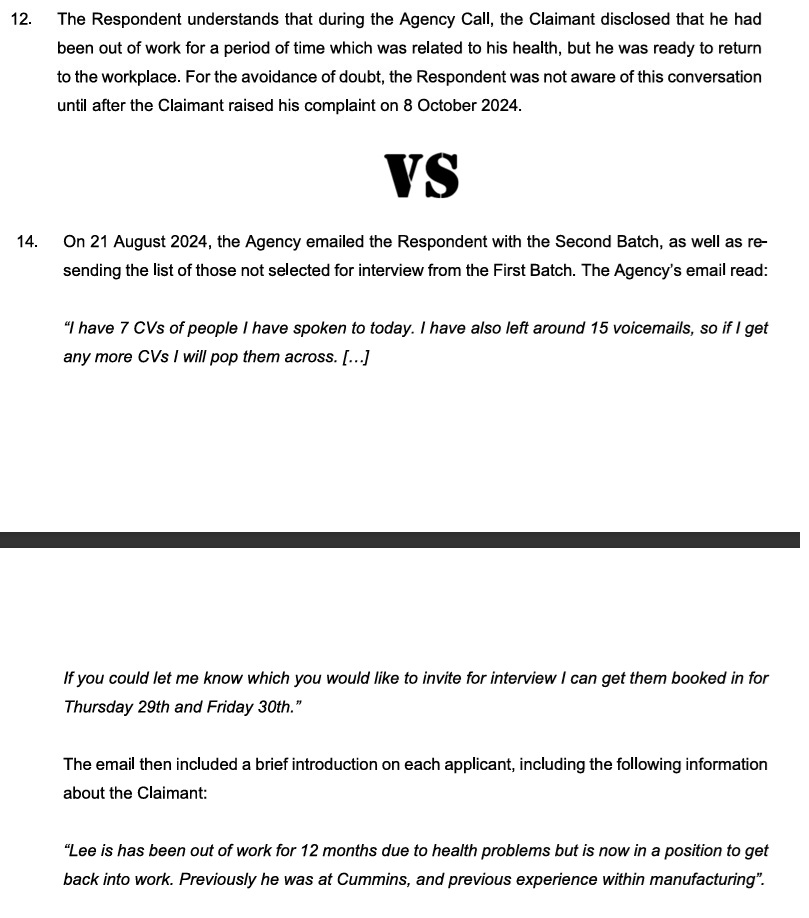
Cepac ET3 paragraphs 12 and 14 – the knowledge question now travelling through Asda’s supply-chain orbit.
The £50,000 Checkout Test
The ET3 question is bad enough. The money makes it uglier.
Cepac appears to have spent around £50,000 through Horsfield Menzies pursuing a disabled claimant through procedural warfare after he had the audacity to raise a complaint.
This is not the clean version of corporate defence where a company denies discrimination, faces the merits and proves the treatment was spotless. The allegation is nastier. The machinery turned on the disabled person who complained. Distress became the problem. Pressure, bullying, legal aggression and procedural ambush were pushed into the background while the claimant’s reaction was repackaged as scandal.
A disabled person complains. The pressure cooker gets hotter. Steam appears. Management points at the steam and asks the tribunal to call it unreasonable.
Neat little trick.
Ugly little system.
Not inclusion.
A meat grinder with a supplier-code badge clipped to its apron.
If Asda’s responsible sourcing language means anything beyond corporate wallpaper, the company should want to know why a packaging-linked business in its orbit is accused of using that playbook.
Asda’s Own Inclusion Aisle Is Already Leaking
Asda cannot wander into this as a clean inclusion saint clutching a basket of supplier standards.
Its own record has disability receipts.
In Hutchinson v Asda Stores Ltd, the Employment Tribunal found claims for constructive unfair dismissal, age and disability-related harassment, direct age discrimination and discrimination arising from disability well founded. Joan Hutchinson was a 75-year-old worker with dementia. The tribunal found against Asda on multiple fronts. That is not a policy footnote. That is an inclusion alarm going off in the George aisle.
Then there is Asda Stores Ltd v Raymond. The EAT decision records an appeal involving disability discrimination and unfair dismissal. The underlying tribunal had found discrimination arising from disability and unfair dismissal. The EAT dismissed Asda’s appeal. Again, keep the point clean: this is not a brand-new Asda scandal from last Tuesday. It is part of the public record showing what happens when disability, discipline, process and corporate decision-making collide.
Those cases matter because Asda’s supplier-chain tolerance cannot be separated from Asda’s own inclusion history. A company with its own disability receipts should not need a fucking seminar on why disabled people should not be processed into the problem.
If anything, Asda should be more alert.
More careful.
More likely to ask questions.
Instead, the question sits there like an abandoned trolley.
Does Asda see disability discrimination risk in its supply chain?
Or does it only see packaging?
Equal Pay At The Value Supermarket
Asda’s inclusion problem does not stop at disability.
The company is fighting one of the biggest equal-pay battles in British retail. Tens of thousands of mostly female store workers are pursuing claims comparing their work with higher-paid warehouse roles, mostly held by men. Leigh Day says more than 60,000 workers are represented in the claim. In 2025, Asda workers advanced to the final stage after an Employment Tribunal ruled that some store jobs were of equal value to warehouse roles.
Asda disputes the claims. Fine. Let that sentence sit there in its little legal hairnet.
The optics remain rancid.
A supermarket built on value is fighting over how it valued the work of thousands of shop-floor staff. A company selling inclusion is arguing through years of tribunal machinery while workers ask whether their labour was underpriced because the system valued one part of the machine differently from another.
That matters here because inclusion is not a slogan. It is pay. It is process. It is who gets delayed. It is who gets believed. It is who gets crushed under paperwork while the corporate brand smiles over a basket of cheap mince and school uniforms.
If Asda’s own equality story is this messy, why should anyone assume it is naturally allergic to disability discrimination smoke in the packaging chain?
Maybe the smell is familiar.
Inclusive Shopping, Selective Seeing
Asda also promotes inclusive shopping environments. Its “Every Customer Matters” material talks about colleagues understanding different shopper needs, including non-visible disabilities such as autism, mental health conditions, sensory impairments and chronic pain.
That is the front of house.
The problem is the back of house.
Because the same company can talk about invisible disabilities while sitting above a supply-chain question involving a disabled claimant whose health-related work gap appears to be part of the ET3 contradiction. It can talk about customer needs while its own employment tribunal record includes disability discrimination findings. It can talk about supplier transparency while the cardboard trail leads to Cepac.
This is where corporate inclusion gets cold.
It sees disabled customers when the signage looks good.
It sees disabled colleagues when the network page needs content.
But does it see disabled claimants in the supplier chain?
Or are they just noise outside the store?
The Rollback Of Responsibility
Asda understands rollbacks. It built a brand around cutting prices, pushing value and making the public feel like somebody, somewhere, is doing the squeezing on their behalf.
That is exactly why this works as a supply-chain hit.
Value does not appear by magic. Cheapness lives somewhere. It lives in supplier pressure, logistics, labour, packaging, contracts, outsourcing, procurement and all the little commercial squeezes that let a supermarket look generous at the front while somebody else absorbs the bruise at the back.
So when a company in Asda’s public packaging orbit faces disability discrimination allegations, an ET3 knowledge problem and a reported £50,000 legal pressure campaign against a disabled claimant, the question is not exotic.
It is obvious.
Is this what Asda’s supplier transparency tolerates?
Is this what responsible sourcing misses?
Is this what happens when the chain is cheap enough, distant enough and boring enough to be ignored?
Because there is a difference between value and moral discounting.
One belongs on a shelf label.
The other belongs in a file.
Supplier Codes Do Not Bleed. People Do.
Big companies love supplier standards because supplier standards look impressive and do not talk back. They sit in PDFs, say “human rights”, mention dignity, nod towards international labour codes and create the reassuring impression that someone in a windowless room has definitely handled ethics.
But supplier standards do not bleed.
People do.
Disabled claimants do.
Shop-floor workers do.
Older workers with dementia do.
People whose reactions to pressure are repackaged as misconduct do.
That is why the Cepac question matters. Not because Asda directed Cepac’s conduct. TCAP is not making that claim. The sharper point is that Asda’s own responsible-sourcing system claims to be built on supplier transparency and human rights. So what happens when a supplier-linked chain carries a disability discrimination question right up to the checkout?
Does Asda ask?
Does it check?
Does it care?
Or does it keep scanning the goods while the human being disappears behind the barcode?
The Packaging Does Not Stay Neutral
Asda is not being accused here of personally directing Cepac’s treatment of a disabled claimant. That would be too easy, too blunt and too lazy.
The question is better than that.
Asda sits in the public Cepac trail through C&D Foods. Asda’s own corporate language says it cares about inclusion, fair processes, inclusive shopping, supplier accountability, human rights and supply-chain transparency. Its own record includes disability discrimination findings and a massive equal-pay fight. Underneath that supermarket value glow sits a packaging-linked company facing disability discrimination allegations and an ET3 knowledge problem.
That is the hit.
Not “Asda caused Cepac”.
Something colder.
Asda benefits from the clean box.
So does it care what is in the chain that made it?
The Inclusion Checkout
This is why Asda belongs in The Cepac Files.
Unless Asda thinks this is nothing, in which case The Asda Files can land next.
Not because every supermarket controversy belongs in the same trolley. Not because TCAP needs to pretend a disability tribunal, an equal-pay claim, supplier standards and a packaging dispute are all the same thing. Not because Asda is responsible for everything that happens in every corner of the chain.
Asda belongs here because it is a value brand with an inclusion problem and a supplier-chain question.
It sells value. It sells inclusion. It sells responsible sourcing. It tells the public supplier transparency matters. Meanwhile, the public trail puts Asda in the Cepac/C&D packaging chain, and Cepac has a disability discrimination question that does not stop smelling because someone stacked a crate in front of it.
So here is the Asda question.
Does responsible sourcing reach the packaging chain?
Does supplier transparency include disability discrimination risk?
Does inclusion survive contact with a disabled claimant who complains and then gets framed as the problem?
Or does Asda keep selling value while the cardboard underneath carries the cost nobody wants to price?
Because in this supply chain, the price is not the only thing being rolled back.
So is responsibility.
Lee Thompson – Founder, The Cummins Accountability Project
Sources
- Prolific North – Unite Union Threatens Legal Action In Pay Dispute At Greggs And Asda Packaging Supplier
- Cepac – UK’s Leading Corrugated Packaging Company
- Asda – Equity, Diversity And Inclusivity
- Asda – Inclusive Shopping Environments
- Asda – Responsible Sourcing Policies
- Asda – Standards For Suppliers
- GOV.UK – Mrs J Hutchinson v Asda Stores Ltd
- Personnel Today – Dementia Sufferer Wins Age And Disability Case Against Asda
- GOV.UK – Asda Stores Ltd v Mr D Raymond
- Leigh Day – Asda Workers Advance To The Final Stage Of Their Equal Pay Battle
- Personnel Today – Asda Workers Advance To Final Stage In Equal Pay Claim