Sainsbury’s disability disasters now meet the cardboard chain in The Cepac Files. Sainsbury’s wants to be a “truly inclusive retailer”. Lovely. The kind of warm corporate phrase you can stack beside Taste the Difference mince pies and pretend it came from a conscience rather than a comms calendar. Then the packaging trail coughs up Cepac, the ET3 starts wobbling between paragraphs 12 and 14, and the checkout begins making a much uglier sound. If Sainsbury’s means what it says about inclusion, ethical sourcing, human rights and supply-chain standards, it can start by asking why a packaging-linked company in its orbit appears to have a disability discrimination problem sitting right there in the cardboard.
Sainsbury’s Disability Disasters Meet The Cardboard Chain
Sainsbury’s knows how to talk nicely. It wants to be a truly inclusive retailer. It says all colleagues should be able to excel and all customers should feel welcome. Its corporate material talks about human rights, ethical sourcing, due diligence, supplier expectations and protecting workers’ welfare. The words are soft. The font is clean. The whole thing looks like it was washed in oat milk and board-approved empathy.
Fine.
TCAP is not interested in supermarket poetry unless the poetry survives contact with the loading bay.
This is The Cepac Files, and Sainsbury’s is not being dragged in because somebody got bored and fancied a trolley dash through corporate hypocrisy. The public trail puts Sainsbury’s directly in the Cepac customer map. Unite’s coverage of the Darlington dispute named Sainsbury’s among Cepac’s customers, alongside other major brands, while describing Cepac as a corrugated packaging company locked in a bitter fight with its workforce.
That is enough.
Cepac. Packaging. Sainsbury’s.
The “truly inclusive retailer” now has a cardboard problem.
Put The ET3 On The Checkout
Before we get to Sainsbury’s own disability receipts, equal-pay smoke, facial-recognition mess and supply-chain sermons, the central evidence needs to be placed where nobody can pretend not to see it.
Cepac is facing disability discrimination allegations in a case where its own ET3 appears to raise a serious knowledge problem. Paragraph 12 pulls away from awareness of the health-related background. Paragraph 14 appears to pull the other way, putting the work-gap explanation back in play through the agency email referring to time out of work due to health problems.
That is not a clerical wobble.
That is not a tiny filing wrinkle.
That is the sort of contradiction any company claiming to care about ethical sourcing and human-rights due diligence should fucking hate.
So here is the Sainsbury’s question before anything else gets scanned.
If Sainsbury’s says it takes human rights, supplier standards and inclusion seriously, what does it make of a packaging-linked company whose pleaded case appears to wobble on knowledge in a disability discrimination dispute?
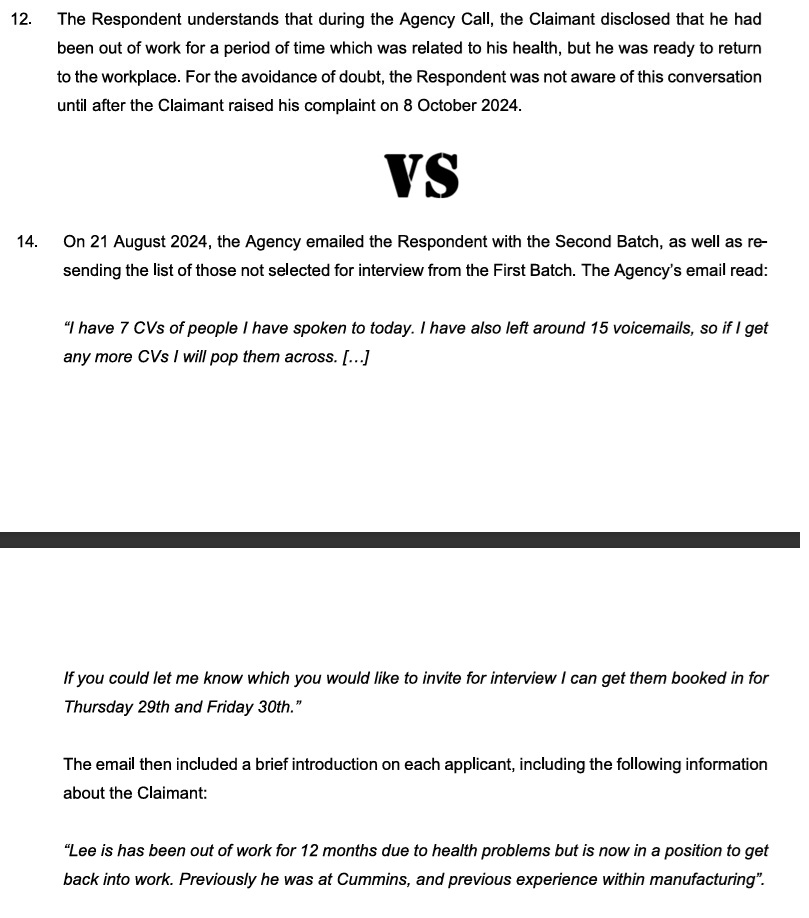
There it is.
The evidence on the belt.
Now scan the rest.
Truly Inclusive, Unless The System Says Otherwise
Sainsbury’s own disability record gives this piece its teeth.
In R J Taylor v Sainsbury’s Supermarkets Ltd, the Employment Tribunal found that Sainsbury’s discriminated against the claimant arising from disability. The findings included dealing with him through the absence-management policy, paying statutory sick pay instead of company sick pay, issuing a formal written warning because of his sickness absence record, halving his bonus because of that warning, and telling him he had not passed probation as a shift manager because he could not commit to working beyond his base contractual hours.
Read that again slowly.
A disabled worker. Absence management. Sick pay. Warning. Bonus halved. Probation failed because he could not commit to extra hours.
That is not inclusion.
That is the machine taking someone’s medical reality, feeding it through procedure, and producing punishment at the other end like a till receipt.
The remedy judgment later put numbers on the damage, but the number is not the worst part. The worst part is the logic. The body says no. The policy says discipline. The company says “truly inclusive retailer” while the worker gets processed through a system that treats disability like an operational inconvenience with a payroll code.
That smell belongs in this article because it is the same smell TCAP keeps finding around Cepac. Disability appears. Process tightens. Reaction follows. Then the human being becomes the problem.
The Men’s Day Receipt
Then there is D Cooper v Sainsbury’s Supermarkets Ltd.
The case involved a long-serving store manager who was disabled, with anxiety in the background, and who was excluded from an International Men’s Day LinkedIn post while on sick leave. The tribunal awarded compensation including injury to feelings and personal injury after the liability judgment. Some claims failed. Keep it clean. TCAP does not need to inflate what the tribunal did.
The part that matters is still ugly enough.
A company that publicly sells inclusion managed to produce a disability harassment finding around exclusion from a post connected to men’s mental health. That is almost too on the nose. It is the sort of corporate inclusion failure that sounds as if someone generated it in a satire lab and then HR approved it for release.
Mental health awareness for the brochure.
Exclusion for the disabled man.
Then compensation later, once the file had done its work.
Again, this matters because Sainsbury’s is not approaching the Cepac question as some spotless ethical priest wandering through the fresh produce aisle with a halo and a clipboard. Its own inclusion checkout is already leaking.
So when a disability discrimination question appears in the packaging chain, Sainsbury’s should not need a fucking guided meditation to understand why it matters.
Sainsbury’s – Taste The Indifference
The Equal Pay Conveyor Belt
Sainsbury’s broader equality record does not exactly smell of lavender either.
The company has faced equal-pay litigation from supermarket workers, with Court of Appeal coverage recording that it lost a bid to throw out claims on a technicality. Other tribunal material shows the machinery of equal-value litigation grinding through lead claimants, comparators, witnesses and expert evidence.
There is the point.
A supermarket that sells itself on fairness has spent years in the kind of legal machinery where workers have to fight over how their labour is valued. This is not a little HR misunderstanding in aisle seven. It is structural. This is the sort of dispute that tells you who gets delayed, who gets priced down, who has to prove value, and who gets to sit behind a legal team while the years roll by.
That is why the Sainsbury’s disability disasters problem lands hard.
This is not just one disability receipt. It is a wider equality pattern. Inclusion at the front. Process at the back. Smiling brand language over a system that only seems to discover complexity when the worker asks to be treated fairly.
Human Rights, But Make It Selective
Sainsbury’s human-rights and ethical-sourcing language is not shy. Its own material talks about integrating human rights into purchasing practices, selecting suppliers, managing supplier relationships, factoring in human-rights risks and promoting good practice along the entire supply chain. Its Ethical Sourcing Policy talks about working with suppliers to drive improvements and protect workers’ welfare.
Good.
Excellent.
Lovely little paragraph buffet.
Now apply it.
Does “entire supply chain” include the packaging chain.
Does “protect workers’ welfare” include asking whether a packaging company in the Sainsbury’s orbit has a disability discrimination question sitting in its ET3.
Does “human rights due diligence” include asking why a disabled claimant says a company and its lawyers turned his reaction into the scandal instead of letting the merits breathe.
Or does the phrase “entire supply chain” have a magic cardboard exemption.
Because that is where corporate ethics usually crawls under a pallet and dies. The slogan says “entire”. The practice says “only where convenient”. The supplier policy says “workers’ welfare”. The real world says “not that worker, not that file, not that uncomfortable little ET3 image with paragraph 12 and paragraph 14 sitting there like a body under the till”.
Surveillance At The Friendly Checkout
Sainsbury’s also managed to make itself a national example in the facial-recognition debate.
In 2026, reporting described Warren Rajah being wrongly ejected from a Sainsbury’s store in Elephant and Castle after a facial-recognition mix-up. He had to prove he was not the person the system apparently had in mind. Sainsbury’s and Facewatch apologised.
Again, keep the point clean. That is not a Cepac point. It is a Sainsbury’s point.
The incident matters because it shows the kind of modern retail logic that sits behind the warm brand language. Trust us, says the store. We know who belongs. We know who should be watched. We know who should be challenged. We know who should have to prove themselves.
Then the system gets it wrong and an innocent customer gets marched into the role of suspect.
That is the same institutional smell in a different aisle.
The person becomes the problem because the system says so.
Now bring that back to disability, supply chains and Cepac. If Sainsbury’s can get public-facing surveillance wrong and still call itself inclusive, why should anyone assume its supplier-chain conscience naturally catches disability discrimination risk before TCAP shoves the ET3 image under its nose.
The Price-Fixing Aftertaste
Sainsbury’s reputation cupboard is not exactly sterile.
The old dairy price-fixing cartel remains one of those corporate events that should never be allowed to vanish into the archive fog. Supermarkets and dairy processors were fined after the regulator found arrangements around dairy prices. Consumers were told one thing by the shelf. The market was doing something else behind it.
That matters here because it tells you the obvious: supermarkets are not innocent little village shops with loyalty cards. They are power systems. They price. They squeeze. They lobby. They litigate. They monitor. They source. They process. They write ethical sourcing policies while sitting on the sort of commercial machinery that can make “fairness” sound like a joke with a barcode.
So when Sainsbury’s pops up in the Cepac customer trail, TCAP is not looking at a cuddly grocer. It is looking at a corporate machine with enough history to know exactly how ugly a supply chain can get when nobody wants to look too closely.
The £50,000 Smell In The Bag
Then comes the money.
Cepac claims to have spent around £50,000 through Horsfield Menzies pursuing a disabled claimant through procedural warfare after he had the audacity to raise a complaint.
The allegation is not simply that Cepac denied discrimination and fought the case. Companies do that all the time. The nastier allegation is that the machinery turned on the disabled person who complained, the pressure mounted, the reaction to that pressure was repackaged as scandal, and the merits did not need to be properly disproved if the claimant could be framed as the problem instead.
That is not inclusion.
That is not human-rights due diligence.
That is not worker welfare.
That is a fucking corporate mincer with a supplier policy stapled to the side.
If Sainsbury’s thinks that is unfair, good. Ask Cepac. Look at the ET3. Check the chain. Test the policy against the cardboard. Find out whether the packaging orbit is carrying more than boxes.
Because if the answer is “we did not look”, then the policy is just laminated theatre.
Supplier Ethics Do Not Bleed. People Do.
Big companies adore supplier ethics because supplier ethics look marvellous in PDFs and cannot interrupt a meeting.
Supplier ethics do not shake. They do not have flare-ups. They do not get punished for sickness absence. They do not get excluded from a mental-health post. They do not have to prove they are not a criminal to a shopfront surveillance system. They do not get legally battered for reacting badly to being processed, pressured and framed.
People do.
Disabled people do.
Workers do.
Claimants do.
That is why Sainsbury’s belongs in this lane. Not because it personally directed Cepac’s conduct. TCAP is not making that claim. The sharper question is whether Sainsbury’s tolerates a disability discrimination smell in its supply chain while selling the public an inclusive-retailer sermon.
That is the Sainsbury’s disability disasters question.
Does the inclusion reach the cardboard.
Does ethical sourcing reach the ET3.
Does human-rights due diligence reach the disabled claimant.
Or does the whole thing stop where the discomfort begins.
The Sainsbury’s Disability Disasters Problem
The Sainsbury’s disability disasters problem is simple.
Sainsbury’s says it wants to be a truly inclusive retailer. To embrace difference.
Its own record includes disability discrimination findings, disability harassment compensation, equal-pay litigation, facial-recognition embarrassment and old cartel stink. Meanwhile, the public Cepac customer trail puts Sainsbury’s in the packaging orbit, and Cepac has a disability discrimination question sitting in its own pleaded defence.
Maybe Sainsbury’s has already asked what the fuck is going on.
Maybe it has not.
Maybe the company thinks a disability discrimination allegation, an ET3 contradiction and a reported £50,000 pressure campaign are all too far down the chain to trouble the orange glow.
Fine.
That is an answer too.
The Inclusive Checkout Is Beeping
This is why Sainsbury’s belongs in The Cepac Files.
Unless Sainsbury’s thinks this is nothing, in which case The Sainsbury’s Files can land next.
Not because every supermarket scandal belongs in the same basket. Not because TCAP needs to pretend a disability judgment, an equal-pay fight, facial-recognition cock-up, cartel history and packaging dispute are all the same thing. Not because Sainsbury’s is automatically guilty of everything that touches its orbit.
Sainsbury’s belongs here because it is a values brand with a supply-chain question and a disability record that makes that question sharper.
It talks inclusion. It talks human rights. It talks ethical sourcing. It talks workers’ welfare. Meanwhile, the public trail puts Sainsbury’s in the Cepac orbit, and Cepac has a disability discrimination problem that does not stop smelling because someone stacked groceries in front of it.
That is the hit.
Sainsbury’s may not own the ET3 contradiction.
But if it is willing to tolerate the stink, it inherits the question.
Because in this checkout, the till is not the only thing beeping.
So is the bullshit detector.
Lee Thompson – Founder, The Cummins Accountability Project
Sources
- Unite The Union – Darlington Printers Cepac In Fire And Rehire, Redundancy And Legal Dispute Shame As Strikes Deepen
- Unite The Union – Cepac Print Workers In Darlington Announce 10 Days Of Strike Action Over Pay
- Unite The Union – Darlington Cepac Print Strikes Escalate In Pay Dispute
- J Sainsbury plc – Championing Human Rights
- J Sainsbury plc – Ethical Sourcing Policy
- J Sainsbury plc – Plan For Better
- Sainsbury’s – Accessibility At Sainsbury’s
- Sainsbury’s – Valuable 500
- GOV.UK – Mr R J Taylor v Sainsbury’s Supermarkets Ltd – Reserved Judgment
- GOV.UK – Mr R J Taylor v Sainsbury’s Supermarkets Ltd – Remedy Judgment
- GOV.UK – Mr D Cooper v Sainsbury’s Supermarkets Ltd – Reserved Judgment
- GOV.UK – Mr D Cooper v Sainsbury’s Supermarkets Ltd – Remedy Judgment
- Personnel Today – Sainsbury’s Loses Bid To Throw Out Equal Pay Claim
- GOV.UK – Mrs A Ahmed And Others v Sainsbury’s Supermarkets Ltd – Equal Pay Judgment
- The Guardian – “Orwellian”: Sainsbury’s Staff Using Facial Recognition Tech Eject Innocent Shopper
- Retail Gazette – Sainsbury’s Removes Innocent Shopper Misidentified As Offender