There are two lazy ways to deal with The Quiet Mancunian.
One is to believe every sentence instantly, because the story is explosive and the documents are uncomfortable. Another is to dismiss him instantly, for exactly the same reason.
TCAP does neither.
This article is not a court judgment. It is not a criminal finding. No finding is made here that HSA Group, Cepac, Longulf Trading, Dirhem Abdo Saeed, Abdul Rahman Hayel Saeed, or any other named individual committed any offence. This is not a substitute for a proper public inquiry, a police investigation, a parliamentary committee, or a court process.
Instead, it is something simpler.
It is a public-interest evidence review.
The Quiet Mancunian, Anthony C Heaford, has spent years publishing serious allegations about Yemen, HSA Group, Longulf Trading, 9/11, Al Qa’idah, Khalid Sheikh Mohammed, corporate fronts, British-linked business structures, and what he says happened to him as a field service engineer in 1997.
According to his own account, he was not a journalist, not a researcher, and not an author building a brand. He says he was a witness under attack. That may sound dramatic. However, it is also a testable claim, because his work is full of names, dates, companies, locations, documents, photographs, public records and timelines.
I have read enough to say this plainly.
I personally believe The Quiet Mancunian’s core account deserves serious public scrutiny.
Not because every conclusion is proven. Or because every inference is safe. Not because all of his wider geopolitical conclusions must be accepted.
I believe him because the material is too specific, too persistent, too document-led, too exposed to rebuttal, and too serious to be waved away with a judicial sniff and a corporate shrug.
What The Quiet Mancunian Claims
At the centre of The Quiet Mancunian’s account is a 1997 Yemen trip.
In September 1997, he says, he was sent to Yemen as a field service technician to install machinery in what he believed was a customer’s factory. According to his account, the customer was not what it appeared to be. His allegation is that the operation involved a front company connected to Khalid Sheikh Mohammed’s network, operating inside or through the HSA Group orbit in Taiz, Yemen, near Al Qaidah.
The account then becomes more specific. The Quiet Mancunian says HSA’s managing director introduced him to a man he identifies as “Engineer”, later, in his account, Khalid Sheikh Mohammed. He also describes receiving what he characterises as a 9/11-style warning involving the World Trade Center and a hijacked aircraft.
His wider chronology points to Longulf Trading, a London-linked HSA business structure, a Chicago machinery purchase, a Cayman-linked payment vehicle called Atlantic Investments, and a supposed customer whose identity and purpose were, in his view, not ordinary commercial transparency but concealment.
That is the allegation.
Now comes the important part.
Why I do not dismiss it.
He Does Not Hide Behind Vagueness
The Quiet Mancunian does not write like someone making a loose pub allegation.
His account gives readers specifics. The year is named. So is the route, the employer, the machinery context, HSA, Longulf, Atlantic Investments, Taiz, Al Qaidah, Khalid Sheikh Mohammed, the alleged meetings, and the corporate interfaces.
He also provides maps, photographs, timelines, export references, public-source links and a chronology that can be attacked if it is wrong.
That matters.
A vague conspiracy theory hides in fog. The Quiet Mancunian’s material walks into the road wearing a high-vis jacket and dares people to identify the wrong turn.
That does not make every claim true. It does, however, make the claims unusually exposed to falsification.
Anyone seeking to debunk him has obvious places to start. Show that the Yemen trip did not happen. Prove the machine was not installed. Establish that Longulf was not involved. Publish the real customer documents. Identify the men in the photographs. Explain why the route, dates, invoices, shipping, machine, factory and corporate interfaces are wrong.
The striking feature is not just what he alleges.
It is how much of it he places within reach of rebuttal.
He Separates Evidence From Testimony
One of the strongest reasons I take The Quiet Mancunian seriously is that he does something many reckless accusers do not do. He tells readers where his case is strongest and where it still depends on his testimony.
In his material on the 1998 US embassy bombings, he expressly says there are only two elements he considers independently verifiable at that stage. Those are the proximity of PO Box 5302 to Al Qaidah and the sourcing of certain chemicals by HSA Group in August 1996.
After that, he separately acknowledges that his claim to have met KSM and Pakistani chemistry graduates is backed by his testimony and photographs. He says confirming or denying the identities of the men in the photographs is key.
That is not how a careless fabulist usually writes.
A careless fabulist blurs everything into certainty.
The Quiet Mancunian often does the opposite. He identifies what he says is independently verifiable, what depends on his eyewitness account, and what requires identification of people in photographs.
That is not proof. It is a form of evidential discipline.
It is also precisely the sort of distinction a serious tribunal, regulator, journalist, customer, or due-diligence team should understand before sneering.
The Corporate Geography Is Real
Cepac is not some unrelated name dragged randomly into an internet theory.
Cepac presents itself publicly as part of HSA Group. HSA’s own material also lists Cepac as an HSA Group company engaged in carton production in the UK. Companies House records show long-standing officer connections involving Dirhem Abdo Saeed Anam at Cepac.
Longulf Trading’s Companies House records separately show Dirhem Abdo Saeed Anam as a long-standing officer there. Meanwhile, HSA’s own announcements describe Dirhem Abdo Saeed as HSA Group chairman.
Again, none of that proves The Quiet Mancunian’s most serious allegations.
But it does establish something important.
The corporate overlap is not imaginary.
Cepac, HSA, Longulf, and overlapping family or business names are not random search-engine confetti. They are part of a real corporate landscape.
That makes the question fair.
If The Quiet Mancunian’s claims are wrong, where is the detailed public rebuttal?
Not a denial.
Not a sneer.
And not a legal threat.
A rebuttal.
The Wider HSA Material Is Not Invented From Thin Air
The Quiet Mancunian’s work repeatedly points to older public material about HSA, MIGA, Nasreddin, Bank Al Taqwa, Pacific Interlink and terror-finance scrutiny.
That surrounding material has to be handled carefully. Parts of it come from old reporting. Other parts concern people and entities later de-listed or unblocked. Several points are contested, and not every source supports every inference The Quiet Mancunian draws.
But the orbit exists.
Public Treasury material discussed Youssef Nada, Bank Al Taqwa, Ahmed Idris Nasreddin and alleged terror-support networks. Older reporting also discussed HSA, MIGA, Abdul Rahman Hayel Saeed, alleged overlap of offices and terror-finance locations, while also acknowledging HSA as a company involved in legitimate business.
There is also an important caveat. UN and US records later show de-listing and unblocking actions in 2007 for Nasreddin and a number of associated entities, including MIGA-related listings.
That caveat matters. TCAP is not interested in fake certainty.
However, de-listing is not the same thing as a detailed rebuttal of The Quiet Mancunian’s 1997 Yemen account. It leaves major questions untouched: who he met, who appears in the photographs, how the machine route operated, what the alleged front company was doing, and how Longulf, HSA and Atlantic Investments fit into the story he has told.
The public record is not clean enough to dismiss him.
It is messy enough to demand answers.
Yemen In 1997 Was Not An Absurd Setting
One easy way to dismiss The Quiet Mancunian is to pretend Yemen in 1997 was an implausible setting for Al Qa’idah-connected activity.
That does not survive even basic scrutiny.
Former US Ambassador Barbara Bodine has described there already being an Al Qa’idah presence in Yemen in 1997, including what she called the warehousing of lower-level people. The Quiet Mancunian also cites Billy Waugh’s memoir and related special-operations/CIA context to support his point that Yemen was already part of the relevant landscape.
So the setting is not fantasy.
The question is not whether Yemen could have mattered in 1997.
It plainly could.
The real question is whether The Quiet Mancunian’s claimed encounter, route and corporate context are true.
That is not answered by calling him a crank.
He Has Been Publishing For Years
The Quiet Mancunian is not a drive-by poster.
His own public profile says he has been whistleblowing on Afghanistan since November 2013 and on Yemen since May 2015. His long-form reports and timelines have continued for years, including detailed publications in 2023 and later.
That does not automatically make him right.
People can be wrong for a long time.
But persistence under a real name, over years, while making claims about powerful companies, intelligence-adjacent history, terror-finance allegations, and named individuals, is not nothing. Especially where the material remains public and specific.
There is a kind of courage in that.
This is not performative courage, hashtag courage, or HR-approved “speak up” branding. It is real exposure.
The sort of courage large organisations praise in annual reports until someone actually uses it.
He Leaves A Trail, Not Just A Conclusion
The Quiet Mancunian’s material is dense because it is built like a trail.
Maps. Dates. Chapters. Companies. Export records. Photographs. Timelines. Articles. Public-source links. Footnotes to official or semi-official material.
His “Al Qa’idah, HSA & me” report is not just a rant. It is structured around chapters, supporting links, maps, external news references and a chronology that invites checking.
That matters because the correct response to serious public-interest allegations is not:
This sounds outrageous, therefore it is false.
A serious response asks better questions:
What is evidenced? What depends on testimony? Where does inference begin? What has been rebutted? What remains unanswered?
That is the method TCAP applies here.
It is also the method that appears to have been missing when my own references to these allegations were treated as scandal rather than scrutinised as public-interest concern.
The Lack Of Public Debunking Matters
I have looked for the clean kill.
The point-by-point rebuttal.
The document that says: here is why The Quiet Mancunian’s chronology is wrong; here is the real customer; here is the real factory; here is the real route; here are the men in the photographs; here is why Longulf’s role was ordinary; here is why Atlantic Investments is irrelevant; here is why the Yemen account is impossible; here is why the HSA, Cepac and Longulf overlap is being misunderstood.
I have not found it.
Instead, I have found denials, silence, corporate self-presentation, old reporting, official designations and de-listings, and enough open-source corporate overlap to make the questions legitimate. What I have not found is a public, detailed, forensic debunking of the core chronology.
That does not prove The Quiet Mancunian right.
But it does make the sneering response look cheap.
If a man has been publishing specific allegations for years, in his own name, against powerful interests, and the public rebuttal is still thinner than the public allegation, then the fair reader is entitled to ask why.
What I Am Not Saying
Let us keep this clean.
I am not saying every claim The Quiet Mancunian makes is proven.
I am not saying his widest geopolitical conclusions must be accepted.
Nor am I saying HSA, Cepac, Longulf, Dirhem Abdo Saeed, Abdul Rahman Hayel Saeed, or anyone else committed a criminal offence.
A corporate connection does not, by itself, prove knowledge, wrongdoing, complicity, or liability.
My position is narrower and stronger:
The Quiet Mancunian’s claims are specific, persistent, partly anchored in public corporate and historical material, openly vulnerable to rebuttal, and serious enough that responsible people should examine them rather than pretend the mere mention is misconduct.
That is why I believe him.
Not blindly.
Not absolutely.
But enough to say his account deserves serious scrutiny, and enough to say the people treating his name as toxic should explain what work they did before reaching for the smelling salts.
Why This Belongs In The Cepac Files
Cepac is part of HSA Group. That is not TCAP invention. It is public corporate identity.
The Cepac litigation was not just about a job application. It became a dispute about what a powerful company can do when challenged by a disabled litigant in person: costs pressure, disability contesting, medical-evidence attacks, litigation-history framing, public-commentary outrage, and a conduct strike-out strategy that moved the case away from the discrimination merits.
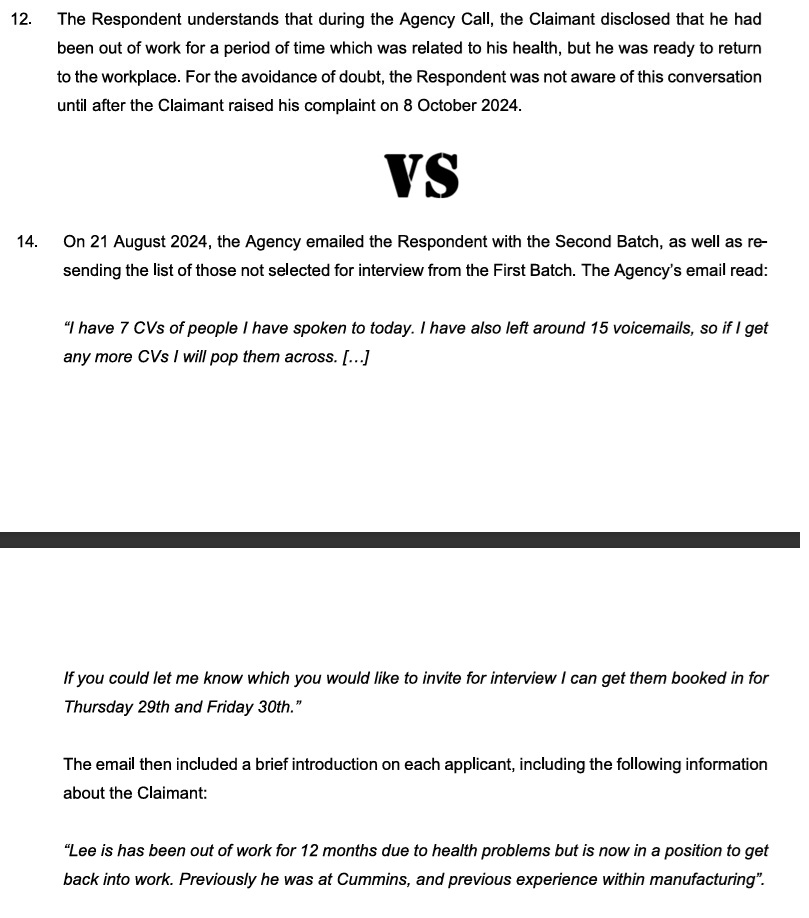
The underlying discrimination case had a real documentary spine. My position was that I was selected or moved toward interview, disclosed a mental-health-related work gap, and was then dropped. Cepac’s response denied selection and denied relevant knowledge, while also pleading that the agency had passed on a two-line context saying I had been out of work for 12 months due to health problems.
That contradiction was obvious enough to require testing.
Instead, the case became a conduct trial.
The merits were left in the box.
The box was then set on fire.
The Tribunal’s Outrage Was Not Evidence
Employment Judge James heard the final public preliminary hearing on 24 April 2026. I did not attend. The Tribunal proceeded in my absence, struck out my claims as unreasonable, scandalous and vexatious, and ordered me to pay £20,000 to Cepac.
The File Problem Judge James Had Before Him
The judgment records that the hearing bundle contained the First Respondent’s strike-out evidence: extracts of my blog posts and X posts, covering long periods of public commentary. It also records that my 21 April and 24 April witness statements were before the Tribunal and said to have been carefully considered.
The same judgment records my application to postpone, in which I identified the First Respondent’s late composite file, uncertainty about what material was actually on the Tribunal file, portal issues, and the wider pattern of late or widened respondent-side material shortly before hearings.
I specifically asked the Tribunal to confirm what material was on file, what claimant-filed material was on file but not visible to me, what was not on file, whether the respondent strike-out, deposit and costs applications were actually before the Judge, and to prevent further late, widened, oversized or respondent-curated material.
That request was basic. I am not a court administrator, and I could not fairly be expected, as a disabled litigant in person, to reconstruct an incomplete record before a case-ending conduct hearing.
My non-attendance was not framed by me as a refusal to engage. It was expressly framed as a safety issue arising from short-notice ambushing, late respondent-side expansion of material, unresolved file uncertainty, portal opacity, the failure to clarify the Tribunal file, and the repeated overload that I said Employment Judge Salter’s order was designed to prevent.
Did Anyone Do The Work?
So here is the question.
When Judge James or the Respondents treated my public-interest references, including references to The Quiet Mancunian’s allegations, as scandalous or outrageous, was the underlying material examined with anything like the care shown above?
That would have required basic work: reading the public sources, separating claim from evidence, distinguishing testimony from inference, checking Cepac’s HSA identity, considering Longulf’s public corporate record, weighing the older HSA, MIGA and Nasreddin reporting against later de-listing records, and asking whether The Quiet Mancunian had ever been publicly debunked point by point.
It would also have required one uncomfortable question.
Was mentioning serious public-interest allegations about the corporate family behind a respondent inherently abusive, or was it uncomfortable because it raised due-diligence questions the Respondent would rather avoid?
Or was the easier move simply to perform outrage?
Because outrage is cheap.
Scrutiny is work.
The Standard TCAP Applies
TCAP does not ask readers to accept The Quiet Mancunian’s entire worldview.
It asks readers to notice the evidence posture.
A named man says he was there. His account gives dates, places, companies, names, corporate trails, photographs, maps and a timeline. It also identifies which parts he says are independently verifiable and which parts depend on his witness account.
He has been publishing for years.
He has not disappeared.
And he has not hidden.
From the corporate side, meanwhile, I have not found the document that shuts him down.
That is why I believe him.
Not as a court. And not a prosecutor. Not as a fantasist looking for a bigger monster. I believe him as a reader, as a claimant who has watched corporate lawyers convert public-interest scrutiny into “misconduct”, as a disabled litigant who watched the Tribunal spend more energy on tone than on contradiction, and as someone who knows exactly how quickly institutions call you unreasonable when the alternative is opening the file.
Questions Cepac, HSA And Their Customers Could Answer
If The Quiet Mancunian is wrong, the route to proving him wrong should be straightforward.
Cepac, HSA or their customers could explain the true end customer for the 1997 Yemen machinery installation. They could clarify the exact corporate relationship between HSA, Longulf Trading, the alleged customer entity, and the payment structures he identifies. Or they could identify the men in the photographs. They could also state whether any part of his Yemen itinerary, machine installation, or corporate contact history is wrong.
Most importantly, they could point readers to any public, detailed, point-by-point rebuttal of his chronology.
Cepac could also answer a simpler due-diligence question: does it accept that public concern about HSA Group is relevant to customer scrutiny when Cepac sells itself through major brands?
For the Tribunal, the question is even shorter.
Before treating reference to these allegations as evidence of scandalous conduct, did anyone actually do the work?
The Cardboard Box And The Unopened File
Cepac makes packaging.
TCAP opens it.
Inside this box is not a conviction. It is not a finding. Nor is it a demand that readers believe every allegation without question.
Inside this box is something more dangerous to corporate comfort.
There is a public record that has not been properly answered. A witness who has not gone away. There is a corporate trail that is not imaginary. There is also a judge’s outrage that looks much less impressive once the material is actually read.
And a simple proposition remains:
If powerful people want to call public-interest scrutiny scandalous, they should first prove they scrutinised the public interest.
Until then, The Quiet Mancunian stays in The Cepac Files.
Not as decoration.
As evidence that some boxes are dirty before TCAP ever touches them.
Lee Thompson – Founder, The Cummins Accountability Project
Sources
- The Quiet Mancunian
- The Quiet Mancunian : Yemen 9/11
- The Quiet Mancunian : My 9/11 Timeline
- The Quiet Mancunian : Al Qa’idah, HSA & Me
- The Quiet Mancunian : 1998 US Embassy Bombings
- The Quiet Mancunian : Anthony C Heaford
- The Quiet Mancunian : Corrections
- Cepac : Cepac Group
- HSA Group : Cepac
- Companies House : Cepac Limited
- Companies House : Dirhem Abdo Saeed Anam Appointments
- Companies House : Longulf Trading UK Limited
- HSA Group : HSA Group Chairman Appointment
- US Treasury : Designation Of Terrorist Financiers Fact Sheet
- US Treasury : United States And Italy Designate New Financiers Of Terror
- United Nations : Security Council Committee Removes One Individual And Twelve Entities From Consolidated List
- PBS Frontline : Understanding Yemen’s Al Qaeda Threat
- Google Books : Hunting The Jackal