

Horsfield Menzies helped Cepac turn a disability-discrimination claim into a prolonged assault on the disabled man who brought it.
Daniel Rubin knows the language of reputation management.
Horsfield Menzies advertises that expertise openly. According to the firm, Rubin advises large corporate clients on sensitive disputes, investor confidence and reputational risk.
Then came Cepac.
The company faced a disability-discrimination claim from an unrepresented disabled man. Meanwhile, Cepac had corporate resources, experienced solicitors and the backing of a vast international business group.
The claimant had himself.
On the corporate side stood Daniel Rubin, Sam Butler and Horsfield Menzies.
However, they did not simply defend Cepac’s recruitment decision. Their litigation style helped turn a narrow discrimination claim into a sprawling examination of the claimant’s character, medical evidence, correspondence, litigation history and public criticism.
Consequently, the company’s alleged conduct faded into the background.
The disabled claimant became the case.
The Claim Cepac Never Answered at a Full Merits Hearing
The original allegation was straightforward.
I applied for a production role at Cepac. On 21 August 2024, I say I received a telephone call telling me that Cepac had selected me for an interview after the bank holiday.
During that conversation, I disclosed the mental-health-related gap in my employment history.
Afterwards, the promised follow-up never came.
Cepac denied offering me an interview. Instead, its formal response presented the call as an agency screening exercise. According to the company, Cepac had never selected me.
That dispute should have gone to a merits hearing.
At such a hearing, the Tribunal could have tested the recruitment records. Witnesses could have answered questions. In addition, the agency evidence could have been examined. Cepac could then have explained what it knew, when it knew it and why the anticipated interview disappeared.
Instead, the litigation went somewhere else.
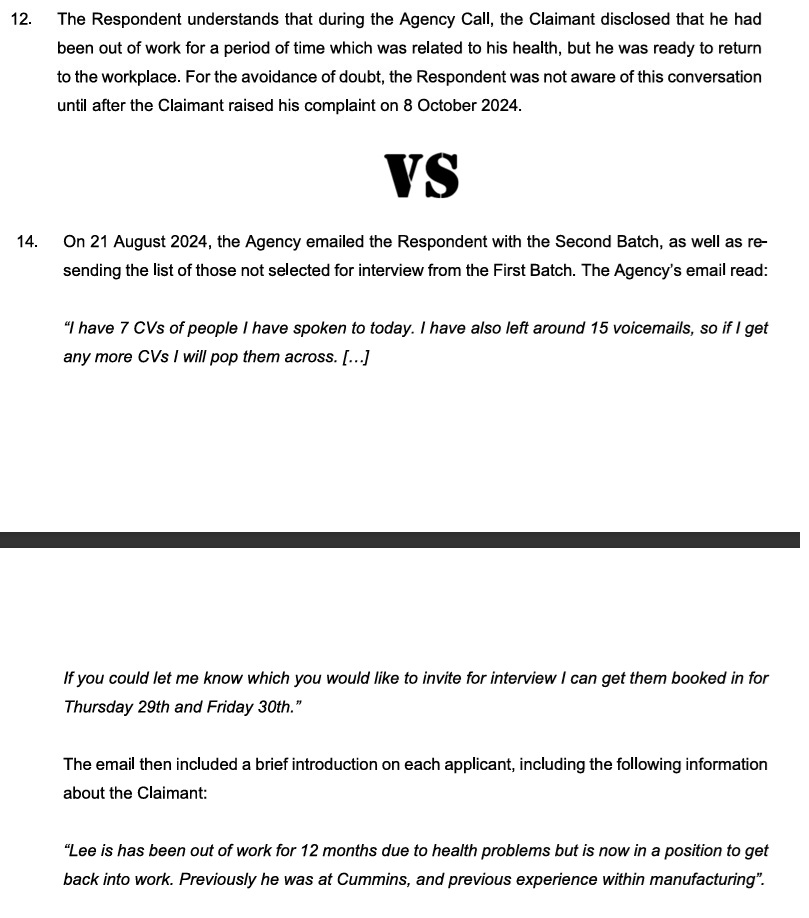
Cepac’s pleaded position contained an obvious problem.
On one hand, the company sought distance from any knowledge of disability. On the other, the recruitment information relied upon by Cepac referred to my absence from work because of health problems.
That contradiction deserved scrutiny.
Nevertheless, Daniel Rubin, Sam Butler and Horsfield Menzies helped ensure that another subject dominated the proceedings.
Me.
Horsfield Menzies Changed the Battlefield
A conventional defence challenges the claimant’s evidence.
Horsfield Menzies went much further.
The firm searched my litigation history. It collected my correspondence and reviewed my blog. Moreover, it gathered social-media posts and catalogued complaints to regulators, MPs and public bodies.
Every attempt to obtain scrutiny became another exhibit.
Angry responses became character evidence. Institutional failures became proof that I had complained too often. Meanwhile, the original recruitment dispute sank further beneath the paperwork.
The resulting inversion suited Cepac perfectly.
No longer did the company need to remain at the centre of the story. Instead, Horsfield Menzies invited the Tribunal to examine whether the claimant was difficult, offensive, persistent or unreasonable.
That shift mattered.
A recruitment decision can be tested against records, witnesses and chronology.
By contrast, a person’s whole life can be buried under paper.
Daniel Rubin and Reputation Management
Daniel Rubin was not a junior employee carrying out anonymous instructions.
Horsfield Menzies presents him as a partner trusted by large corporate clients. His public profile emphasises sensitive disputes, reputation management and investor confidence.
Those words matter because Rubin’s name appeared throughout the proceedings.
He received correspondence and Tribunal communications. Counsel’s withdrawal was addressed to him. Furthermore, attempts to secure replacement representation also involved him.
Finally, Daniel Rubin appeared for Cepac at the hearing on 24 April 2026.
The Tribunal judgment misspelled his surname as “Rubian”. Even so, his role was clear.
Rubin represented the corporate respondent.
I did not attend. Before the hearing, I had explained why late material, uncertainty over the files and unresolved participation issues made safe attendance impossible.
Despite that, the hearing continued without me.
The Tribunal struck out the claim. Cepac then obtained a £20,000 costs order.
Crucially, no full merits hearing examined the central discrimination allegation.
The Tribunal never heard all the recruitment evidence and concluded that Cepac had not discriminated. Rather, the proceedings ended through conduct findings.
For a lawyer associated with reputation management, that result carried an obvious advantage.
Cepac escaped a public merits determination.
Sam Butler’s Litigation Style
Sam Butler also deserves proper recognition.
Horsfield Menzies presents Butler as an experienced Employment Tribunal lawyer. His public profile also highlights mentoring, community work and his position as a Law Society Social Mobility Ambassador.
The litigation correspondence revealed a colder style.
On 21 March 2025, Butler estimated Cepac’s costs at between £25,000 and £30,000. He described my conduct as “quite frankly bizarre and utterly vexatious”.
He then invited me to withdraw.
This warning did not go to another multinational company with an internal legal department. It went to a disabled litigant in person.
The imbalance could hardly have been clearer.
Cepac had Horsfield Menzies. Beside the company stood Daniel Rubin and Sam Butler. Behind all three sat the resources of a major international business group.
Across from them, I faced a potential five-figure costs application while trying to conduct a disability claim without legal representation.
That is the Horsfield Menzies version of social mobility.
The corporate client travels through the system with professional support.
Meanwhile, the disabled claimant receives the bill for continuing.
Sam Butler Called My Medical Centre
The most revealing episode concerned my medical appointment.
Horsfield Menzies contacted the medical centre responsible for that appointment.
Afterwards, Sam Butler informed the Tribunal that another appointment could be arranged. He argued that moving my medical care would be more expedient than rescheduling the hearing.
Consider the mentality behind that decision.
A law firm acting for a company accused of disability discrimination contacted the disabled claimant’s medical provider. It then gathered information about possible alternative appointments. Finally, Butler used that information against the claimant’s postponement request.
My appointment became a litigation obstacle.
My health became a scheduling inconvenience.
Cepac’s preferred timetable came first.
Horsfield Menzies maintained that the medical centre had not disclosed private medical information. However, that response misses the real point.
The contact itself was the disturbing feature.
Cepac’s solicitors considered it appropriate to telephone my medical provider, investigate appointment availability and place the result before the Tribunal.
“The People Focused Law Firm” found a person’s medical appointment.
Sam Butler focused on moving it.
Disability Evidence Became Character Evidence
Horsfield Menzies did not restrict itself to disputing whether my condition met the legal definition of disability.
Instead, the firm also used my health against me.
My medical evidence could explain anxiety, depression, emotional dysregulation and difficulties managing frustration under intense stress. Yet that explanation threatened the conduct narrative.
Therefore, the evidence had to shrink whenever context became inconvenient.
Horsfield Menzies argued that disability did not provide “carte blanche” for my behaviour.
That phrase performed a familiar trick.
First, acknowledge the condition.
Next, detach every manifestation of that condition from the condition itself.
Finally, punish the disabled person for failing to behave like someone without the impairment.
Cepac’s submissions later referred to my “alleged mental illness” and claimed there was no supporting evidence.
In reality, the record contained medical material.
There were GP letters, medical records, medication records and fit notes. The evidence described depression, severe anxiety and problems with emotional regulation.
Horsfield Menzies did not need that material to disappear completely.
It merely needed the Tribunal to discount it.
A 1,599-page Answer to One Question
By April 2026, the Combined Bundle had reached at least 1,599 pages.
Yet the case had begun with one narrow question.
Did Cepac move me towards an interview and then drop me after learning about my mental health?
Daniel Rubin, Sam Butler and Horsfield Menzies answered with volume.
The firm assembled social-media posts, blog articles, correspondence, regulatory complaints and material from previous litigation.
Gradually, the paperwork created its own atmosphere.
After enough pages, the original allegation started to look small. That was precisely the advantage.
Search the claimant’s history.
Collect the profanity.
Catalogue the complaints.
Record every approach to a regulator.
Then present persistence as obsession, frustration as misconduct and demands for accountability as evidence of disruption.
Through that process, the replacement narrative took over.
Cepac’s recruitment conduct became a footnote.
My reaction to the proceedings became the main event.
Horsfield Menzies Made Accountability Look Suspicious
I complained to regulators and public bodies because the ordinary process was failing.
Among others, I approached the SRA, ICO, BSB, JCIO, MPs and government departments.
Horsfield Menzies treated those approaches as part of the alleged misconduct.
The firm described third-party involvement as distracting. Complaints became evidence of escalation. Similarly, requests for oversight became further proof that I was difficult.
As a result, the litigation created a perfect trap.
When one institution refused to act, I approached another.
Each refusal increased my concern. Consequently, every new complaint became another item in Cepac’s conduct case.
The more doors remained closed, the more aggressively Horsfield Menzies criticised my knocking.
Accountability became suspicious.
Silence became the only safe behaviour.
Legal Muscle for Yemen’s Largest Business Dynasty
Cepac is not an isolated packaging company.
It belongs to HSA Group.
HSA is a vast family-controlled conglomerate with interests across food, manufacturing, packaging, logistics and other sectors. The group describes itself using the language of community, compassion and service.
In Yemen, HSA presents itself as a vital national institution.
Its businesses operate against the backdrop of war, hunger and humanitarian crisis. Accordingly, the group often speaks about helping communities and supporting vulnerable people.
Now consider the conduct of its British subsidiary.
When I alleged disability discrimination, Cepac did not respond with restraint.
It instructed Horsfield Menzies.
Sam Butler threatened substantial costs. He also contacted my medical centre. Meanwhile, Horsfield Menzies searched my litigation history and collected my online criticism.
The company’s lawyers built their case around my conduct.
Throughout that process, Daniel Rubin remained attached to the proceedings. Ultimately, he appeared for Cepac at the hearing that ended the claim without a merits determination.
This article does not allege that HSA, Cepac, Daniel Rubin, Sam Butler or Horsfield Menzies supports Iran or the Houthis.
No invented association is necessary.
The genuine contrast cuts deeper.
HSA promotes compassion in a country defined by human suffering. Meanwhile, its British packaging company deployed experienced employment lawyers against a disabled litigant in person.
Corporate values are easy to print.
Litigation reveals the real hierarchy.
“The People Focused Law Firm”
Horsfield Menzies calls itself “The People Focused Law Firm”.
Which people?
Daniel Rubin stood beside Cepac.
Sam Butler stood beside Cepac.
Alongside them stood Horsfield Menzies.
Behind Cepac sat HSA Group, a multinational business empire with tens of thousands of employees and operations across numerous countries.
Across from that machinery stood one disabled man.
I had no solicitor, no barrister and no corporate litigation budget.
My allegation was that a promised job interview disappeared after I disclosed information about my mental health.
Of course, everyone deserves legal representation.
However, that principle does not grant lawyers anonymity.
Daniel Rubin cannot advertise reputation management while expecting the public to ignore the reputation created by his work.
Likewise, Sam Butler cannot advertise social mobility while his conduct towards an unrepresented disabled opponent remains beyond examination.
Nor can Horsfield Menzies call itself people focused and then complain when the public asks which people benefited.
The record answers that question.
Its lawyers served the corporate client. They attacked the claimant’s credibility, searched his history and scrutinised his medical evidence.
Moreover, the firm contacted his medical provider, threatened costs and converted public criticism into strike-out material.
A disability claim became a trial of the claimant’s character.
Daniel Rubin then appeared at the hearing that brought the process to its conclusion.
The Solicitors Had Names
Cepac denied discriminating against me.
That denial remains part of the record.
However, the Tribunal never resolved the central allegation at a full merits hearing. Instead, the claim ended through conduct findings.
I dispute that outcome and continue to challenge the process that produced it.
One matter requires no further determination.
Cepac’s lawyers had names.
Daniel Rubin.
Sam Butler.
Their firm also had a name.
Horsfield Menzies.
Meanwhile, their litigation style served a clear purpose.
Move attention away from the powerful company’s alleged treatment of a disabled applicant.
Place the disabled applicant under permanent examination.
Keep digging until his distress becomes evidence.
Add paperwork until the original allegation disappears beneath the bundle.
Escalate until the claimant can no longer participate safely.
Finally, describe the result as justice.
That approach may impress corporate clients. It may also protect reputations and preserve investor confidence.
Nevertheless, nobody should confuse it with being people focused.
It is power focused.
The people are simply where Daniel Rubin, Sam Butler and Horsfield Menzies apply the pressure.
Lee Thompson – Founder, The Cummins Accountability Project