
Warburtons sells family, care and mental-health support. An Employment Tribunal found disability discrimination, HSE records show £3.9 million in safety fines, and HSA Group owned Cepac publicly called it a longstanding customer.
Warburtons is celebrating its 150th anniversary.
Naturally, ordinary words were not enough.
The company brought in Morgan Freeman to narrate its history. Jonathan Warburton introduced him as the “voice of God himself”, because nothing says humble family bakery like recruiting the Almighty’s preferred voice-over artist to bless a slice of Toastie.
The advertisement offers heritage, newborn babies, warm bread, family continuity and delivery lorries rolling towards another century of national affection.
Warburtons brought the voice of God.
TCAP brought an Employment Tribunal judgment.
The judgment records that Warburtons committed disability discrimination against a driver with generalised anxiety disorder.
That finding is considerably less buttery than the advert.
It does not fit neatly beside the company’s claim that it “always” does the right thing. Nor does it sit comfortably with Warburtons describing almost 5,000 employees as one enormous family supported by mental-health training, occupational health and wellbeing ambassadors.
However, public records are awkward bastards.
They arrive without a celebrity narrator. For now anyway!
The Warburtons Disability-Discrimination Finding
Mr J Kofkin worked as a delivery driver at Warburtons’ Enfield operation.
Warburtons admitted that he had generalised anxiety disorder, that the condition amounted to a disability and that the company knew about it at the relevant time.
His disability required consistency and structure.
That became important after Warburtons changed its delivery arrangements during the national driver shortage. Routes became less predictable. Instead of driving a regular route, drivers could face hundreds of possible combinations as the company tried to keep supermarket customers supplied.
The Tribunal accepted that Warburtons faced genuine operational difficulties. It also found that the company made several adjustments for Mr Kofkin.
Nevertheless, another problem arrived through the attendance-management process.
Mr Kofkin had been absent for 104 days because of his disability. On 30 March 2022, Warburtons placed him on Stage 1 of its Attendance Management Procedure.
That stage was not dismissal.
However, it moved him onto a formal path that could eventually lead there. The letter warned that an insufficient improvement in attendance could result in progression to Stage 2.
And for a man with generalised anxiety disorder, the machinery had started turning. The vicious circle of not feeling cared for, just processed instead.
Less Dicriminatory measures were available
The Tribunal found that placing Mr Kofkin on Stage 1 amounted to unfavourable treatment because of absence arising from his disability.
Warburtons argued that it had legitimate aims. It needed regular attendance, accurate absence records and a process for supporting employees.
The Tribunal accepted those aims.
What it rejected was the company’s chosen method.
It found that placing Mr Kofkin on Stage 1 was not proportionate because less discriminatory measures were available. Warburtons could have monitored his attendance informally. Managers could still have discussed support, further absence and reasonable adjustments without moving him closer to the later stages of a dismissal process.
The conclusion was explicit.
There had been disability discrimination under section 15 of the Equality Act 2010.
Not an allegation.
Not a furious blog interpretation.
Or something TCAP found behind a loose floorboard and inflated for effect.
An Employment Tribunal finding.
Warburtons was ordered to pay £2,000 for injury to feelings, plus £304.66 in interest.
The amount was modest.
The legal finding was not. The compensation reflecting the dismissive, illogical and offensive language that had become all too familiar in UK court systems.
The Parts Warburtons Won
This must be reported accurately.
Mr Kofkin did not win everything.
His reasonable-adjustment complaints concerning the later period failed. An earlier part of that claim was out of time, and the Tribunal declined to extend time (Because a stopwatch is more important than investigating whether discriminatio . It also dismissed the indirect-discrimination and victimisation complaints.
Furthermore, Mr Kofkin successfully appealed the Stage 1 decision internally. Warburtons cancelled the monitoring period and warning.
Those facts belong in the article.
So does the complaint he won.
Corporate public relations loves an all-or-nothing account. If a claimant loses several issues, the successful finding can be swept into the crumbs and treated as though nothing happened.
Fuck that.
A mixed judgment remains a judgment. Warburtons defeated several allegations and was found liable on another. The successful complaint concerned formal attendance action taken against a disabled worker because of an absence caused by his disability.
Readers can cope with two facts at once.
Perhaps the marketing department can receive training.
“Live Well” Meets Stage 1
Warburtons operates a wellbeing programme called Live Well.
The company says its employees are the lifeblood of the business. It promises occupational-health support, physiotherapy, remote GP appointments and access to GroceryAid services.
Warburtons also says every employee should complete mental-health training during their first year. Its targets include mental-health first aiders and ambassadors across its sites.
Fine.
Training slides are easy.
The real examination begins when a disabled employee’s attendance collides with operational pressure.
That is where wellbeing leaves the conference room and meets the manager holding the policy.
In Mr Kofkin’s case, Warburtons knew about the disability. It knew the 104-day absence arose from that disability. Its own procedure allowed managerial discretion.
Even so, the company placed him on Stage 1.
The Tribunal found that choice discriminatory because a less discriminatory route existed.
Apparently, the mental-health ambassador had not reached that part of the bakery.
“We always do the right thing”
Warburtons’ current values page contains an admirably fearless claim:
We always do the right thing.
Always.
Not regularly.
Not after an appeal.
Once the Employment Tribunal has explained proportionality? Alas, not here
Always.
This is the trouble with absolute corporate virtue. One judgment can put a brick through the window.
A serious organisation might say it tries to do the right thing, sometimes fails and learns from the consequences. That would sound human.
Instead, Warburtons serves the usual values-page white bread: uniform, air-filled, square-cut and designed to offend nobody. Family. Care. Responsibility. Quality. Warmth. Togetherness.
Then the public record arrives carrying an Equality Act finding.
The company can wrap itself in orange, curve the wordmark into a smile and place Jonathan Warburton’s signature on the packet. None of that changes what happened on 30 March 2022.
The Tribunal found disability discrimination.
No amount of brand warmth can toast that back into innocence.
£3.9m in Workplace-Safety Fines
The discrimination judgment is not the only ugly material outside the anniversay advert.
HSE records show that Warburtons received two enormous workplace-safety fines in 2017.
They concerned separate incidents at different sites.
Together, the fines reached £3.9 million, before prosecution costs.
That number deserves to sit beside every fluffy sentence about the Warburtons family.
Not because modern Warburtons should be frozen permanently in incidents from 2013 and 2015. Businesses can improve. Procedures can change. Lessons can be learned.
However, a company celebrating 150 years of virtue does not get to select only the chapters with soft lighting.
History includes the machinery.
It includes the workers beside it.
It includes what happened when the safeguards failed.
A Worker Fell From the Mixing Equipment
The first case followed an incident at Warburtons’ Wednesbury site in November 2013.
Andrew Sears was cleaning mixing equipment when he fell almost two metres. He suffered a compression fracture to his spine and life-changing injuries.
Reports of the prosecution said workers were routinely expected to access the top of the mixers for cleaning. They were left in unbalanced positions without adequate supervision or proper training for the work at height.
Mr Sears eventually returned to work. However, he could not continue in his previous role and was later dismissed following another long period of sickness absence.
Warburtons pleaded guilty to breaching the Work at Height Regulations.
The fine was £2 million, with a further £19,609.28 in costs.
Afterwards, Warburtons said its procedures had failed to protect Mr Sears. It expressed sadness and said preventative steps had been taken.
That response was appropriate.
The failure that required it was not.
An Agency Worker Became Trapped in the Bread Line
The second prosecution concerned Warburtons’ Nottingham factory.
In August 2015, an agency worker was cleaning part of a bread-production line when his arm became trapped between running conveyors.
Part of the machinery had to be dismantled to release him.
The worker suffered friction burns requiring skin grafts.
The HSE investigation found that local guarding could have prevented access to the dangerous space between the conveyors. Warburtons pleaded guilty to breaching work-equipment regulations.
The fine was £1.9 million, plus £21,459.71 in costs.
There is a temptation to keep making bread jokes here.
It would be easy.
A production line. A company in the dough. Safety sliced too thinly.
However, a fractured spine and an arm requiring skin grafts are where the puns stop.
The corporate sneer belongs upstairs, where “family” is polished into a commercial identity. It does not belong beside the workers who carried the consequences.
The Family Photograph is Overwhelmingly Male
Warburtons’ latest statutory gender-pay data adds another piece to the company portrait.
Women represented about 15% of its employees.
They made up 17.3% of the highest-paid quarter but 22.9% of the lowest-paid quarter. Women’s median hourly pay was 3.9% lower, while their median bonus pay was 23.2% lower.
The mean figures moved in the opposite direction. Women’s average hourly pay and average bonus pay were higher than men’s.
Therefore, TCAP is not presenting the data as an equal-pay violation or another discrimination finding. It is neither.
Still, the composition is striking.
When Warburtons invites Britain to admire its vast corporate family, roughly 85 out of every 100 faces in that workforce are male.
Perhaps the sixth generation can widen the family photograph while it inherits the signature, the orange packaging and the dividend stream.
The 150 Cepac Pizza Boxes
Now we reach the cardboard.
In August 2024, Cepac published a cheerful news item about donating 150 corrugated pizza boxes to Warburtons’ Innovation Team.
Warburtons employees had organised an internal pizza sale for Cancer Research UK. Suppliers donated ingredients, Cepac supplied the boxes, and the event raised £595.
The fundraiser is not the scandal.
Cancer research is not a prop for TCAP to kick over. Warburtons employees have since helped raise millions for Cancer Research UK, which is an achievement deserving recognition.
The significance lies in one phrase Cepac chose to publish.
It called Warburtons its “longstanding customer”.
That is Cepac’s description, not an inference made from a blurry photograph.
Cepac publicly claimed the commercial relationship.
The boxes became evidence.
The Date Matters
Cepac published the fundraiser article on 5 August 2024.
My recruitment call took place on 21 August 2024.
Therefore, the Cepac article predates my disability-discrimination dispute. It does not show that Warburtons knew about my allegation, the later litigation or any of the disputed conduct surrounding it.
TCAP will not manipulate the chronology.
The page proves a longstanding customer relationship existed by August 2024. It does not prove Warburtons knowingly entered or continued that relationship after the Cepac case emerged.
That creates the next question.
Does the relationship continue?
Cepac’s public page remains online. Warburtons has since redesigned packaging across more than 70 products, although TCAP has found no evidence that Cepac produced that consumer-facing redesign.
If Cepac still supplies Warburtons in any capacity, what due diligence has taken place since the dispute became public?
If the relationship ended, when did it end and why?
A clean answer would remove speculation.
Silence leaves the cardboard on the table.
Two Disability Files in One Supply Chain
The Warburtons position is unusually uncomfortable because disability discrimination is not an abstract supplier-risk issue for the company.
Warburtons has its own adjudicated finding.
It knows how quickly an attendance policy can turn disability-related absence into formal jeopardy. The company has already sat in a Tribunal while a driver with generalised anxiety disorder explained what happened when structure, predictability and mental health collided with operational demands.
Cepac presents another disability case.
I applied for a production role. During a telephone call on 21 August 2024, I say I was told that Cepac had selected me for an interview after the bank holiday.
During the conversation, I disclosed the mental-health-related reason for the gap in my employment history.
The promised follow-up never arrived.
Cepac denied offering me an interview. Its formal response characterised the call as an agency screening exercise.
The dispute did not receive a full merits hearing.
Instead, the Tribunal struck out my claim on conduct grounds and later imposed a £20,000 costs order. The Tribunal took a severe view of my conduct, and TCAP does not pretend otherwise.
However, I dispute the circumstances in which the strike-out and costs decisions were made. They are subject to an Employment Appeal Tribunal challenge.
The orders remain operative unless overturned. An appeal does not prove that the Tribunal was wrong.
Equally, the procedural outcome did not decide whether an interview was promised or whether my mental-health disclosure affected what followed.
Cepac denied discrimination.
No merits judgment cleared it.
Those facts coexist, however inconveniently.
The Contradiction Inside Cepac’s Response
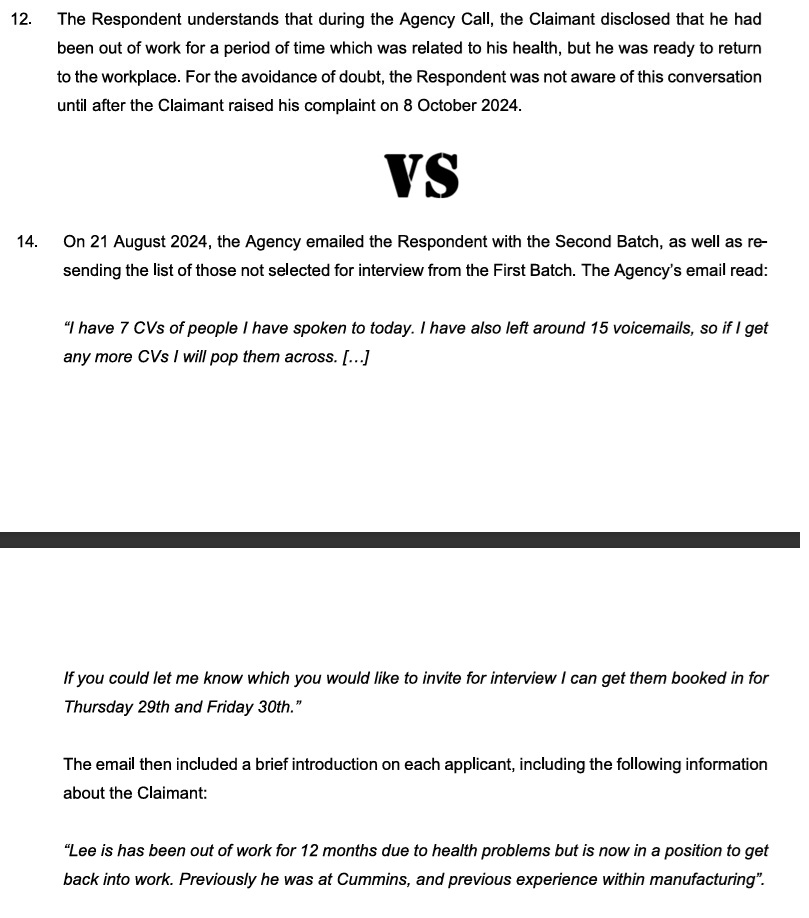
TCAP has repeatedly highlighted what it says is a contradiction in Cepac and Page Outsourcing’s Tribunal response.
The relevant passages concern what was known about my disability and what I disclosed during the recruitment call.
That issue should have been tested through evidence.
Witnesses could have answered questions. Recruitment records could have been examined, and the agency chain could have been placed under oath.
It never happened.
The case became about the claimant’s conduct rather than the recruitment decision that started it.
Warburtons was not a party to that litigation.
It did not write Cepac’s response, instruct Horsfield Menzies or impose the costs order.
TCAP does not allege otherwise.
The responsibility begins somewhere simpler.
A company publicly identified as a longstanding Cepac customer now has enough information to ask questions.
Will it?
Supplier Due Diligence is Not a Decorative Loaf
Corporate supplier policies are full of moral theatre.
Integrity. Human rights. Inclusion. Responsibility. Ethical conduct. Mutual respect. Speak-up culture. Compliance.
The words are kneaded until every supplier brochure rises into exactly the same pale, obedient shape.
The test begins when a supplier becomes awkward.
Warburtons says its farmers, suppliers and retail partners form part of its extended family. It says those partners share its passion for quality and care.
Very well.
Does Cepac remain in that family?
Has Warburtons asked about the disability-discrimination allegation?
Did it review the litigation conduct, including the substantial costs warning issued to a disabled litigant in person?
Has anyone examined the contact between Cepac’s lawyers and my medical centre?
Was the absence of a merits determination understood?
Furthermore, does Warburtons consider Cepac’s response consistent with the care expected from a member of its extended family?
Supplier due diligence is worthless if it begins and ends with delivery performance, price and whether the boxes collapse in the rain.
Sometimes the defect is not in the cardboard.
It is in the company making it.
The Cepac Files Supply Chain Nonchalance Award 2026
Warburtons is now nominated for The Cepac Files Supply Chain Nonchalance Award 2026.
The citation reads:
For publicly appearing as Cepac’s longstanding customer, operating beneath its own disability-discrimination judgment and maintaining a values page so soft that the public record could use it as bedding.
The award is provisional because Warburtons has an opportunity to answer.
Perhaps the relationship ended.
Maybe the company conducted serious due diligence privately.
Perhaps Warburtons challenged Cepac, reviewed the file and concluded that further action was unnecessary.
If so, it can explain.
What it cannot reasonably do is claim ignorance after this article.
The cardboard has arrived.
Somebody in compliance can open the fucking box.
Questions for Warburtons
TCAP invites Warburtons to answer the following questions:
- Does Warburtons currently purchase any packaging, products or services from Cepac Limited?
- If the relationship has ended, when did it end?
- Has Warburtons reviewed the disability-discrimination allegations and litigation conduct connected with Thompson v Cepac Limited and Page Outsourcing UK Limited?
- Did Warburtons undertake any supplier due diligence after the Cepac dispute became public?
- What company-wide changes followed the disability-discrimination finding in Kofkin v Warburtons Limited?
- Did Warburtons review its Attendance Management Procedure after the Tribunal found that less discriminatory measures were available?
- How does the finding fit beside Warburtons’ claim that it “always” does the right thing?
- Does Warburtons consider a supplier’s treatment of disabled applicants and litigants relevant to its procurement decisions?
These are not exotic questions.
Nobody is asking for the recipe to the Toastie loaf or Morgan Freeman’s invoice.
We are asking whether the values survive contact with the file.
The Voice-Over Ends
Warburtons has existed for 150 years.
That history contains hard work, commercial success, useful products and employees who have raised millions for cancer research. TCAP does not need to erase any of it.
Good conduct does not cancel bad conduct.
A charity milestone does not reverse a disability-discrimination finding. Nor can a wellbeing programme erase a formal warning imposed because of disability-related absence.
Meanwhile, two enormous safety fines remain part of the company’s record. One worker suffered a life-changing spinal injury. Another required skin grafts after becoming trapped in machinery.
Then there is Cepac.
Cepac called Warburtons a longstanding customer. The public page survives. The commercial relationship may or may not have continued, and Warburtons can clarify the position.
The company already understands disability discrimination from the respondent’s side of a Tribunal room. It should not require a supplier code, celebrity narrator or divine revelation to recognise the question now sitting in its supply chain.
Warburtons says it always does the right thing.
Here is the opportunity.
Ask Cepac what happened.
Examine the documents.
Decide whether the relationship remains acceptable.
Then publish the answer.
The anniversary advertisement will eventually end. Morgan Freeman’s voice will fade, the warm slice will disappear and the lorries will roll out of shot.
The judgment will remain.
So will the HSE records.
So will Cepac’s description of Warburtons as a longstanding customer.
Corporate bread goes stale.
The public record has a longer shelf life.
Lee Thompson – Founder, The Cummins Accountability Project
Sources
- Warburtons : 150 Years in the Baking
- Warburtons : Our Values
- Warburtons : Live Well
- Employment Tribunal judgment and reasons : Mr J Kofkin v Warburtons Limited
- GOV.UK : Warburtons Limited gender-pay report for 2025 to 2026
- HSE conviction record : Warburtons Limited, Wednesbury
- HSE breach record : £2 million Work at Height fine
- HR News : Warburtons fined £2 million after worker suffered life-changing injuries
- HSE conviction record : Warburtons Limited, Nottingham
- HSE breach record : £1.9 million work-equipment fine
- Insider Media : Warburtons fined £1.9 million after Nottingham factory injury
- Cepac : Pizza boxes for Warburtons’ Cancer Research fundraiser
- Warburtons : £4 million raised for Cancer Research UK
- Companies House : Warburtons Limited filing history
- Employment Tribunal reconsideration judgment : Thompson v Cepac Limited and Page Outsourcing UK Limited
- Employment Tribunal pleadings, correspondence, orders and judgments in Thompson v Cepac Limited and Page Outsourcing UK Limited
- Employment Appeal Tribunal appeal papers concerning the strike-out and costs order
- Correspondence concerning Cepac’s estimated costs and contact with the claimant’s medical centre