Diageo says it wants to be one of the world’s most trusted and respected consumer-products companies. It has a disability network called We Are All Able. Its supplier code demands integrity, competition-law compliance, safe workplaces and freedom from bullying, intimidation and abuse. The brochure arrives dressed for dinner, cufflinks polished, conscience dry-cleaned and every value arranged in alphabetical order.
Then the files arrive and empty their pockets onto the fucking table.
Indeed, the Diageo disability finding concerns a production operator with rheumatoid arthritis. An Employment Tribunal found Diageo Scotland discriminated against her while managers were assembling what the judgment repeatedly calls a “dream team”. The disabled worker did not make it. Her inability to hand-pack bottles played more than a trivial part in removing her from her established role and dumping her into an ill-defined backup position.
Consequently, that was unlawful discrimination arising from disability under section 15 of the Equality Act 2010. The award was £12,760.
Now place that finding beside Diageo’s packaging supplier Cepac Limited, the unresolved disability-discrimination allegations arising from Cepac’s recruitment process, and the ET3 passages TCAP says pull in different directions over knowledge of disability.
Suddenly, “We Are All Able” sounds less like a promise and more like the name of the corporate choir hired to sing while the awkward disabled people and their paperwork are carried out through the fucking service entrance.
However, disability is only the first file. Diageo also brings bribery-control failures, excess shipments, competition restrictions, a badly burned worker and a fresh Indian product ban to this particular drinks trolley.
Pour carefully. The glass is full of receipts, and several of them have already been stamped by courts and regulators.
Cepac Is In Diageo’s Supply Chain
This is not guilt by brand association, an imaginative hop between drinks cabinets or TCAP mistaking one multinational alcohol company for another.
Indeed, during the 2023 Cepac pay dispute, Unite publicly named Diageo among Cepac’s customers. Moreover, the same list identified Mars, Carlsberg, Innocent Drinks, Pernod Ricard, Lidl, Sainsbury’s and several supermarket chains already examined in The Cepac Files.
Therefore, the commercial link is not inferred from a bottle photographed near a box. A trade union named the relationship while reporting on workers at Cepac’s Darlington site.
That matters because Diageo’s own supplier rules are not decorative suggestions left beside the cocktail napkins. The company says its Partnering with Suppliers Standard establishes minimum requirements covering business integrity, human rights, labour standards, health and safety and environmental impact. It is written with the square-jawed confidence of a document that assumes nobody will ever drag one of the company’s named suppliers into the same room and start reading aloud.
Moreover, Diageo says continued non-compliance may jeopardise a supplier’s commercial relationship. Its human-rights policy also says failure to deliver appropriate mitigation can ultimately lead to cessation of trading.
Excellent.
The mechanism exists. Diageo wrote the standards. Meanwhile, the customer link and the disability file are already sitting in public view.
All that remains is the inconvenient bit corporate ethics departments tend to schedule for the next financial year, preferably after the responsible director has left and the inbox has been ceremonially set on fire: using the fucking mechanism.
Diageo’s Dream Team Had A Disability Problem
Patricia Johnston had worked for Diageo Scotland since 2005 and operated a labelling machine at its Leven bottling plant. She had rheumatoid arthritis affecting her wrist and finger. Occupational-health advice imposed a permanent restriction against hand-packing because the task risked aggravating her condition.
Meanwhile, when Diageo reorganised the plant under “Project Neptune”, managers selected a high-performing crew for line 15. Moreover, the judgment records that they called it a “dream team”. Apparently, even a bottling line required its own Avengers, except one of the superpowers was having hands that did not arrive with medical restrictions and spoil the management fantasy.
Meanwhile, Johnston was the main labelling operator. Nevertheless, she was removed from line 15 and sent to lines 11 and 17 as a second backup operator, despite those lines already having label operators and backups. At times she spent entire shifts cleaning. Moreover, a risk assessment suggested by occupational health was never carried out.
However, Diageo relied on several explanations, including attitude, attendance, teamwork and flexibility. Yet the Tribunal rejected the suggestion that her inability to hand-pack played no part. It found that this disability-linked limitation had contributed more than trivially to the decision.
Consequently, the move was unfavourable treatment because of something arising from disability. Diageo’s justification defence failed because the means used were not proportionate. Management had built a dream team and, with almost parodic neatness, left outside it the worker whose body complicated the fucking spreadsheet.
The “dream team” survived.
Inclusion, however, was poured down the fucking drain.
The Judgment Is Not An Allegation
There is no need to inflate this case. Its precise finding is damaging enough.
Indeed, Johnston succeeded under section 15. However, her separate reasonable-adjustments and victimisation claims were dismissed. The Tribunal also accepted that Diageo later offered genuine alternative roles and rejected parts of her case.
Therefore, that balance matters. TCAP does not turn a mixed judgment into a total corporate conviction because bullshit remains bullshit even when pointed at a company with money.
Nevertheless, the central result is unambiguous. Diageo treated a disabled worker unfavourably because of something arising from her disability and failed to justify that treatment as proportionate.
Paragraph 194 says so without corporate garnish:
“We did not consider the means by which the respondent endeavoured to deal with their legitimate aim was proportionate.”
– Employment Tribunal, Johnston v Diageo Scotland Ltd, Case No. 4121976/2018, paragraph 194. The Tribunal upheld the section 15 disability-discrimination complaint.
Meanwhile, Diageo promotes its We Are All Able employee resource group as support for the employment and development of disabled people. Fine. Organisations can learn, policies can improve and later work should not be dismissed merely because an earlier tribunal found unlawful conduct.
However, learning has consequences. A company that has already lost a section 15 case cannot treat disability risk in its supply chain as strange weather no one could reasonably predict.
It has seen the forecast in judicial ink.
Now Put Cepac’s ET3 Under The Same Light
Meanwhile, Lee Thompson, yes, me, says Page Outsourcing moved him forward for an interview for a role at Cepac. He says disability-related information was then disclosed, and the promised interview then did not happen, and the recruitment chain later constructed explanations for the disappearance. Page and Cepac denied unlawful discrimination.
However, those allegations were never determined at a full merits hearing. Accordingly, TCAP does not present them as findings against Cepac or Page.
Yet procedural closure does not feed the pleadings into a furnace.
Cepac’s ET3 Grounds of Resistance remain public evidence of the positions it chose to advance. TCAP says Section 12 appears to distance Cepac from relevant knowledge of disability. Section 14 then refers to information passed through the recruitment chain about time away from work because of health problems.
That tension required evidence, witnesses and findings.
It received none.
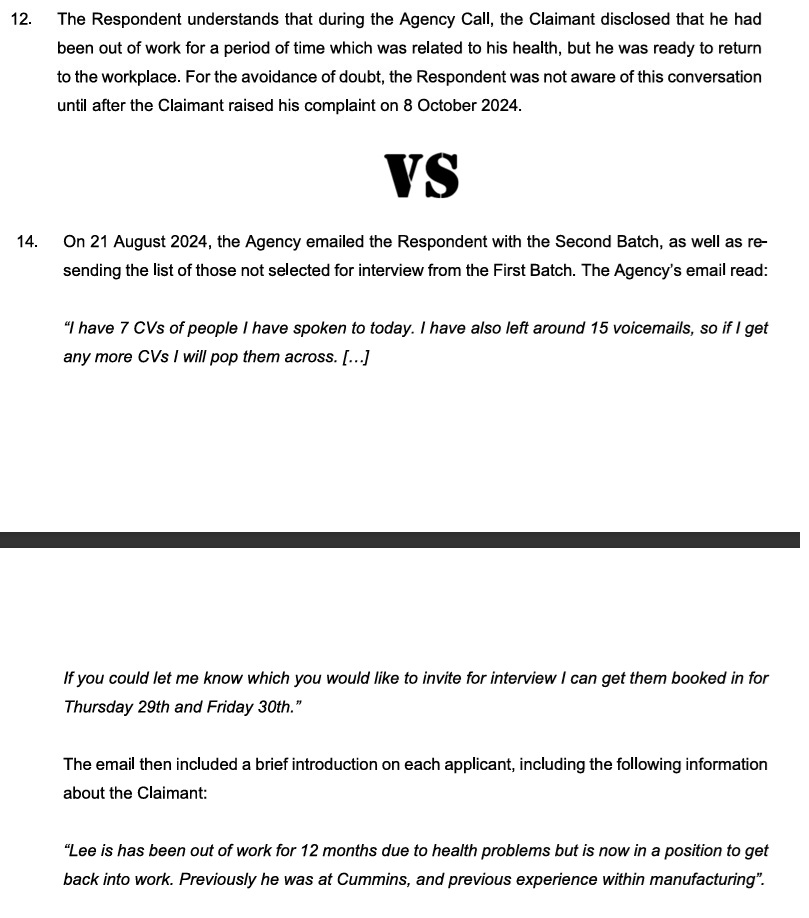
The distinction is straightforward. Diageo has an adverse tribunal finding. Cepac faces unresolved allegations and a pleaded knowledge issue TCAP says was never properly tested.
That difference prevents false equivalence. It does not prevent supplier due diligence.
Indeed, due diligence exists precisely because waiting for every risk to mature into a final judgment is management by fucking obituary.
The Conduct Case Ate The Discrimination Case
The underlying Cepac/Page allegation did not reach the hearing it was built for. The recruitment witnesses were never heard in a full merits trial so a tribunal could decide whether unlawful disability discrimination occurred. Cross-examination never reconciled the competing explanations. Nor did any tribunal make a merits finding that the ET3 tension was innocent, immaterial or fatal to Thompson’s case.
Instead, the litigation became consumed by conduct: Thompson’s public commentary, his language, his reactions to Cepac’s legal aggression and threats against a disabled litigant and the escalating procedural war around them. Moreover, the respondents deployed substantial legal force against the way he reacted. Ultimately, the Tribunal punished the reaction without first determining the alleged disability-related trigger beneath it.
The respondents are entitled to argue that the conduct independently justified the outcome. They rely on the Tribunal’s findings. TCAP’s position, however, is that the process severed reaction from cause, repackaged disability-related escalation as freestanding misconduct and allowed the conduct case to swallow the discrimination case before the latter could draw breath in open court.
TCAP says the Tribunal became deliberately hostile after a procedural outburst provoked by Employment Judge Moss’s pathetic handling of a deferment request. The claimant received only one day’s notice of a preliminary hearing and asked for it to be deferred, expressly explaining that he needed time to prepare. Although the request was not expressly made on disability grounds, TCAP says Moss failed to take proper account of the claimant’s known disability before refusing it. A disability-led outburst, supported by medical evidence, followed and was subsequently apologised for. What came next was the emboldened bullying of a disabled claimant by Cepac’s solicitors, Sam Butler, Senior Associate and Daniel Rubin, Partner, of Horsfield Menzies, conducted in full view of Newcastle Employment Tribunal and seemingly to its fucking delight. Dirty fuckers.
That is an argument, not a judicial finding. It is also the central fucking issue.
How To Bury A Trigger Without Answering It
Legal aggression can become its own laundering cycle. Start with an allegation about a disabled person’s treatment. Apply pressure until his reaction becomes ugly. Photograph the reaction. Enlarge it. Mount it under courtroom lighting. Then invite everyone to forget what the bastard was reacting to.
Whether that happened here should have been tested with the same seriousness later applied to policing Thompson’s language. Instead, the allegation remained untried while the response to the allegation became the main event. The restaurant never served the meal, but it delivered a 200-page complaint about the customer kicking the locked door.
That procedural history does not prove the original claim. Equally, it does not acquit the recruitment process. Untested is not disproved. Unheard is not exonerated. A conduct judgment is not a time machine that travels backwards and disinfects an ET3.
For Diageo, that is the due-diligence problem. Its supplier standards speak about human rights, fair treatment, intimidation, remedy and corrective action. Those words do not become inapplicable because a sufficiently expensive legal campaign moved the camera from alleged discrimination to the claimant’s reaction.
The Supplier Code Has A Conveniently Sharp Edge
Diageo expects suppliers to prohibit harassment, intimidation, bullying and abuse. More directly, its standard says suppliers must not discriminate in any aspect of employment or the hiring process on grounds including disability and health. It also requires compliance with the letter and spirit of applicable law, accurate records, business integrity, competition rules and health-and-safety standards.
More importantly, the company demands an accessible and fair grievance process, says it assesses supplier human-rights risks and expects time-bound corrective plans where remediation is required. Persistent non-compliance can threaten the commercial relationship.
Therefore, TCAP is not inventing a moral jurisdiction for Diageo. Diageo wrote one for itself.
The questions follow its own fucking paperwork:
- Has Diageo reviewed the disability-discrimination allegations concerning the Page/Cepac recruitment process?
- Has it examined Sections 12 and 14 of Cepac’s ET3?
- Did it ask Cepac or Page Outsourcing to explain the recruitment decision and the positions pleaded afterwards?
- Did it assess the subsequent allegations of litigation pressure, disability-linked conduct framing and the disposal of the proceedings without a merits hearing on discrimination?
- Has Cepac been required to produce a mitigation or corrective-action plan?
- If Diageo’s supplier standard does not apply to a named packaging customer relationship, when the fuck does it apply?
Perhaps Diageo has already completed that work. If so, it can publish the conclusion and explain what supplier accountability looks like when the supplier has hired lawyers without ever reaching a merits answer.
Otherwise, the supplier code is just another premium label wrapped around a bottle of corporate tap water.
Sixteen Million Dollars Of Bribery-Control Failure
Diageo’s own record makes its integrity sermon considerably more entertaining.
In 2011, the US Securities and Exchange Commission found that Diageo subsidiaries paid more than $2.7 million to government officials in India, Thailand and South Korea over more than six years to obtain sales and tax benefits. Diageo agreed to pay more than $16 million to settle charges concerning books, records and internal controls under the Foreign Corrupt Practices Act.
The conduct included payments routed through subsidiaries connected to Johnnie Walker and Windsor Scotch.
This was not somebody accepting an overgenerous Christmas hamper and forgetting to tell compliance. It was a multi-country regulatory failure measured in millions, followed by a settlement large enough to make “doing business the right way from grain to glass” sound like a route planned by a drunk satnav with a diplomatic passport.
Of course, the enforcement action is old. That does not make it irrelevant. Diageo’s present supplier code still demands a zero-tolerance approach to bribery and corruption and warns against gifts that create even the appearance of obligation.
Fair enough.
Yet when the company lectures suppliers about integrity, the historical record should remain on the bar beside the policy. Corporate memory cannot keep only the embossed menu while throwing the regulatory bill into the ice bucket.
Five Million Dollars For Shipping The Story
In 2020, the SEC returned.
This time, the regulator said employees at Diageo North America pressured distributors to buy products beyond consumer demand so the business could meet internal sales targets during declining market conditions. The excess shipments helped Diageo hit performance targets and report higher growth in indicators watched by investors and analysts.
According to the SEC, Diageo failed to disclose the known trend created by those shipments. It agreed to pay $5 million to settle the action.
There is something beautifully corporate about solving weak demand by pushing more stock into the channel and then allowing the market to admire the resulting numbers. If reality refuses to buy enough bottles, perhaps the distributor can hold the plot upright until the reporting period closes and the executives have finished applauding the corpse.
Again, this does not prove anything about Cepac’s recruitment process.
It proves something about the absurdity of Diageo presenting supplier integrity as a one-way inspection hatch.
Records must be accurate. Explanations must withstand scrutiny. Known problems must not be hidden inside a better-looking narrative.
Those principles apply when the subject is distributor inventory.
They also apply when a supplier’s ET3 appears to say one thing about disability knowledge and another about health information moving through the recruitment chain.
Different file. Same fucking allergy to unreconciled stories.
Competition Rules, Served With A $750,000 Chaser
Diageo’s supplier code also insists upon compliance with competition and antitrust law.
In 2025, the COMESA Competition Commission concluded a four-year investigation into Diageo’s distribution arrangements in eastern and southern Africa. The probe concerned territorial restrictions and market-allocation practices affecting trade between member states.
Diageo offered commitments on a non-admission basis and agreed to pay a $750,000 settlement. The Commission’s case registry records the matter as decided.
The legal qualifier matters: this was a settlement and commitments package, not a confession recited beneath a portrait of Johnnie Walker. Nevertheless, three quarters of a million dollars did not leave the building because the competition file was a triumph of immaculate corporate restraint.
Once more, Diageo’s policy language is unobjectionable. Suppliers should obey competition rules. They should avoid restrictions that carve up markets. They should maintain appropriate controls.
However, a code becomes credible only when the company holding it applies equivalent curiosity inward and outward.
Otherwise, ethics resembles table service in a private club. Suppliers receive the stern lecture and plastic tumbler. The multinational keeps the crystal, the caveats and a compliance department trained to call every regulatory collision a learning journey before reversing the Bentley over the minutes.
Ten Thousand Litres At 104 Degrees
The health-and-safety language becomes harder to swallow at Glenlossie Distillery.
In March 2021, mechanical engineer Michael Thomson was repairing a defective pump when an incorrectly fitted valve released around 10,000 litres of pot ale at 104°C. The force knocked him down. He suffered burns to roughly 30% of his body, spent two weeks in intensive care and was placed in an induced coma.
Diageo Scotland pleaded guilty to health-and-safety failures. In December 2024, Inverness Sheriff Court fined the company £537,500.
Diageo apologised, described Thomson as a valued employee and said improved isolation procedures had been implemented. Those steps matter. So does the guilty plea.
Nevertheless, the image should remain where the corporate policy cannot crop it out: a worker on the floor beneath boiling industrial liquid because a valve showed closed when it was open and the system around it failed. No slogan survives 10,000 litres at 104 degrees. It just peels off the wall and joins everything else on the floor.
Diageo expects suppliers to maintain clear health-and-safety policies. Sensible. Yet Glenlossie demonstrates the distance between owning a policy and preventing a human body from becoming the final fucking warning label.
The lesson for Cepac is not that every allegation equals that prosecution. It is that paperwork without scrutiny is decorative insulation. Eventually, reality gets through.
This Week, India Took Bottles Off The Shelf
As this article was being prepared, Diageo’s scandal file acquired a fresh page.
India’s food-safety regulator barred sales of selected products made by Diageo-controlled United Spirits, including Antiquity Blue Whisky, Royal Challenge Whisky and McDowell’s No.1 Rum. The regulator said testing found artificial or nature-identical flavourings being used to recreate characteristics that should arise through ingredients, fermentation, distillation or maturation.
Royal Challenge is not a dusty side bottle forgotten behind the optics. Diageo says millions of nine-litre cases are sold annually in India.
United Spirits is contesting the orders. It has said the relevant labels comply with applicable laws and described aspects of the dispute as an industry-wide issue. Therefore, the legal challenge and company position belong in the account.
Still, the immediate fact remains magnificently awkward: while Diageo’s supplier code demands quality, legal compliance and accurate records, a regulator in one of its largest markets has ordered named products off the shelf over flavouring and labelling concerns.
The timing could not be better if TCAP had hired the regulator as a fucking sub-editor and paid it in confiscated whisky.
Diageo wanted grain to glass.
India has paused the glass to ask what happened between the two.
We Are All Able To Read The Files
Diageo is entitled to promote disability inclusion. Its employee network may do valuable work. Its supplier standards contain sensible requirements. The company may also have strengthened systems after each regulatory failure, prosecution and tribunal case.
But progress is not a ceremonial amnesty.
The Diageo disability judgment says a worker was treated unfavourably because of something arising from disability. The supplier list places Cepac inside Diageo’s commercial orbit. Cepac’s ET3 contains a knowledge tension TCAP says was never tested. Diageo’s own rules claim that human rights, labour standards, integrity, safety and corrective action matter throughout the supply chain.
Meanwhile, the wider record shows why trusting corporate language without opening the files would be fucking negligent. Diageo’s ethics suite is a beautifully stocked bar, but half the bottles contain footnotes and the fire exit opens into litigation.
$16 million for FCPA books-and-records and controls failures.
$5 million for disclosure failures connected to excess distributor shipments.
$750,000 after a competition investigation resolved through non-admission commitments.
£537,500 after a worker was catastrophically burned.
Now selected Indian products barred from sale while United Spirits challenges the regulator.
Diageo does not approach Cepac from a spotless pulpit. Good. Spotless pulpits are usually marketing props anyway.
Instead, it approaches with experience.
Disability law is already in the corporate file.
Internal-control failure is there too.
Moreover, it has watched regulators refuse to drink the brochure.
Use that experience.
Open the ET3. Ask Cepac the questions. Ask why the discrimination allegation never reached merits while the reaction attracted industrial quantities of legal attention. Apply the supplier code. Publish the answer.
Check your fucking suppliers.
Because “We Are All Able” should include being able to recognise the same disability problem when it arrives in somebody else’s fucking cardboard.
Lee Thompson – Founder, The Cummins Accountability Project
Sources
- Unite – Cepac Print Workers In Darlington Ballot For Strike Action Over Pay
- Employment Tribunal – Patricia Johnston v Diageo Scotland Limited
- Diageo – Disability Inclusion Guidelines And Disclosure For Employees
- Diageo – Our Inclusive Workplace Culture
- Diageo – Partnering With Suppliers And Agency Partners
- Diageo – Human Rights Policy
- SEC – Diageo Charged With FCPA Violations
- SEC – Diageo Charged With Disclosure Failures
- COMESA Competition Commission – Investigation Into Diageo
- Capital Business – Diageo Agrees $750,000 COMESA Competition Settlement
- HSE – Diageo Scotland Conviction Record
- Scottish Legal News – Diageo Fined After Distillery Worker Suffers Severe Burns
- Reuters – India Bars Some Diageo And Inbrew Liquor Over Artificial Flavouring