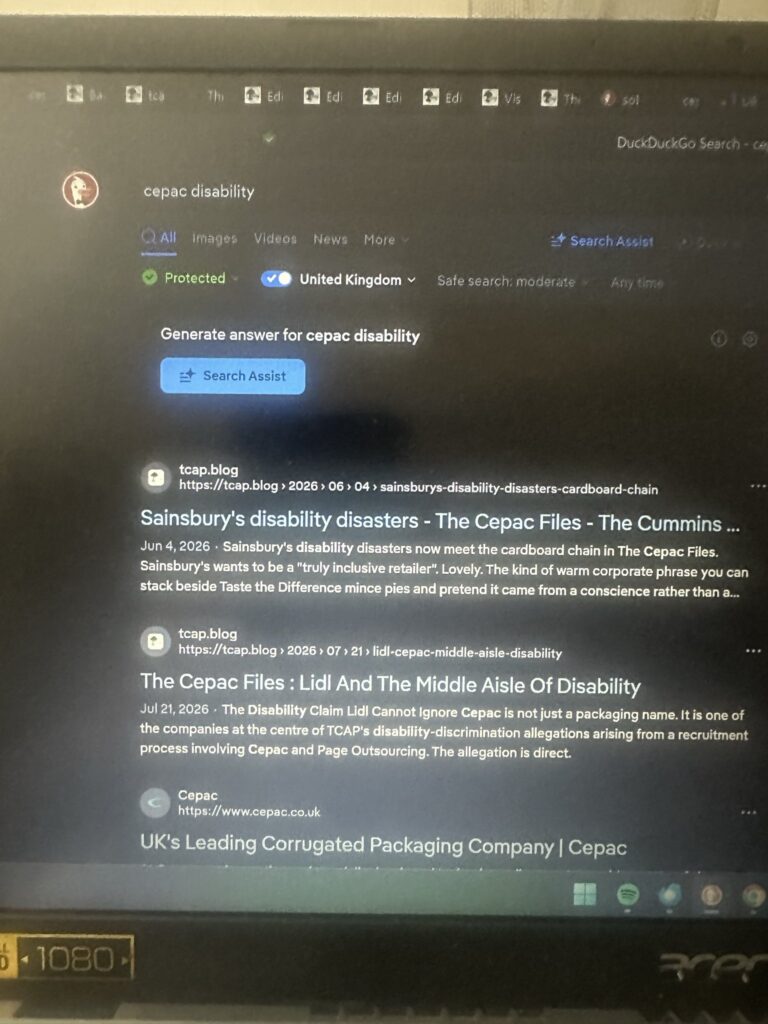
This one started with a joke. I searched DuckDuckGo for “Cepac disability”, screenshotted the result and ribbed Cepac on X because TCAP was outranking the company on a subject rather close to its employment history. Then curiosity got the better of me. Why was an accountability blog outranking Cepac for disability? The answer was remarkable for 2026. Cepac has an “Our Values” page, an 86% male workforce and ten men sitting on its board. What it does not have on its public website is a dedicated equality policy explaining its position across the nine protected characteristics. Suddenly the search result made perfect sense.
It Started With A DuckDuckGo Search
There was no grand investigative plan behind this one. I typed “Cepac disability” into DuckDuckGo and looked at the results.
TCAP was sitting there.
Naturally, I took a screenshot and had a laugh about it on X. DuckDuckGo draws heavily on Bing for conventional web results, so the screenshot gave me another little indicator that The Cepac Files was travelling beyond Google. More importantly, there was something inherently funny about an accountability project outranking Cepac when somebody searched for the company alongside disability.
At first, I treated it as another SEO win. TCAP has published extensively about the disability-discrimination dispute, the recruitment process and everything that followed. Therefore, appearing prominently for Cepac disability hardly seemed mysterious.
Then I wondered why Cepac itself was so easy to beat.
That was where the joke became an article.
So Where Is The Cepac Equality Policy?
I expected to find something obvious.
Perhaps Cepac had a dedicated equality policy. Maybe there was a diversity and inclusion statement buried under recruitment. There could have been guidance on disability equality, reasonable adjustments or equal opportunities.
Instead, the public cupboard was remarkably bare.
Cepac publishes information about sustainability. It discusses modern slavery. Gender pay receives reports. Recruitment has its own material. Packaging, raw materials, responsible sourcing and corporate values all receive space on the website.
However, I could not find a dedicated public Cepac equality policy setting out the company’s approach to protected characteristics.
That absence explains the search result rather better than any SEO wizardry.
TCAP was not simply outranking Cepac on disability.
Cepac had barely bothered entering the fucking race.
Our Values. Equality Not Included
The discovery became stranger when I reached Cepac’s page titled Our Values.
This should be the simple page. A company creates an “Our Values” section because it wants employees, customers, suppliers and potential recruits to understand what matters to the organisation.
Cepac discusses collaboration, professionalism, ethics, responsibility, innovation and entrepreneurship. Employees are important. Customers receive attention. Suppliers matter. Sustainable materials certainly get their share of corporate affection.
Yet equality across the protected characteristics does not receive comparable treatment.
That is not some microscopic omission in the privacy-policy boilerplate. The page is literally called Our Values.
A company can tell the public what it thinks about paper, collaboration and innovation. Somehow its values on equality require considerably more detective work.
Nine Protected Characteristics Walk Into A Packaging Company
The Equality Act 2010 identifies nine protected characteristics: age, disability, gender reassignment, marriage and civil partnership, pregnancy and maternity, race, religion or belief, sex and sexual orientation.
That gives us a useful checklist.
Where is Cepac’s public commitment to disability equality and reasonable adjustments? What does the company say about race equality, racial discrimination or equal opportunity? Where are its stated values on religion or belief, sexual orientation and LGBT equality, age discrimination, gender reassignment, pregnancy and maternity, or marriage and civil partnership?
Sex equality at least appears elsewhere through gender-pay reporting and initiatives aimed at women.
The broader principle is harder to find.
Nobody needs Cepac to paste the Equality Act onto its homepage like a fucking terms-and-conditions banner. A substantial employer should, however, be able to explain what equality means inside the business.
That seems especially reasonable when the company has already published a page specifically telling everyone what it values.
Then The Boardroom Door Opened
Website language is one thing. Corporate structure is another.
The current Cepac board consists of ten men.
Not nine men and one woman. Not a board gradually approaching balance.
Ten men.
That fact lands rather differently after TCAP’s recent investigation into the Cepac gender pay gap.
Cepac’s own 2025 figures show a workforce that is 86% male and 14% female. Women earn 10.7% less on the mean hourly measure, while the mean bonus gap stands at 33.4%. Female representation is also highest in the lowest-paid quartile.
Then you reach the top.
Ten directors.
Ten men.
No amount of corporate prose can make that configuration look like an administrative accident.
Women Get A Forum. Men Get The Boardroom
Cepac has created a Senior Women’s Forum. It has leadership programmes, mentoring and executive coaching. The company has also talked publicly about supporting women into management.
Those initiatives may help individual employees. Yet they create an extraordinary picture when placed beside the actual distribution of power.
Women get a forum. Women get mentoring. And women get development programmes. A male executive can even collect recognition for being an ally.
Meanwhile, men retain every seat on the board.
At some stage, corporate equality has to stop being something discussed beneath the people holding power and begin changing who actually holds it.
Otherwise, the hierarchy remains exactly where it was.
HR has simply put some fucking bunting around it.
Disability Was Merely The Doorway
Disability happened to expose the wider problem because that was the term I searched.
There is an obvious reason TCAP has substantial material around Cepac disability discrimination, disabled recruitment and mental-health disability. The underlying dispute began with a disabled applicant expecting a job interview. Disability-related information entered the recruitment chain. The interview disappeared. What followed became years of litigation, correspondence and conduct proceedings.
So “Cepac disability” was an entirely natural search.
What surprised me was discovering how little Cepac’s own public values material had to say about disability equality.
There was no prominent disability section waiting to outrank TCAP. There was no obvious dedicated equality framework explaining reasonable adjustments or disabled recruitment. Nor did the flagship values page provide a broader commitment covering the protected characteristics.
Disability did not turn out to be an isolated omission.
It was simply where I first found the hole.
Race, Religion, Sexual Orientation And The Rest Of The Empty Box
Once that gap is visible, the obvious questions multiply.
What does Cepac equality mean for somebody facing race discrimination? What commitment does Cepac make concerning religion or belief? Where does sexual orientation sit within its stated values? How does the company address LGBT inclusion or gender reassignment?
The same questions apply to age, pregnancy and maternity, marriage and civil partnership, and sex.
These are not fringe HR topics. They are the basic architecture of equality law in Britain.
Moreover, Cepac operates inside an international corporate network and employs hundreds of people. Different ages, backgrounds, religions, disabilities, sexual orientations and family circumstances are not hypothetical possibilities.
They are called a workforce.
Yet the public values statement manages to talk around equality rather than planting a flag in it.
Professional Equality, Professionally Undefined
Cepac has elsewhere used the language of professional equality.
Fine.
Then the obvious question is what that phrase actually means.
Does professional equality include disability? Does it include race and religion? Are gay, lesbian and bisexual employees covered by the principle? What about transgender employees, older workers, younger workers, pregnant employees and people returning from maternity leave?
Those should be easy questions for a company claiming equality as part of its professional identity.
Instead, somebody searching the public website has to assemble the answer from scattered initiatives and statutory reports.
That is the opposite of a values statement.
A value should be visible before somebody needs a fucking search party.
The Search Result Was Trying To Tell Me Something
I originally screenshotted DuckDuckGo because seeing TCAP outrank Cepac for “Cepac disability” amused me.
Now the screenshot is more interesting.
The real story was not that TCAP had become particularly effective at search optimisation. It was discovering why Cepac was so remarkably beatable on a subject as basic as equality.
Its public record shows an overwhelmingly male workforce. Its own figures show a substantial gender bonus gap. Every current individual board seat is held by a man. Meanwhile, the company’s flagship values page finds room for professionalism, collaboration, ethics and innovation without giving equality across the nine protected characteristics comparable prominence.
That produces a clearer corporate portrait than another dozen photographs of cardboard boxes ever could.
Nine protected characteristics. Ten men in the boardroom. One “Our Values” page. And an accountability blog apparently doing more work explaining Cepac and equality than Cepac itself. Around £50k spent warding off a discrimination claim. Seemingly £0k spent presenting as an inclusive company. In 2026, that should get a 10-man board sacked.
No wonder I fucking outranked them.
Lee Thompson – Founder, The Cummins Accountability Project