
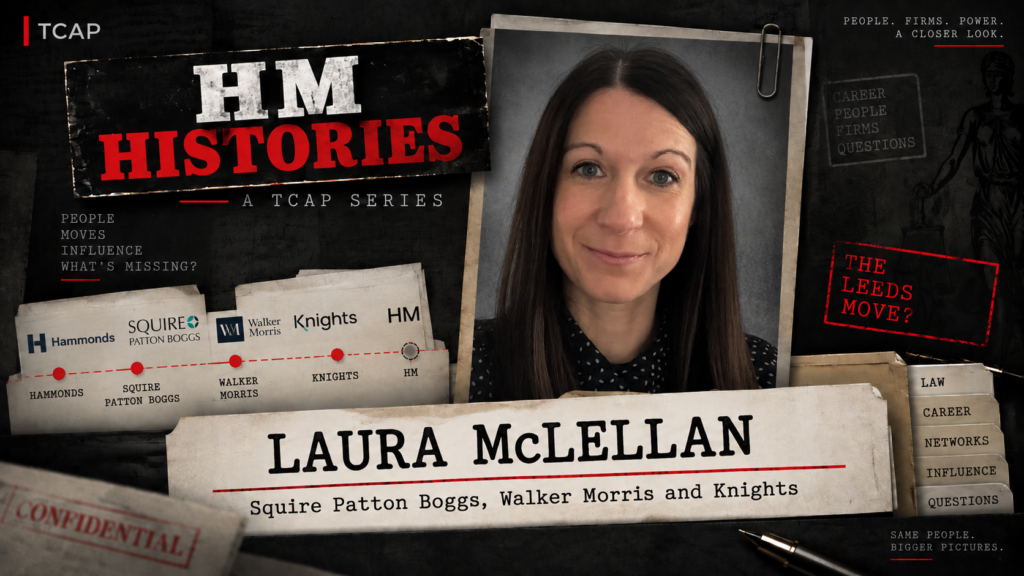
Welcome, everyone, to HM Histories, our new TCAP series following the career histories of the people behind Horsfield Menzies. We will be visiting the firms on their biographies, opening the public records and looking at what sits behind those reassuring corporate names. Think of it as the guided tour after the estate agent has gone home. The brochure has shown you the polished staircase. Now we can have a proper look at the bastard underneath it.
Our first stop is Laura McLellan and Walker Morris, the Leeds law firm whose employment expertise looks rather different beside its own age-discrimination judgment. A firm can sell advice about treating people lawfully while getting its own arrangements badly wrong. Here, that contradiction comes with a named claimant, a written policy and a unanimous tribunal decision. Plenty to work with before anyone starts shovelling out the usual corporate horseshit about professional excellence.
Laura McLellan: The Leeds Route
McLellan joined Horsfield Menzies in March 2026 as a partner and head of its Leeds office. Her joining interview describes fourteen years at Hammonds, later Squire Patton Boggs, followed by two years at Walker Morris and four at Knights. That is the route HM presents to prospective clients: substantial firms, substantial experience, a career with the right stamps in the passport.
Walker Morris announced her appointment as an employment director on 23 January 2020. Its welcome emphasised her tribunal experience, major clients and work on projects affecting thousands of employees. McLellan praised the department’s standing and its ambitions. David Smedley, then head of employment and chairman of partners, supplied the accompanying assurance about the team’s expertise. Everybody had their best professional trousers on.
By the time Walker Morris forced partner Martin Scott to retire in April 2023, McLellan had moved to Knights. The retirement policy, however, was already in place during her Walker Morris years. This chapter follows that former firm’s record, and the gulf between the advice a legal business sells and the rules it chooses to live by.
Walker Morris Age Discrimination: Best Before Sixty
Scott had spent decades at Walker Morris, including leading its construction and engineering department. At sixty, he had to obtain special permission to continue as a partner. His first extension took him to sixty-three. A further application failed, and his partnership ended on 30 April 2023. In February 2025, the tribunal unanimously found that the firm had discriminated against him because of age.
There is something especially bleak about turning a professional career into a supermarket date label. Years of experience remain perfectly serviceable, the clients still need advice, but the calendar says the contents require special authorisation. Sixty arrives and suddenly the question becomes whether you are sufficiently extraordinary to avoid being taken off the shelf. What a miserable bloody way to organise a workplace.
The revised policy retained sixty as the normal departure point. Extensions depended on an exceptional contribution and arrangements for passing on goodwill. Older partners therefore faced a higher performance hurdle to remain than their younger colleagues. The bullshit sits in that unequal demand: age creates the obstacle, then the individual must perform exceptionally to get around it.
An extension can look generous when described by the people controlling the door. From the other side, it is permission to keep doing something you were already doing. Add a demanding approval process and the supposed favour becomes a recurring audition for your own working life. Experience goes into the room as an asset and comes back out carrying a renewal form.
The Warning Was Already In The Building
Smedley’s name makes this history particularly instructive. The same employment specialist quoted in McLellan’s welcome had warned the partnership about its retirement position years earlier. The judgment records a 2013 warning that retaining sixty would expose the firm to claims it would struggle to defend. Legal expertise was available inside the business. It had already pointed towards the problem.
For fuck’s sake, that is the service these firms charge other people to provide. Identify the danger, explain the consequences, recommend a safer course. When the warning concerns your own comfortable arrangements, however, advice can become remarkably easy to accommodate without actually following. A fire alarm makes a lovely ceiling ornament once everyone agrees the noise is inconvenient.
The policy eventually went to a vote at a Lisbon partners’ conference in November 2018. Retirement received a fifteen-minute agenda slot; there was no debate there. Forty-three of the forty-five partners present voted for it, including Scott. Earlier discussion had taken place, but the final collective endorsement still arrived through a show of hands.
Scott’s vote belongs in the story. He helped approve the arrangement that later caught him. A policy does not acquire legal immunity because the eventual claimant once supported it, though. Nor does a room full of raised hands turn an unjustified distinction into sound practice. Consensus can make a rotten rule feel wonderfully respectable. The trapdoor works just as well beneath the people who voted to install it.
A Birthday Is A Shit Performance Review
Walker Morris relied on succession planning and preserving a harmonious partnership. The tribunal accepted legitimate aims. The firm still had to show that its treatment was a proportionate way of achieving them. That second question is where a pleasing boardroom explanation has to get off its arse and produce something stronger than confidence.
Evidence of the claimed problem was thin. The tribunal found no demonstrated need to release equity for younger partners, and no identified individual who had left because advancement was blocked. Assertions that older partners’ performance declined also lacked objective support. Meanwhile, the firm already assessed partner performance through its remuneration committee. It possessed a mechanism for examining the work rather than simply counting birthdays.
Calling that sort of assumption “commercial judgement” does not improve it. Bollocks with a business rationale attached is still bollocks. If someone is underperforming, examine their performance. If the concern is succession, show how the chosen rule actually helps. Otherwise, the birth certificate starts doing the job of an appraisal, which is convenient for management and a piss-poor substitute for evidence.
The judgment also records Scott reacting badly to criticism and behaving inappropriately towards staff. That matters: this was a real workplace dispute involving an imperfect claimant. Equality protections cannot depend on a person being agreeable enough to deserve them. A difficult colleague may require difficult management. His age does not supply a universal disposal instruction.
Plenty Of Tools, Straight For The Exit
Less discriminatory approaches were available. The tribunal considered options including career discussions, a higher retirement age, part-time working and stronger use of existing performance processes. The firm’s aims therefore did not leave it stranded with one unavoidable solution. It had choices about how to plan its future and deal with the people already working there.
That is what makes this such an instructive cock-up. Legal businesses sell judgement: the ability to distinguish between what sounds plausible and what survives scrutiny. Here, the distinction between a legitimate objective and a justified method was central. Wanting an orderly succession did not settle whether this particular partner had to go. A tidy explanation is easy to print; proving the necessity of the treatment takes considerably more work.
Nor is a senior partner’s status a reason to shrug. Workplace protection becomes a peculiar luxury if we only defend it when we like the claimant’s salary, manners or politics. The point is that the rule has to survive examination. Scott had the resources and resolve to challenge this one. The tribunal’s finding leaves the firm with a public record that its recruitment prose cannot talk away.
The CV And The Case File
HM’s current profile presents McLellan as a partner and experienced employment adviser with a substantial investigations and litigation practice. Her former firm’s announcement celebrated much the same professional strength. Those are the claims through which this career history is marketed. Walker Morris’s judgment supplies another part of the institutional picture, one that does considerably less work for the brochure.
That is why HM Histories will keep opening these files. Familiar names on a CV deserve more than an automatic nod of approval. Some have decisions, policies and public findings attached that are worth reading closely. The useful question is what those records reveal about how professional authority operates when the institution itself is being examined.
Walker Morris could advertise an employment team equipped for complex problems. Its own retirement arrangements then produced a successful discrimination claim. All that expertise in the building, and the calendar still got promoted to personnel director. The firm helped Scott out of the partnership; the tribunal helped its policy out of the packaging. Beneath the professional wrapping sat an unlawful expiry date.
Lee Thompson – Founder, The Cummins Accountability Project
Sources
- Horsfield Menzies – Welcome To Laura McLellan, March 2026: her career sequence and appointment as head of Leeds.
- Walker Morris – Employment Team Expands Expertise With Appointment Of Lateral Hire, 23 January 2020: McLellan’s appointment and David Smedley’s comments.
- Scott v Walker Morris LLP, case 1806503/2023 – full tribunal judgment, dated 17 February 2025 and sent to the parties on 19 February: especially paragraphs 24, 59, 180 and 211-221.
- Matrix Chambers – Law Firm’s Discriminatory Retirement Policy Violates The Equality Act 2010, 20 February 2025: Scott’s career, extensions and the unanimous liability finding.
- Addleshaw Goddard – Age Discrimination In Partnerships And LLPs, 7 March 2025: the retirement criteria, evidential weaknesses and existing performance arrangements.
- Keystone Law – The Practical Implications Of Age Discrimination Claims For LLPs And Partnerships, 6 May 2026: legitimate aims, proportionality and alternatives to age-based retirement.
- Horsfield Menzies – Laura McLellan’s current professional profile.