
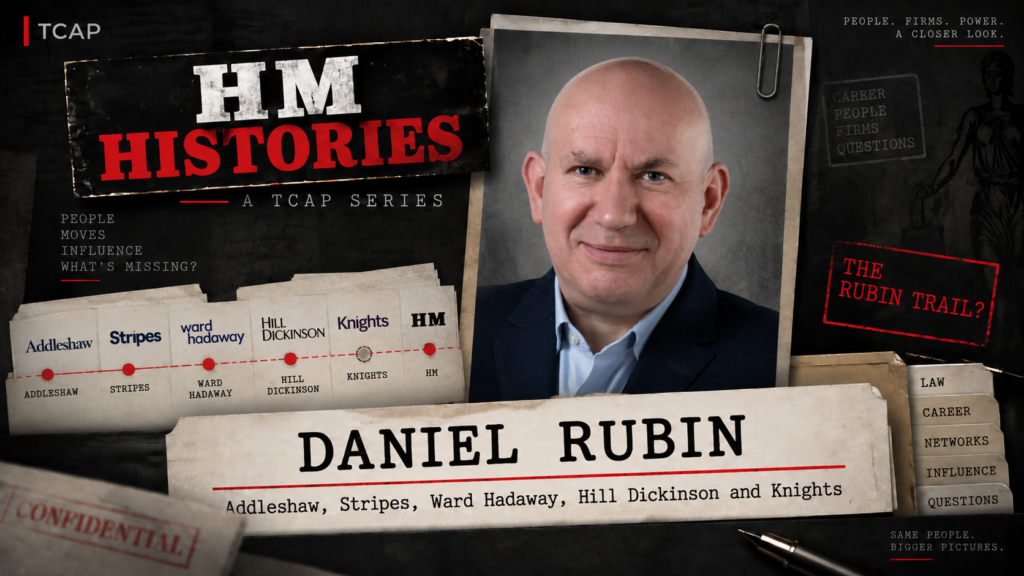
HM Histories is career mapping with the cupboards opened. Each instalment takes one Horsfield Menzies character, travels back to the earliest employer the public record allows us to identify, and gives that institution’s polished biography the treatment usually reserved for a disputed invoice: line by line, description against substance, no assumption that expensive stationery makes the wording true.
For Daniel Rubin, the first documented pin lands at Addleshaw Booth. When Rubin moved to Stripes Solicitors in September 2009, TheBusinessDesk reported that he had spent the previous decade at Addleshaw Goddard and risen to managing associate. The Law Society records his admission in September 2001, meaning his reported decade began before qualification. His precise entry-level title is not public, but the employer is.
Addleshaw Booth merged with Theodore Goddard in 2003 and the combined firm emerged as Addleshaw Goddard, a name apparently designed to sound as though two mahogany boardrooms had mated. Therefore, Rubin’s first career chapter runs through both versions: roughly 1999 to 2009, ending with Legal 500 recognition and a senior employment-law move.
Rubin is the route into this chapter; Addleshaw is the destination. Some of what follows happened during his decade there and some came after he left, because this series maps the history of each employer rather than pretending a workplace ceases to exist when one CV moves on. With that established, we can stop fondling the disclaimer and start opening the fucking cupboards.
A Disabled Applicant And A Vacancy Without A Blueprint
In September 1999, close to the beginning of Rubin’s reported decade, Addleshaw Booth notified V.M.S. Bruce about an employment-law vacancy. Bruce was a solicitor, admitted in 1997, and a wheelchair user who had been disabled since childhood. He had previously brought proceedings against the firm, after which Addleshaw agreed to tell him about suitable openings.
The vacancy sat in the zero-to-two-years-qualified range. Yet when Bruce requested a job or person specification, Addleshaw said it was not the firm’s practice to produce a detailed one. It wanted somebody with employment experience after qualification or a newly qualified solicitor wishing to specialise. Bruce was interviewed and rejected.
Addleshaw said he lacked experience in corporate employment support, TUPE and other relevant areas, answered technical questions incorrectly, and lost out to a candidate with stronger experience. Those are conventional recruitment reasons. The interesting part is the beautiful corporate flexibility of measuring an applicant against criteria whose detailed blueprint apparently lived inside the interviewers’ heads.
Bruce argued that disability had restricted his opportunity to acquire the experience now being used against him and that a substantial employer could offer training or adjust the role. The tribunal struck out that reasonable-adjustments argument, and the Court of Appeal refused permission to revive it. Legally, the required knowledge did not itself relate to his disability. Institutionally, the trick was cleaner: an unequal career history arrived at the interview table relabelled as a neutral skills gap. Bureaucratic bastardry seldom kicks down the door. Usually, it asks a competency question and deducts points.
The Applicant Becomes “Trouble”
Bruce later alleged something uglier. In a separate victimisation claim, he said Addleshaw contacted third parties seeking information about his other cases, attempted to instigate vexatious-litigant proceedings and spread the idea that he was “trouble”, harming his prospects with employers and causing distress. Addleshaw acknowledged taking steps towards a restraint order but contested his case.
The tribunal struck out the claim because the Disability Discrimination Act 1995 did not provide the freestanding cause of action Bruce needed outside the relevant employment relationship. He had never worked for Addleshaw, while the alleged conduct occurred after the recruitment process. Consequently, the factual allegations were not tried. “The claim failed” and “the conduct was disproved” remain two different propositions, however hard a reputation team might try to shag them into the same timesheet entry.
Then came the complication that ruins any cheap hero-versus-villain script. In 2006, the Attorney General obtained an indefinite restriction-of-proceedings order against Bruce after approximately 80 known applications over a decade. The Employment Appeal Tribunal found that he had habitually and persistently brought vexatious proceedings without reasonable grounds, often repeating rejected arguments. It even warned that his behaviour could make tribunals and employers more suspicious of claims brought by other disabled people.
That later finding gave real substance to concerns about Bruce’s litigation. It did not travel backwards and decide the earlier allegations that had never received a factual hearing. Both things fit in the same file: Bruce eventually became a vexatious litigant, and Addleshaw’s alleged treatment of him in the earlier episode was never tested. Reality can accommodate two awkward facts at once. Corporate communications departments generally prefer a smaller suitcase.
Taxi Fares Enter The Photocopier
Rubin left Addleshaw in September 2009. Two years later, the firm found discrepancies involving real-estate partner Mark Gilbert, investigated them and reported the matter to the Solicitors Regulation Authority. Gilbert had allowed taxi costs and secretarial overtime to be billed to clients as photocopying or scanning charges.
The Solicitors Disciplinary Tribunal fined him £20,000 and ordered him to pay £38,000 in costs. Dishonesty was not alleged, while lack of integrity was not proved. Gilbert instead admitted conduct likely to diminish public trust. The firm was not a party to the proceedings and received credit for detecting and reporting the problem.
Still, the language deserves to be placed under the office strip-light. Taxis did not accidentally evolve toner cartridges. Secretarial overtime did not fall into a scanner and emerge laminated. Costs that could legitimately be charged were passed through descriptions that were not legitimate, because apparently even a recoverable expense needs fancy dress when the billing department begins pouring drinks.
The regulator’s handling supplied another controversy. The tribunal criticised the SRA for creating an impression that City lawyers received more favourable treatment than solicitors from smaller firms, calling its position “most unsatisfactory”. Thus, the case managed to place both the billing culture and the regulator’s class system under the same flickering fluorescent tube. Efficient work, if nothing else.
Ninety-Four Bills Is Not A Typo
Gilbert was not the only Addleshaw partner whose invoices developed an adventurous relationship with nouns. Emmett Peters and David Wilson were each fined £5,000 in 2013 after disbursement discrepancies involving 94 and 74 bills respectively. No dishonesty, personal gain or client loss was found, and the costs themselves were properly incurred and chargeable. Once again, the poison sat in the description.
One incorrectly labelled bill might be a mistake. Ninety-four is a workflow. At that point the euphemism has its own desk, security pass and preferred sandwich order. The money was chargeable, the tribunal accepted, but clients were entitled to be told what the bloody charge represented rather than receiving an invoice written by a photocopier experiencing delusions of grandeur.
Addleshaw said an independent Deloitte review had found its systems fit for purpose. Meanwhile, the firm froze the partners’ positions at 2011 levels, a measure reportedly producing a six-figure loss for one of them. That response deserves recognition. It also produced the magnificently City spectacle of a system declared sound while several senior users were being financially punished for what they had managed to do with it.
By now, the Addleshaw corporate thesaurus was earning its shelf space. Taxi and overtime costs could become copying. Repeated misdescription could become discrepancy. A machine could be fit for purpose while its outputs required disciplinary hearings. Nothing dishonest, nothing lost, nothing to see here beyond dozens upon dozens of bills wearing the wrong fucking name badge.
£1.24 Million Of “Housekeeping”
The thesaurus achieved its masterpiece through Simon Tager, an Addleshaw real-estate partner from January 2017 until May 2019. The Solicitors Disciplinary Tribunal found that he had caused or allowed billed time worth up to £1,241,790.51 to be transferred between unconnected client matters or different matters within client groups. At least one client was overcharged.
Tager admitted lack of integrity, recklessness, failure to act in clients’ best interests and damage to public trust. He said the transfers were a misguided attempt at internal “housekeeping”. Housekeeping: the gentle domestic art of moving dust, towels and £1.24 million in recorded time until the room looks presentable and somebody else’s matter is holding the fucking hoover.
The judgment recorded important mitigation. Tager did not conceal the requests, intended no personal gain, did not mean to overcharge anyone, self-reported, cooperated fully and expressed genuine remorse. Medical evidence described anxiety, depression and a possible adjustment disorder amid substantial pressure. Addleshaw paid one client £472,079 plus VAT, although that was not established as the true overcharge; Tager calculated a maximum potential overcharge of approximately £130,129. After repayment, no client ultimately lost money.
The tribunal nevertheless assessed culpability as total and harm as high. It fined Tager £8,500 and ordered £25,000 in costs, while also condemning the SRA’s extraordinary six-year delay. The misconduct was serious, the prosecution was glacial and the euphemism was immaculate. “Housekeeping” did not merely sweep dirt beneath the carpet. It moved the carpet onto another client file and asked finance to rebalance the room.
The Conduct Seminar Was Coming From Inside The Building
In March 2019, Addleshaw published an article about #MeToo, workplace culture and the use of non-disclosure agreements to silence harassment allegations. It advised employers to promote openness, dignity and respect, create clear complaint pathways, review bullying and harassment policies and operate a zero-tolerance approach. Sensible guidance, every word of it.
Later that year, RollOnFriday reported that a senior Addleshaw partner had left following an internal investigation into allegations of bullying, harassment, and pregnancy and maternity discrimination. According to the report, a fellow partner and the HR director conducted the investigation; the subject had been on garden leave since June and resigned before any ruling on gross misconduct. Addleshaw declined to discuss the reason for the departure while confirming the period of garden leave.
These remained reported allegations, not a published disciplinary finding. However, the collision with the firm’s educational output was exquisite. In public, Addleshaw was teaching employers how to construct open reporting routes and warning that harassment allegations create reputational danger. Inside the building, it was reportedly investigating one of its own senior partners before declining to explain why he left. The guidance had barely cooled on the website before the practical exercise arrived wearing a partnership badge.
Expertise plainly did not operate as a vaccine. A law firm can know every clause, publish every checklist and still discover that culture is what happens after the seminar packs have been cleared away and HR hears a knock at the door.
Privilege Goes Behind Closed Doors
In February 2025, former Entain chief executive Kenny Alexander and former chair Lee Feldman issued High Court proceedings against Entain and Addleshaw Goddard. The dispute arose from legal advice connected to Entain’s Turkish business and the £615 million deferred prosecution agreement reached after an HMRC bribery investigation.
Alexander and Feldman alleged that privileged material may have been disclosed to investigators without their consent. They sought declarations that they had also been Addleshaw clients, access to the relevant advice and details of material shared with HMRC, the Crown Prosecution Service or others. Entain called the claim meritless and said it would defend it robustly. Addleshaw said client-confidentiality obligations prevented comment.
The claim remains unresolved. During 2026, the High Court ordered parts of case-management and disclosure hearings to take place in private, while formal defences were kept from public inspection. No finding has established that Addleshaw mishandled privilege. What exists is a live lawsuit in which former executives are asking who owned confidential legal advice, what was shared and who was entitled to authorise it.
For a law firm, that is not a minor disagreement over the office biscuits. Confidentiality and privilege are structural steel. Addleshaw now finds itself litigating partly behind closed doors about whether the people relying on its advice were entitled to see how that advice travelled. The corporate thesaurus may eventually need a locked supplement.
The Bonus Pool Eats First
Against that history, the modern numbers arrive in a chauffeur-driven convoy. Addleshaw reported £644 million in revenue for the year ending 30 April 2026, distributable profit of £262 million and profit per equity partner of £1.1 million. Its partner count reached 479, global headcount reached 3,216 and the annual staff bonus pot rose to £22 million.
The bonus pool had already swallowed a smaller meal. In 2025, the firm froze newly qualified London salaries at £100,000 and redirected £1 million intended for NQ pay rises into a bonus pot worth £19 million. Managing partner Andrew Johnston said the arrangement would meaningfully reward significant contributions. Apparently, the money had not disappeared; it had simply been promoted beyond the reach of anyone insufficiently material.
Then came the medals. On 30 September 2026, Addleshaw announced that it had been named UK Law Firm of the Year at the Legal Business Awards, its fourth major law-firm-of-the-year title in a little over two years. Awards panels adore growth, expansion and innovation. They rarely ask whether the photocopier once moonlighted as a taxi, whether £1.24 million of moved time qualifies as domestic maintenance, or whether the firm’s own controversies have read its workplace-culture briefings.
Success is real. So is the record. The interesting material lives where those two truths grind together: a hugely profitable, heavily decorated firm selling precision, judgement and risk management while periodically discovering that its own partners have treated descriptions, culture or client files as unusually flexible concepts.
First Stop, Fully Mapped
Daniel Rubin’s first documented employer is therefore not a vague line beneath a polished biography. It is Addleshaw Booth becoming Addleshaw Goddard: the firm where he spent roughly a decade, qualified, reached managing-associate level and earned Legal 500 recognition before leaving for Stripes Solicitors in 2009. That is the first pin on his career map. Stripes is the next one.
This instalment does not need to haul Rubin prematurely into Horsfield Menzies or pretend that every later Addleshaw scandal belongs in his personal conduct column. The series follows the employer as well as the employee. Once a CV opens the door, the institution gets the full tour, including the rooms it would prefer visitors to mistake for storage.
What fell out here was not one neat scandal but an entire vocabulary system. A disability-shaped disadvantage became insufficient experience. A complainant alleged he was converted into “trouble”. Taxi and overtime costs became photocopying and scanning. Ninety-four misdescribed bills became discrepancies. £1.24 million of transferred time became housekeeping. Frozen junior pay became performance reward, while an unresolved privilege fight moved partly behind closed doors.
That is Addleshaw Goddard’s contribution to the first Daniel Rubin chapter: a prestigious training ground, a commercial success story and a corporate dictionary thick enough to stop a tribunal bundle. At this firm, language has never merely described the problem. It has interviewed it, reallocated it, billed it and sent the bastard downstairs wearing a cleaner name.
Lee Thompson – Founder, The Cummins Accountability Project
Sources
- TheBusinessDesk: Appointments – Rubin in at Stripes
- The Law Society: Daniel Paul Rubin
- Law Society Gazette: Addleshaw Goddard born
- Court of Appeal: Bruce v Chamberlain and another
- Employment Appeal Tribunal: Bruce v Addleshaw Booth & Co
- Employment Appeal Tribunal: HM Attorney General v Bruce
- Law Society Gazette: SRA taken to task over perceived City bias
- Legal Business: Two Addleshaw partners fined following billing discrepancies
- RollOnFriday: Addleshaws partners fined for buggering up bills
- Solicitors Disciplinary Tribunal: Simon Jonathan Tager judgment
- Addleshaw Goddard: #MeToo and workplace culture
- RollOnFriday: Senior Addleshaw partner departure following internal investigation
- Financial Times: Ex-Entain bosses sue over advice linked to bribery probe
- NEXT.io: Addleshaw and Entain defences kept under seal
- Courts and Tribunals Judiciary: Alexander and Feldman v Addleshaw Goddard and Entain, March 2026 order
- Courts and Tribunals Judiciary: Alexander and Feldman v Addleshaw Goddard and Entain, June 2026 privacy order
- City AM: Addleshaw prioritises bonuses over junior pay rises
- Addleshaw Goddard: 2026 financial results
- Addleshaw Goddard: UK Law Firm of the Year 2026