
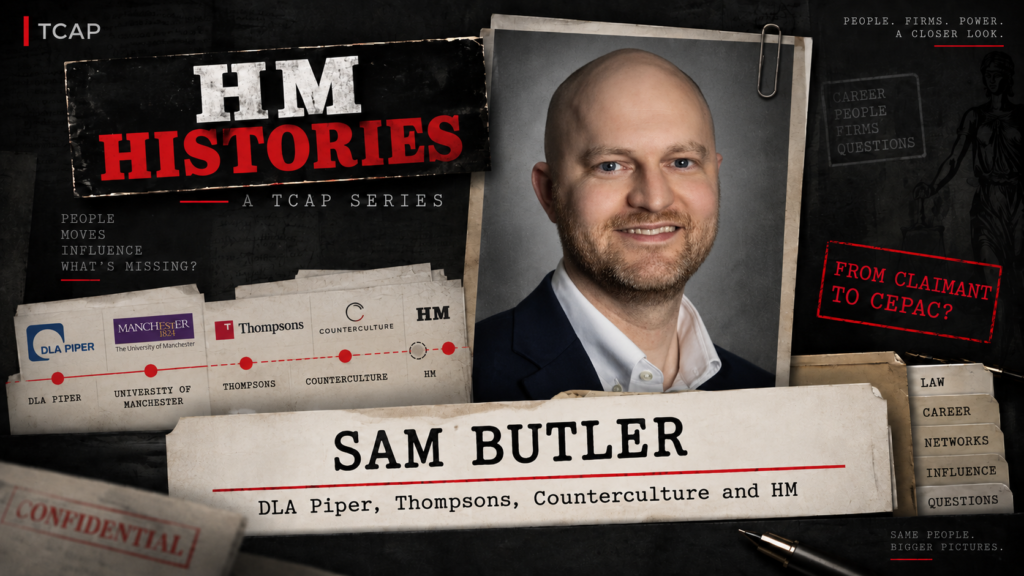
Sam Butler at DLA Piper is the first pin in this HM Histories map. Horsfield Menzies says he began his legal career at the international firm, while the Law Society records that he trained and qualified there. More precisely, his admission date was 3 September 2018. By February 2019, he was named among the DLA lawyers advising on Nichols plc’s £4.2 million acquisition of Adrian Mecklenburgh Limited. That makes DLA Piper his first documented legal employer, not a guess assembled from a biography written backwards.
The distinction matters because this series is not an invitation to blame Butler for every scandal attached to a former firm’s letterhead. After all, some of the events below predate him; others came after he left. Accordingly, he is the route into the institution, not the cunt hiding behind every filing cabinet. HM Histories follows the prestige on a CV back to the shop that manufactured it. In DLA’s case, the shop has produced a glorious legal-industrial shitshow: a withdrawn job offer after a depression disclosure, emails about churning a bill, a partner driven to the point where a false signature entered a banking deal, sexual-misconduct allegations pushed towards private arbitration, and £1.1 million in costs sought from climate protesters. That is not a career paragraph. It is a fucking discovery exercise.
Sam Butler At DLA Piper: The First Stop
The Law Society’s social-mobility profile supplies the clearest chronology. Specifically, Butler trained and qualified at DLA Piper, working for international companies, charities and public institutions. He then spent twelve months with the University of Manchester’s in-house legal team, where Covid created its own thicket of legal problems. After that came Thompsons Solicitors, representing employees and trade unions, followed by his first partnership role leading employment work at Counterculture Partnership. Horsfield Menzies is the current stop, where his profile describes him as a senior associate handling TUPE, collective redundancy and tribunal work.
Moreover, there is a worthwhile human fact in that story. Butler describes himself as the first person in his family to attend university and as somebody from a working-class background. Good. Social mobility should open doors that old professional networks spent generations guarding like hereditary wine cellars. Even so, none of that requires us to treat the first corporate name on his CV as holy ground. If anything, access to the profession makes scrutiny more important. The ladder should lead somewhere better than a billing factory with fucking inspirational posters in reception.
DLA Piper sells global scale, elite expertise and commercial certainty. The firm operates across more than forty countries. That enormous footprint can look magnificent in a profile because prestige is wonderfully portable: the lawyer leaves, while the brand continues doing unpaid promotional work. HM Histories sends the invoice back to its point of origin and asks what else came with the bloody training.
Disclose Depression, Meet The Recruitment Freeze
In June 2008, a lawyer identified as J received an offer from DLA Piper for a professional support role. However, the offer was conditional on completing a medical questionnaire. Before submitting it, she told a human-resources employee that she had experienced depression. According to the later Employment Appeal Tribunal judgment, the employee responded that the position was high pressure and asked whether J thought it was right for her. Then, several days later, the offer disappeared. Meanwhile, DLA said a recruitment freeze caused by the credit crunch was responsible.
J believed the timing told a different story and brought a disability-discrimination claim. At the first tribunal hearing, however, the only issue tried was whether she met the legal definition of disability. She represented herself, was found not to be disabled and saw the claim dismissed before the alleged reason for withdrawing the offer was determined. Crucially, the tribunal did not find that DLA had discriminated, and the public record located for this article does not disclose a later ruling on the merits.
Still, the sequence is grim enough to survive without bullshit embroidery. Tell HR about depression; hear that the role is demanding; watch the offer vanish; receive an explanation involving a conveniently timed economic freeze. Of course, the freeze may have been genuine. Nevertheless, that disputed question was precisely the door the preliminary ruling prevented J from reaching. As a result, the case became an argument about whether her mental health was sufficiently serious to let her ask why the job had gone.
The Appeal Tribunal Reopens The File
The Employment Appeal Tribunal overturned that preliminary decision in 2010. Specifically, it held that the original tribunal had dealt wrongly with the medical evidence and had made a perverse finding about the substantial adverse effect of J’s earlier depression. Consequently, the claim was sent back for reconsideration. J had also argued that DLA perceived her as disabled, although the appeal judgment explained the limits of that route under the law as it then stood.
This was not a finding of discrimination against DLA, and pretending otherwise would be cheap. Instead, the sharper point is procedural. Before the reason for the withdrawn offer could be tested, a mentally unwell, self-represented claimant had to prove that her suffering fitted the statutory doorway. The first tribunal shut it. However, the appeal court then found the lock had been fitted incorrectly. By that stage, the recruitment decision had already matured into litigation, with two levels of tribunal examining whether the claimant was entitled to have the central allegation heard properly.
Current DLA recruitment material presents a more polished world. It talks about equitable and accessible hiring, disability, neurodiversity, long-term health conditions, confidentiality and applicants sharing only what they feel comfortable disclosing. Those commitments postdate J’s experience and should not be treated as evidence of what policy existed in 2008. Nevertheless, the contrast is brutal. The modern careers page invites trust. The old judgment records what happened when one applicant disclosed depression before starting work. Corporate memory loves a redesign; the archived bundle does not give a shit about the colour palette.
Churn That Bill, Baby
If the J litigation shows what can happen when vulnerability enters the recruitment process, DLA’s 2013 fee dispute shows what happens when candour escapes into email. The firm sued energy executive Adam Victor for roughly $675,000 in allegedly unpaid legal fees. Victor counterclaimed, accused DLA of systematic overbilling and sought about $22.5 million in punitive damages. In response, DLA denied the accusation and maintained that the fees reflected work performed.
Then discovery opened the office biscuit tin and found a live grenade. Specifically, internal emails included the lines “churn that bill, baby!”, “That bill shall know no limits,” and a celebration that the team was already $200,000 over estimate. In response, DLA described the messages as an inexcusable attempt at humour and said they did not reflect actual billing practices. Ultimately, the case settled on confidential terms, so there was no public finding that the firm had overbilled Victor.
Quite right: allegations are not judgments, and jokes are not time sheets. Unfortunately for DLA, jokes can reveal what a workplace finds funny. “Churn that bill, baby” is not gallows humour from exhausted public defenders. It is the sound of a meter discovering cocaine. Even if every billed minute was immaculate, the emails turned the client’s nightmare into an office catchphrase. A firm selling judgment had allowed its own written record to sound like a fucking casino croupier whispering encouragement to the invoice.
When The Timesheet Eats The Retainer
Big Law normally hides its appetite behind neutral verbs. For example, teams “resource” a matter. Lawyers “capture” time. Meanwhile, work is “leveraged” across offices. By the time the client receives the bill, a perfectly ordinary hour has travelled through enough management vocabulary to acquire airport-lounge access. However, the Victor emails tore off that corporate bib and let the greedy bastard speak in its outdoor voice.
The episode matters beyond one disputed account because DLA’s product is trust sold in measured units. After all, clients cannot stand behind every associate and verify each tenth of an hour. Therefore, they rely on the firm’s systems, supervision and restraint. A joke about limitless bills consequently lands differently inside a legal practice. It is like finding a butcher’s staff chat titled “thumb on the scales.” Of course, perhaps the meat still weighs exactly what the label says. You would nevertheless be a credulous bastard not to ask for the calibration certificate.
Ultimately, confidential settlement closed the litigation but did not put the language back inside the building. Consequently, those emails became part of DLA’s public history because the firm chose court to pursue its fees, and litigation brings discovery. That is the exquisite little turn of the screw: a demand for payment produced the documents that made the billing culture famous. In short, the invoice went out wearing a suit; the internal correspondence followed it into daylight with its corporate arse hanging out.
Seventy Hours And One False Signature
The next file contains no unresolved allegation. In 2023, the Solicitors Disciplinary Tribunal considered the conduct of former DLA Piper partner Robert Arnison. While based in the firm’s Manchester office in February 2020, Arnison inserted a witness signature onto a legal charge without that person’s knowledge or consent. He then sent the document to the bank’s solicitors as though it had been signed properly. The transaction concerned a £13.5 million Chelsea property and a £6 million mortgage.
Arnison admitted dishonesty and described the act as a moment of madness. His mitigation painted the surrounding machinery in darker colours. He had been working fourteen- to sixteen-hour days, around seventy hours a week, including Sundays and holidays. Medical evidence addressed anxiety, panic and impaired judgment; his case was that he was overloaded and approaching burnout. He gained no personal benefit, caused no identified financial loss and reported what he had done. DLA removed his equity status, retained him temporarily as a consultant on reduced pay and joined him in notifying the regulator.
The tribunal rejected a proposed six-month suspension as inadequate and imposed twelve months, plus £17,250 in costs. Individual responsibility belongs to Arnison, who admitted the misconduct. Yet the working conditions are not decorative scenery. When a partner is running at seventy hours a week until a false squiggle starts masquerading as legal execution, the firm’s wellbeing language should be served with the time records stapled to it. Burnout is not incense. It does not drift in from nowhere and make everybody sad near a bloody beanbag.
The Machine Was Working As Designed
DLA’s handling after discovery matters. The firm reduced Arnison’s position, reported the conduct and cooperated with the regulatory process. Those were necessary steps, and the public record does not justify claiming a cover-up. However, compliance after the signature appeared cannot answer what created the conditions described in mitigation. In other words, a system may respond correctly to the red warning light after spending months paying people to ignore the smoke.
Professional firms adore the myth of the exceptional fuck-up. First, one person buckles, one rule breaks and one disciplinary file opens. Then, the institution gathers around the incident in high-visibility concern, as if it has discovered weather. However, fourteen-hour days and Sunday work are not secret character defects. They are visible organisational facts. Somebody allocates the matters, receives the emails, reviews the numbers and enjoys the output. The same machine that counts every six minutes apparently becomes innumerate when the total describes a human life being fed through the corporate shredder.
Butler was not implicated in Arnison’s conduct, and the incident occurred after Butler’s documented period at DLA. Nevertheless, it belongs here because HM Histories examines the institution whose name supplies the career credential. Training is more than technical doctrine; it is exposure to a professional culture, its incentives and its idea of normal. For its part, DLA can point to its response once the false signature emerged. TCAP can point to the seventy-hour week beneath it and ask why catastrophe had to become a document before overwork became evidence.
Arbitration Behind The Frosted Glass
In 2019, DLA junior partner Vanina Guerrero accused senior partner Louis Lehot of sexual assault, battery and harassment. Meanwhile, Lehot denied the allegations. Guerrero sought release from a contractual arbitration requirement so that she could pursue her claims in public court. Law students protested the use of forced arbitration, while DLA said an internal investigation had not substantiated the allegations at that stage. The firm subsequently parted ways with Lehot.
Subsequently, DLA placed Guerrero on paid administrative leave while investigating what it called serious issues unrelated to her complaint. In a public response, the firm accused her of having orchestrated an “emotional flirtation” to advance her career. In turn, her lawyers said the action was retaliation. However, no public judgment deciding the assault allegations has been located for this article, so they remain allegations, fiercely disputed and not findings of fact.
Nevertheless, the institutional conduct is ugly enough without converting accusation into verdict. A junior partner alleged sexual violence by a senior colleague and wanted a public forum. However, the contract pointed towards private arbitration. Then the firm publicly framed part of the relationship as careerist manoeuvring while insisting the leave concerned other matters. This is corporate transparency by Venetian blind: enough movement to show somebody is inside, never enough to see the whole bloody room. Although confidential procedure may protect privacy, it also protects institutions from the sustained public examination that ordinary litigation can bring. When reputation is the product, secrecy is not neutral furniture; it is a locked fucking conference room.
£2,500 To Describe The Bill
From 2021, DLA acted for public bodies including National Highways and HS2 in obtaining injunctions against more than 200 climate protesters, principally people associated with Just Stop Oil and Insulate Britain. Subsequently, an investigation published in 2024 reported that the firm sought around £1.1 million in costs. For example, its claimed rates included £350 an hour for advice and £75,000 for one hearing. Preparing a document that listed its own fees was itself priced at £2,500.
Pause there and admire the perfect bastard circuit. The bill generated a smaller bill explaining the larger bill. Somewhere, a time-entry system achieved consciousness, ate its own tail and charged the client for digestion. More specifically, DLA sought £727,573.84 in one claim against roughly 140 activists. However, a judge reduced that figure to £580,000, and a later agreement reportedly left individuals paying about £3,000 each. Meanwhile, some people pursued for costs had obeyed the injunctions and had not been found to have breached them.
For its part, DLA said it supports lawful protest and a sustainable future, while arguing that illegal direct action can create serious safety risks. Likewise, the public bodies involved relied on safety and the cost to taxpayers. Those arguments deserve recording. Nevertheless, so does the financial architecture: a global law firm monetising the suppression of disruptive protest at commercial rates, then charging thousands to enumerate the charges. Consequently, the climate crisis becomes an injunction; the injunction becomes a costs schedule; the costs schedule becomes its own billable event. Planet on fire, fucking meter running.
Four Point Six Billion Reasons
DLA Piper’s financial scale removes any temptation to describe these episodes as the growing pains of a fragile practice. In July 2026, the firm announced global revenue of $4.6 billion for 2025, up 8.4 per cent, and profit per equity partner of $4.14 million, up 19.6 per cent. It also reported recruiting 72 partners and promoting another 65. In other words, this is not a corner shop that forgot to update the staff handbook. It is a multinational professional machine with enough money to make “resources” sound like a bloody threat.
Scale is the defence and the problem. Certainly, a vast firm will handle countless matters properly, employ thousands of people who never enter a disciplinary judgment and inevitably generate more disputes than a three-person office. Therefore, raw incident counts prove little on their own. Yet DLA sells size as institutional capability: more knowledge, deeper systems, wider reach and greater control. However, it cannot flash the global network during the pitch, then transform into an unrelated collection of unfortunate individuals when the public record becomes inconvenient.
Crucially, the controversies differ in law and outcome. J won an appeal on a preliminary disability issue, not a discrimination verdict. Likewise, Victor’s billing allegations settled without a public finding. Meanwhile, Guerrero’s allegations were denied and not adjudicated publicly. By contrast, Arnison admitted dishonesty and was suspended. The protest costs sit in court records and reporting. Keeping those distinctions is not softness; it is what makes the pattern worth trusting. We do not need to inflate the record. DLA has already billed us for the full bloody version.
First Stop, Fully Mapped
Sam Butler’s documented legal career begins at DLA Piper. From there, his route moved through the University of Manchester, Thompsons, Counterculture and Horsfield Menzies. Consequently, that chronology is now nailed down. The first employer gave him experience on large deals and high-profile litigation, and a 2019 transaction record shows him working inside the sort of corporate machinery the firm’s global reputation promises.
However, the machinery has another history. An applicant disclosed depression and watched an offer vanish into a disputed recruitment freeze. Billing litigation excavated emails cheering an apparently limitless account. A partner described seventy-hour weeks before admitting a dishonest false signature. A junior partner’s sexual-misconduct allegations met mandatory arbitration and a public counter-narrative. Climate protesters faced a seven-figure costs demand, including £2,500 for the privilege of being told what the lawyers had charged. Nevertheless, different files and different outcomes reveal the same vast institution converting conflict into process and process into fees.
That is the first lesson in Butler’s HM history. After all, a prestigious former employer is not merely a badge of expertise. Instead, it is a claim about the environment that trained the lawyer, and claims invite examination. DLA Piper can keep the forty-country map, the billions in revenue and the prose about values. Meanwhile, we will keep the judgments, disciplinary findings, pleadings, emails and costs schedules beside it. If the firm wants its name to confer authority on every departing CV, the whole fucking name comes with it.
Lee Thompson – Founder, The Cummins Accountability Project
Sources
- Horsfield Menzies – Welcome Sam Butler: Butler says he began his legal career at DLA Piper and describes his subsequent career route.
- Horsfield Menzies – Sam Butler: current profile and areas of practice.
- The Law Society – Sam Butler, social mobility ambassador: trained and qualified at DLA Piper.
- The Law Society – Samuel Butler: admission date, 3 September 2018, and SRA number 631113.
- MarketScreener – Nichols plc acquired Adrian Mecklenburgh Limited, 4 February 2019: Butler named among DLA Piper’s legal advisers.
- BAILII – J v DLA Piper UK LLP [2010] UKEAT 0263_09_1506, 15 June 2010: withdrawn offer, depression disclosure, preliminary tribunal ruling and successful appeal.
- Law Society Gazette – DLA Piper Denies Lawyer’s Discrimination Claim, 19 February 2010.
- The Guardian – Mental Health And Discrimination At Work, 25 June 2010: discussion of J’s appeal.
- DLA Piper Careers – Discovery Days: current UK recruitment language on disability, neurodiversity, long-term health conditions and adjustments.
- DLA Piper Careers – Culture: current careers and inclusion commitments.
- New York County Supreme Court filing – Affidavit in DLA Piper LLP (US) v Victor: filed material containing the internal billing emails.
- ABA Journal – Sued By DLA Piper For $675K, Ex-Client Discovers “Churn That Bill, Baby” Email, 25 March 2013.
- ABA Journal – DLA Piper: “Churn That Bill” Email Was Inexcusable Effort At Humor, 26 March 2013.
- ABA Journal – DLA Piper Settles Fee Dispute Case, 18 April 2013.
- Solicitors Disciplinary Tribunal – SRA v Robert Arnison, judgment dated 10 October 2023: false witness signature, admitted dishonesty, working hours, mitigation and sanction.
- Law Society Gazette – Ex-DLA Piper Partner Working 70-Hour Week Suspended For False Signature, 12 October 2023.
- Financial Times – DLA Piper Partner Alleges Sexual Assault From Senior Colleague, 3 October 2019: Guerrero’s allegations, Lehot’s denial and the arbitration dispute.
- TIME – DLA Piper Lawyer Who Accused A Partner Of Sexual Assault Put On Leave, 16 October 2019: the firm’s stated reasons and the parties’ responses.
- ABA Journal – DLA Piper Accuser Orchestrated “Emotional Flirtation” To Advance Her Career, Law Firm Alleges, 11 October 2019.
- The Bureau of Investigative Journalism – City Law Firm Sought “Eye-Watering” £1.1m Costs From Climate Protesters, 16 August 2024.
- The Guardian – Climate Activists Faced With Huge Court Costs After Protest Bans, 16 August 2024.
- DLA Piper – Strong Year-Over-Year Global Financial Results, July 2026: 2025 global revenue, profit per equity partner and partner recruitment.