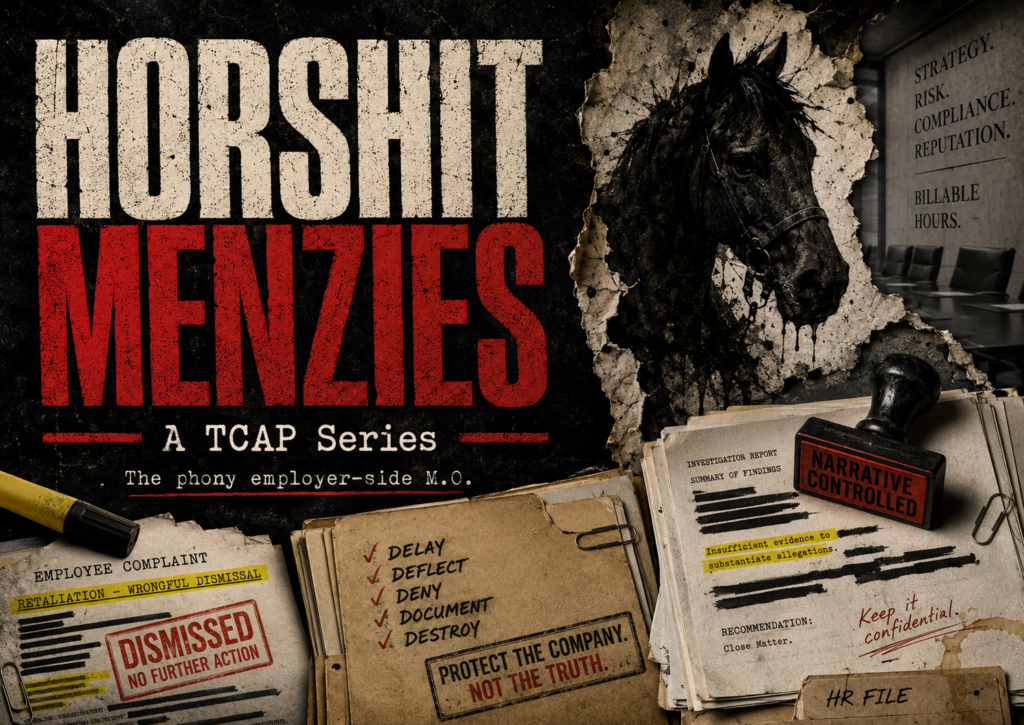
Horsfield Menzies dress their website up as helpful employer guidance. Read beside the Page/Cepac file, the Formal Complaint Against Horsfield Menzies Solicitors, Sam Butler, and Daniel Rubin, the pre-preliminary ambushes, and the Wendy Miller KC escalation, it reads less like information and more like a phony fucking M.O.: know the disability pressure points, know the recruitment traps, know the medical-evidence buttons, then sell employers the map while pretending it is a wellness leaflet.
The Hidden Sector
Naive me.
I thought employer-side employment law websites were just dull SEO traps. A few articles about grievances. A few pieces about disability. A cheery little note about neurodiversity. A DSAR explainer. A mental-health awareness post polished up for HR managers who want to feel like they are not part of the machine.
Then I started reading Horsfield Menzies’ website properly, and there it was: a hidden sector. Not hidden because nobody can find it. Hidden because most ordinary people have no reason to look. You only discover it when you become the problem. When you are the claimant. When you are disabled, unrepresented, angry, overwhelmed, documented, inconvenient, and suddenly staring at a professional industry that knows exactly where to press.
That is the fucking outrage. It is not just that Horsfield Menzies have articles. It is that the articles read, beside the Page/Cepac file, like a polite little advert for employer-side pressure management. Mental health. Hidden disability. Recruitment-stage exclusion. Misconduct. DSARs. Public hearings. Medical evidence. Costs. Conduct. Procedure. All the buttons. All the soft language. All the ways a human being gets turned into a risk file.
The Compassion Brochure
Horsfield Menzies’ website is full of the usual employer-side smoothie. Mental health matters. Hidden disability matters. Recruitment processes can exclude. Disclosure can become a red flag. Misconduct and disability need careful handling. DSARs are serious legal rights. Employers should not blunder around like drunk rhinos with HR software.
Lovely. Very polished. Very “we understand people”.
Then the Page/Cepac file walks in carrying a bucket and ruins the carpet. Because this is not some abstract HR seminar about hypothetical neurodivergent candidates and fictional managers learning empathy from a laminated guide. This is a live disability-linked recruitment dispute where health information entered the recruitment chain, the candidate disappeared from the process, and the law firm involved in the respondent’s defence had already written half the warning labels on its own website.
That is why the website matters. Not because it proves Horsfield Menzies are naive. Because it suggests they know exactly where the buttons are.
Cepac Did Not Hire A Mental Health Charity
Let’s not insult anyone’s intelligence.
There is not a chance Cepac looked at Horsfield Menzies’ website, saw a glowing mental-health advocate, and thought: yes, these are the gentle souls we need to help us navigate disability with tender hands and scented candles.
No. Employers do not hire employment solicitors because they want a group hug. They hire them because they want risk controlled, claims contained, paper trails managed, costs applied, procedure weaponised where useful, and the claimant made smaller. That is the business.
So when Horsfield Menzies publish articles about mental health, neurodiversity, DSARs, misconduct, disability, public hearings, evidence and process, the question is not whether the prose sounds nice. The question is what the prose is really advertising. Because read beside the Page/Cepac dispute, it starts to look less like an information source and more like a nasty little advert for their actual skillset: spot the pressure point, package it as guidance, use it when the file arrives.
Sneaky bastards with a blog section.
The Recruitment Trap They Wrote About
Their own material talks about candidates fearing that disclosure will be seen as a red flag. It talks about recruitment processes weeding people out. It talks about hidden disability at the exact stage where employers like to pretend everything is clean, objective and spreadsheet-shaped.
Recruitment. The gate. The first sift. The phone call. The CV. The health gap. The awkward disclosure that suddenly makes the room colder.
That is precisely where the Page/Cepac case lives. The respondent’s own Grounds of Resistance says Page Outsourcing was used for shortlisting and initial telephone screening. It says Page called Thompson around 21 August 2024. It says he disclosed that he had been out of work due to health problems and was ready to return. It then records agency wording passed to Cepac: “Lee has been out of work for 12 months due to health problems but is now in a position to get back into work”.
That is not invisible. That is not background fluff. That is health-related candidate information travelling through the recruitment chain. So Horsfield Menzies’ website asks whether recruitment processes are truly inclusive for hidden disabilities.
TCAP asks it back, louder, with the file open.
The Health Gap Was Not Fog
There are only so many ways to dodge this before the dodge becomes the story.
Page either carried health-related information to Cepac, or it did not. If Page carried it fairly, Cepac was on notice. If Page carried it unfairly, Page has a problem. If Page carried it fairly and Cepac then treated it as recruitment risk, Cepac has a problem.
If everyone now wants to point at Lee Thompson’s tone, blog, emails, X posts, AI use, complaint style, frustration, sleep-deprived wording, and refusal to be a nice quiet little litigant in person, that is not an answer. That is a diversion wearing court shoes.
The health information was there. The recruitment-stage issue was there. The firm’s own website says this is where hidden disability can be filtered out. Then the respondent-side machinery starts behaving like the real problem is not the health gap entering the process, but the disabled claimant refusing to shut up about it.
That is not a mystery. That is the M.O. beginning to show through the wallpaper.
The Formal Complaint Named The Conduct
Do not reduce this to “an SRA complaint”. That is too vague. Too soft. Too easy for them to waft away with the usual professional-regulator fog machine.
Call it what it was: the Formal Complaint Against Horsfield Menzies Solicitors, Sam Butler, and Daniel Rubin, dated 25 March 2025.
That complaint did not say, “The other side disagreed with me and I am sad”. It named conduct. It accused Horsfield Menzies and Sam Butler of misrepresenting litigation history. It accused them of disproportionate costs threats. It accused them of gaslighting. It accused them of misleading statements in the ET3. It accused them of misusing medical records. It accused them of contacting the GP / medical centre. It accused them of weaponising public-hearing pressure against severe anxiety. It accused them of hostile labels like “bizarre” and “vexatious”. It accused them of failing to engage properly on critical procedural matters. It named Daniel Rubin on oversight and involvement.
That complaint existed before the later ambushes. Before the April bundle shitshow. Before the Wendy Miller KC escalation became another respondent-side firework. Before the full conduct-theatre version of the case started performing for the cheap seats.
The complaint was not the story ending. It was the timestamp. The behaviour was already visible.
Costs Pressure From The Awareness Merchants
Now place their lovely mental-health guidance beside Butler’s 21 March 2025 letter.
The letter rejected settlement and told Thompson Cepac would not pay him anything. It said costs would increase to around £25,000 to £30,000. It said he was being put on notice of a costs application. It described his conduct as “quite frankly bizarre and utterly vexatious”. It offered not to pursue those costs if he withdrew by 28 March 2025 and entered a settlement agreement.
That is the same universe as their mental-health awareness material. Same firm. Same brand. Same website humming about anxiety and depression while a disabled litigant in person receives a letter tying hostile labels, costs pressure, withdrawal terms and tribunal threats into one neat little package.
Mental-health sensitivity in public. Pressure language in private. Awareness week on the website. Boot on the claimant’s throat in correspondence.
Do not call that accidental hypocrisy. It is too tidy for that.
Medical Evidence Becomes A Button
The medical evidence did not drift in from nowhere.
Dr Melanie Pritchard’s letter said Thompson had a history of depression and anxiety, difficulty controlling emotions, difficulty managing frustration especially under stress, and significant problems in daily life. The records included mental-health entries, medication, fit notes, depression/anxiety material, and the wider context of a man trying to navigate litigation while unwell.
Horsfield Menzies’ website knows what that means. Their mental-health article says this is not a soft issue. Their disability articles know constructive knowledge can matter. Their misconduct-disability pieces know behaviour has to be analysed for disability links, medical evidence, stressors, medication and process adjustments.
They know the map. Then the conduct complained of shows the map being used: dispute disability, push public hearing, frame conduct, use medical material, contact the medical centre, point to previous litigation, threaten costs, say the claimant is bizarre, say the claimant is vexatious, make the reaction the case.
That is the trick. The alleged discrimination starts the fire. The process adds petrol. The disabled claimant reacts. The reaction becomes the headline. The original recruitment question is left in the corner, still breathing, while everyone pretends the real issue is whether Lee Thompson typed too loudly.
Public Hearing Pressure Against Severe Anxiety
The formal complaint also nailed the public-hearing pressure. This was not decorative.
For someone with severe anxiety, a public conduct hearing is not just “open justice”. It is exposure. It is pressure. It is the threat that sensitive medical and personal material will be dragged into a public room while the respondent points and says “look how unreasonable he is”.
Horsfield Menzies know process can disadvantage disabled people. Their own material says enough. Yet the respondent-side posture pushed public-hearing pressure while disability was still being contested and medical context was still being fought.
That is a beautiful little squeeze, if you are into ugly things. The claimant says public exposure worsens anxiety. The respondent says the hearing should be public. The claimant becomes more distressed. The distress becomes conduct. The conduct becomes strike-out fuel. Then the firm can point at the smoke and say, “See? Fire risk”.
That is not advocacy. That is a pressure loop.
DSAR Gospel For Employers, Nuisance For Claimants
Horsfield Menzies also write about DSARs.
When they are advising employers, DSARs are serious legal rights. Searches should go wide. Personal data is broader than people think. Transparency matters. Internal silos are not a magic cupboard where inconvenient records go to die.
Then elsewhere, the language gets greasier: dreaded requests, disgruntled former employees, pain points, fishing expeditions.
There it is again. The split face. Rights are serious when Horsfield Menzies are explaining them to employers. Rights-holders become awkward little nuisances when they start asking for the paper trail.
That matters in the Page/Cepac file because the agency records, recruitment notes, health-related wording, wrong-CV issues and data trail are not side salad. They are the meal. A DSAR is not a tantrum. It is how the claimant sees the machinery.
Horsfield Menzies know that too. Their website says so. Which makes the conduct look even worse.
The Litigation-History Smear
Then comes the litigation-history framing.
The respondent-side correspondence put Thompson’s history into the file as if there were a neat pattern. Serial. Repeated. Similar. The claimant corrected it. The response softened into “appears”, “may”, “unclear”, and an explanation about dates of withdrawal.
Classic little manoeuvre. The smear enters first. The correction limps in later, already covered in mud.
“Serial litigator” is not neutral language. It is a character weapon. It tells the Tribunal: this man is the pattern. It tells the respondent: he has done this before. It tells the system: do not look too closely at the current contradiction because the claimant himself is the problem.
And what is the current contradiction? Health-related candidate information sits inside the recruitment chain, yet everyone would quite like the case to become about Lee Thompson’s conduct instead.
Very convenient. Very professional. Very Horsfield Menzies website, once you read it twice.
The Ambushes Were The Method
And then came the ambushes.
Voluminous material before preliminary hearings. Out-of-scope material pushed into the process. Order breaches dressed as urgency. Late expansions. Bundle pressure. Conduct material dragged into places where the real recruitment issue should have been the spine.
This was not harmless admin clutter. This was pressure.
And Horsfield Menzies knew exactly what kind of claimant they were putting it on. Their own website shows they understand mental health, stress, disability-linked conduct, procedural strain and the need for careful handling. Their own correspondence shows they knew the medical context was live. The Formal Complaint Against Horsfield Menzies Solicitors, Sam Butler, and Daniel Rubin had already named the conduct pattern.
Then the pattern escalated. More paper. More pressure. More scope-creep. More “conduct”. More attempts to make the disabled claimant’s reaction the main exhibit.
And what did the Tribunal do? Too little. Too late. Too convenient.
The court machinery did not neutralise the pressure. It allowed it to operate. It let the respondent-side pile-on keep moving while the claimant was expected to absorb the load, decode the ambushes, answer the smear, manage the medical fallout, and somehow remain a perfectly calm little litigant in person while being squeezed through a process that already knew where he was vulnerable.
That is the part that stinks. Because once the respondent knows the Tribunal is not going to properly police the pressure, the pressure becomes strategy. Dump the material. Stretch the scope. Breach the spirit of the order. Watch the claimant react. Point at the reaction. Ask for strike-out.
A tidy little loop. A disabled claimant is overloaded, then criticised for looking overloaded. A litigant in person is ambushed, then criticised for responding like someone ambushed. A recruitment-discrimination claim is buried under conduct theatre, then everyone acts as if the pile of paper is the case.
Fuck that. That was not process management. That was the M.O. in motion.
The Wendy Miller Message
Then came Wendy Miller KC.
Not some random name from the employment-law cupboard. Not neutral counsel quietly instructed because the case needed a specialist. Wendy Miller had already contested a different case against Lee Thompson within the previous year.
So when she appeared in the Page/Cepac matter, it did not land as ordinary representation. It landed as a message.
A barrister already associated with opposing the same disabled litigant in person was brought into a second dispute, in a second arena, at a point where pressure, conduct, public criticism and disability-linked litigation stress were already live. If that was not deliberate, it was an astonishing piece of convenient blindness from people who claim to understand litigation pressure, mental health and vulnerable participation.
But TCAP is not required to pretend not to see it.
To a disabled litigant in person already raising concerns about pressure, conduct, public hearing stress and professional behaviour, instructing counsel from a recent separate battle was never going to look calm, neutral or accidental. It looked like escalation. It looked like provocation. It looked like another hand finding the bruise and pressing down.
And once again, the system appears to have treated the claimant’s reaction as the problem, rather than asking why that particular pressure point was pressed at all.
That is the beauty of this little sector, if beauty can be found in a drain. The respondent-side machinery can personalise the pressure, then accuse the claimant of taking it personally. It can bring in a familiar legal opponent, then act shocked when the move is read as antagonism. It can build a theatre set out of documents, counsel, costs, public hearings and conduct allegations, then insist the disabled claimant is the one making the show.
Fuck off.
The message was obvious. The timing was obvious. The effect was obvious. And if nobody in that chain thought about the effect, then the website’s mental-health wisdom is even more phony than it first looked.
The Tribunal Lane Washing Machine
When the professional-conduct route was pushed back toward the Tribunal lane, the conduct did not become clean. It just entered the washing machine.
Professional conduct goes in. Tribunal procedure comes out. Everyone stands around pretending the stains are now case management.
But the complaint had already named the behaviour. The file had already recorded the pattern. The later ambushes did not come from nowhere. The Wendy Miller KC escalation did not arrive in a vacuum. The conduct-theatre version of the case did not magically spawn from Lee Thompson’s personality like mould in a damp bedsit.
The warning was already filed. The machinery carried on. Then the machinery acted shocked when TCAP started taking photographs.
This is the sector I did not know existed. A little professional ecosystem where employers buy process control, lawyers sell risk language, tribunals absorb the paperwork, and the disabled claimant is expected to remain polite while being professionally squeezed.
Then, when the claimant stops being polite, everyone points and says: “There. That is the problem”.
Disgusting little fucking circus.
The Website Is The M.O.
This is the point.
Horsfield Menzies’ website is not just hypocritical. Hypocrisy is too weak. This reads like knowledge applied.
They know hidden disability can be filtered out at recruitment. They know disclosure can become a red flag. They know mental health can trigger legal duties. They know anxiety and depression can matter. They know disability-linked conduct needs careful handling. They know medical evidence can change the frame. They know public hearings can create pressure. They know DSARs expose machinery. They know costs threats frighten litigants in person. They know hostile labels move attention from documents to personality.
They know a familiar barrister from a recent separate fight would not land like neutral admin.
That is why the website is so fucking ugly beside the file. It reads like they know exactly where to press. Not because they are advocates for mental health. Because they are employer-side technicians advertising the control panel.
A Nasty Little Advert
So call it what it looks like.
Horsfield Menzies’ website is a nasty little advert for employer-side pressure management, dressed up as benevolent HR guidance.
The articles say: we understand disability. The file appears to say: we understand how to fight a disabled claimant.
The articles say: we understand recruitment-stage risk. The file appears to say: we understand how to turn the recruitment issue into a conduct issue.
The articles say: we understand mental-health sensitivity. The file appears to say: we understand how anxiety can be squeezed.
The articles say: we understand DSARs. The file appears to say: we understand why the paper trail is dangerous when the claimant starts asking.
The articles say: we understand process. The file appears to say: we understand how much process a person can be made to carry before his reaction becomes useful.
That is not a resource hub. That is a brochure for the scalpel kit.
Clients Should Read It Twice
Employers looking at Horsfield Menzies should read the website twice.
First, read it the way it wants to be read: polished, careful, informed, inclusive, full of practical employment-law guidance for nice managers trying their best in a complicated world.
Then read it beside the Page/Cepac file and the Formal Complaint Against Horsfield Menzies Solicitors, Sam Butler, and Daniel Rubin. Read it as a map of pressure points: recruitment disclosure, hidden disability, mental-health vulnerability, public-process stress, medical evidence, costs leverage, DSAR exposure, claimant conduct, procedural choke points, and the careful art of making a person’s reaction more important than the thing they reacted to.
Then ask the obvious question. Is this firm helping employers comply with the law, or selling them a polite, professional method for making the disabled claimant the problem?
Fuck The Brochure
Horsfield Menzies can keep the webshite.
Keep the neat little articles. Keep the mental-health concern. Keep the neurodiversity language. Keep the DSAR wisdom. Keep the inclusive recruitment sermon. Keep the soft-focus employer guidance polished for clients who want their conscience hoovered before invoice.
Because beside the Page/Cepac file, it reads like horseshit.
Not guidance. Not compassion. Not public education.
Horseshit.
The kind scraped into shape by people who know exactly where the pressure points are and have the front to call the map “support”.
A disabled claimant raises a recruitment-discrimination issue. Health information sits in the chain. Medical evidence follows. Anxiety and depression are documented. Emotional regulation under stress is documented. The firm’s own website knows why that matters.
Then the machinery starts. Dispute the disability. Threaten the costs. Press the public hearing. Use the medical material. Smear the history. Dump the volume. Stretch the scope. Breach the orders. Bring in counsel from a recent separate fight. Let the Tribunal look the other way. Call the conduct “bizarre”. Call it “vexatious”. Make the claimant the problem. Pretend the website was just there to help.
Fuck that.
TCAP is not here to applaud the brochure while the file stinks. Horsfield Menzies wrote the soft language. Their conduct supplied the hard meaning.
If this is what employer-side “awareness” looks like when a disabled litigant in person is on the other side, then clients should read every article on that website as a warning label.
Not because Horsfield Menzies do not understand disability.
Because they appear to understand it perfectly.
And that is the biggest fucking disgrace.
Lee Thompson – Founder, The Cummins Accountability Project
Sources
- Horsfield Menzies – Neurodiversity
- Horsfield Menzies – Mental Health Awareness Week
- Horsfield Menzies – When Misconduct Meets Disability
- Horsfield Menzies – Where Disability And Disciplinary Collide
- Horsfield Menzies – DSARs: Lessons Learned From Ashley v HMRC
- Horsfield Menzies – DSARs: What Counts As A Reasonable And Proportionate Search?
- Horsfield Menzies – To Postpone Or Not To Postpone
- Lee Thompson Evidence Bundle – Butler costs correspondence, Cepac Grounds of Resistance, Page/Cepac health wording, GP evidence, medical-centre contact correspondence, litigation-history correspondence and supporting material. – Available soon.