Tesco sells inclusion by the aisle-load. Hidden disability support. Accessibility guides. Sunflower lanyards. Everyone welcome. The full supermarket compassion kit, buffed until it shines under strip lighting. Then the receipts start moving: Tesco’s own disability discrimination record, equal-pay litigation, pandemic access failures, and a packaging-chain link to Cepac, a company accused of spending serious legal money turning a disabled claimant’s reaction into the scandal instead of having to disprove the discrimination merits. Maybe that is why Tesco tolerates the smell in the supply chain. It already knows the smell.
Welcome To The Inclusion Aisle
Tesco knows how to talk inclusion. A corporate giant with enough communications muscle can make a bag for life sound emotionally available, so the words are not the test. Hidden disabilities recognised, customers supported, colleagues valued, suppliers expected to behave, communities served: the whole supermarket compassion kit sits there under strip lighting, polished enough to blind a procurement team.
That is why Tesco belongs in The Cepac Files. The route runs through the public customer trail. Unite named Cepac clients including C&D Foods Group, and C&D Foods’ customers include Tesco, Aldi, Morrisons and Asda. From there, the packaging-chain hook drags Tesco’s inclusion sermon out of the bright shopfront and into the back corridor where the cardboard lives.
Inclusion is easy when it is a web page. Real inclusion has to survive procurement, supplier due diligence, recruitment decisions, HR records, tribunal pressure and the ugly little moments where a disabled person becomes inconvenient. If Tesco wants the public to believe it understands disability, dignity and barriers, then the question is unavoidable: what does Tesco do when a company in its supplier-linked orbit is accused of disability discrimination and appears to have spent around £50,000 making the disabled claimant’s reaction the issue, rather than letting the discrimination merits breathe in daylight?
Does Tesco ask? Will it care? Or does the stink coming off the packaging chain feel familiar enough to leave alone?
The Inclusion Shelf Is Already Leaking
No spotless inclusion priest is floating through this supermarket with a sunflower lanyard and a hymn book. Tesco has its own disability receipts, its own tribunal stink, and its own record of glossy inclusion language colliding with disabled people who needed the machine to behave like it had a pulse.
In McCarthy v Tesco Stores Ltd, the Employment Tribunal found unfair dismissal and upheld a complaint of direct disability discrimination. The successful disability finding concerned Tesco failing to follow disciplinary procedures by pulling the claimant into an office without offering representation and showing him CCTV footage from a manager’s mobile phone. Other disability claims were dismissed, so the point stays clean. The part that succeeded is ugly enough without inflation.
In Maxwell v Tesco Stores Ltd, a Scottish tribunal upheld a failure-to-make-reasonable-adjustments claim. The issue was not some gold-plated fantasy demand. It concerned the claimant’s advocacy worker being present at meetings. Tesco knew the support worker could not attend on the rescheduled date. The tribunal found that mattered.
Across the Irish Sea, the company was ordered to pay €40,000 in a disability discrimination case involving a worker with visual impairment. Reporting on the decision described Tesco’s reliance on occupational-health material in brutal terms, including “utterly bizarre and disingenuous”.
So when Tesco talks about disability inclusion, the obvious response is: which version? The one on the web page, or the one that turns up in tribunal files? Once the company’s own inclusion aisle is already leaking, Cepac’s presence in the supply-chain orbit stops looking like an awkward exception and starts looking like part of the same corporate ecosystem: disability celebrated at brand level, managed at policy level, then resisted the moment a disabled person becomes inconvenient.
Why The Smell Looks Tolerable
Here is the inference, and it should land like a dropped crate in a stockroom. Maybe Tesco tolerates disability rot in the supply chain because its own house is not exactly a sensory garden of justice. Perhaps the packaging chain does not trigger alarm because the alarm was already disabled in-store.
A company with disability discrimination receipts, pandemic access failures and equal-pay litigation may not collapse in moral horror when Cepac’s cardboard arrives with a disability discrimination allegation attached. That is the nasty question. Not whether Tesco caused Cepac’s conduct. Something worse: has Tesco’s inclusivity brand become so used to the gap between slogan and practice that disability discrimination in the supply chain becomes just another tolerable business smell?
Corporate rot rarely needs a grand conspiracy. Comfort will do. Familiarity will do. Procurement inertia will do. A decision not to look too hard will do. One shrug in a room where everyone knows the supplier code exists mainly to be waved after the fire starts will do.
Tesco can tell disabled customers it sees them. The harder question is whether it sees disabled claimants in the supply chain, or only the cardboard.
Cepac Has A Question To Answer
Cepac is not a neutral packaging name in the background. It is a company facing disability discrimination allegations where its own pleaded case appears to raise serious questions about knowledge.
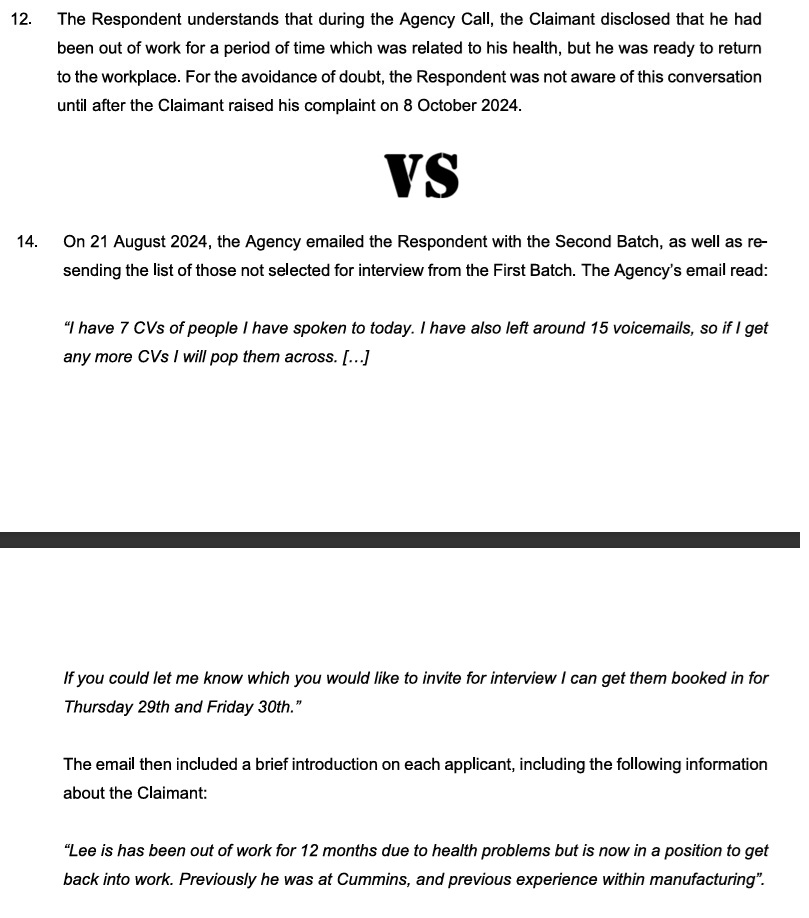
Paragraphs 12 and 14 of the ET3 are the paperwork wobble that deserves daylight. On one reading, Cepac tries to distance itself from knowledge of the disability-related background. Another reading suggests it appears to admit enough contact with the work-gap explanation to make that distancing look like a man falling through a glass table while insisting he meant to sit down.
That matters because disability discrimination often turns on knowledge. What was said, what was passed on, what was understood, what Page knew, what Cepac knew, and what Cepac received before the recruitment door closed are not side issues. If Cepac’s own defence appears to wobble between “we did not know” and “we were told enough to understand there was a health-related issue in play”, Tesco’s inclusion aisle has a supply-chain problem staring at it from the packaging.
The £50,000 Inclusion Test
Then comes the money. Cepac appears to have spent around £50,000 through Horsfield Menzies, whose own website reads like an advert for knowing exactly where the pressure points are, pursuing a disabled claimant through procedural warfare after he had the audacity to raise a complaint.
This is not just defending itself on the merits. Nor simply saying “we deny discrimination” and proving the treatment was clean. Something much nastier sits in the allegation: the machinery turned on the disabled person who complained, the distress became the problem, the reaction to pressure, bullying, legal aggression and procedural ambush was repackaged as scandal, and the merits did not need to be disproved if the claimant could be framed as the scandal instead.
A disabled person raises a complaint. The company helps create the pressure cooker, points at the steam, and asks the tribunal to call the steam unreasonable. That is a neat trick, and an ugly one. It is not inclusion. It is a corporate meat grinder wearing an equality badge.
For Tesco, that should be a supplier-chain alarm bell. If the brand’s inclusion values mean anything beyond the aisle, the company should want to know why a packaging-linked business in its supply orbit is accused of using that playbook.
Equal Pay And The Inclusion Performance
Tesco’s broader inclusion problem does not stop at disability. The company is fighting one of the biggest equal-pay battles in British retail, brought by store workers, many of them women, comparing their work with higher-paid warehouse and distribution roles, largely male. Tesco disputes the claims. Fine. Let that sentence sit there like a lawyer holding a wet sandwich.
The optics are still rancid. In May 2026, Tesco lost another important Court of Appeal round when the court dismissed its challenge to the tribunal’s approach to determining job facts in the equal-value process. Put plainly, the supermarket tried to fight the comparison machinery, and the workers’ side won that point. The case grinds on.
This matters in an inclusion piece because inclusion is not just disability. It is power, pay, belief, delay, value, complaint, and who gets processed into dust. Tesco’s inclusion brand is standing next to thousands of workers fighting through the courts over whether the supermarket giant’s pay structures undervalued shop-floor work, so no one should act shocked when TCAP asks whether the supplier chain reflects the same gap between brochure and behaviour.
At the shopfront, everyone is welcome. The record suggests some people are more welcome once they stop complaining.
Food Slots And The Pandemic Test
Tesco’s disability problem also reached customers. During Covid, disabled shoppers who were not on the government’s “extremely clinically vulnerable” list struggled to access priority online delivery slots. Joanne Baskett, a disabled mother from Swindon who could not leave her home, took legal action. After that pressure, Tesco expanded access so hundreds of disabled shoppers could be added to the priority list.
That was not a minor lockdown hiccup. It was the inclusion aisle under stress. Tesco had the scale, the systems, the online infrastructure and the brand language about helping communities. Apparently, it did not have a machine capable of seeing disabled people who failed to fit neatly into the official box being fed into it.
So disabled people had to push legally to be seen by the company that sells food. That is dark. Proper institutional dark. The kind where the slogan smiles while someone vulnerable tries to work out how the fuck they are supposed to eat.
Again, the Cepac question is fair. If Tesco’s own systems have already struggled to see disabled people until legal pressure arrives, why would anyone assume Tesco is naturally alert to disability discrimination risk in the packaging chain?
The Supplier Code Stops Where The Stink Begins
Big companies adore supplier codes because supplier codes are cheap. They photograph well, sit beautifully in sustainability reports, and let procurement teams look morally hydrated while the chain does whatever the chain does until someone gets caught.
A supplier code that does not ask hard questions is not ethics. It is wallpaper. Tesco can sell inclusion all day, talk about disabled customers, colleague belonging, community support and respect, then decorate the aisles with soft language until the whole supermarket feels like a counselling brochure with meal deals.
If that inclusion does not reach the packaging chain, it is just branding. When a company in Tesco’s supply orbit can face disability discrimination allegations, spend serious money reframing the claimant’s reaction as the scandal, and wobble in its own ET3 about what it knew, Tesco’s supplier values have a very specific question to answer.
Where do they start? At what point do they stop? Who gets crushed in the gap?
The Packaging Does Not Hide The Problem
This is why Tesco belongs in The Cepac Files.
This is not random scandal garnish. It is not a supermarket greatest-hits list. Nor is it some lazy “big brand bad” swipe. Tesco belongs here because this is an inclusion story.
The company sells inclusion at the front of house while its own record shows disability discrimination findings, pandemic access failures and equal-pay litigation. Cepac appears in Tesco’s public supply-chain orbit through the C&D Foods route. That same packaging-linked company faces disability discrimination allegations, has an ET3 that appears to raise questions between paragraphs 12 and 14, and seems to have spent around £50,000 turning the disabled claimant’s reaction into the issue rather than letting the merits take the light.
There is the story. A supermarket inclusion brand sits above a packaging chain with a disability discrimination smell. Beneath it, a supplier-linked company has questions to answer. Around it, a corporate ecosystem lets the vulnerable person’s complaint become the inconvenience, the reaction become the scandal, and the machine pretend it was only ever defending process.
So here is Tesco’s choice. Ask Cepac what the fuck is going on, or keep selling inclusion while the cardboard underneath it smells of the exact problem Tesco’s own record suggests it already knows far too well. Maybe we’ll even crack open The Tesco Files.
Because every little helps cuts both ways. Sometimes it helps the customer. Other times, it helps the machine. Eventually, it helps everyone see exactly where the rot has been packed.
Lee Thompson – Founder, The Cummins Accountability Project
Sources
- Unite Live – Cepac Print Workers To Strike
- Unite The Union – Darlington Printers Cepac In Fire And Rehire, Redundancy And Legal Dispute Shame As Strikes Deepen
- Packaging Gateway – Pay Dispute Causes Packaging Shortages At Darlington Cepac Print Firm
- Cepac – UK’s Leading Corrugated Packaging Company
- Tesco PLC – Diversity, Equity And Inclusion
- Tesco – Hidden Disabilities Help With Shopping In Tesco Stores
- Tesco PLC – Sunflower Lanyards Help Customers With Hidden Disabilities
- AccessAble – Tesco Accessibility Guides
- GOV.UK – Mr N McCarthy v Tesco Stores Ltd
- GOV.UK – Mr R Maxwell v Tesco Stores Ltd
- Legal Island – Maxwell v Tesco 2024
- RTÉ – Tesco Pays €40k To Worker Let Go Due To Vision Impairment
- Leigh Day – Tesco Fails In Court Of Appeal Bid To Challenge Equal Pay Job Assessment Approach
- Retail Gazette – Tesco Loses Court Of Appeal Bid In Equal Pay Case
- Personnel Today – Equal Pay: Tesco’s Appeal Over Job Assessment Method Fails
- Disability News Service – Coronavirus: Tesco Opens Priority Home Deliveries To Disabled Shoppers
- Able2UK – COVID-19: Disabled Shopper Takes Legal Action Against Tesco
- Horsfield Menzies – Employment Tribunal Support