C&D Foods sells private-label pet food on quality, trust, transparency and “farm to bowl” traceability. Lovely. Bowl polished. Dog smiling. Customer reassured. Then the cardboard starts talking. Unite names C&D Foods in the public Cepac customer trail, with C&D’s own customers including Tesco, Aldi, Morrisons and Asda. Suddenly the question is not what is in the bowl. It is what is wrapped around it, who supplied it, and whether C&D’s famous transparency stops dead the second the packaging gets awkward.
From Farm To Bowl, But What About The Box?
C&D Foods knows how to sell trust. That is the whole private-label game. The consumer sees the supermarket brand. The pet eats the food. Beneath that neat retail moment sits the manufacturer, the packaging route, the procurement trail, and all the uncomfortable little relationships quietly holding the shelf together.
There is money in that invisibility. Serious money. Private label works because the public sees Tesco, Aldi, Asda or Morrisons on the shelf, not every factory, supplier, packaging decision and awkward corporate link sitting underneath the barcode.
C&D’s own language is slick. It talks about quality. Integrity gets a polish too. “Farm to bowl” traceability is served up like a warm ethical blanket. Raw material supply chains, supplier auditing, customer confidence and transparency all get their turn under the marketing lights.
Good.
TCAP likes transparency.
So let us follow it past the bowl, past the ingredient list, past the smiling pet-food language, and into the cardboard chain.
Because the public trail does not just lead to wholesome pet dinners. It leads to Cepac.
The Bridge In The Chain
C&D Foods is not a random name dragged into The Cepac Files for garnish. This company is the hinge.
Unite’s coverage of the Cepac Darlington strike stated that Cepac produces corrugated packaging and that its clients include C&D Foods Group. The same coverage said C&D’s customers include Aldi, Tesco, Morrisons and Asda.
That is the bridge.
Cepac sits at one end. Major supermarkets sit at the other. C&D Foods stands in the middle, looking very much like the cardboard toll booth nobody was supposed to notice.
This matters because the Tesco hit was never just about Tesco. That article was about inclusion, supply-chain tolerance, and the ugly little question of how far brand responsibility actually travels when the mess belongs to a company one link down the chain.
C&D is where that question sharpens.
If the company sells traceability, does it trace only the meat, grain, pouch and tin?
Or does the transparency sermon also reach the cardboard?
Tesco’s Dog Food Receipt
This is not just a vague customer-map exercise either.
Law Print’s own case material says one of its briefs from C&D was to help Tesco relaunch Tesco complete dry dog food packaging to compete with strong established brands on the shelf.
There it is. C&D. Tesco. Pet food. Packaging. All in one neat little receipt.
That does not mean Cepac made that exact packaging. TCAP is not claiming that. The point is cleaner and more useful: C&D publicly sits in the Tesco private-label pet-food packaging world, while Unite publicly places C&D in Cepac’s client trail.
Supply chains rarely work like courtroom cartoons, with every hand holding the same knife. They work through comfortable distances. A supermarket brand. A private-label manufacturer. A packaging manager. A corrugated supplier. Somewhere underneath, a tribunal file waits with a disabled claimant trying not to be processed into dust.
Everyone gets distance.
The product gets packaging.
The brand gets shine.
The person at the bottom gets the machine.
The ET3 Question Travels With The Cardboard
Cepac’s disability problem does not vanish because the product moves through another company’s chain. That is the whole point of supply-chain accountability. Responsibility is not supposed to dissolve the second the cardboard leaves the factory.
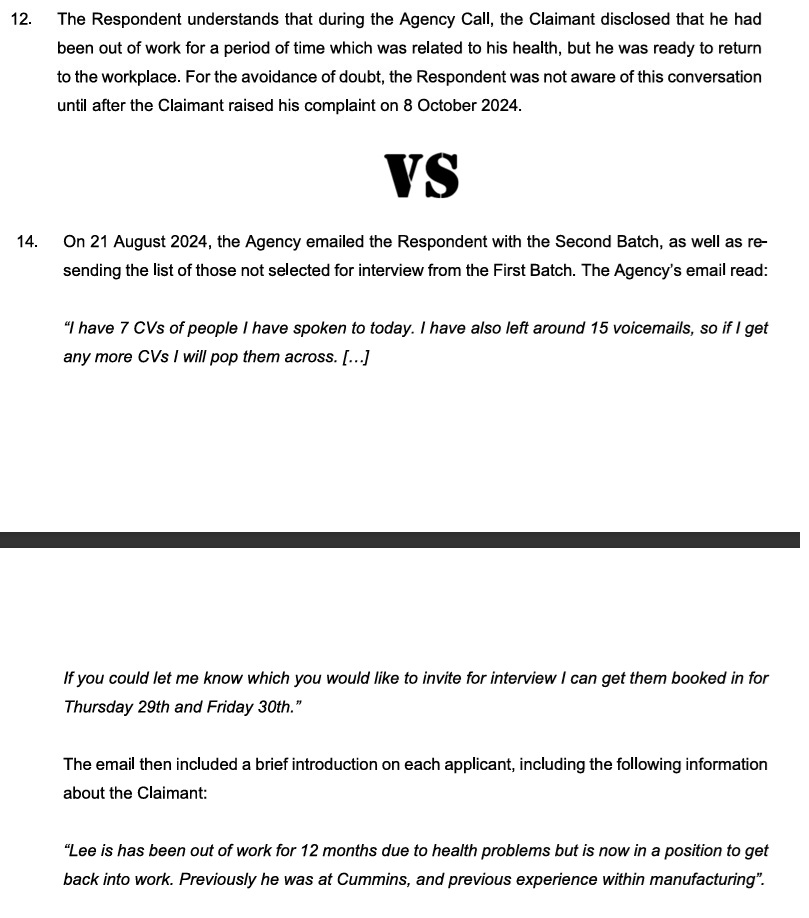
The company is facing disability discrimination allegations in a case where its own ET3 appears to raise a very specific knowledge problem. Paragraph 12 distances Cepac from awareness of the health-related background. Paragraph 14 then appears to put the work-gap explanation back in the frame, with the agency email referring to time out of work due to health problems.
That is not decorative paperwork. It is the kind of contradiction procurement people should hate.
Disability discrimination often turns on knowledge. What was said matters. What was passed on matters. The agency’s understanding matters. Cepac’s understanding matters. Any information received before the recruitment door closed matters.
If Cepac’s own pleaded case wobbles between “we did not know” and “we had enough information to understand health was in play”, any company sitting in that supplier chain should be asking questions.
C&D sells traceability.
Fine.
Trace this.
Did the transparency stop at the ingredient list? Whabout at the dog bowl? Did it stop before the cardboard? Or does C&D want the comfort of major supermarket customers while treating a disability discrimination question in the packaging chain as someone else’s mess?
The £50,000 Smell In The Packaging
The ET3 question is bad enough. The money makes it uglier.
Cepac appears to have spent around £50,000 through Horsfield Menzies pursuing a disabled claimant through procedural warfare after he had the audacity to raise a complaint.
This is not the clean version of corporate defence where a company calmly denies discrimination and then proves the treatment was spotless. A nastier allegation sits in the file. The machinery turned on the disabled person who complained. Distress became the problem. Pressure, bullying, legal aggression and procedural ambush were pushed into the background while the claimant’s reaction was repackaged as scandal.
That is a very neat trick.
A disabled person complains. The pressure cooker gets hotter. Steam appears. Management points at the steam and asks the tribunal to call it unreasonable.
That is not inclusion.
It is a meat grinder with a supplier code taped to the side.
So here is the question for C&D Foods: if your customer world includes Tesco, Aldi, Morrisons and Asda, and your public trail runs through Cepac, do you care what is sitting under the cardboard?
Or is that someone else’s smell?
The Same Word Keeps Coming Back
There is also the cultural smoke.
Anonymous employee reviews are not findings. They are not tribunal judgments. Nor are they proof of protected-characteristic discrimination, and TCAP is not pretending otherwise.
But words matter. Patterns of vocabulary matter. Around this industrial food-and-packaging ecosystem, the same ugly language keeps crawling out from under the skirting board: bullying, harassment, pressure, management culture, people treated as numbers.
For C&D, the workplace-review material is soft smoke, not a formal verdict. Fine. Put the caveat in a small box and leave it there.
The point is the echo.
When anonymous workplace complaints use words like bullying and harassment, and Cepac sits in the same chain facing allegations that a disabled claimant was pressured, legally battered and then framed for reacting, the word starts to feel less like random static and more like atmosphere.
Not proof.
A warning label.
The Goodman And ABP Shadow
C&D is not a lonely shed with a mixing bowl and a dream. It is part of the ABP Food Group orbit, the Goodman machine, the wider agri-food system where scale, supply, pressure and brand distance are not exactly alien concepts.
Industry sources describe C&D as one of Europe’s leading private-label pet-food manufacturers and ABP’s pet-food division. ABP’s own profile places pet food under C&D within its broader integrated agri-food structure.
If C&D does not want the question, ABP can have it.
How far does responsibility travel through the Goodman food chain? Does it reach the packaging supplier? The disability discrimination allegation? Does it reach a claimant’s ET3 paragraph 12 and paragraph 14 problem?
Or does it stop at the polished line about traceability, with the rest of the chain quietly shoved into a corporate cupboard until someone opens the door?
Private Label, Public Stink
Private label is a wonderful trick. It gives supermarkets a product that looks like their own. Manufacturers get volume without visibility. Everyone gains commercial benefit while the supply chain hides in plain sight.
That is why C&D matters.
The Tesco customer sees Tesco complete dry dog food. The dog gets dinner. Packaging does its job. Behind the label, the supply chain stays conveniently boring.
But boring is not the same as clean.
If the chain behind that world includes a packaging supplier accused of disability discrimination, a contested ET3 knowledge issue, and a reported five-figure legal campaign that turned the disabled claimant’s reaction into the centrepiece, then the private-label curtain deserves a tug.
C&D cannot sell transparency as a virtue and then act allergic to the bit of the chain where the cardboard comes from.
The Supermarkets Should Be Asking Too
The supermarkets should not get to pretend this question died at C&D’s loading bay.
Tesco was first because Tesco sells inclusion loudly and sits in the named C&D customer trail. Aldi, Morrisons and Asda sit there too. That makes C&D the pressure point, not the endpoint.
Major supermarket brands enjoy the convenience of private-label supply. They can also have the discomfort of private-label accountability.
What do they expect C&D to know?
What does C&D expect Cepac to answer?
Which standards does ABP expect from a packaging supplier sitting under its pet-food division?
At what point does everyone stop pretending the words “responsible sourcing” only apply to the edible bit?
The Cardboard Chain
This is why C&D Foods belongs in The Cepac Files.
Not because C&D has Tesco’s public scandal stack. TCAP is not inventing a discrimination finding where one has not been found. Anonymous workplace reviews are not being dressed up as legal documents with witness statements stapled to them.
C&D belongs here because it is the bridge.
The company connects Cepac to the supermarket layer. Its own world is built on private-label trust, traceability, supplier auditing, customer confidence and packaging that helps major retailers sell products under their own names. That is exactly why the Cepac question belongs on its doorstep.
If C&D wants to sell “farm to bowl” transparency, it can answer the cardboard question.
Does transparency reach the packaging chain?
Does supplier confidence include asking why Cepac has a disability discrimination allegation hanging over it?
Will C&D ask why a packaging-linked company in its orbit appears to have spent around £50,000 turning a disabled claimant’s reaction into the scandal instead of letting the merits face daylight?
Or does the company keep polishing the bowl while the box starts to stink?
Because in this chain, the food is not the only thing being packaged.
So is responsibility.
And TCAP has started opening the box.
Lee Thompson – Founder, The Cummins Accountability Project
Sources
- Unite Live – Cepac Print Workers To Strike
- Unite The Union – Darlington Printers Cepac In Fire And Rehire, Redundancy And Legal Dispute Shame As Strikes Deepen
- Packaging Gateway – Pay Dispute Causes Packaging Shortages At Darlington Cepac Print Firm
- C&D Foods – Our Values: We Care
- C&D Foods – Homepage
- C&D Foods – Our Products
- ABP Food Group – C&D Foods
- EIT Food – ABP Food Group
- PetfoodIndustry – C&D Foods
- GlobalPETS – Goodman Takes Over C&D Foods
- Law Print & Packaging – Tesco Complete Dry Dog Food
- Glassdoor – C&D Foods Reviews
- Glassdoor – C&D Foods Poor Management Review