The Innocent Drinks Cepac relationship is where the halo meets the purchase order.
Innocent has spent more than two decades cultivating the voice of a clever child raised inside a sustainability department. Everything is lower-case, lightly mischievous and morally pre-approved. The bottles have little messages. The website talks about dogs, fruit, doing things properly and leaving the world better than it was found.
Even the logo arrives wearing a halo.
Then Unite names Innocent Drinks as a Cepac customer.
That is not speculation based on a discarded carton or a blurry photograph from a loading bay. In August 2023, Unite expressly listed Innocent Drinks among Cepac’s customers while reporting on industrial action at the packaging company’s Darlington operation.
The halo is in the supply chain.
The Innocent Drinks Cepac Receipt
Unite reported that more than 90 workers at Cepac’s Darlington site were beginning four weeks of strike action over pay and conditions. According to the union, Cepac had offered a pay increase tied to detrimental conditions, including longer hours, lower overtime rates and changes to shift patterns.
Unite also alleged that Cepac intended to impose the inferior conditions if employees refused to accept them.
Cepac was entitled to state its position in that dispute. Nevertheless, the customer list was unusually clear. Alongside Mars, Carlsberg, Pernod, Lidl, Sainsbury’s and Diageo sat Innocent Drinks.
No detective work was required. No anonymous source had to be protected. A major trade union placed the name in public, beside the cardboard supplier and the labour dispute.
That relationship matters because Innocent does not market itself as a company merely interested in receiving the correct number of cartons at the correct price. It sells a moral identity with the drink.
Once ethics become part of the product, the supplier stops being somebody else’s problem.
The Brand That Writes Its Own Character Reference
Innocent’s current website says it has been committed to doing business “in the right way” since 1999. It says the company puts people and the planet at the heart of everything it does. It promotes its B Corp status, its charitable giving and its efforts to source responsibly.
The message is not subtle.
Buy the drink. Enjoy the fruit. Feel reasonably decent about the transaction.
This is the commercial genius of modern virtue branding. The company does not simply sell liquid. It offers moral relief in a refrigerated bottle. The consumer can spend three pounds on crushed fruit and briefly imagine the machinery behind it has been inspected by kind people wearing sensible trainers.
Innocent says that it gives 10 per cent of its profits to good causes. It says it has donated millions. Those may be worthwhile commitments. Charity, however, is not a coupon that can be redeemed against supplier scrutiny.
A knitted hat on a smoothie bottle can help an older person.
It cannot answer a disability-discrimination allegation.
Innocent’s Human-Rights Promise
Innocent’s human-rights policy is unusually useful because it removes several possible excuses.
The company declares a commitment to identifying, preventing and mitigating adverse human-rights impacts arising from its business activities. It says it has a long-standing commitment to equal opportunity and an intolerance of discrimination and harassment.
Disability is expressly included.
More importantly, Innocent says those principles apply not only to its employees but also to the business partners with whom it works.
That is excellent language.
Now earn it.
A human-rights policy should not function like the nutritional information on the back of the bottle, technically present but rarely permitted to interfere with the sale. It should change what the company does when an uncomfortable supplier issue reaches the desk.
Innocent’s own policy says disability discrimination within a business relationship matters. Nobody from TCAP forced those words onto the page. Innocent chose them, published them and placed its halo above them.
The Otter Lost At The ASA
Innocent already knows what happens when the story becomes more virtuous than the evidence.
In 2022, the Advertising Standards Authority upheld complaints against an Innocent advertising campaign about the environment. The advertisement moved from images of pollution and ecological damage into a brighter world where people consumed Innocent drinks while the planet was apparently being fixed.
There was music. An animated otter. There were reassuring instructions to reduce, reuse and recycle. Finally, Innocent presented its “little drinks” as having “big dreams for a healthier planet”.
It was charming.
Charm is what advertising uses when proof would spoil the meeting.
The ASA concluded that many consumers would understand the campaign to mean that purchasing Innocent products was an environmentally positive choice. However, the company’s environmental initiatives did not demonstrate that its products had a net positive impact across their full lifecycles.
The regulator also noted the presence of non-recycled plastic in the bottles and the environmental effects associated with producing that material.
Consequently, the ASA found the advertisements misleading and ordered that they must not appear again in their existing form.
The otter survived the storyboard.
The claim did not survive the regulator.
Big Dreams, Incomplete Lifecycles
The ASA ruling matters beyond green advertising.
It revealed a corporate habit familiar to anyone who spends time reading ethical-business material. The brand presents an aspiration. The consumer receives an implication. When challenged, the company explains that it never quite said what everybody understandably thought it said.
It was not claiming the drink fixed the planet. It was merely inviting everybody on a journey.
Lovely.
Journeys are useful in corporate communications because nobody has to arrive. A destination can be delayed, reformulated or moved into the next reporting period. Meanwhile, the advert has already run, the bottle has already sold and the moral association has already entered the customer’s head.
Supplier ethics can work the same way.
The policy speaks about human rights. The annual statement speaks about audits. The website speaks about responsible business. Yet the meaningful test begins when a real supplier carries a real controversy involving real people.
Innocent’s named relationship with Cepac is that test.
The Cepac Disability File
Cepac and Page Outsourcing are respondents in the disability-discrimination case brought by Lee Thompson, founder of The Cummins Accountability Project.
The central allegation is straightforward.
Thompson says he applied for work connected to Cepac, progressed toward an interview and disclosed disability-related information during the recruitment process. He says the promised interview route and callback then disappeared.
Cepac and Page deny unlawful discrimination.
A proper merits hearing could have tested the sequence carefully. It could have examined the recruitment records, communications, knowledge, decision-making and explanations given by the respondents. Witnesses could have been questioned. Documents could have been compared. The factual dispute could have been resolved in public.
That did not happen.
Instead, the case was struck out on conduct grounds. A £20,000 costs order followed. Therefore, the underlying disability allegation was not rejected after a completed merits hearing.
That distinction is not a technical indulgence.
It is the distinction between answering an allegation and removing the person making it.
When The Claimant Became The Product
TCAP’s criticism goes beyond the vanished interview.
Its position is that, once a disabled litigant in person began challenging the respondents, the litigation turned increasingly toward his language, distress, public commentary, complaints and conduct. The person alleging discrimination became the item under inspection.
That inversion should trouble any company selling itself as human-rights conscious.
A disabled person says the recruitment process changed after disclosure. Rather than the underlying issue receiving a final evidential determination, the legal machine eventually produces a strike-out and a £20,000 bill for the claimant.
The institution can call that procedure.
The person underneath it may reasonably call it pressure.
TCAP estimates that Cepac committed approximately £50,000 to its legal response through Horsfield Menzies. That figure is TCAP’s position based on its review of the litigation material, not a judicial finding.
Companies are entitled to defend claims. They are entitled to instruct lawyers and challenge conduct they consider improper. However, expenditure does not become morally neutral merely because it appears on a solicitor’s invoice.
The question is what the money accomplished.
It did not produce a full merits judgment clearing the recruitment process of disability discrimination. Instead, it helped produce an ending in which the disabled claimant’s behaviour eclipsed the allegation that brought everybody into the room.
That is not vindication.
It is procedural victory with the original question still sitting on the table.
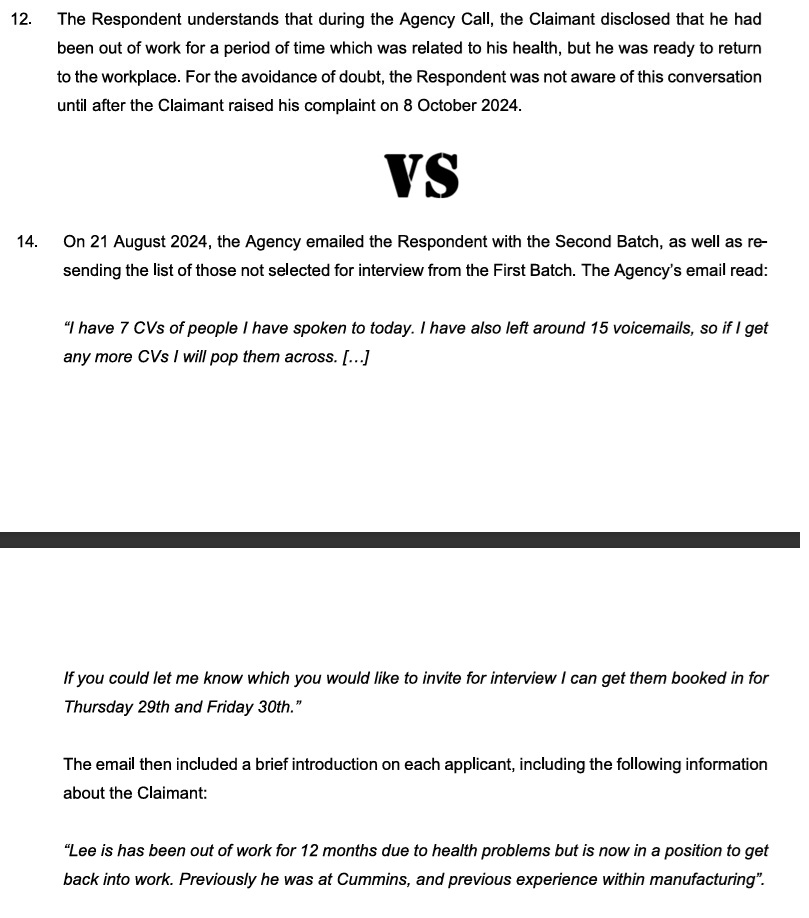
The ET3 image is essential because Innocent Drinks is not being added to a generic collection of corporate grievances.
This is about a specific supplier relationship, a specific recruitment dispute and a specific documentary contradiction that TCAP says deserves examination.
The bottle is incidental.
The paperwork is the point.
Innocent Claims To Monitor Discrimination Risk
Innocent’s latest modern-slavery statement makes the supplier question much harder to avoid.
The company says it operates an end-to-end supply-chain model in which it procures ingredients and packaging. Packaging suppliers are identified among its direct suppliers. Innocent also says its packaging is sourced primarily from Western Europe.
According to the same statement, sustainability risk assessments are completed annually for major direct suppliers. Those assessments expressly cover labour practices and discrimination risks.
Innocent says it reviews audit findings, supplier questionnaires, NGO reports and media coverage. The resulting information feeds into a human-rights risk tracker.
Furthermore, the company says its supplier contracts and purchase orders include human-rights requirements and a right to terminate for non-compliance.
That is not a vague pledge to be nicer.
It is a claimed system.
It has staff, risk assessments, audits, external information, contractual terms, reporting lines and consequences. Innocent even says that workers at direct packaging suppliers fall within the scope of its social-compliance audit tracking.
Good.
Then the excuse drawer is empty.
Did The System Notice Cepac?
The questions for Innocent Drinks are now painfully ordinary.
Was Cepac assessed under Innocent’s direct-supplier risk procedures? Did the assessment identify the 2023 industrial dispute reported by Unite? Was disability discrimination considered after TCAP’s allegations became public? Did Innocent examine whether the underlying claim received a merits hearing?
Innocent says it reviews media coverage and discrimination risk. The relevant material is public. TCAP has published extensively. The Employment Tribunal judgments exist. Unite named the customer relationship.
No expedition into an inaccessible foreign jurisdiction is required.
Nobody needs to interview a frightened agricultural worker in secret or reconstruct a hidden subcontracting chain across five countries. This file is sitting in England, written in English, attached to companies Innocent already knows.
Supplier due diligence does not become impressive merely because it can find exploitation somewhere far away.
The harder test is whether it notices injustice close to home, involving people whose names are known and whose documents are available.
The Labour Policy Meets The Labour Dispute
Innocent’s human-rights policy also says it respects freedom of association and employees’ rights to join unions. It promises constructive dialogue and good-faith bargaining where workers are legally represented.
Cepac’s Darlington workers were represented by Unite.
The union’s account was not a portrait of constructive dialogue. It described deteriorating industrial relations, proposed detrimental changes and a threat to impose inferior conditions if workers refused them.
Again, that was Unite’s account of a contested employment dispute, not a court judgment.
However, due diligence exists precisely because customers should not wait for every concern to arrive as a final judicial finding. By then, the worker has often endured the harm, the dispute has hardened and the annual ethics report has already gone to print.
A company serious about worker rights asks questions while they still matter.
A company interested mainly in appearances waits for somebody else to prove everything at their own expense.
The Halo Belongs To Coca-Cola
Innocent is not an independent cottage business financed by cheerful people passing a hat around Fruit Towers.
It is wholly owned by The Coca-Cola Company.
Innocent’s own website says Coca-Cola took full ownership in 2013. The brand says it continues to operate independently and remains committed to its social, ethical, charitable and environmental goals.
Coca-Cola’s corporate website likewise lists Innocent among its juice, dairy and plant-based brands.
Therefore, the halo sits inside a publicly traded multinational. The relevant parent ticker is NYSE: KO.
That does not invalidate every good thing Innocent does. Nor does it make Coca-Cola responsible for every decision taken by a separately operated brand.
It does remove the romance.
Innocent has access to the resources, compliance expertise and corporate machinery of one of the world’s largest drinks companies. It cannot plausibly present itself as too small, too informal or too innocent to examine the people supplying its packaging.
The Cute Voice Has Adult Responsibilities
Innocent’s writing style has been central to its success.
The brand talks as though the bottle itself has opinions about fruit, bank holidays and household pets. Even formal subjects receive the softened treatment. Modern slavery reports suggest grabbing a cup of tea. Sustainability officers receive whimsical internal titles.
There is nothing inherently wrong with making corporate material readable.
The problem begins when the cute voice lowers the apparent stakes.
Discrimination is not whimsical. Industrial pressure is not an endearing misunderstanding. A disabled applicant losing an interview route after disclosure cannot be resolved by a sentence written in lower case beside a cartoon.
Human-rights policies concern adults making decisions about other adults’ lives.
At that point, the brand voice should stop performing innocence and start exercising responsibility.
The Separate HSA Group Question
The disability-discrimination case is one lane.
The allegations published by The Quiet Mancunian concerning HSA Group, Longulf Trading, Yemen, 9/11-related material and terrorism-shadow issues are another.
They must not be conflated.
TCAP has published a separate evidence review explaining why it believes The Quiet Mancunian’s core account deserves serious scrutiny. That article expressly states that it is not a court judgment, criminal finding or substitute for a proper investigation.
Cepac publicly sits within the HSA Group corporate landscape described in that material.
This does not make Innocent Drinks responsible for those allegations. Nor does a customer relationship establish knowledge, complicity or wrongdoing.
The relevance is due diligence.
When a supplier presents several distinct categories of public risk, a customer claiming sophisticated human-rights monitoring should examine each category carefully. It should not mix them together, but neither should it use their complexity as permission to examine none of them.
The disability file requires an answer.
The industrial-relations file requires an answer.
The wider corporate-risk file requires an answer.
A functioning due-diligence process should be capable of holding three folders at once.
The Greenwashing Lesson Innocent Should Have Learned
The ASA ruling offered Innocent a useful lesson.
Good intentions are not the same as substantiation. Aspirations are not outcomes. A charming presentation cannot bridge the distance between what a consumer reasonably understands and what the evidence proves.
The same discipline should apply to human-rights claims.
Saying that discrimination risk is monitored does not demonstrate that Cepac was examined.
Publishing a supplier policy does not prove that anybody acted on it.
Calling a committee the Human Rights Working Group does not tell the disabled claimant whether his allegations reached its agenda.
Innocent’s own modern-slavery statement says the group meets quarterly. It says the board-sponsored Sustainability Steering Committee receives human-rights attention. It says external media reports are reviewed.
Then there should be a trail.
There should be a risk entry, an assessment, a decision or a defensible explanation of why no action was considered necessary.
Otherwise, the human-rights system begins to resemble the environmental advert: attractive intentions presented in a way that encourages the public to infer more than the company can demonstrate.
The Cepac Files Supply Chain Nonchalance Award 2026
Innocent Drinks now receives The Cepac Files Supply Chain Nonchalance Award 2026.
The award is not made because TCAP has established that Innocent committed disability discrimination. It has not.
It is not made because Innocent caused the Cepac strike, directed the litigation or wrote the ET3. There is no evidence of that.
The award is made because Innocent has constructed one of the most elaborate public cases for expecting more from it.
This is a B Corp that says it puts people and the planet at the heart of its business. It publishes an intolerance of disability discrimination that extends to business partners. It claims annual supplier-risk assessments covering discrimination and labour practices. Claims media coverage is reviewed and that it reserves contractual rights where suppliers fail to comply.
Then a named packaging supplier appears with a public industrial dispute, a disability-discrimination allegation that never reached full merits determination, a £20,000 costs order against the disabled claimant and a wider corporate-risk file.
At that point, silence is not the absence of a decision.
Silence is the decision.
Questions For Innocent Drinks
TCAP invites Innocent Drinks to confirm whether Cepac is a current supplier and to explain the scope of that relationship.
It should also state whether Cepac has been examined under Innocent’s human-rights and supplier-risk processes, whether the disability-discrimination allegations were considered, and whether Innocent has reviewed the fact that the underlying claim ended without a complete merits hearing.
A response should address the Unite dispute as well. Did Innocent engage with Cepac about the reported changes to hours, overtime and shift patterns? If not, how does that fit with the worker-rights language published under the Innocent name?
Finally, Innocent should clarify whether the Cepac relationship has been referred to its Human Rights Working Group, Sustainability Steering Committee, responsible-sourcing team or Coca-Cola compliance functions.
These are not hostile questions.
They are the questions Innocent’s own policies invite.
The Bill
Innocent Drinks built a brand around the proposition that commerce need not be cruel, careless or stupid.
That proposition is worth defending.
However, defending it requires more than donating money, writing jokes on cartons and commissioning animated animals to sing about the planet. It requires looking squarely at the companies inside the commercial chain, especially when doing so may be inconvenient.
Unite named Innocent as a Cepac customer.
Innocent says disability discrimination is intolerable.
Its supplier system claims to assess discrimination and labour risk.
The Cepac and Page disability allegation remains publicly unresolved on its merits. The disabled claimant received a £20,000 costs order. TCAP says the respondents redirected the case toward his conduct while the recruitment question escaped a full hearing.
Those facts do not automatically condemn Innocent.
They demand that Innocent stop acting like the label answers the question.
A halo is not evidence of goodness.
It is packaging.
Lee Thompson – Founder, The Cummins Accountability Project
Related TCAP Reads
- The Cepac Files : Why I Believe The Quiet Mancunian
- The Cepac Files : Absolut Vodka – The Dirty Packaging Partnership
- The Cepac Files : Lidl And The Middle Aisle Of Disability
- The Cepac Files : Aldi And The Discount Inclusion Problem
- The Cepac Files : Asda And The Inclusion Checkout
Sources
- Greggs, Costa, Subway and Pret, facing packaging crisis as Darlington Cepac print workers announce four weeks of strikes
- ASA Ruling on Innocent Ltd t/a Innocent
- We’re Innocent
- The Innocent Promise
- Our Policy on Human Rights
- Our Modern Slavery Statement 2025
- Our Owner
- B Corp
- The Coca-Cola Company : Brands