HSA Group Muslim values appear to come with an overseas exemption.
In Yemen, one HSA company advertises the printing of the Holy Qur’an. In Britain, another designs award-winning displays and packaging to help sell vodka, rum-based liqueur, whiskey, gin and wine.
Same group.
Same inherited values.
Different fucking till.
This is not speculation about the private faith of HSA’s owners. Nor is it an argument based on their nationality. HSA’s own websites establish everything required.
Genpack identifies itself as a Hayel Saeed Anam Group company. Its product catalogue includes “Printing the Holy Quran”. Meanwhile, HSA identifies Cepac as another of its companies. Cepac proudly advertises alcohol packaging for Absolut, Malibu, Jameson, Beefeater and Campo Viejo.
One side prints the scripture.
The other builds the bar.
Apparently the moral firewall is made from corrugated cardboard.
Freshly Crowned Champions Of Ethics
The timing could hardly be better.
On 27 July 2026, HSA announced that it had won Culture & Ethics Initiative of the Year at the ICA Compliance Awards MENA. Its Compliance Ambassadors Network supposedly brought ethics closer to employees and embedded responsible conduct across the organisation.
HSA Chairman and Managing Director Nabil Hayel Saeed described ethical and responsible conduct as a “non-negotiable priority”.
Non-negotiable.
A magnificent phrase. Strong. Certain. Almost carved in stone.
Unfortunately, somebody forgot to send it to the subsidiary building an immersive Malibu Tiki Bar.
HSA also said its programme turned ethics from a corporate objective into a shared responsibility. Employees across the group were apparently empowered to protect its values and translate governance into everyday decisions.
Perhaps one of the Compliance Ambassadors can explain the everyday decision to print the Holy Qur’an in Yemen while engineering vodka displays in Britain.
Maybe the answer is buried in the packaging specification.
The Qur’an And The Profit Centre
Genpack’s HSA page is a remarkable little document.
First, it identifies the company as part of the Hayel Saeed Anam Group. Then it lists chocolates, sweets, pasta and other printing work.
Among those products sits “Printing the Holy Quran”.
That is not a third-party rumour or an inference from Yemen’s population. HSA publishes the claim itself.
Even better, Genpack says one of its goals is to apply the company and group value system in accordance with HSA’s approach to success. Shortly afterwards, another goal appears: “Enhancing our profitability center”.
There it is.
Scripture.
Group values.
Profitability.
All on the same page.
HSA has kindly supplied the entire article in three headings. The only work left for TCAP was opening another group company’s website and discovering what profitability looks like once the containers reach Britain.
Apparently, it looks like six bottles of Absolut Original vodka wrapped in paper and pointed towards the impulse aisle.
Islam Is Not Ambiguous About Intoxicants
This article is not sneering at Islam. Quite the opposite.
Islamic teaching is extremely clear about intoxicating alcohol. The Qur’an describes intoxicants as evil and instructs believers to shun them. A well-known hadith extends condemnation beyond the person drinking. It includes those involved in producing, carrying, serving, selling and consuming the proceeds of alcohol.
Packaging is not expressly listed in that narration. Therefore, TCAP will not pretend to issue a fatwa from behind a WordPress dashboard.
However, Cepac was not making anonymous transit boxes that accidentally encountered a bottle.
It designed branded sales machinery.
The Absolut packaging was created for an exclusive launch in impulse channels. The unit held six 70cl bottles and carried vivid branded graphics. Cepac said the judges loved it as much as the company did.
The Malibu project went further. Cepac built a fully assembled Tiki Bar with colourful graphics, stackable shopping units and three-dimensional elements. Its stated purpose was to bring the alcohol brand to life.
Meanwhile, the Jameson display was designed for a St Patrick’s Day promotion. It included removable panels so retailers could replenish stock while the whiskey kept moving.
That is not remote or accidental involvement.
It is creative, technical and commercial assistance intended to promote alcohol sales.
Six Bottles At A Time
Cepac’s Absolut project deserves particular attention because the language is so gloriously damning.
Pernod Ricard wanted a short production run for a new brand launch. Cepac provided the graphics, structure and shelf-ready packaging. Each unit carried six full-sized vodka bottles.
Not miniature samples.
Not alcohol-free branding.
Six 70cl bottles of Absolut Original vodka, prepared for impulse retail.
Cepac then entered the work for industry recognition and celebrated when it won. The company did not hide the alcohol account behind generic language about consumer products. Instead, it placed “Absolut vodka” directly on its awards page.
In 2025, another Absolut display won Gold. The same awards page celebrates trophies for Jameson and Malibu. It also records work for Beefeater Pink Gin and Campo Viejo wine.
Consequently, this is not one awkward historical project that slipped past group supervision.
It is a portfolio.
Vodka.
Whiskey.
Gin.
Wine.
Malibu.
Enough alcohol branding to stock the wake after HSA’s corporate values finally die of embarrassment.
The Tiki Bar Beneath The Family Legacy
HSA repeatedly invokes family heritage.
Its strategic material promises integrity, honesty, trust and respect. The group says it keeps its promises. Moreover, it claims its reputation rests on decades of honesty and integrity.
Lovely.
Yet inherited values are only meaningful when they survive contact with a purchase order.
If a group company prints the Holy Qur’an and explicitly connects that work to HSA’s value system, HSA cannot treat religious context as irrelevant when another subsidiary helps alcohol brands sell more bottles.
It cannot point towards sacred printing when discussing heritage, then point towards corporate separation when the Tiki Bar rolls out.
Cepac is not a mystery business owned by an unknown investment fund. HSA’s own corporate website names Cepac as one of the group’s companies. It praises the British operation, its technology and its customer service.
Therefore, the ownership connection is not TCAP’s invention.
HSA claims the company when the machinery looks impressive.
It can keep claiming it when the machinery is dressed as a rum shack.
Diversification, Corporate Style
HSA describes itself as a diversified group.
That word is doing heroic work.
Diversification normally means spreading commercial risk across industries and markets. At HSA, it also appears to spread moral responsibility so thinly that nobody can find it when an inconvenient invoice arrives.
One company prints the Holy Qur’an.
Another company creates a Malibu bar.
One operation applies the group’s value system.
Another wins Gold for selling vodka more attractively.
Then the parent collects an ethics award and announces that responsible conduct is non-negotiable.
This is not diversification.
It is moral arbitrage.
The sacred material stays in one jurisdiction. The profitable contradiction takes place in another. Corporate language bridges the gap, collects a trophy and hopes nobody checks the group directory.
Unfortunately, TCAP checked.
Compliance Ambassadors, Please Report To The Bar
HSA says its Compliance Ambassadors act as trusted contacts and help colleagues navigate ethical considerations.
Splendid.
Here is one for the next training session.
A company within the group prints the central religious text of Islam. Another group company actively designs promotional packaging for products that Islam prohibits. The alcohol work wins awards. The group then wins another award for embedding ethics into everyday decisions.
Discuss.
Perhaps the official answer is that every subsidiary follows local law. If so, that would miss the point completely.
Nobody is alleging that Cepac’s alcohol packaging is unlawful in Britain. The question is whether HSA’s inherited values mean anything beyond the markets in which those values are commercially convenient.
Legal does not mean principled.
Profitable does not mean coherent.
An ethics programme that reaches every frontline except the one printing Jameson displays is not embedded. It is decorative.
Then There Is The Disabled Applicant
The alcohol contradiction does not sit alone.
Cepac is also the company facing continuing public scrutiny over its alleged treatment of a disabled job applicant.
The Quiet Mancunian says Page Personnel offered him an interview for a Cepac production role. He says he disclosed that his employment gap involved treatment for a mental health condition. According to his account, a promised follow-up call to arrange the interview never came.
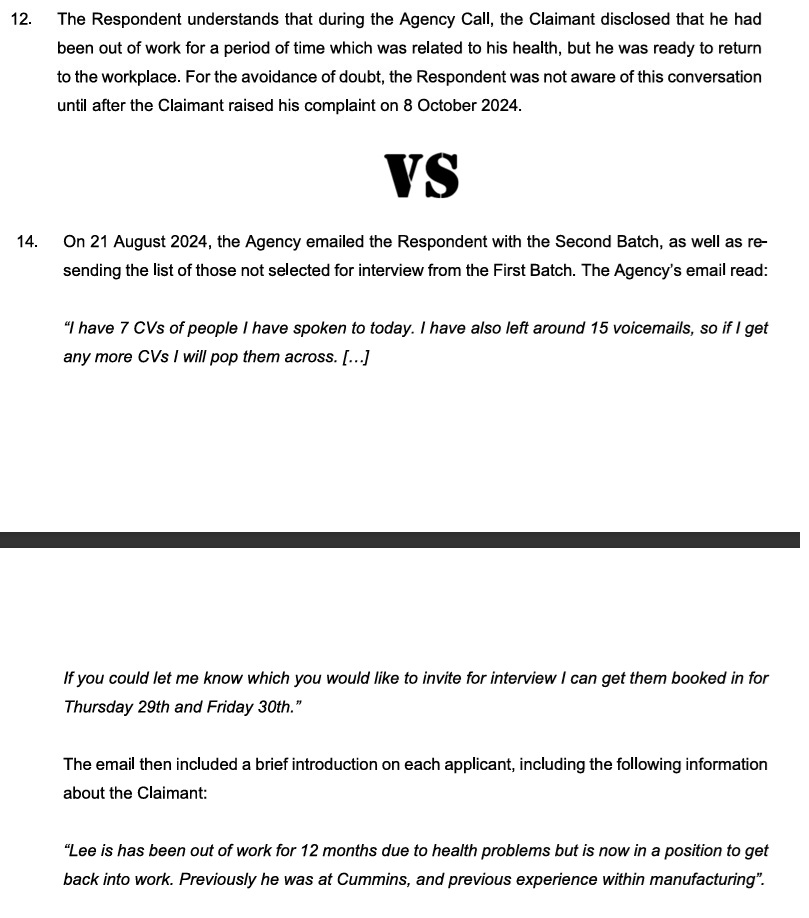
Cepac denied disability discrimination. It said its recruiting manager did not know about the disclosed mental health issues and that the applicant had not made the shortlist.
However, TCAP says the ET3 contains an obvious knowledge contradiction. One paragraph denies relevant disability knowledge. Another refers to the agency knowing that the applicant had been away from employment for medical reasons.
Those competing accounts never received a full merits hearing.
Instead, the claim ended through strike-out after a prolonged and aggressive procedural fight. Therefore, the underlying discrimination allegation was not judicially determined in Cepac’s favour.
Values At Every Level, Except Darlington
This is where HSA’s new ethics award becomes useful.
The group says integrity must reach daily decisions at every level. Cepac’s recruitment and litigation conduct presents precisely the sort of daily decision that deserves examination.
What did Page know?
What reached Cepac?
Why did the interview process allegedly vanish after mental health entered the conversation?
And why do the ET3 paragraphs appear to pull in different directions?
Why did a group celebrating frontline accountability spend its energy fighting the disabled claimant instead of ensuring those questions received a merits hearing?
HSA’s Compliance Ambassadors may be excellent at distributing policies. However, policies are the easy part. Corporations can manufacture policies by the tonne. They stack beautifully and never ask to be cross-examined.
The test arrives when a vulnerable person challenges the company.
At that point, HSA’s values appear to have been packed away with the Absolut display.
Holy Text, Retail Theatre
The contrast could not be cleaner.
Genpack prints the Holy Qur’an.
Cepac builds retail theatre for alcohol.
HSA presents both as group companies while proclaiming that integrity governs how it conducts business.
Nobody forced HSA to put religious printing on its website. Nobody forced Cepac to publish the vodka projects. And nobody forced the group chairman to describe ethical conduct as non-negotiable.
They volunteered every component.
TCAP merely placed them on the same table.
The result is not subtle. It is an ethical autopsy performed using the group’s own webpages.
The body has a compliance badge pinned to its chest.
Not A Question Of Private Faith
HSA may dislike this article’s title.
Therefore, the distinction should be recorded clearly.
TCAP does not claim to know how individual members of the owning family practise religion. It does not infer faith from ethnicity, nationality or allegations published elsewhere. Nor does it claim that printing the Qur’an makes every activity across a multinational group subject to one simple theological ruling.
The criticism is corporate.
HSA invokes inherited values, prints the Holy Qur’an through one group company, promotes itself as an ethical organisation and declares responsible conduct non-negotiable. Meanwhile, another of its companies actively helps market alcoholic drinks and celebrates the awards.
That is the documented contradiction.
If HSA believes its alcohol packaging portfolio fits comfortably beside its proclaimed values, it is welcome to explain how.
Preferably without hiding behind the word “diversified”.
The Non-Negotiable Price List
HSA’s values are apparently universal until the British subsidiary receives a profitable brief.
Then integrity becomes flexible.
Heritage becomes regional.
Responsibility becomes somebody else’s department.
The Qur’an stays in Yemen.
The vodka goes to Tesco.
The Compliance Ambassadors collect a trophy.
Cepac collects the packaging award.
Everybody gets something except the disabled applicant, who says he never received the promised call.
This is the HSA version of values-led capitalism. Sacred text on one production line. Alcohol promotion on another. Ethics at the awards ceremony. Legal muscle when accountability reaches the door.
One company prints the instruction to shun intoxicants.
Another builds the display that helps sell them.
Apparently HSA Group Muslim values are non-negotiable.
The price, however, is available from the sales department.
Lee Thompson – Founder, The Cummins Accountability Project
Sources
- HSA Group : Culture & Ethics Initiative of the Year
- HSA Group : Strategic Direction and Values
- HSA Yemen : Genpack and Printing the Holy Qur’an
- HSA Group : Cepac
- Cepac : Our Awards
- Cepac : Award Spotlight, Absolut Vodka
- Cepac : Award Spotlight, Malibu Tiki Bar
- Cepac : Award Spotlight, Jameson
- Qur’an 5:90 : Intoxicants
- Jami at-Tirmidhi 1295 : Those Involved In Wine
- TCAP : Absolut Vodka and the Dirty Packaging Partnership