The Galaxy Cepac supplier problem is almost too perfect. Mars publishes commandments on human rights, non-discrimination, child labour and responsible supply chains. Galaxy talks about inclusion. Then somebody opens the British cardboard drawer and finds Cepac, two awkward paragraphs in an ET3, a disabled claimant, a curated conduct war and more than £50,000 in claimed legal costs. The disability-discrimination merits were never tried. Mars has built a cathedral to ethical sourcing. Time to see whether anyone is actually inside.
The Galaxy Cepac Supplier Problem
Galaxy and Maltesers appear in Cepac’s customer material. Normally, this would be industrially dull. Cepac makes cardboard, Mars sells confectionery and somewhere between them sits a procurement system quietly processing invoices while everybody involved gets on with the serious business of pretending packaging is exciting.
Then you open the other drawer.
Inside sits a disability-discrimination claim involving a disabled applicant who says he was promised a job interview, disclosed the health reasons behind a lengthy gap in employment and then watched the promised interview disappear. Cepac denied discrimination. That ought to have produced the most obvious thing imaginable: evidence, witnesses and a proper merits hearing capable of determining what actually fucking happened.
It did not.
Instead, the case was dragged away from the recruitment decision and deep into conduct territory. By the end, the disability-discrimination merits were buried beneath correspondence, reactions, blogs, X posts and curated collections of material assembled around the claimant’s conduct. The disabled claimant’s medically documented difficulty regulating emotion under stress became part of the very machinery eventually used against him.
Then, on 24 April 2026, with the claimant absent and unrepresented, the case was struck out on conduct grounds.
Cepac got a £20,000 costs order.
Its claimed costs had climbed beyond £50,000.
The merits never got their fucking hearing.
That is not vindication on the recruitment evidence.
That is a different corpse entirely.
Put The Fucking ET3 On The Table
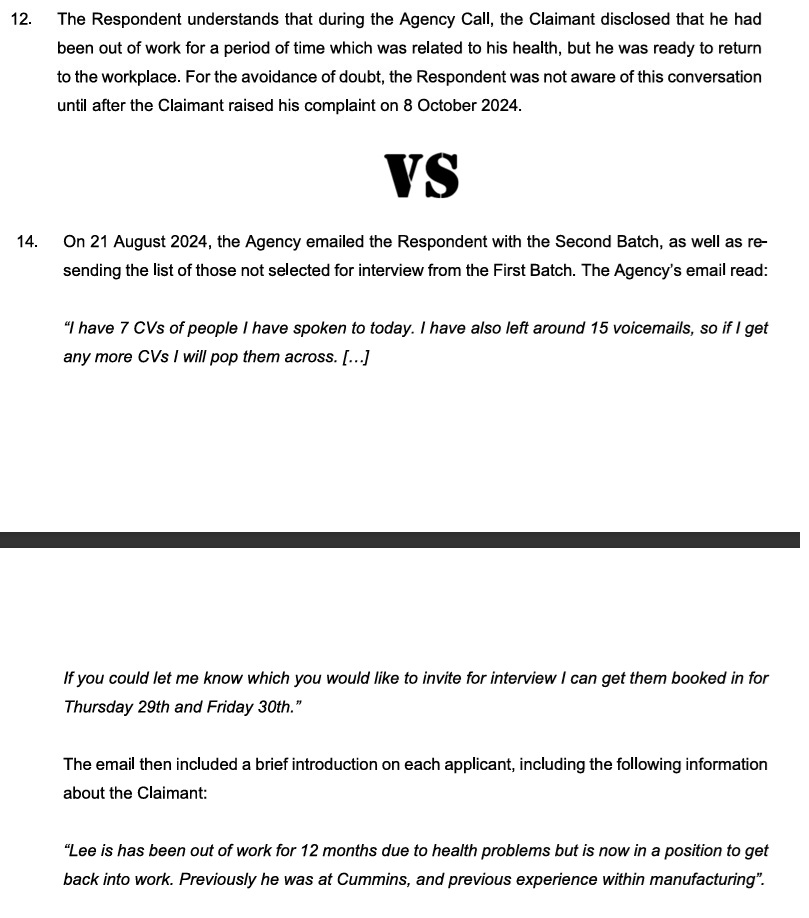
There it is.
Not a tweet. Not one of my metaphors. Not an angry claimant’s recollection scribbled after midnight. This is Cepac’s own pleaded defence, served into the litigation and now preserved with all the stubborn permanence of a toe tag.
Paragraph 12 seeks distance from knowledge relevant to disability. Paragraph 14 records recruitment information referring to an absence from employment because of health problems. Both passages belong to the same ET3, concern the same recruitment exercise and came from the same respondent.
One paragraph backs away from knowledge.
The other leaves fingerprints on the fucking filing cabinet.
There may be an explanation. Excellent. That is precisely why courts and tribunals traditionally possess things called merits hearings. Put witnesses under scrutiny. Open the recruitment records. Establish who received the information, what was understood, when it was understood and what happened to the promised interview afterwards.
Instead, the question was left sitting in the file while everything around it mutated.
Paragraphs 12 and 14 survived.
They always were going to.
Paper has no nervous system. You cannot bully it until it loses emotional regulation.
How A Disability Case Became A Conduct Factory
The strike-out did not fall from the fucking sky.
The underlying claim began with disability discrimination and victimisation. Yet the litigation gradually became saturated with arguments about the claimant’s communications, reactions, online material and behaviour. Large collections of correspondence, blog posts and X material were assembled around that conduct case until the original recruitment dispute became almost archaeological.
There is a grotesque circularity to what happened. A disabled litigant had medically documented difficulties regulating emotion under stress. He says he was then subjected to sustained pressure and antagonism throughout hostile litigation. The reactions produced under that pressure became material for a conduct narrative, and the conduct narrative eventually helped kill the case before the discrimination merits were tried.
That is the part polite corporate prose tends to struggle with.
Cepac and its disability bullies did not need to win the argument about what happened during recruitment if the case could instead become an argument about how the disabled claimant reacted to the fucking process.
The disability moved from being part of the claim to becoming part of the prosecution of the claimant’s behaviour.
That is some bleak institutional alchemy.
Feed disability into one end.
Label the resulting dysregulation “conduct”.
Then use the conduct to close the door on the disability case.
By the time the machinery stopped, the respondent side had its strike-out and its costs order.
The claimant still did not have a merits judgment answering the original question.
More Than £50,000 To Reach Anywhere Except The Merits
Cepac’s claimed legal costs had exceeded £50,000.
That number deserves to sit on the table beside the ET3 because it transforms the whole spectacle from ordinary litigation into something approaching procedural civil engineering.
More than fifty grand buys a tremendous quantity of law. Solicitors write to solicitors. Counsel enters the building. Bundles thicken until they qualify as blunt instruments. Applications acquire appendices, appendices develop exhibits and somebody starts producing schedules explaining the cost of producing all the previous fucking schedules.
Eventually, the invoice becomes architecture.
Meanwhile, somewhere beneath all that professional masonry sits the original question: what happened when a disabled applicant disclosed health information and the promised interview failed to materialise?
So ask the bastard plainly.
How did a disability-discrimination claim generate more than £50,000 in claimed legal costs, a vast conduct case and a £20,000 costs order, while the actual discrimination allegations never received a full merits hearing?
If the recruitment decision was clean, try it.
If the health information made no difference, prove it.
Should paragraphs 12 and 14 fit together perfectly, explain them under scrutiny and let the evidence do the work.
Instead, a mountain of procedural material grew where the merits hearing should have been.
Maybe Mars should ask why.
After all, it appears to care very deeply about human rights.
Mars Has Built A Fucking Human Rights Basilica
Mars does not lack policies.
Its Supplier Code of Conduct covers child labour, forced labour, non-discrimination, violence, harassment and other human-rights concerns. Mars publishes wider human-rights material, modern-slavery disclosures and supply-chain expectations designed to reach deep into the businesses from which it buys.
Galaxy itself talks about creating a modern, inclusive and responsible supply chain. Mars Wrigley has attached billion-dollar programmes to cocoa sustainability and speaks in the grand vocabulary of rights, livelihoods, resilience and responsible sourcing.
The ethical furniture is exquisite.
Human rights in one chapel. Non-discrimination in another. Responsible sourcing illuminated beneath tasteful corporate stained glass. Somewhere behind the altar, Compliance is presumably polishing a Supplier Code until you can see your reflection in the fucking thing.
Good.
Because policies become interesting only when they are forced to carry weight.
Any company can publish principles while everything is comfortable. The document gets approved, uploaded and forgotten. Procurement carries on buying shit. Everybody gets to feel virtuous without anybody having to make an inconvenient telephone call.
Then a supplier arrives with an awkward file.
Suddenly the policy has manual labour to perform.
Cepac is that file.
Mars Knows What Human Rights Due Diligence Looks Like
Mars has spent years confronting ugly human-rights risks in the cocoa supply chain. Child labour and forced labour concerns in West African cocoa production are not abstract concepts tucked into academic journals. They have generated litigation, NGO scrutiny, corporate programmes, supplier controls and substantial investment from the companies whose chocolate ultimately reaches supermarket shelves.
Mars has responded with extensive programmes of its own. Galaxy describes work intended to protect children and improve conditions in cocoa-growing communities. Mars publishes due-diligence structures precisely because it accepts that responsibility does not magically stop at the factory gate.
That principle matters.
If a business can look through layers of farms, cooperatives, traders, certification programmes and processors in search of human-rights risk, then examining a British packaging supplier should not require the Hubble fucking Telescope.
Cepac is not buried six contractual layers deep in a rainforest.
The ET3 is not written in hieroglyphics.
Paragraph 14 is not hiding in Côte d’Ivoire.
It is right there.
Cocoa Litigation And The Corporate Microscope
The cocoa industry’s darker history has also followed major chocolate companies into court. In one US case, eight Malian plaintiffs sought to hold companies including Mars responsible over alleged forced child labour in Côte d’Ivoire. An appeals court ultimately rejected the case because the plaintiffs had not sufficiently connected their experiences to farms supplying the particular defendants.
That dismissal matters. The allegations were grave, but the litigation did not establish that Mars was responsible for those plaintiffs’ treatment.
Elsewhere, however, litigation involving Mars, Cargill and Mondelēz over cocoa supply-chain representations has continued. A consumer-protection case survived dismissal arguments in early 2026, meaning the merits remained alive for further litigation rather than being snuffed out at the threshold.
There is a fucking irony sitting there with its coat already off.
Mars understands that the difference between an allegation and a merits determination matters.
Excellent.
Perhaps somebody can explain that concept to the people staring at Cepac’s strike-out and pretending the discrimination question somehow evaporated with it.
A conduct strike-out is not a merits acquittal.
You do not get to wheel the body out through a procedural side door and then boast that nobody found a knife in the operating theatre.
Galaxy Has Already Had Sustainability Paperwork Turn Ugly
Mars has also seen corporate values collide with employment litigation closer to home.
Former AMV BBDO creative partner Polina Zabrodskaya brought Employment Tribunal proceedings after raising concerns connected with sustainability claims in advertising work involving Mars brands, including Galaxy. Her allegations reportedly touched on subjects such as child labour, deforestation and farmer pay in West African cocoa production.
AMV BBDO disputes her allegations. Mars has said its advertising complied with applicable requirements and its own sustainability standards.
Fine.
Again, the point is not to turn allegations into findings.
The point is that Galaxy already sits inside a corporate ecosystem where employees, activists, lawyers and campaigners scrutinise the distance between the magnificent words in sustainability material and whatever they believe the documents underneath actually show.
That distance is where TCAP lives.
The glossy brochure goes on one side of the mortuary table.
The evidence goes on the other.
Then somebody turns on the lamp.
Even Responsible Cocoa Has Corporate Plumbing Attached
Galaxy explains that some of its responsibly sourced cocoa operates through a mass balance system. Under that model, certified and non-certified cocoa may be mixed through processing and manufacturing, meaning the certified cocoa purchased into the system does not necessarily physically end up inside the particular bar carrying the sourcing claim.
There is nothing secret about that. Galaxy explains the mechanism, and mass balance is an established sourcing model intended to support certified production without requiring every bean to remain physically segregated.
Still, the conceptual gymnastics are beautiful.
Mars can understand responsibility across a supply chain even when the morally desirable input and the final physical product are not literally the same fucking molecules.
That is sophisticated thinking.
Yet somehow corporate sophistication often experiences catastrophic equipment failure when the supplier problem is closer to home.
No complex cocoa accounting is required here.
Just read the ET3.
Russia And The Corporate Memory Hole
Mars’s corporate promises also became interesting after Russia invaded Ukraine.
In March 2022, the company said business as usual was not an option. Mars announced the suspension of new investment in Russia and restrictions affecting imports and exports, while continuing activity it described as necessary to feed people and pets.
Strong language.
Then time passed.
By 2025, reporting indicated Mars had leased more than 40,000 square metres of warehouse space in Moscow amid reported business growth. In 2026, Interfax reported plans by Mars LLC to expand its Stupino factory, including a new building designed to contain three production lines.
Perhaps Mars has an explanation for how those developments sit alongside the 2022 commitment.
Corporate history is increasingly a library of documents explaining why today’s document does not mean quite what yesterday’s document sounded like it fucking meant.
That makes Mars an especially appropriate audience for Cepac’s ET3.
It knows paperwork can age badly.
Back To The Cardboard Morgue
Forget cocoa for a moment.
And Russia.
Forget billion-dollar sustainability programmes, child-labour monitoring systems and multinational human-rights disclosures.
Come back to British, or Yemeni, cardboard.
Cepac’s pleaded defence contains two passages that still require explanation. A disabled applicant disclosed health information. The promised interview did not happen. Disability-discrimination proceedings followed. Then the case was dragged into a conduct war in which the claimant’s reactions, communications and public commentary became central evidence against him.
By 24 April 2026, the claimant was absent and unrepresented when the Tribunal struck the case out on conduct grounds.
The underlying discrimination merits remained untried.
Cepac’s claimed costs had exceeded £50,000. Much of it likely billed to stalk me on the internet.
A £20,000 costs order landed on the disabled claimant.
And the ET3 remained sitting in the fucking file.
That is not administrative trivia.
It is precisely the kind of ugly, uncomfortable supplier history a company with pages of human-rights commitments should at least have the balls to examine.
Cepac And Its Disability Bullies Built The Wrong Case
The most grotesque part is the inversion.
A claimant comes forward alleging disability discrimination. His medical evidence records difficulty regulating emotion under stress. Instead of that disability simply forming part of the factual landscape, his dysregulated responses during adversarial litigation become raw material for a conduct case.
Cepac and its disability bullies curate the reactions.
The reactions become exhibits.
The exhibits become a narrative.
The narrative becomes the fucking guillotine.
Meanwhile, the allegation that began the case sits untouched on the other side of the room.
That is why the phrase “the claim was struck out” tells only the procedural ending and almost nothing about the journey that created it. The merits were not defeated after evidence showed the recruitment process was clean. They were never tried.
The conduct case ate them.
And it ate well.
More than £50,000 well.
Mars Can Map Cocoa Farms. It Can Find Paragraph 14.
This is where corporate patience starts wearing thin.
Mars can map human-rights risk across some of the most complicated agricultural supply chains on Earth. It funds intervention programmes, engages suppliers, builds due-diligence systems and publishes detailed disclosures explaining how seriously it takes risks involving vulnerable people.
Fine.
So locate paragraph 14.
No satellite required.
No NGO partnership.
No multi-year impact programme.
No fucking blockchain.
Open the document and read it.
Then ask Cepac how paragraph 12 and paragraph 14 fit together. Ask what happened to the promised interview. Ask what it knew about the claimant’s health. Ask why a discrimination claim became a giant conduct war rather than a merits trial.
Finally, ask what more than £50,000 in claimed costs actually bought.
Because it did not buy a merits judgment clearing Cepac.
Ignorance Becomes Expensive Once The File Arrives
Perhaps Mars knew nothing about any of this.
That would not be surprising. Huge corporations have enormous supplier networks, and nobody expects a global confectionery business to wake every morning and search Employment Tribunal filings attached to every fucking cardboard invoice.
Before notice, ignorance can be innocent.
After notice, ignorance needs servicing.
Someone has to decide not to read the material. Someone has to decide the ET3 does not merit a question. Somebody must keep the Supplier Code glowing brightly online while placing the uncomfortable file somewhere it cannot interrupt procurement.
At that point, silence is no longer absence.
It is administration.
That is when corporate values finally become measurable. The policy either leaves the website and enters the building, or it remains where most corporate principles spend their natural lives: embalmed in PDF.
A Billion Dollars For Cocoa. Five Minutes For Cepac.
There is something magnificently bleak about the scale mismatch.
Mars can invest enormous sums in global sustainability programmes, human-rights systems and cocoa initiatives stretching across continents. Consultants can measure outcomes, auditors can assess suppliers and executives can explain the moral architecture in reports thick enough to stop a small calibre round.
Cepac requires considerably less.
Five minutes.
Two paragraphs.
One obvious question.
Perhaps that is what makes it more awkward.
Distance is comfortable. Global human-rights programmes arrive with budgets, targets, conferences and dashboards. A nearby supplier with an ugly employment file is just some bastard sitting inconveniently close to the purchase order.
There is nowhere for the abstraction to hide.
The Mars Test
Galaxy says Mars wants a modern, inclusive and responsible supply chain. The Supplier Code addresses non-discrimination. Mars publishes elaborate human-rights commitments and programmes designed to detect abuse far beyond its own factory walls.
So test them.
Does Mars currently buy Cepac packaging for Galaxy or Maltesers? Has anyone responsible for supplier ethics reviewed the Employment Tribunal history? Has somebody read paragraphs 12 and 14? Has Mars asked Cepac how a disability-discrimination case was converted into a conduct war ending in strike-out while the merits remained untouched?
More importantly, what does Mars think about the mechanism itself?
A disabled claimant alleges discrimination.
His medically documented emotional dysregulation becomes visible under sustained litigation pressure.
Cepac and its disability bullies curate the reactions.
The conduct case grows.
The merits die.
The costs bill survives.
If that sequence comfortably fits inside Mars’s conception of an inclusive and responsible supply chain, wonderful.
Put that in writing too.
The archive has room.
Welcome To The Dark Side Of The Galaxy
KFC got its cardboard file last.
Now Galaxy and Maltesers get theirs.
Cepac built a customer wall full of household names. TCAP is simply walking along it with the documents.
One customer at a time.
One corporate values statement at a time.
One fucking light switched on after another.
Mars has spent years explaining that human rights do not stop at its own front door. Good. That principle becomes considerably more interesting once it reaches a supplier carrying a disability-discrimination file, a contested recruitment history, more than £50,000 in claimed legal costs and a strike-out produced after the case had been dragged deep into conduct territory.
The merits never received their hearing.
The ET3 did not disappear.
Paragraph 14 is still there.
So is paragraph 12.
Cepac and its disability bullies may have managed to turn the claimant’s medically documented emotional dysregulation issues into part of the case against him.
They did not manage to turn the fucking archive off.
Mars can spend billions building a cathedral of human-rights promises.
TCAP only needs a mortuary lamp.
Welcome to the dark side of the Galaxy. Welcome to Surgical Summer. Snip.
Lee Thompson – Founder, The Cummins Accountability Project
Source List
- Mars – Supplier Code of Conduct
- Mars – Global Human Rights Disclosure
- Mars – Respecting Human Rights
- Galaxy – Responsibly Sourced Cocoa
- Galaxy – Impacting Communities
- Financial Times – Ad Agency AMV BBDO Faces Claim Over Mars ‘Greenwashing’
- International Rights Advocates – Kassim et al v Cargill, Mars and Mondelēz
- Business & Human Rights Resource Centre – Court Rejects Appeal In Cocoa Child Labour Case Against Mars And Others
- Mars – Update On Russia And Ukraine
- Business & Human Rights Resource Centre – Mars Leases 40,000 Sq M Warehouse In Russia
- Interfax – Mars Plans To Expand Its Factory In Russia’s Stupino
- Newcastle Employment Tribunal : Deliberate Maladministration?
- Employment Tribunal Judgment – Thompson v Cepac Ltd and Another
- The Cepac Files : Greggs, Cepac And The Dirty Conduct Narrative
- Cepac customer material identifying Galaxy and Maltesers
- Cepac ET3 Grounds of Resistance – paragraphs 12 and 14