
The KFC Cepac supplier problem begins with cardboard and ends with something considerably less disposable. KFC publishes ethical-sourcing standards. Yum! Brands talks human rights and non-discrimination. Cepac comes with a disability-discrimination file, an ET3 whose paragraphs appear to be staring suspiciously at one another and around £50,000 spent on litigation that still never delivered a full merits hearing on the central allegations. Pull up a chair, Colonel. Procurement has brought home paperwork.
The KFC Cepac Supplier Problem
KFC appears in Cepac’s customer material. Ordinarily, this would be magnificently dull. Cepac makes packaging, KFC needs packaging and somewhere between the two sits a purchase order living its best anonymous life in an accounts system. Cardboard leaves one building, enters another and eventually disappears into the great commercial digestive tract without anybody outside procurement giving much of a fuck.
Then somebody opens the litigation file.
Inside sits a disabled applicant who says he was promised a job interview, explained that a lengthy employment gap was caused by his health and then did not receive the promised interview. Cepac denied disability discrimination. The claim was eventually struck out, meaning the central discrimination allegations themselves never received a full merits determination.
That procedural ending did not make the underlying paperwork disappear. Legal proceedings are excellent at many things, but cremation is not one of them. Once words have been typed into a pleaded defence and sent into the machinery, they tend to remain there long after everybody has finished arguing about conduct, procedure, costs and which particular drawer the original fucking question was last seen in.
For Cepac, two paragraphs remain especially awkward.
For KFC, they have just arrived with the cardboard.
Put The ET3 On The Table
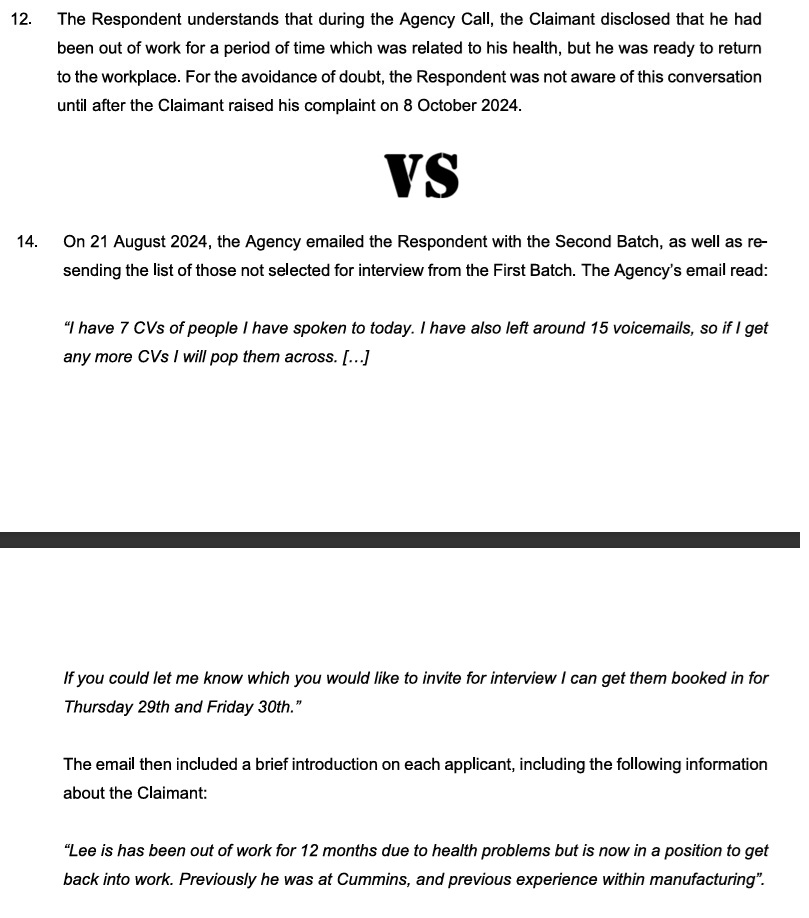
There it is. Not a tweet, not a metaphor and not something scratched onto a toilet wall by a disgruntled blogger after four cans of Monster. Cepac’s own pleaded defence contains the problem in black and white.
Paragraph 12 seeks to put distance between Cepac and knowledge relevant to disability. Paragraph 14 records recruitment information referring to an absence from employment because of health problems. Both passages live inside the same defence, concern the same recruitment process and were placed into the Tribunal record by the same company.
That leaves an obvious question. How exactly do those positions sit together?
A merits hearing would have been a rather useful place to find out. Witnesses could have been questioned, documents examined, the recruitment trail put under proper scrutiny and the issue of who knew what established through evidence rather than corporate archaeology. Instead, the litigation developed its own weather system. Procedure accumulated around the original dispute until the file began resembling a burial mound built entirely from professionally formatted PDFs.
The discrimination allegations never received their full merits hearing.
Paragraphs 12 and 14 survived anyway.
Paper is stubborn like that.
Fifty Grand And The Merits Still Died Outside
Over £50,000 went into fighting this litigation. That is a serious amount of money to feed into a legal machine whose central dispute still ended without a full determination on the merits.
Fifty grand buys an impressive amount of professional solemnity. Solicitors write to solicitors, counsel enters the machinery, bundles acquire the density of structural materials and schedules begin reproducing in captivity. Before long, people with expensive email signatures are discussing documents created to explain previous documents, while another document records the cost of everybody discussing the fucking documents.
Eventually, the invoice becomes architectural.
Yet underneath all that expensive sediment sits the same small question about what happened to the promised interview and what Cepac knew about the applicant’s health.
So here it is.
Why would a company spend around £50,000 fighting litigation that ends without the central disability-discrimination allegations receiving a full merits hearing?
If the recruitment process was clean, establish it. If the health information played no relevant part, demonstrate that. Should paragraphs 12 and 14 fit together perfectly, put the explanation under scrutiny and let somebody explain why the apparent tension disappears when the evidence is properly understood.
Perhaps there is a magnificent answer. Excellent. Open the fucking drawer and produce it.
Because around £50,000 is a remarkable amount of money to spend wandering through the legal system only for the merits to remain outside in the rain. A company can cover almost anything in procedure if enough paper is poured over it. The trouble starts when somebody notices the ground has been disturbed.
KFC Has A Cathedral Full Of Values
KFC Western Europe publishes an Ethical Sourcing Policy, while its parent Yum! Brands publishes human-rights and supply-chain commitments addressing discrimination, labour practices and supplier conduct. The modern corporate conscience is always beautifully formatted. Strong headings, solemn language and enough principled vocabulary to make procurement resemble a small humanitarian agency with access to SAP.
Large corporations have become remarkably good at converting morality into office infrastructure. Human rights gets a policy. Inclusion gets a framework. Responsible sourcing receives minimum standards. Somewhere, almost inevitably, a diagram contains several tasteful circles explaining how values flow through the business without ever troubling an accounts-payable clerk.
However, corporate ethics policies possess one potentially fatal defect.
Some bastard may eventually ask the company to use them.
Ethical sourcing is not tested when a supplier delivers on time, fills in the right questionnaire and produces the certificate procurement wanted. That is administration wearing a lanyard. The real examination starts when somebody hands the customer an inconvenient file and asks whether all those published standards apply when there might actually be a commercial relationship to disturb.
Here is Cepac. Here is its ET3. Here is the disability-discrimination case. Here is around £50,000 spent fighting litigation that still did not produce a full merits determination of the central allegations.
KFC’s policy has finished orientation.
It can report for work now.
Discrimination Has Already Walked Under The KFC Sign
KFC should not require a PowerPoint presentation explaining why workplace discrimination matters. A recent Employment Tribunal case involving Nexus Foods Ltd, a KFC franchise operator in south-east London, resulted in findings including direct race discrimination, race-related harassment, victimisation and wrongful dismissal. The claimant, Madhesh Ravichandran, was awarded roughly £66,800.
The reported circumstances were fucking grim. His manager referred to him as a “slave”, while derogatory remarks were also made concerning Indians. Nexus Foods was the employer and franchise operator, so the findings were not against Kentucky Fried Chicken (Great Britain) Ltd itself.
That legal distinction matters.
So does the enormous fucking KFC sign above the door.
Franchising is one of capitalism’s prettier pieces of theological engineering. When business is good, everything belongs to the brand. The colours, customer experience, advertising, identity, standards, loyalty and glowing logo are all carefully constructed to ensure the customer understands exactly whose world they have entered.
Then an employment judgment arrives carrying something rotten and everyone suddenly develops an intense scholarly interest in corporate anatomy. Separate company. Independent franchisee. Distinct employer. Different legal entity. All perfectly true, yet there remains something magnificent about spending decades making the brand omnipresent and then discovering shyness when the paperwork starts smoking.
The brand gets the applause.
Apparently the franchisee can keep the autopsy.
None of that makes KFC responsible for Cepac’s recruitment process. What it does is demonstrate that the company should understand perfectly well how employment conduct connected to organisations operating around a major brand can become a reputational problem long before Legal finishes explaining the organisational chart.
Promises Have An Excellent Survival Instinct
Then there are KFC’s animal-welfare commitments. For years, the business reported against the Better Chicken Commitment, including ambitions around slower-growing breeds and welfare improvements. Eventually, the timetable proved difficult and KFC acknowledged that important elements of the original plan were not going to be achieved as envisaged.
By 2026, KFC was among major restaurant businesses moving away from the Better Chicken Commitment and towards a different industry framework. The companies involved pointed to issues including economics, supply availability and environmental considerations, while animal-welfare campaigners viewed the change rather less generously.
The arguments themselves can fight outside.
What interests me is the corporate ritual.
A commitment is born beneath flattering lighting and immediately carried around the organisation like a saint’s finger bone. It enters sustainability reports, presentations and stakeholder literature. Everybody admires the ambition until reality eventually comes through the service entrance carrying an invoice.
Then the language begins changing.
Targets become challenges. Challenges become trade-offs. Trade-offs evolve into revised frameworks until the original promise eventually reappears wearing a different acronym and everybody solemnly explains that this is actually progress.
Corporate English is glorious stuff.
You could reverse a hearse into a graveyard and describe the manoeuvre as a stakeholder-led mobility transition.
That matters here because supplier standards live or die by exactly the same mechanism. A promise is worth fuck-all if the language becomes infinitely elastic whenever following it might inconvenience somebody commercially.
KFC Has Already Paid For The Supplier-Risk Course
KFC should also understand supplier dependency better than most companies on Earth. In 2018, changes to its UK distribution arrangements contributed to hundreds of restaurants closing because chicken was not reaching them. At the height of the disruption, more than three-quarters of KFC restaurants across the UK and Ireland were reportedly closed.
A chicken company had become unable to reliably distribute chicken.
There are moments when satire should simply sit down and admire the craftsmanship.
Underneath the national comedy, however, sat a serious supply-chain failure. Logistics arrangements had changed, the new system depended heavily on a central distribution operation and the machinery promptly seized. KFC eventually brought former distributor Bidvest back to handle part of the network.
Reality had completed the supplier review.
The lesson should have remained engraved somewhere inside head office. Suppliers matter. Logistics matter. Oversight matters. What happens several contractual steps away from the customer can still arrive through the front door wearing the company logo around its neck.
That makes KFC an unusually poor candidate for pretending supplier behaviour is merely somebody else’s administrative weather.
It already paid tuition.
China Removed The Punchline
A much darker supplier lesson arrived in China in 2014. A Shanghai food supplier became engulfed in allegations involving expired meat and altered production dates, with the fallout affecting major restaurant brands including KFC and Pizza Hut. Chinese authorities closed the plant, while Yum! subsequently severed its relationship with the supplier’s owner.
Once again, the supplier sat behind the consumer-facing brand. Customers had not selected the processing company, negotiated its contract or audited its systems. They bought from the logo they recognised.
Yet when the supplier became radioactive, the contamination travelled forward.
That is the irritating quality of supply chains. Corporate diagrams depict them as orderly horizontal lines because lines look controllable. Reality behaves more like a nervous system. Damage something far enough away from the face and eventually the fucking eyelid starts twitching.
This is why supplier due diligence exists. Not because executives particularly enjoy policies, and not because “responsible sourcing” looks handsome between “Our People” and “Our Planet”. It exists because the company you quietly pay today can become the company you publicly have to explain tomorrow.
Which brings us back to Cepac.
Here Is The Fucking Document Again
This is the centre of the article.
Not chicken welfare.
Or the distribution catastrophe.
Not Nexus Foods.
Not China.
Those stories merely establish that KFC already knows corporate standards, employment conduct and supplier relationships can become substantially more interesting once something unpleasant escapes from the paperwork.
Cepac’s paragraphs 12 and 14 belong to the same pleaded defence. Health-related information appears in the recruitment account. A disability-discrimination claim followed. Around £50,000 went into fighting the litigation and the central allegations still never reached a full merits determination.
There is no need to decorate that.
The paperwork is already lying on the slab.
KFC does not need to accept my interpretation, declare Cepac guilty or recreate an Employment Tribunal beside the photocopier. It merely needs to perform the most primitive form of supplier due diligence imaginable: open the document, read the words and ask Cepac what they mean.
Even a compliance department upholstered entirely in ESG brochures should be capable of that.
Ignorance Has A Shelf Life
Perhaps nobody at KFC knew any of this. That is perfectly plausible. Major companies deal with extensive supplier networks and litigation documents do not spontaneously materialise in the correct ethics inbox merely because somebody filed them.
Before notice, ignorance can simply be ignorance.
After notice, it becomes a choice with administration attached.
KFC can read the material, ask questions, seek reassurance, investigate further and decide there is absolutely no problem. Alternatively, somebody can quietly lower the file into a drawer and hope the furniture develops attorney-client privilege before anyone comes looking for it.
Either way, a decision has been made.
That is when corporate ethics stops being decorative literature and starts acquiring weight. Before somebody presents the evidence, the policy is a promise. Afterwards, it becomes a measuring instrument against which the company’s actual behaviour can be compared.
Trees in sustainability reports rarely create that kind of inconvenience.
Litigation files do.
The £50,000 Question For KFC
The questions are not difficult. Does KFC currently use Cepac? Has somebody responsible for ethical sourcing reviewed Cepac’s ET3? What explanation exists for paragraphs 12 and 14? Has anyone compared the circumstances of the disability-discrimination case against the standards KFC and Yum! publish for suppliers?
Then there is the question beneath all the others.
Why did around £50,000 go into fighting litigation that ended up being dragged into an engineering conduct hearing, concluding without the central disability-discrimination allegations receiving a full merits determination?
That question survived the strike-out. It survived the correspondence, applications, conduct arguments, hearings and whatever quantity of professional paper was eventually stacked on top of the original dispute. Legal files have a habit of preserving awkward questions long after institutions have congratulated themselves for achieving procedural closure.
The darkest institutional machinery rarely has blood on it.
Mostly it has page numbers.
A human being enters one end as somebody asking why a promised interview disappeared. Soon he is a claimant number. His disability becomes a paragraph, the disputed recruitment decision becomes another paragraph and lawyers begin adding layers until the original human problem is almost invisible beneath the sediment.
Nobody needs to drag a body through reception.
The filing system can handle it.
Around £50,000 later, the merits still never received their full hearing.
The ET3 remained on file.
That is the corpse in the cabinet.
Finger Lickin’ Due Diligence
The KFC Cepac supplier problem is ultimately smaller than KFC’s ethical-sourcing literature and considerably harder to bury beneath it. KFC publishes supplier standards. Yum! publishes human-rights commitments. Cepac appears in KFC’s customer trail, while Cepac’s own pleaded defence contains two passages that deserve explanation.
There is no need for theatrical corporate punishment. Nobody is asking KFC to set fire to a pallet of cardboard in the car park while an ethics committee chants over it. Read the ET3. Ask what happened. Compare the answer with the standards already published under the KFC and Yum! names.
Perhaps everything will satisfy them.
Fine.
At least somebody opened the fucking drawer.
That is the difference between an ethics policy and ethics. One sits weightless inside a PDF waiting to be quoted in an annual report. The other begins when the evidence is inconvenient, the supplier is useful and somebody still decides the question deserves an answer. Does KFC hire disabled workers?
The Colonel can keep smiling. Procurement can keep ordering. Cepac can keep making cardboard.
But paragraphs 12 and 14 are in the box now.
Around £50,000 could not make them disappear.
KFC certainly cannot recycle them.
Lee Thompson – Founder, The Cummins Accountability Project
Source List
- KFC Western Europe – Ethical Sourcing Policy
- Yum! Brands – Ethics & Human Rights
- Yum! Brands – Supplier Code of Conduct
- Yum! Brands – Human Rights & Labor Practices Policy
- KFC Western Europe – Chicken Welfare Annual Progress Report
- KFC Franchise Employee Wins £66k In Race Discrimination Claim
- Nando’s And KFC Among UK Restaurant Chains To Drop Chicken Welfare Pledge
- The Inside Story Of The Great KFC Chicken Shortage Of 2018
- The Cepac Files : Greggs, Cepac And The Dirty Conduct Narrative
- Cepac ET3 Grounds of Resistance – paragraphs 12 and 14
- Cepac customer material identifying KFC