McCain sells frozen potatoes. Cepac sells cardboard. Between them sits enough corporate ethics language to insulate a fucking walk-in freezer, all polished principles, responsible sourcing and solemn promises about how human beings should be treated somewhere beyond the loading bay.
Unfortunately, corporate scripture becomes considerably less decorative when somebody reads the small print. McCain’s own Supplier Code reaches directly into employment discrimination, expressly covering recruitment and disability, which is inconvenient because TCAP happens to possess some recruitment paperwork from one of its packaging suppliers. Not a rumour fermented overnight in somebody’s grievance cellar. Not a wounded LinkedIn post. An Employment Tribunal pleading.
Buried inside that document are two paragraphs which have followed Cepac around like the smell escaping from a badly sealed mortuary drawer.
Paragraph 12.
Paragraph 14.
Surgical Summer, meet the fucking freezer.
McCain Wrote The Fucking Rule
Corporate supplier codes are magnificent pieces of ceremonial masonry. Somewhere inside a headquarters, committees gather around conference tables and spend weeks deciding whether respect should precede integrity, whether people require a capital letter and precisely how many photographs of smiling employees are necessary before a multinational corporation can safely pronounce itself compassionate.
Eventually the document emerges. Human rights have been polished until they resemble hotel-lobby marble, responsibility has received the ecclesiastical treatment, and Procurement gets another PDF to place inside the great digital basilica of corporate virtue. Nobody expects some troublesome bastard to actually read it.
TCAP reads the fucking things.
McCain’s Supplier Code is unusually useful because underneath the polished surface it contains something specific. Employment discrimination includes recruitment and hiring. Disability is expressly covered. Suppliers are expected to comply with the standards McCain has chosen to publish, while those expectations are supposed to continue through the commercial chain rather than evaporating the moment a purchase order changes hands.
Its Global Human Rights Policy adds another layer to the cathedral. Discrimination, harassment and bullying are not tolerated, according to McCain, while adverse human-rights impacts connected to business relationships are supposed to matter when they are brought to the company’s attention. Reporting systems exist, investigations are contemplated and corrective action sits waiting somewhere inside the machinery.
Lovely.
Consider this article the fucking doorbell.
The Cardboard On The Slab
The Cepac story began with recruitment, not social media, not blogging and certainly not some grand plan to spend the following years conducting corporate autopsies between cups of coffee. In 2024, I applied for a production role through Page Outsourcing and took part in a telephone conversation on 21 August. During that call, I was offered an interview at Cepac “after the bank holiday”, a contemporaneous, time-stamped Whatsapp message shows it, and I also disclosed the mental-health-related reason for a gap in my employment history.
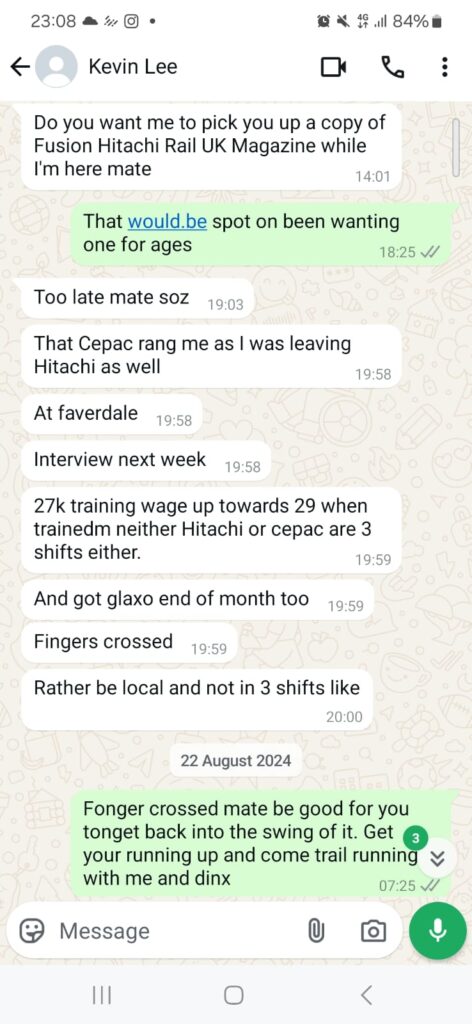
I later complained, knowing that the offer had been made before my medical disclosure. Cepac denied I was ever offered an interview. Funny, that. My friend’s witness statement confirms I’m unlikely to be mistaken.
Cepac’s position was that the conversation formed part of an agency screening exercise, and from that disagreement grew a disability-discrimination dispute that ultimately reached the Employment Tribunal. The central discrimination allegations, however, never received a full merits hearing.
That last fact is not a decorative procedural footnote. It is the doorway into everything that followed, because the document TCAP has subsequently carried through Cepac’s customer network did not disappear merely because the litigation ended somewhere else. Paper has an annoying tendency to survive the people arguing over it.
A document has no nervous system. You cannot bully it until it loses emotional regulation, exhaust it until its tone deteriorates or surround it with enough lawyers that it starts doubting what is printed on the fucking page. Paper simply lies there beneath the mortuary lamp, indifferent to everybody’s salary, title and tactical positioning.
Eventually someone reads it again.
Cepac’s ET3 rewards the second reading.
Paragraph 12 Meets Paragraph 14
The contradiction TCAP has repeatedly identified concerns what Cepac knew about my health during the recruitment process. In one part of its pleaded response, Cepac puts distance between itself and knowledge relevant to disability. A little further down the same document, however, the recruitment record is described as containing information that my absence from employment had been because of health problems.
Those propositions were not excavated from separate cases, different witnesses or paperwork found six months apart in somebody’s filing cabinet. They live together inside Cepac’s own ET3, separated by little more than a handful of numbered paragraphs and the increasingly uncomfortable sound of corporate masonry beginning to crack.
Paragraph 12.
Paragraph 14.
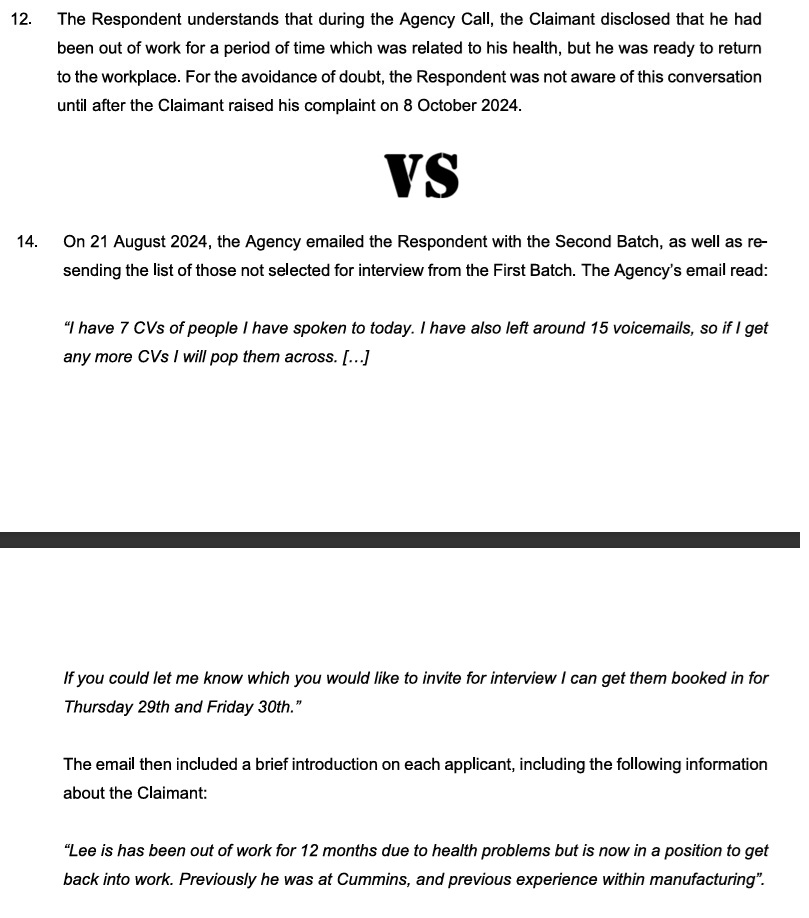
There it fucking is.
No reconstruction assembled years later from grievance, hindsight and smoke. No anonymous source whispering from behind a loading bay. Cepac put both propositions into the same formal Employment Tribunal response, filed the document and left them sitting there together like two bodies accidentally wheeled into the same mortuary drawer.
That is precisely why the merits mattered. A full hearing could have put the recruitment chronology under proper forensic light, examined the records, tested the witnesses and explored Page Outsourcing’s role in carrying information between applicant and employer. Most importantly, somebody deciding the actual discrimination claim could have asked the obvious questions: what was recorded, who knew it, when did they know it, and what significance did any of that have after the medical disclosure?
Instead, the proceedings migrated somewhere else entirely. The conduct case grew until it occupied the room, swallowed the furniture and eventually ate the merits. Disability discrimination and victimisation were struck out on conduct grounds, the original allegations were never tried to judgment, and a £20,000 costs order landed on top of what remained like a fucking gravestone.
Cepac denied discrimination throughout. No Tribunal ultimately found that Cepac discriminated against me.
Neither did a merits judgment decide that it did not.
That distinction is not legal trivia. It is the entire reason paragraphs 12 and 14 remain alive inside this project. The question they raised was never killed by evidence, cross-examination and a judicial determination on the discrimination merits. It was simply left behind when the litigation took a different road.
The corpse everybody originally arrived to identify never reached the post-mortem.
The paperwork is still on the slab.
Before McCain Inspects The Cardboard
Before McCain reaches down the supply chain, straightens its ethical clipboard and begins checking whether everybody else has complied with the rules, we should probably open one of the older drawers in its own institutional freezer. There is history in there, and history has an unfortunate habit of refusing to stay respectfully wrapped.
In 2003, the United States Equal Employment Opportunity Commission sued McCain Foods USA in federal court. The allegation concerned two female employees at McCain’s Othello operation who, according to the EEOC, had been denied promotions because they were women.
McCain denied discrimination.
No merits judgment ultimately decided the allegation. The litigation instead concluded through a court-approved consent decree in 2004, under which McCain paid the two women a combined $9,000 and agreed to a series of measures involving anti-discrimination policy, equal-employment-opportunity training and regulatory reporting.
The procedural distinction matters. A consent decree is not a judicial finding that McCain discriminated, and there is absolutely no need to stuff a false conviction into the coffin when the actual historical record already has enough weight.
America’s federal employment-discrimination regulator sued McCain alleging that two women were denied promotion because they were women. Money, training, policies and compliance reporting subsequently formed part of the resolution.
That file smells strongly enough without TCAP pouring fucking gravy over it.
A Match Made In Misogynist Heaven?
Then there is Cepac.
At the time of writing, Companies House records ten active individual directors at Cepac Limited. TCAP’s review of those directors identifies ten men, which gives the boardroom roughly the gender diversity of a Victorian undertakers’ convention.
Picture the architecture for a moment. A polished table stretches beneath fluorescent corporate lighting while ten leather chairs sit occupied by ten men, testosterone slowly curing in the atmosphere like industrial resin. Somewhere at the far end of the room, perhaps, somebody is explaining how profoundly modern the organisation is.
Across the supply chain sits McCain, carrying an old federal case in which the employment regulator alleged women had been denied promotion because of their sex. Cepac arrives carrying enough men into one boardroom to field a football team, assuming somebody eventually appoints a goalkeeper.
Perhaps the potatoes and cardboard simply recognised something in one another across a crowded procurement spreadsheet.
A match made in misogynist heaven?
An all-male board does not prove misogyny, obviously. Nor does a discrimination case resolved more than two decades ago establish some eternal corporate hostility towards women. The point is not to turn symbolism into evidence.
Corporations, however, fucking adore symbolism whenever the symbolism flatters them.
A rainbow logo is symbolic. So is the smiling employee beneath the word belonging, the woman in a hard hat decorating page six of the sustainability report and the annual photograph of somebody planting a tree while Corporate Affairs gently masturbates the word purpose into LinkedIn.
Fine.
Ten chairs occupied by ten men can wear symbolism too.
Quite the family photograph.
Good Ethics Is Good Business
McCain has a phrase for all this.
Good Ethics is Good Business.
There is something wonderfully ecclesiastical about corporate ethics language once it reaches that level of confidence. The Code of Conduct expects employees, officers and directors to follow the rules, while suppliers and business partners sit inside the wider ethical architecture. Leaders are supposed to foster inclusion, encourage reporting and cooperate when potential misconduct requires investigation.
TCAP loves good ethics. What interests us rather more is watching them leave the climate-controlled PDF and attempt to survive outdoors.
McCain’s modern-slavery reporting similarly describes supplier standards, human-rights diligence and responsible sourcing as meaningful parts of the way the company operates. None of it is presented as garnish beside the Potato Smiles. These are supposedly working controls inside a serious multinational supply chain.
Policies remain laboratory specimens until somebody introduces discomfort.
The genuine experiment begins when Procurement receives an awkward document involving a real supplier, Legal starts reading paragraphs which do not sit happily beside each other and Compliance has to decide whether anything actually needs doing. Suddenly all those beautiful nouns leave the basilica and find themselves standing in a loading bay beside something inconvenient.
That is when an ethics policy gets its first fucking heartbeat.
Meanwhile, The Potatoes Have Lawyers
McCain’s contemporary corporate record is hardly an untouched snowfield either. Across the Atlantic, the company currently sits among the frozen-potato producers named in significant antitrust litigation alleging that major processors exchanged competitively sensitive information and used that environment to maintain artificially high prices.
Those remain allegations. McCain and the other defendants are entitled to contest them, and no finding has established the plaintiffs’ case.
Then, in February 2026, the United States Department of Justice walked into the freezer.
Its Antitrust Division filed a Statement of Interest addressing aspects of the legal framework being argued in the litigation. DOJ expressly declined to take a position on the ultimate merits, but challenged certain propositions about when exchanges of market information can produce anticompetitive effects.
That does not prove McCain fixed the price of chips.
It does, however, create one of those magnificent moments when corporate mundanity collides with federal law. Somewhere, presumably, lawyers bill serious hourly rates while discussing aggregated potato data and the economics of frozen fries beneath the solemn gaze of the United States government.
Civilisation really did peak beautifully.
When the Department of Justice arrives in litigation concerning the price of frozen fucking potatoes, reasonable people may briefly look up from the fryer.
Apparently even chips can acquire counsel.
Keep Your Fingers Away From The Machinery
Appleton, Wisconsin provides another drawer.
In 2023, the US Occupational Safety and Health Administration issued McCain Foods USA a Serious machine-guarding citation at its Appleton operation. Hazards identified in the citation involved equipment including conveyors, an auger, a case erector and a box sealer, with multiple employees recorded as exposed.
The final penalty came to $14,609.
Two years later, the machinery produced another helping of federal paperwork. A December 2025 citation at the same operation was again classified as Serious, this time identifying employees exposed to hazards involving unguarded sprockets, chains and caught-in risks. Following settlement of the citation, a monetary penalty remained and the matter became a final order in January 2026.
There is nothing remotely funny about somebody’s hand meeting industrial machinery.
The humour belongs upstairs.
It belongs with the strange institutional ability to manufacture acre after acre of immaculate prose about safety, dignity, people and responsibility while federal inspectors downstairs are writing SERIOUS into another fucking box. Corporate language is wonderfully soft to the touch until reality arrives with gears.
Compliance brochures have rounded corners.
Machinery does not.
The Ammonia File
Environmental enforcement supplies another wonderfully physical reminder that corporate principles eventually encounter real objects.
In 2018, McCain Foods USA agreed to pay a $225,000 penalty concerning alleged failures involving chemical-accident-prevention and emergency-planning requirements at its Easton, Maine operation. The facility used significant quantities of anhydrous ammonia as part of its refrigeration processes, making emergency preparation considerably more important than another tasteful paragraph about stakeholder wellbeing.
Money was not the only component of the settlement. McCain also had to work with local emergency responders around arrangements for notifying nearby Amish residents if an ammonia release occurred.
There is an image for the sustainability report.
Thousands of pounds of potatoes sit inside an industrial refrigeration complex while somebody eventually discovers that emergency planning must account for actual human beings living beyond the perimeter fence. Real risk does not care how beautifully the company describes itself.
It leaks.
Then it burns.
Then it catches fingers and enters lungs.
Somewhere upstairs, another PowerPoint says People First.
Plastic Potatoes And Other Garnishes
Even the product line has contributed its own small pieces of grotesque garnish.
Canadian authorities announced a December 2025 recall involving McCain Tasti Taters Crispy Potato Bites because pieces of plastic were present. Another recall in 2024 concerned McCain potato products potentially containing metal fragments, although that incident was linked to contaminated salt used during manufacturing, so pretending McCain personally forged shrapnel into the fucking fries would be both inaccurate and stupid.
The imagery is sufficiently deranged without embellishment.
Plastic turns up in the potatoes. Metal appears in another production chain. Antitrust lawyers circle the freezer, OSHA paperwork sits beside industrial machinery, environmental enforcement gathers around the ammonia system and an old federal sex-discrimination case waits further down the archive.
Underneath all of it remains a Supplier Code informing companies inside McCain’s commercial ecosystem not to discriminate against disabled people in recruitment.
Corporate life has always been generous to TCAP.
Leave it unattended for long enough and the metaphors start writing themselves.
Back To The Cardboard
None of McCain’s own history decides what happened during the Cepac recruitment process. That distinction matters because TCAP is not interested in constructing some gigantic rhetorical blender where every corporate failure magically proves every other allegation.
An OSHA citation does not prove disability discrimination. Antitrust litigation about frozen potatoes cannot determine the meaning of Cepac’s ET3, while a historical EEOC case says nothing about what anybody at Cepac or Page Outsourcing knew during August 2024.
The real point is much cleaner.
McCain wrote the rule.
Not TCAP.
Or an activist group.
Not some hostile former employee angrily demanding that McCain adopt a standard invented specifically for this article.
McCain says disability discrimination in recruitment is unacceptable within the supplier framework it chose to publish. Its human-rights architecture expects suppliers to meet relevant standards, while compliance problems are supposedly capable of investigation and corrective action.
So forget the frozen-potato detour for a moment.
Turn off the machinery, close the antitrust file and wheel the ammonia cylinder back into its cupboard. Place two documents beside each other under the mortuary light and remove every ornamental corporate noun from the room.
McCain says suppliers must not discriminate on the basis of disability in recruitment.
Cepac’s ET3 contains the contradiction TCAP has repeatedly identified concerning health information during a disputed recruitment process. The contemporaneous WhatsApp message supports my account of the interview offer and makes Cepac’s later denial considerably harder to square with the record.
Somebody’s version is wrong.
Funny how the paperwork keeps pointing in the same fucking direction.
The discrimination merits were never tried.
That is the fucking file.
Everything else is scenery.
Has McCain Actually Looked?
Perhaps it has.
Somebody inside McCain may already have opened the ET3, placed paragraph 12 beside paragraph 14, contacted Cepac and reviewed the recruitment circumstances. Procurement or Legal may have considered the material and reached a perfectly defensible conclusion that no supplier action was required.
Excellent.
What was the conclusion?
The commercial relationship itself may also have changed. Contracts expire, suppliers rotate and procurement departments occasionally move on without issuing a fucking commemorative plaque. If Cepac no longer supplies McCain, that is useful information and McCain can simply say so.
There is, however, a third possibility.
Nobody looked.
Nothing happened.
The Supplier Code remained inside its immaculate corporate chapel while an actual supplier-risk question walked past outside carrying a folder marked DISABILITY, RECRUITMENT, ET3. Human rights stayed polished behind glass, Procurement continued purchasing things and the ethical machinery never so much as coughed.
If that is what happened, another fifty pages of ESG prose will not make the silence prettier.
It will simply make the coffin heavier.
Questions For McCain
McCain does not need to solve an ancient philosophical riddle here. Nobody is asking the company to disclose the molecular architecture of a waffle fry or explain why one particular frozen chip tastes inexplicably better at 1 a.m. than it does at lunchtime.
The questions are considerably duller, which is exactly why they matter.
Does McCain currently purchase packaging, products or services from Cepac Limited? If that relationship has ended, when did it end?
Has McCain reviewed the disability-discrimination litigation involving Cepac Limited and Page Outsourcing UK Limited?
Did anybody within McCain examine paragraphs 12 and 14 of Cepac’s ET3, including the recruitment information concerning my health-related employment gap?
Has Cepac been asked to explain the apparent contradiction identified by TCAP between those passages? Search “Cepac discrimination” and the problem is hardly hiding in the fucking undergrowth. TCAP has published the contradiction repeatedly. This article also debuts the contemporaneous WhatsApp message supporting my account of the interview offer, a time-stamped little corpse Cepac’s denial now has to lie beside.
Does McCain consider its prohibition on disability discrimination in recruitment applicable to the circumstances raised by this file?
Have McCain’s Procurement, Legal, Compliance or Human Rights functions undertaken any supplier-risk assessment concerning Cepac as a result?
Has McCain requested information from Cepac demonstrating compliance with its Supplier Code?
Has McCain considered Page Outsourcing’s role within the recruitment chain?
If McCain reviewed the material and concluded no action was required, what was the basis of that conclusion?
And finally:
If nobody has reviewed it, what exactly is the Supplier Code for?
That is the experiment.
Not whether McCain can publish a policy.
Whether the fucking machinery switches on when something inconvenient arrives.
The Freezer Door
McCain has spent years telling employees, suppliers and the public that ethics matter. Cepac, like every sufficiently large corporate organisation with access to a marketing department and a cupboard full of adjectives, has wrapped itself in the familiar language of people, responsibility, standards and doing business properly.
Together they make quite a fucking box.
Inside sits McCain’s Supplier Code, containing a prohibition on disability discrimination in recruitment. Beside it lies Cepac’s ET3 and the contradiction TCAP has repeatedly identified between paragraphs 12 and 14. Next to that sits the contemporaneous WhatsApp message, time-stamped on the day of the disputed interview offer and making its first appearance on TCAP here, long before the Tribunal, long before the blog and long before anybody had a conceivable reason to start manufacturing exhibits for litigation that did not fucking exist.
Quite the evidence locker.
Behind the lot is a disability-discrimination case whose merits were never tried. More than £50,000 in claimed legal costs accumulated around a vast conduct battle which eventually swallowed the original discrimination questions whole. By the time the machinery stopped grinding, disability discrimination and victimisation had been struck out, a £20,000 costs order had landed, and the recruitment dispute which brought everybody into the building had disappeared beneath enough procedural concrete to build a fucking mausoleum.
The case began with disability and recruitment. What followed was an aggressive, tailored legal strategy that drove the proceedings deep into conduct territory, where collections of communications, posts and other material were assembled around my behaviour until the claimant became the exhibit and the original allegations became scenery. The discrimination question was not killed by a merits judgment. It was buried beneath the conduct case.
Further back in McCain’s freezer sits its own institutional history. A federal sex-discrimination lawsuit resolved through a consent decree shares shelf space with Serious machine-guarding citations, environmental enforcement and current antitrust allegations significant enough for the United States Department of Justice to enter the litigation on questions of law. Quite the collection for a company now standing at the end of a supply chain waving a code of ethical conduct at everybody else.
Across the aisle stands Cepac’s boardroom.
Ten directors.
Ten men.
A glorious little corporate mausoleum of modernity.
Cepac’s owners are Yemeni. Its ten-person board contains ten men. Make of the fucking tableau what you will.
What it provides is another magnificent piece of corporate scenery in a story where McCain once faced federal allegations that women had been denied promotion because of their sex, while its packaging supplier currently manages to seat ten men around a ten-person boardroom table. Somewhere, surely, a diversity PowerPoint is quietly trying to crawl into the fucking sea.
Strip away the skeletons, however, and the central problem remains beautifully simple. McCain wrote rules specifically designed for the moment when supply-chain ethics stop being abstract nouns embalmed inside a PDF. One of those rules concerns disability discrimination in recruitment.
This is one of those moments.
The supplier relationship exists, or existed, and McCain can clarify its current status. Cepac’s ET3 exists. Paragraphs 12 and 14 exist. The contemporaneous WhatsApp message exists, while a witness statement confirms its provenance and explains why its author considers it highly unlikely that I misunderstood the interview offer.
The merits judgment does not exist.
That absence is the fucking hole in the middle of the room.
So now the question moves to McCain. Not whether it can publish another policy, commission another brochure or find another tasteful photograph of somebody standing in a potato field beneath the word responsibility. The question is whether the ethical machinery actually switches on when a real supplier problem arrives carrying paperwork, including a contemporaneous WhatsApp message supporting the disputed interview offer, an ET3 containing the contradiction TCAP keeps putting under the mortuary lamp, and a disability-discrimination case in which more than £50,000 in claimed legal costs accumulated around a vast conduct battle built from material curated by the respondent side to recast my conduct as the central problem, after an aggressive, tailored legal strategy drove the proceedings away from the recruitment merits and deep into conduct territory.
The machinery was enormous. Claimed legal costs climbed beyond £50,000 while communications, posts and behaviour were assembled into the new centre of gravity, leaving the original discrimination questions buried somewhere beneath the fucking paperwork.
And after everything had been dragged through that procedural meat grinder, the discrimination merits were never heard.
The documents are on the slab.
The freezer light is on.
McCain knows how to keep potatoes frozen.
TCAP has no intention of letting the paperwork join them.
Lee Thompson – Founder, The Cummins Accountability Project
Source List
- McCain Foods Supplier Code of Conduct
- McCain Foods Global Human Rights Policy
- McCain Foods Code of Conduct
- McCain Foods GB Modern Slavery Statement
- EEOC v McCain Foods USA complaint
- EEOC v McCain Foods USA case record and consent decree information
- US Department of Justice, Frozen Potato Products Antitrust Litigation Statement of Interest
- OSHA, McCain Foods USA Appleton citation, 2023
- OSHA, McCain Foods USA Appleton citation, 2025
- US EPA, McCain Foods USA Easton enforcement settlement
- Government of Canada, McCain Tasti Taters recall
- Companies House, Cepac Limited officers
- TCAP, Warburtons Disability Discrimination: Sliced Bullshit