On 24 April 2026, Horsfield Menzies helped Cepac end a disabled claimant’s case through a manufactured conduct hearing held in his absence. The judgment was dated 28 April. On 30 April, the firm published a sermon by Scottish solicitor Calum Maclean on meaningful dialogue, psychological safety and compassionate responses to mental ill health. Six days from courtroom to conscience. Forty-eight hours from judgment to fucking wellbeing copy.
Horsfield Menzies keeps publishing the ruler by which its own behaviour can be measured, then leaving the thing beside the case file like it expects nobody to notice the numbers. TCAP has noticed. This is the third time the firm’s public advice has been placed against the documented conduct of the lawyers selling it, and the comparison is becoming less like satire and more like an internal audit performed by an enemy.
The first hit put Marcia Sumbe’s article about disability-linked misconduct beside a case in which Horsfield Menzies helped turn a disabled claimant’s emotionally dysregulated reactions into strike-out material. Next came Laura McLellan’s workplace-investigation sermon and a firm that gave no investigation outcome to the disabled man who complained directly to its owners about Sam Butler. Now we look at how Horsfield Menzies published Mental Health Awareness Week beneath Calum Maclean’s byline, a polished little slab of professional conscience released almost immediately after the firm’s work helped finish the claimant’s case without the underlying disability-discrimination allegation ever reaching a merits hearing.
The Horsfield Menzies mental health article says all the correct things. Depression and anxiety can qualify as disabilities. Constructive knowledge can be enough. Employers should seek medical advice, use discretion, engage in “meaningful dialogue” and create a “psychologically safe environment”. Dismissive treatment can cause harm. Rigid disciplinary systems can discriminate. Compassion should last all year rather than appearing for one branded week in May.
Lovely. Apparently, the website understands everything the file appears to have forgotten.
Six Days From Hearing To Awareness
The chronology does not need decoration. On 24 April 2026, Employment Judge James conducted the strike-out and costs hearing by video. I did not appear after a late document ambush, that a previous tribunal order was explicitly designed to prevent, and was not represented. Daniel Rubin of Horsfield Menzies appeared for Cepac, although the published judgment misspelled his name as “Rubian”. The Tribunal proceeded in my absence, considered the written material and heard the respondents’ submissions.
That material was not a modest examination of whether a promised job interview disappeared after disclosure of mental ill health. The main hearing bundle ran to 1,657 pages, excluding its index, alongside a 136-page authorities bundle. Cepac’s strike-out evidence included one section built from communications and blog posts and another assembled from X posts. Distress had been collected, numbered, indexed and delivered back into the hearing as a professionally prepared account of why the disabled person alleging discrimination had become the problem.
The judgment carries the date 28 April 2026. It struck out the claims as a result of findings about the conduct of the proceedings and ordered me to pay Cepac £20,000 towards costs. Two days later, on 30 April, Horsfield Menzies published Calum Maclean’s advice about compassion, dialogue and mental-health-aware decision-making.
Compassion had not vanished. It was waiting for the litigation team to finish with the room.
Calum Maclean And The Scottish Solicitor Warning Label
Horsfield Menzies describes Calum Maclean as an “Associate (Scottish Solicitor)”, a parenthesis that lands less like a qualification than a small consumer warning: rates not the most competitive; may contain traces of battered Mars bar. The firm had already hung him out to dry on its own website before TCAP arrived, so there is no need to pile on. Maclean is not the main target here. The firm that attached the warning label, chose his byline and scheduled the article is.
Behind that spectacularly unnecessary nationality bracket, Maclean’s profile describes a commercially focused employment lawyer with significant experience of discrimination and Employment Tribunal work. It also records that he previously served as a director of Glasgow Council on Alcohol. Mental health, vulnerability and the consequences of pressure are therefore not alien concepts wandering onto the firm’s website without an appointment.
The article bearing Maclean’s name presents the public version. Mental health is not a “soft” issue, it says. Employers should recognise that symptoms fluctuate, avoid one-size-fits-all treatment and understand that formal medical labels are not always required before duties arise. It advises meaningful engagement and warns that proceeding without proper consideration can expose organisations to disability-discrimination claims.
It is immaculate employment-law copy. Smooth, wipe-clean and ready to invoice around. Unfortunately, Horsfield Menzies had already created the case study showing what the advice looks like when the disabled person is not the client.
Meaningful Dialogue For Whoever Holds The Purchase Order
Maclean recommends meaningful dialogue. The phrase sits beautifully on a webpage because dialogue is cheap when it belongs to somebody else’s workplace. In March 2025, I sent a detailed complaint about Sam Butler directly to Angus Menzies, Simon Horsfield and Daniel Rubin. It raised alleged misuse of disability-related medical information, contact with my GP or medical centre, aggressive costs pressure and statements made during the litigation. No investigation outcome was communicated to me.
The firm later launched a Workplace Investigations Unit offering paying organisations impartiality, sensitivity, evidence review, findings and recommendations. When the complaint named one of its own solicitors, those attractive nouns apparently lost the office postcode. Horsfield Menzies had the quiet version of the dispute, the case number, the allegations and the chance to explain what it had examined. What came back was not a reasoned outcome. Eventually, my reaction returned instead, enlarged and filed as evidence about me.
Then there was the medical appointment. Horsfield Menzies contacted the medical centre, established that another appointment could be arranged and used that availability against a postponement request. The firm maintained that no private medical information had been disclosed. That never answered the uglier question of why solicitors acting for a company accused of disability discrimination considered a disabled opponent’s healthcare timetable something to investigate and deploy.
Maclean’s public advice says to seek medical input where appropriate. His colleagues found a more commercially useful relationship with the medical provider: check the diary, protect the hearing date and place the result before the Tribunal. At Horsfield Menzies, meaningful dialogue appears to depend heavily on which side of the purchase order the human being is standing.
The Medical Evidence Went In. Conduct Came Out
This was not a case in which Horsfield Menzies had to infer mental ill health from a sad face on a Teams call. The record contained GP letters, anxiety and depression screening scores, references to ambulance call-outs, medication history and evidence concerning emotional regulation under stress. A GP letter recorded depression, anxiety, difficulty controlling emotions and serious problems managing frustration under pressure. The disability context was not hidden. It was in the fucking bundle.
Cepac’s case, advanced through its legal team, attacked the weight and meaning of that evidence. The published judgment records the GP letter being characterised by the respondent as “self-serving and derivative”. It also records the argument that reliance on mental health was internally inconsistent, opportunistic and insufficient to explain the sustained course of conduct. The Tribunal ultimately accepted in principle that my medical condition could sometimes lead to emotional dysregulation, but rejected it as justification for the wider pattern and struck out the claim.
That is the conversion line. Medical distress entered the process as context. Horsfield Menzies helped drain it of explanatory weight, catalogue the reactions and return them as evidence of character and conduct. The firm did not lack knowledge. It had enough knowledge to argue about causation in detail and enough medical material to build submissions around why the link should not save the claim.
Maclean’s article warns against rigid disciplinary treatment where disability is involved. Horsfield Menzies helped construct something more efficient than a rigid policy. Every angry email could become an entry. Complaints could become escalation. Each blog post could become another numbered extract. The person’s condition remained real enough to discuss but never powerful enough to interrupt the machinery processing his reactions.
Psychological Safety In A 1,657-Page Bundle
“Psychological safety” is another excellent phrase from the Maclean article. It sounds humane, modern and pleasingly billable. In the actual proceedings, safety looked rather different. I sought adjustments including remote or private participation, breaks and support. My written case also argued that pressure, late material, hostile correspondence and the conduct-focused framing were worsening the disability-related disadvantage. The strike-out hearing still proceeded without me.
Meanwhile, the documentary operation was magnificently healthy. A 1,657-page hearing bundle arrived with separate strike-out evidence devoted to communications, articles and X posts. The legal team did not merely encounter distress. It indexed it. The case moved further from the disputed recruitment decision and deeper into a curated archive of everything I had written while fighting companies, lawyers, regulators and a tribunal process I believed was failing me.
This is the most revealing part of Horsfield Menzies’ dual system. For paying employers, mental-health-linked conduct should trigger discretion, medical advice, thoughtful process and careful consideration of disadvantage. Put a disabled litigant opposite its client and the reactions became raw material. One side received a seminar. The other became the slide deck.
Maclean also says Mental Health Awareness Week must not become a box-ticking exercise. Horsfield Menzies can relax on that point. Its litigation work was not box-ticking. It was box-building, page-numbering and tabulation on an industrial scale. Meanwhile, empathy stayed online while the distress went into Part 1 and Part 2.
The Merits Were Left In The Waiting Room
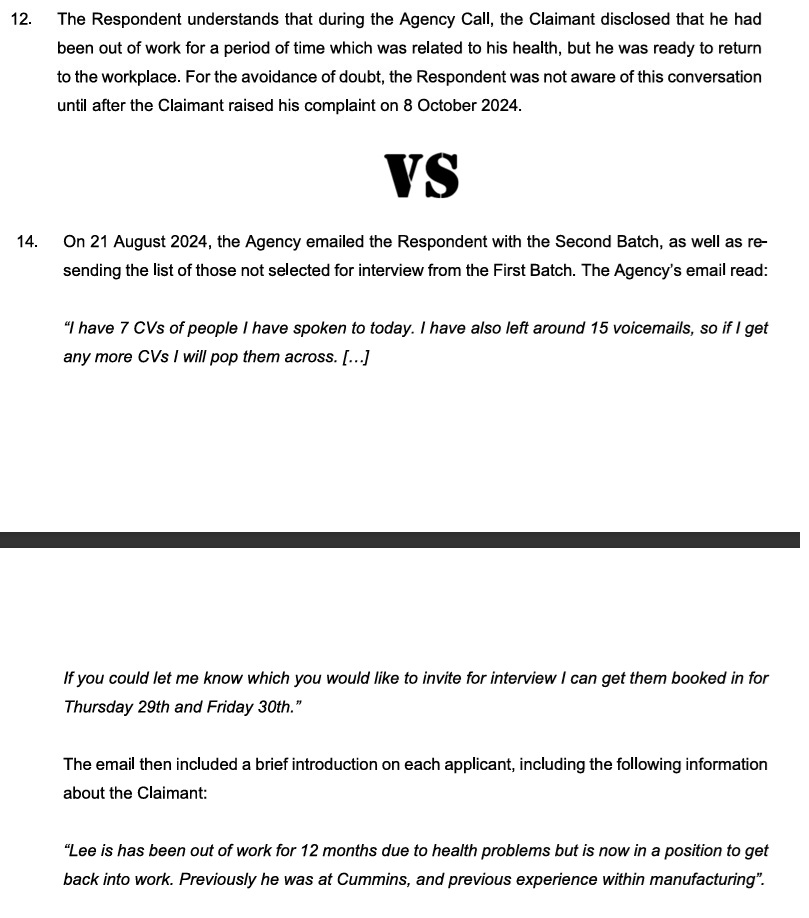
The underlying allegation was painfully simple. I say that I was selected for an interview with Cepac, disclosed a mental-health-related gap in my employment and then never received the promised follow-up. Cepac denied that an interview had been offered and presented the call as part of an agency-screening process. Its formal response also relied on recruitment information referring to the health-based employment gap while seeking distance from knowledge of disability.
That contradiction should have been tested through witnesses, records and cross-examination at a merits hearing. It never was. The Tribunal accepted the respondents’ conduct case, struck out the claims and imposed the £20,000 costs order. I have appealed. No completed merits hearing determined whether Cepac discriminated after learning about my mental health.
Instead, Cepac and its disability bullies helped make the claimant the principal exhibit. The recruitment chronology became a short opening act before the lawyers wheeled in the correspondence, complaints, posts and regulatory approaches. A case about what happened after a disability disclosure ended with the disclosure’s human consequences used to help close the case.
Maclean’s article tells employers that mental health and employment law are closely intertwined. Horsfield Menzies demonstrated a more profitable knot. Consequently, the firm’s client escaped a merits determination, the disabled claimant left with a costs order and the lawyers retained enough moral vocabulary to publish a wellbeing article before the week was out.
Compassion Was Scheduled For Thursday
The conclusion to Maclean’s article says employers who understand their obligations, act early and respond compassionately are better placed to support people throughout the year. Horsfield Menzies published that on Thursday 30 April. The judgment ending my claim was dated Tuesday 28 April. By Thursday, the content calendar had recovered from the moral injury.
Nobody at Horsfield Menzies needed a training course to recognise the ingredients. The firm knew about the anxiety and depression. Its lawyers had the GP letters, the emotional-regulation evidence, the adjustment requests, the complaints and the repeated statements that the process was causing harm. They also had the professional skill to understand precisely how distress could interact with tone, volume, attendance and behaviour. Marcia Sumbe had already written about it. The firm was about to publish the same lesson again beneath Calum Maclean’s name.
Knowledge was abundant. Application depended on who was paying.
The public received a law firm explaining compassion. Cepac received lawyers who helped gather a disabled man’s reactions, resist their medical explanation and carry them into a hearing he could not attend. The website calls for psychologically safe environments. Its case file shows a pressure system with numbered exhibits and a £20,000 invoice at the end.
Blog Versus Behaviour, Exhibit Three
This is why Horsfield Menzies : Blog vs Behaviour will remain a standalone series. The firm keeps producing clean little lectures about fairness, disability, investigations, stress and proper process. TCAP merely takes each article, places it beside the documented behaviour and waits for the professional varnish to blister under its own fucking heat.
This is not about pretending Maclean personally designed Cepac’s litigation strategy or selected every exhibit. Horsfield Menzies nevertheless placed his name beneath advice about mental-health compassion two days after a judgment in which the firm’s client obtained a conduct-based strike-out and costs against a disabled claimant. That byline is part of the comparison because the firm chose it, chose the publication date and chose to make its values public while its case work was already public too.
On 24 April, the disabled claimant was absent and Daniel Rubin represented Cepac. Four days later, the judgment converted the conduct case into strike-out and £20,000 costs. By 30 April, Horsfield Menzies had converted compassion into content beneath Calum Maclean’s byline.
The website was ready for Mental Health Awareness Week. By then, the disabled man had already been processed out of the fucking building.
Lee Thompson – Founder, The Cummins Accountability Project
Sources
- Horsfield Menzies : Mental Health Awareness Week
- Horsfield Menzies : Calum Maclean
- Employment Tribunal Judgment : L Thompson v Cepac Limited and Page Outsourcing UK Limited
- Horsfield Menzies: Blog vs Behaviour – When Misconduct Meets Disability, Unless It Is Lee Thompson
- Horsfield Menzies: Blog vs Behaviour – Investigate The Reaction, Not The Complaint
- Horsfield Menzies: When Misconduct Meets Disability
- Horsfield Menzies: Workplace Investigations Unit
- Horsfield Menzies: Angus Menzies And Simon Horsfield Got The Sam Butler Complaint. Welcome To Category Fucking Zero
- Horsfield Menzies: Daniel Rubin And Sam Butler – Legal Muscle For Yemen’s Corporate Dynasty