
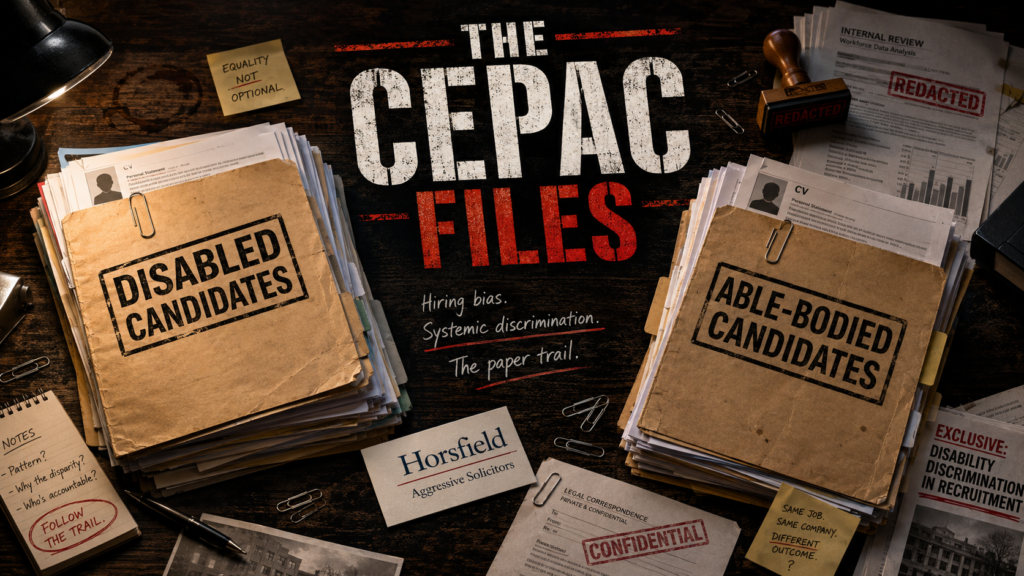
Cepac’s own 2026 portfolio displays a KitKat Bunny unit carrying the Nestlé name. Meanwhile, Nestlé’s supplier rules prohibit disability discrimination in hiring, discriminatory health screening, intimidation, harassment and misuse of personal data. Its grievance process promises independent investigation, non-retaliation, remediation and escalation to Group Compliance. Maria Walker’s denial, the same-day WhatsApp receipt, Cepac’s ET3 contradiction and a legal campaign costing more than £50,000 are now waiting beside the fucking chocolate display.
The Nestlé Cepac Supplier Receipt
Cepac published its POS Portfolio 2026 to advertise the retail displays it can produce. On the FSDU page, one photograph shows a KitKat Bunny promotion installed beside a Swizzels unit. The KitKat artwork covers the display, while the Nestlé name appears at the bottom. Cepac put the work in its own sales document and supplied the contact details of its Doncaster sales manager at the back.
Indeed, that is the Nestlé Cepac supplier receipt. TCAP has not inferred the connection from two companies appearing at the same trade show or excavated a vague claim from somebody else’s marketing copy. Cepac itself chose Nestlé-branded KitKat work as an example of what Cepac sells.
TCAP previously published Ce-UnPac’d : Nestlé’s Abhorrent Rap Sheet and Part Two. Those articles covered Nestlé’s long history of controversy. However, neither article contained Cepac’s pleaded defence, the contemporaneous WhatsApp record or Maria Walker’s later denial of the interview offer.
Consequently, this is not another tour through baby formula, cocoa, water and deforestation. It is the first Nestlé article built around the complete Cepac recruitment file. The old rap sheet can remain on the shelf. This one comes with timestamps.
Nestlé Wrote The Recruitment Test
Nestlé updated its Responsible Sourcing Core Requirements in June 2025. The document applies to direct suppliers and requires them to cascade the rules through the supply chain. It also includes packaging materials within its sourcing framework. Therefore, a cardboard display does not sit outside the human-rights aisle merely because nobody eats it.
Specifically, the employment clauses are remarkably detailed. Workers must receive equal opportunities and must not face discrimination during hiring because of disability. Nestlé also prohibits health screening that might cause discrimination, except where the law requires it. In addition, no worker should suffer psychological or verbal abuse, intimidation or harassment.
Moreover, personal information receives its own rule. Suppliers must process workers’ data lawfully and fairly, protect it from unauthorised use and keep it secure against loss or misuse. Meanwhile, suppliers must operate accessible grievance mechanisms and address grievances effectively and promptly.
Nestlé has also preserved the enforcement tools. It may use desk-based assessments, independent audits and other verification methods. Suppliers must retain supporting documents, preserve grievance and investigation records and give Nestlé access on demand. When the facts reveal non-compliance, Nestlé can require a time-bound action plan, suspend the relationship or terminate it.
This is not a cocoa-sourcing aspiration stretched until it covers a recruitment dispute. Disability in hiring, health screening, personal data, intimidation, grievances, evidence and remediation all appear in the fucking document.
Two Lines Before Anybody Needed A Litigation Story
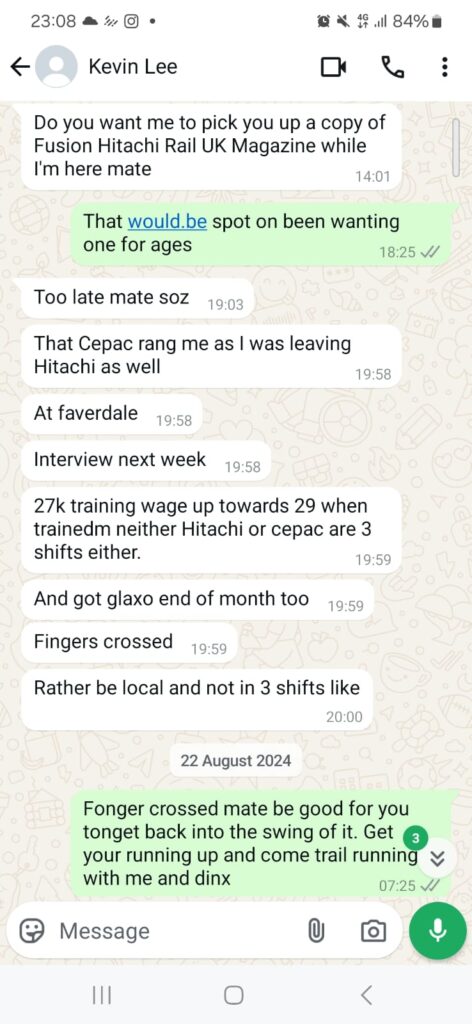
First, Page Outsourcing called me on 21 August 2024 about a production role at Cepac. During that conversation, Page offered an interview for the week after the bank holiday and discussed a £27,000 training wage rising towards £29,000. I also explained that mental-health treatment accounted for the lengthy gap in my employment.
Then Page said my details would go forward and that another call would confirm an exact, mutually agreeable interview time. However, that confirmation never arrived.
Consequently, I sent a WhatsApp message recording what had happened later that day:
“Interview next week”
“27k training wage up towards 29”
The recipient retained the conversation and later supplied a witness statement dated 20 February 2025 confirming its origin and context. Crucially, the message existed before any complaint, ACAS process, Tribunal claim or TCAP article. Nobody had a case theory to support, a respondent to attack or a reason to manufacture an interview. It was simply the ordinary little receipt somebody creates after receiving good news.
Nestlé says its investigations can use records and interviews. Fine. Page’s call notes, candidate-status history, communications and system audit trail should show exactly when the interview entered the process, what happened after the health disclosure and who removed the promised confirmation.
Maria Walker Changed The Recipe At 09:52
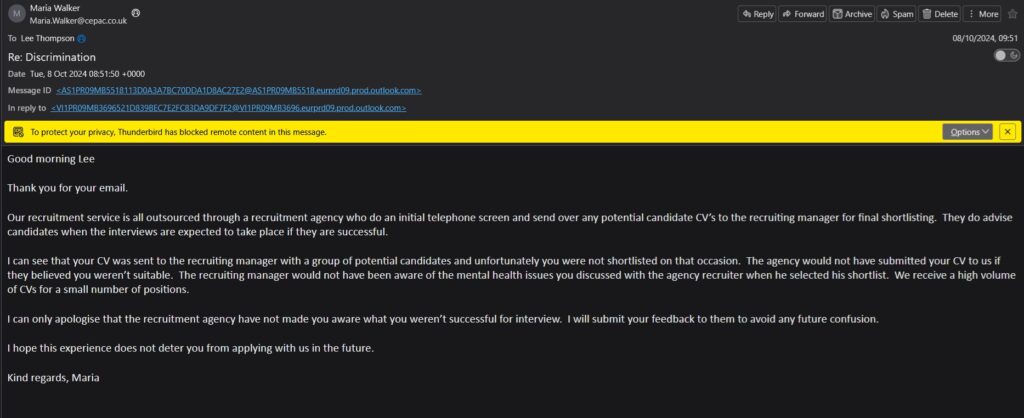
Subsequently, at 04:35 on 8 October 2024, I complained directly to Cepac. The email described Page’s interview offer, its planned timing after the bank holiday, the promised arrangement call, the questions about my employment gap and my disclosure that I had received treatment for a mental-health condition.
Five hours and seventeen minutes later, Cepac HR Business Partner Maria Walker replied at 09:52. She said Page had screened a group of potential candidates and sent their CVs to Cepac. Walker then supplied a different outcome:
“I can see that your CV was sent to the recruiting manager with a group of potential candidates and unfortunately you were not shortlisted on that occasion.”
Walker maintained that the recruiting manager would not have known about the mental-health information. She apologised because Page had supposedly failed to explain that I had not secured an interview. Finally, she placed the conflict between an offered interview and a failure to shortlist inside the neat corporate wrapper marked “confusion”.
Crucially, Walker had not seen that record when she answered. Therefore, the sequence is fixed. Page offered an interview and discussed the wage. I disclosed my mental health. The promised confirmation disappeared. Then Cepac replaced the offer with a failed shortlist before it knew the interview receipt had survived.
Nestlé promises independent, conflict-free investigation. That starts by asking what Walker reviewed, who she spoke to and which record justified her 09:52 answer.
Paragraph 12 Meets Paragraph 14
Cepac’s later ET3 made the knowledge problem worse. Paragraph 12 distanced the company from knowledge relevant to disability. However, paragraph 14 recorded recruitment information that I had spent around twelve months out of work because of health problems and felt ready to return.
The extract reproduced below is from Cepac Ltd’s Grounds of Resistance.
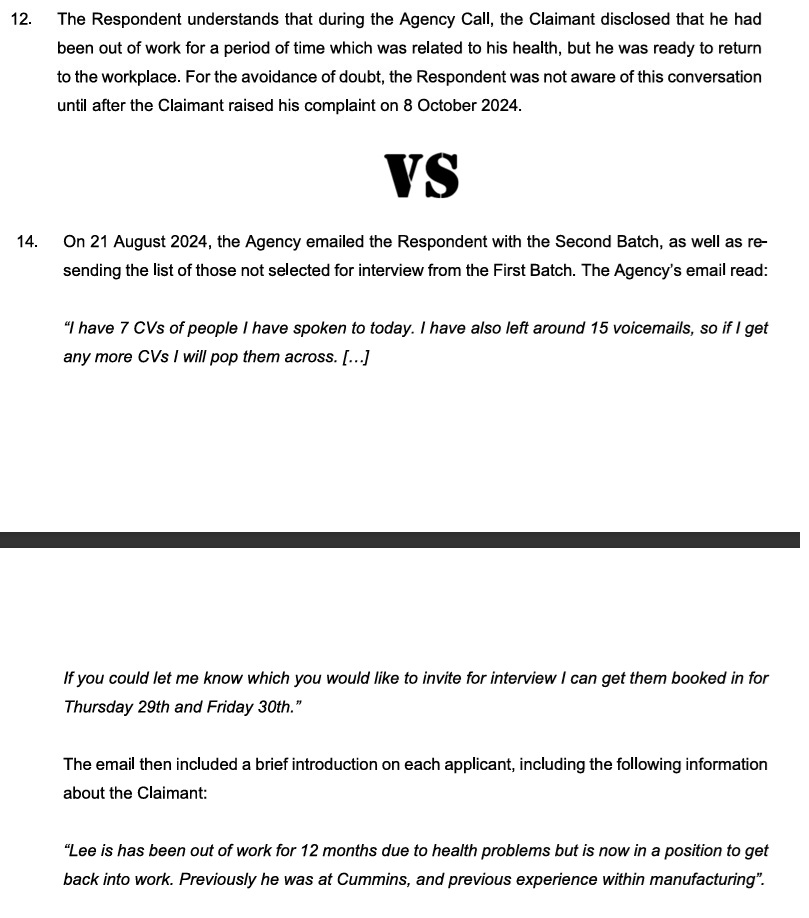
Therefore, the health information entered Cepac’s pleading through somebody. Page recorded it, passed it along or placed it inside material that later reached Cepac. Otherwise, the company could not have used that information while explaining the recruitment process.
Nestlé’s requirements prohibit disability discrimination during hiring. They also prohibit health screening that produces discrimination and require fair handling of workers’ personal data. Consequently, paragraphs 12 and 14 do not belong in separate compliance boxes. They create the audit question.
What did Page record during the call? Who could access it? When did the candidate status change? What reached Cepac before Walker replied? Which document or witness supplied paragraph 14? Most importantly, why did the promised confirmation disappear after Page learned that my work gap related to mental health?
A merits hearing could have answered every question through disclosure and cross-examination. Cepac chose a different route.
The Grievance Became The Product
Nestlé requires suppliers to provide an effective grievance mechanism and respond in a timely manner. Cepac instead converted the person raising the grievance into the main item under inspection.
By contrast, in March 2025, Horsfield Menzies estimated Cepac’s costs at £25,000 to £30,000 and offered not to pursue them if the discrimination claim disappeared. The firm directed that pressure at a disabled litigant in person who had reported financial hardship, worsening mental health and serious difficulty participating safely.
Moreover, the operation grew. Cepac collected correspondence, complaints, TCAP articles and posts on X into a 191-page conduct dossier. Its lawyers removed the disability, medical deterioration and procedural failures surrounding my reactions. Next, they repackaged those reactions as independent misconduct and used them to argue that the original claim should never reach a merits hearing.
Ultimately, Cepac chose to bully me, invade my privacy and weaponise the reactions that its pressure helped produce. It spent more than £50,000 doing so because a character prosecution offered something the recruitment evidence did not: an exit.
That was not grievance resolution. It was grievance conversion. A discrimination complaint entered the process. Cepac wrapped the disabled complainant in a conduct label and presented him as the problem. Nestlé requires suppliers to prevent intimidation, harassment and psychological abuse. Cepac supplied the fucking demonstration batch.
The Medical Centre Entered The Supply Chain
Specifically, Horsfield Menzies contacted my medical centre for Cepac, investigated appointment availability and used the result to oppose a postponement. I had supplied medical evidence to establish disability and explain why safe participation required an adjustment. That did not invite Cepac’s solicitors to test my access to healthcare and turn a reception-desk inquiry into adversarial material.
The firm maintained that the medical centre disclosed no private medical information. Nevertheless, that answer avoids the central issue. Cepac’s legal representatives entered the healthcare relationship because they wanted material capable of resisting a disability-related postponement.
Nestlé’s rules require suppliers to process personal data lawfully and fairly, guard it against misuse and preserve proper records. Accordingly, Nestlé can request every instruction, attendance note, email and submission connected with the medical-centre contact. It can also ask who authorised the step, what privacy assessment occurred and how the tactic matched a system supposedly designed to prevent adverse human-rights impacts.
Privacy was not some decorative side issue. It formed part of the same conversion process. Cepac used medical evidence to acknowledge disability when useful, investigated access to treatment when procedural pressure required it and then stripped health context from the reactions placed before the Tribunal.
The chocolate display tells shoppers to have a break. Cepac’s lawyers investigated whether the disabled claimant could get a medical appointment, then used the result to resist the postponement he needed.
More Than £50,000 Bought A Break From The Merits
Cepac’s combined costs schedules eventually exceeded £50,000. Meanwhile, nobody cross-examined Page about the interview offer. Nobody required Walker to reconcile her denial with the same-day message. Nor did anybody trace the health information used inside paragraph 14.
Instead, the money followed the conduct strategy. Lawyers gathered material, opposed adjustments, entered my medical terrain and built an argument for ending the claim before the original facts could face witnesses. Pressure generated reactions. Cepac preserved those reactions, removed their causes and sold the edited version back to the Tribunal as the reason a fair hearing could not occur.
Consequently, Nestlé’s rules require suppliers to identify adverse impacts, investigate grievances, retain evidence and remedy what they caused or contributed to. The expenditure therefore creates a second investigation. Who authorised more than £50,000? What did the decision-makers know about disability and medical deterioration? Why did nobody spend a fraction of that amount resolving the Page record, Walker chronology and ET3 contradiction?
Cepac did not lack resources. It made a commercial choice about where to direct them. More than £50,000 went into escaping the merits while two WhatsApp lines waited for somebody to open the fucking wrapper.
Newcastle Sealed The Wrapper
The institutional machinery appears in Newcastle Employment Tribunal : Deep Dive : Deliberate Maladministration, Disability Shaming, Judicial White Knights, Speed-reader Smith And The Horsfield Menzies Feeding Frenzy. Newcastle’s administration and case management created the conditions in which Cepac’s conduct dossier could displace the disability-discrimination evidence.
Correspondence travelled to the wrong Tribunal office. Meanwhile, the contents and visibility of a file approaching two thousand pages remained unclear. Respondent material received attention while claimant applications, medical context and complaints disappeared into procedural fog. Employment Judge T. R. Smith said he spent three hours reviewing a 1,941-page file and called me its “principle culprit”. Three days before the decisive hearing, Employment Judge Brain refused the postponement required for safe participation.
On 24 April 2026, Employment Judge James heard the respondents without me. He struck out the claims and later ordered £20,000 in costs. However, the Tribunal never decided whether Page offered the interview, why the confirmation disappeared, what health information moved through the recruitment chain or whether disability influenced the outcome.
Strike-out did not verify Walker’s answer. It did not reconcile paragraphs 12 and 14 or erase the contemporaneous message. Newcastle simply sealed the wrapper before anybody tested what Cepac had put inside.
Nestlé Group Compliance Now Has A Job
Nestlé published its Supply Chain Grievance Management Process in May 2025. It applies to alleged human-rights, ethical and legal failures involving direct suppliers or the upstream supply chain. The process promises transparent investigation, escalation and resolution. It also commits Nestlé to non-retaliation and says threats or retaliation against somebody raising a good-faith grievance will not be tolerated.
Once a grievance falls within scope, Nestlé says an investigation starts. Its reviewers can conduct desktop assessments, interviews and site visits. Moreover, investigations must remain independent and free from conflicts of interest. Verified failures require time-bound remediation, while an inadequate response can lead to suspension or termination.
The process even allocates responsibility. Group Compliance coordinates and reviews grievance investigations, while top management receives information about them. Therefore, the KitKat display does not end with a buyer quietly forwarding an email to the supplier responsible for the complaint.
First, Nestlé can obtain Page’s call notes, candidate-status history, any available recording and the full recruitment audit trail. It can demand everything Walker reviewed before 09:52 and trace the health information inside paragraph 14. Next, it can inspect the medical-centre correspondence, the 191-page conduct dossier and the costs schedules exceeding £50,000. Finally, it can ask whether Cepac notified Nestlé of any actual or potential severe adverse human-rights impact connected with the proceedings and what corrective action followed.
Nestlé wrote the process. Cepac supplied the facts. Group Compliance can now demonstrate whether the machinery operates beyond the PDF.
Have A Break From The Bullshit
The sequence fits on the side of the display. Page called on 21 August 2024, offered an interview and discussed the wage. I disclosed that mental-health treatment explained my employment gap. A same-day WhatsApp message preserved the result. The promised confirmation vanished. Maria Walker then denied that I had secured an interview before she knew the receipt existed.
Afterwards, Cepac’s ET3 distanced the company from disability knowledge while placing health information inside its recruitment account. Rather than test those facts at a merits hearing, Cepac invaded my privacy, built a conduct dossier and spent more than £50,000 converting the disabled complainant into the offence. Newcastle completed the process without deciding the recruitment claim.
Nestlé’s rules cover every stage. Disability discrimination has no place in hiring. Nestlé also bans discriminatory health screening. Intimidation, harassment and psychological abuse remain prohibited. Personal data must remain secure. Grievances require timely, independent investigation. Suppliers must retain records, remedy failures and face suspension or termination when they refuse.
Cepac’s own 2026 portfolio put KitKat and the Nestlé name into this file. Consequently, Nestlé does not need TCAP to prove that its brand reached Cepac’s cardboard. Cepac published the receipt itself.
The only remaining question is whether Nestlé’s grievance process can survive contact with an actual grievance. Have a break. Open the fucking file.
Lee Thompson – Founder, The Cummins Accountability Project
Source List
- Cepac – POS Portfolio 2026
- Nestlé – Responsible Sourcing Core Requirements
- Nestlé – Supply Chain Grievance Management Process
- Nestlé – Human Rights
- TCAP – Ce-UnPac’d : Nestlé’s Abhorrent Rap Sheet
- TCAP – Ce-UnPac’d : Nestlé’s Abhorrent Rap Sheet Part 2
- TCAP – The Cepac Files : KFC II – Maria Walker And The Interview Receipt
- TCAP – Newcastle Employment Tribunal : Deep Dive : Deliberate Maladministration
- Employment Tribunal – Thompson v Cepac Limited And Page Outsourcing UK Limited
- TCAP case file: WhatsApp record dated 21 August 2024; email exchange between Lee Thompson and Cepac HR Business Partner Maria Walker dated 8 October 2024; supporting witness statement dated 20 February 2025; Cepac ET3 Grounds of Resistance; respondent costs schedules, submissions and medical-information correspondence.