
The HEINEKEN Cepac supplier question starts with Strongbow-branded work in Cepac’s own 2026 portfolio. Strongbow talks about becoming the most inclusive drinks brand. Meanwhile, HEINEKEN publishes supplier standards, monthly compliance reviews and a risk-monitoring system called SHINE. Now the WhatsApp interview receipt, Maria Walker’s denial and Cepac’s ET3 give that machinery something specific to inspect. The cardboard has arrived. Let’s see whether the inclusion comes with it.
Strongbow Came In On A Pallet
On page six of Cepac’s POS Portfolio 2026, a yellow Strongbow display stands beneath a Tesco Clubcard price sign. Fruit graphics cover its sides, while packs of cider occupy the unit. Cepac places the photograph in its pallet-bin section, among examples of the retail display work it offers customers.
Consequently, the commercial starting point comes from Cepac itself. This is branded work selected for its own sales material, not a bottle spotted in somebody’s staff kitchen. HEINEKEN UK identifies Strongbow among its brands. Its procurement team can establish the commissioning route, relevant supplier entities, dates and present arrangements behind that photograph.
This is also HEINEKEN’s first dedicated entry in The Cepac Files. Therefore, the company gets the recruitment chronology together: the offered interview, mental-health disclosure, same-day message, later HR denial and conflict inside Cepac’s defence. There is no need to assemble the story from six scattered updates.
The task is straightforward. Follow the cardboard back through the purchasing records, then follow the health information through the recruitment records. Both journeys involve named businesses, identifiable documents and decisions somebody actually made. Neither requires another fucking brand workshop.
Inclusion Had A Stage And A Sponsor
On 6 August 2024, HEINEKEN UK published an account of Strongbow’s Brighton & Hove Pride activity. It described work with disability-led marketing agency Purple Goat, including an accessible bar, ramped stage access and BSL interpreters. Then its cider brand director, Rachel Holms, described the ambition to become “the most inclusive drinks brand”.
Fifteen days later, Page Outsourcing called me about a production job at Cepac. That gives the editorial question an unusually clear date stamp. What does a public commitment to disability inclusion mean when recruitment evidence later surfaces around a business displaying the brand’s work? The applause had barely faded before the sequence in this file began.
HEINEKEN UK’s current inclusion page also describes its Enable colleague network and Disability Confident Level 1 status. It talks about changing perceptions and removing workplace barriers. Accordingly, the organisation has already identified disability as something requiring practical attention, not just a convenient photograph beside a ramp.
Accessible events are worthwhile. However, the harder test begins when inclusion requires somebody to open an awkward supplier file. A ramp gets people onto the stage; it does not get an unanswered complaint past procurement. For that, somebody has to stop applauding and start reading.
Two WhatsApp Lines Before The Dispute
On 21 August 2024, Page called about the Cepac role and offered an interview for the week after the bank holiday. We discussed a £27,000 training wage rising towards £29,000. During that conversation, I explained that mental-health treatment accounted for the lengthy gap in my employment.
Page said my information would go forward and another call would confirm an exact, mutually agreeable interview time. However, that confirmation never arrived. Later that day, I sent a WhatsApp message recording the news:
“Interview next week”
“27k training wage up towards 29”
The recipient retained the exchange and later supplied a witness statement dated 20 February 2025 confirming its origin and context. Crucially, the message predates my complaint, ACAS notification, Tribunal claim and TCAP. I had received good news, so I told somebody about it.
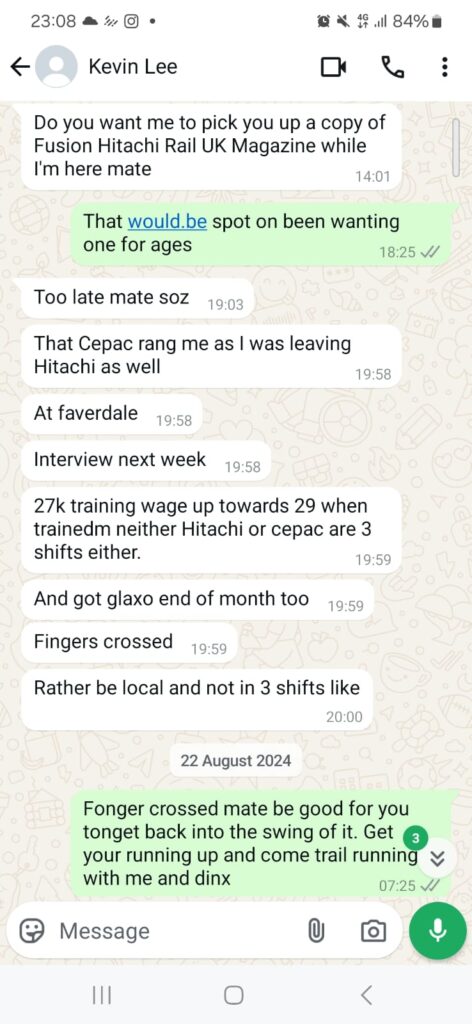
Nobody was preparing a litigation strategy that afternoon. Nor did I know that an HR reply would later replace the offer with a failure to shortlist. Consequently, HEINEKEN can start with a simple comparison: put those two lines beside Page’s call notes, candidate history and internal communications. Ask which account the underlying records support.
Maria Walker Rewrote The Order At 09:52
At 04:35 on 8 October 2024, I complained directly to Cepac. My email described the interview offer, its expected timing, the promised callback, the employment-gap discussion and my mental-health disclosure. Cepac therefore had the substance of the complaint in writing before it supplied its answer.
HR Business Partner Maria Walker replied at 09:52, five hours and seventeen minutes later. She described Page screening candidates and sending their CVs to Cepac. Then she supplied a different outcome:
“I can see that your CV was sent to the recruiting manager with a group of potential candidates and unfortunately you were not shortlisted on that occasion.”
Walker maintained that the recruiting manager would not have known about the mental-health information. Moreover, she apologised because Page had supposedly failed to explain that I had not secured an interview. The gap between the offered interview and Cepac’s account became “confusion”.
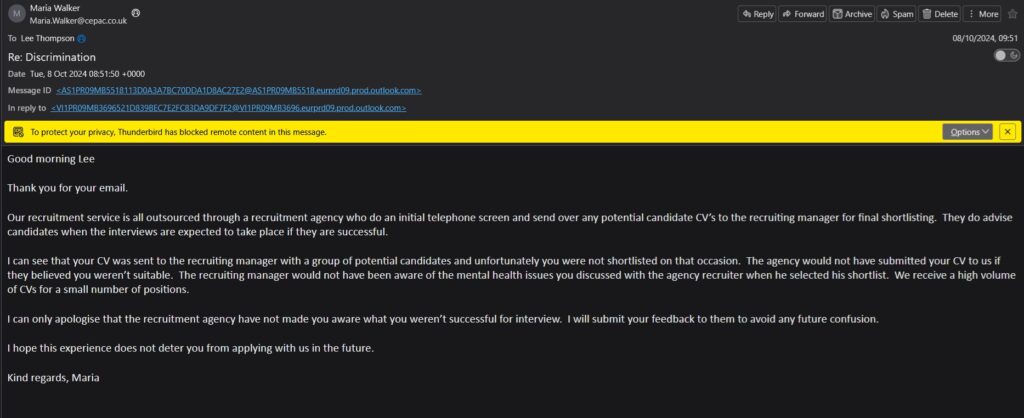
Yet Walker had not seen the WhatsApp when she answered. The receipt already existed, but her response did not address it. Accordingly, an investigator should ask what she reviewed before 09:52, which records supported her explanation and whether Page checked its original call account.
An apology for confusion is not a reconciliation of evidence. It is an answer that still needs checking.
Paragraph 12 Meets Paragraph 14
Cepac’s later ET3 sharpened the knowledge problem. Paragraph 12 distanced the company from knowledge relevant to my disability. However, paragraph 14 recorded recruitment information that I had spent around twelve months out of work because of health problems and felt ready to return.
The extract below comes from Cepac Ltd’s Grounds of Resistance.
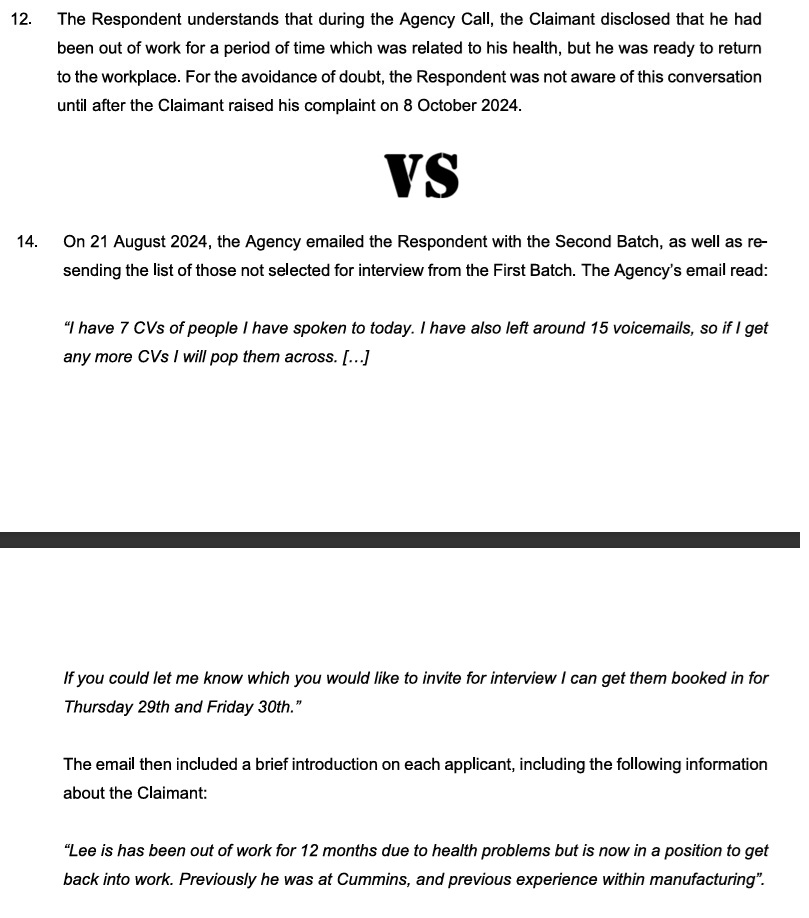
Health information did not write itself into that pleading. Somebody recorded it, passed it on or included it in material that later reached Cepac’s legal team. Therefore, the obvious questions concern timing and access: who knew what during recruitment, what reached the recruiting manager and where did paragraph 14’s wording originate?
That distinction matters. Information available when lawyers draft a defence need not have reached a manager before a hiring decision. Consequently, the audit needs dated records, not another assertion that everybody relevant knew nothing. The same discipline applies to Page’s promised interview and Walker’s later account.
At a merits hearing, witnesses and documents should have tested those questions. Instead, the case ended without that examination. Two paragraphs remain on the page, waiting for somebody to do the fucking work between them.
The Old Code Already Covered Hiring
HEINEKEN’s 2019 Supplier Code named disability in its non-discrimination standard. It required employment decisions, including hiring, to rest on relevant qualities such as experience, qualifications and skills. Furthermore, it prohibited workplace harassment, bullying, abuse and threats. Suppliers were also expected to communicate its standards to people working through third-party arrangements and take steps to extend them through their own supply chains.
The document gave HEINEKEN assessment and corrective-action mechanisms, with possible termination if a supplier failed to correct non-compliance. Its Speak Up section treated reporting as a chance to identify and repair misconduct. Accordingly, the underlying recruitment issue does not need a policy invented after the event to become recognisable.
Page occupied the recruitment corridor. Cepac owned the vacancy and answered the complaint. Together, their records should establish whether an offered interview disappeared after a disclosure about mental health. HEINEKEN can map the relevant commercial relationship against the standards that applied at the time.
This is what makes the file uncomfortable. The question is not whether somebody can compose a fresh statement about treating people fairly. That statement already exists. The question is whether anyone will examine the point at which the candidate stopped moving and the explanations began.
The Complaint Became The Product
In March 2025, Horsfield Menzies estimated Cepac’s legal costs at £25,000 to £30,000 and offered not to pursue them if the discrimination claim disappeared. Meanwhile, I had explained financial hardship, worsening mental health and difficulties participating safely in the proceedings. The pressure therefore arrived with its recipient’s vulnerability already on the file.
Cepac subsequently assembled correspondence, complaints, articles and X posts into a 191-page conduct dossier. Its lawyers separated my reactions from the disability, pressure and procedural failures surrounding them. Then they presented those reactions as misconduct supporting an end to the claim before a merits hearing.
That was the conversion process. A disabled applicant complained about recruitment. In response, Cepac turned the complainant into the thing requiring removal. The interview evidence stayed unresolved while the argument shifted towards whether the person raising it had become too difficult to hear.
Eventually, Cepac’s combined costs schedules exceeded £50,000. The Tribunal struck out the claims and ordered me to pay £20,000 to Cepac. However, it never decided whether Page offered the interview, why the confirmation vanished or whether disability influenced the recruitment outcome.
Cepac chose to bully me and weaponise the responses its pressure helped produce. My criticism of that strategy is direct: it spent a fucking fortune prosecuting the reaction while the original question went unanswered. HEINEKEN should examine that conduct alongside the recruitment record, not mistake procedural victory for a completed supplier investigation.
The Medical Centre Was Not A Sampling Stand
Horsfield Menzies also contacted my medical centre for Cepac, investigated appointment availability and used the result to oppose a postponement. I supplied medical evidence to explain disability and participation needs. That did not turn my healthcare arrangements into a sampling stand for the opposing legal team.
The firm maintained that the centre disclosed no private medical information. Nevertheless, the contact itself remains a concrete part of the chronology. An investigator can establish who authorised it, precisely what the solicitors asked, what the centre supplied and how the resulting information entered the Tribunal submissions.
Those are better questions than another abstract exchange about professionalism. Instead, they lead to instructions, correspondence and attendance notes. More importantly, they let someone assess the purpose and proportionality of the step against the circumstances already known to Cepac.
The broader pattern also deserves attention. My health information mattered when it could help oppose an adjustment. Yet disability and deteriorating health became inconvenient context when Cepac presented distressed reactions as a conduct problem. That is why I describe the campaign as an invasion of privacy and a weaponisation of vulnerability.
HEINEKEN does not need to borrow my adjectives. It needs to inspect the fucking correspondence and reach a reasoned conclusion of its own.
A New Policy Is Not A Fresh Start
HEINEKEN’s replacement Business Partner Policy, effective January 2026, covers direct suppliers and distributors, with expectations extending into their own relevant business relationships. It addresses disability discrimination, hiring, bullying, privacy, remedy and protection of human-rights defenders. The policy also provides for audits, cooperation and corrective action, with commercial restrictions or termination where warranted.
However, the document expressly says it is forward-looking, not a retrospective test of past events. Therefore, the 2019 code supplies the historical benchmark; the new policy informs current decisions and handling. HEINEKEN UK says it is transitioning during 2026, so procurement should identify which terms govern the actual relationship.
A new cover cannot answer an old recruitment question. Nor does a change of policy make present-day risk assessment unnecessary. If the business wants to continue, renew or commission work, it must decide how to handle the evidence now in front of it.
The useful question is not whether someone can move the file from an old folder into a new one. It is whether the underlying concern receives an investigation, an explanation and any appropriate corrective work. Otherwise, the policy refresh only changes the label on the same unopened box.
SHINE Needs Something To Shine On
HEINEKEN UK’s statement for 2025, signed by Legal Affairs Director Lynsey Nicoll on 30 June 2026, describes monthly supplier-code reviews. It says results reach senior management. Moreover, its SHINE system monitors supplier risks, including human-rights issues, with medium- and high-risk alerts going to procurement, legal and assurance functions.
That describes a route into the business. Consequently, HEINEKEN can explain whether Cepac features in the relevant supplier records, what assessment exists and whether this material requires a fresh review. A display commission routed through an intermediary would require that relationship to be mapped, not simply ignored.
The software’s name supplies the joke, but the human decision supplies the test. Has somebody actually read Walker’s answer against the WhatsApp? Can the reviewer identify the source and timing of the health information? Does the assessment distinguish the allegations from findings and the strike-out from a decision on recruitment?
The demand, therefore, is for the actual assessment and its history. What did the screening capture, what did human reviewers examine and what requires attention now? An automated risk label cannot explain an interview that disappeared. Moreover, an empty alert queue cannot substitute for reading material supplied directly.
Shine the light on the record. Then tell us what it shows.
Newcastle Did Not Finish The Investigation
The institutional background appears in Newcastle Employment Tribunal : Deep Dive – Deliberate Maladministration. It documents misdirected correspondence, uncertainty about the Tribunal file and the treatment of applications concerning my ability to participate. Those failures belong in the account of how this case reached its ending.
Employment Judge T. R. Smith said he spent three hours reviewing a 1,941-page file. Three days before the decisive hearing, Employment Judge Brain refused the requested postponement. On 24 April 2026, Employment Judge James proceeded without me. The resulting strike-out and costs order ended the claims without determining the recruitment allegation on its merits.
Consequently, a supplier reviewer cannot treat the outcome as a factual answer to every document reproduced above. The order does not tell HEINEKEN what Page said during the call, what Walker checked or when the recruiting manager received any health information. Those questions remain available for examination.
This distinction is not decorative. Cepac obtained the outcome it sought on conduct and procedure. However, that does not give a customer a completed explanation of the vanished interview. A purchasing team making its own assessment needs to understand what the judgment decided and what it left untouched.
The legal case has an outcome. The recruitment file still has unanswered questions. Putting the first in a presentation does not make the second disappear.
The HEINEKEN Cepac Supplier Check Has Teeth
HEINEKEN UK’s published purchasing terms require supplier-code compliance at clause 14.2. Clause 17 provides for audits on reasonable notice during a contract, cooperation with the auditor and agreed follow-up measures. Its terms also contain termination provisions. Accordingly, the published commercial framework goes beyond asking suppliers to admire the company values from a safe distance.
The first step is to identify the actual contract and any intermediary. From there, HEINEKEN can establish which provisions apply, who owns the relationship and what information it can properly obtain. The portfolio is a lead into that work, not a substitute for the purchase order.
Next comes the evidence request. Obtain Page’s surviving call records and candidate-status history. Identify what Walker reviewed before answering, then trace the material used in paragraph 14. The legal campaign needs the same care: examine the medical-centre correspondence, conduct dossier, costs schedules and relevant decisions together.
Finally, record the assessment, its reasons and any action required. Where commercial records or personal information cannot appropriately be published, HEINEKEN can still explain the investigation’s scope and outcome. Accountability does not require dumping a disabled person’s medical file on the internet.
It requires the business to use its own judgement, document it and stand behind it. A values statement is easy. Here is the part that needs a named person, a deadline and an actual fucking answer.
HSA Has Two Very Different Print Jobs
Meanwhile, the ownership trail adds another familiar contrast. HSA lists Cepac among its group companies, while the Hayel Saeed Anam charitable foundation describes a programme for printing and distributing the Qur’an. TCAP examined that pairing in HSA Group : Big Cardboard Haram?. Strongbow adds another alcohol brand to the British packaging operation’s sales portfolio. Accordingly, this is business in promoting booze, alongside the family’s public religious philanthropy: the revenue opportunity sits in the display, even when the subsidiary never brews a drop. How does HSA reconcile the principles it celebrates with the trade its subsidiary pursues? Qur’an printing on one page, cider merchandising on another. The corporate family seems impressively versatile when there is a print job involved. Perhaps somebody could read both pages before telling us how fucking principled the binding is.
Take A Bow After Opening The File
Strongbow’s inclusion ambition now has a practical test. Page offered an interview, discussed the wage and heard why my employment gap related to mental health. A same-day message preserved the interview and money. Then the confirmation vanished, and Maria Walker supplied a no-interview account before she knew that receipt existed.
Cepac’s ET3 subsequently placed health information inside its recruitment narrative while distancing the company from disability knowledge. Instead of a merits decision resolving those facts, the case produced a conduct dossier, a costly strike-out campaign and a £20,000 order against the disabled complainant. That is the record HEINEKEN needs to examine.
The repeated title is deliberate. Different customers keep receiving the same small set of documents because the central questions remain unanswered. However, repetition does not make HEINEKEN’s response predetermined. It can identify the commercial route, assess the evidence and explain what follows. That would be an actual decision, not another slogan held above the crowd.
An accessible stage matters. So does the treatment of the person whose health disclosure sits inside this recruitment file. The uncomfortable work begins when inclusion stops being an event someone sponsors and becomes a question someone in procurement must answer.
Strongbow knows how to ask people to take a bow. First, HEINEKEN can open the fucking file.
Lee Thompson – Founder, The Cummins Accountability Project
Source List
- Cepac – POS Portfolio 2026, Page Six
- HEINEKEN UK – Strongbow’s Brighton & Hove Pride Activity And Disability Inclusion
- HEINEKEN UK – Diversity, Equity And Inclusion
- HEINEKEN – 2019 Supplier Code
- HEINEKEN – Business Partner Policy, Effective January 2026
- HEINEKEN UK – Modern Slavery Statement For 2025, Signed 30 June 2026
- HEINEKEN UK – General Terms And Conditions For Purchasing Goods And Services
- HSA Group – Cepac
- HSA Charity – Printing The Holy Qur’an
- HSA Charity – About The Foundation
- TCAP – HSA Group : Big Cardboard Haram?
- TCAP – KFC II : Maria Walker And The Interview Receipt
- TCAP – Newcastle Employment Tribunal : Deep Dive – Deliberate Maladministration
- Employment Tribunal – Thompson v Cepac Limited And Page Outsourcing UK Limited
- TCAP case file: WhatsApp record dated 21 August 2024; email exchange with Maria Walker dated 8 October 2024; witness statement dated 20 February 2025; Cepac ET3 Grounds of Resistance; costs schedules, conduct submissions and medical-centre correspondence. The three image placements above are the existing WhatsApp, Walker email and ET3 exhibits.