
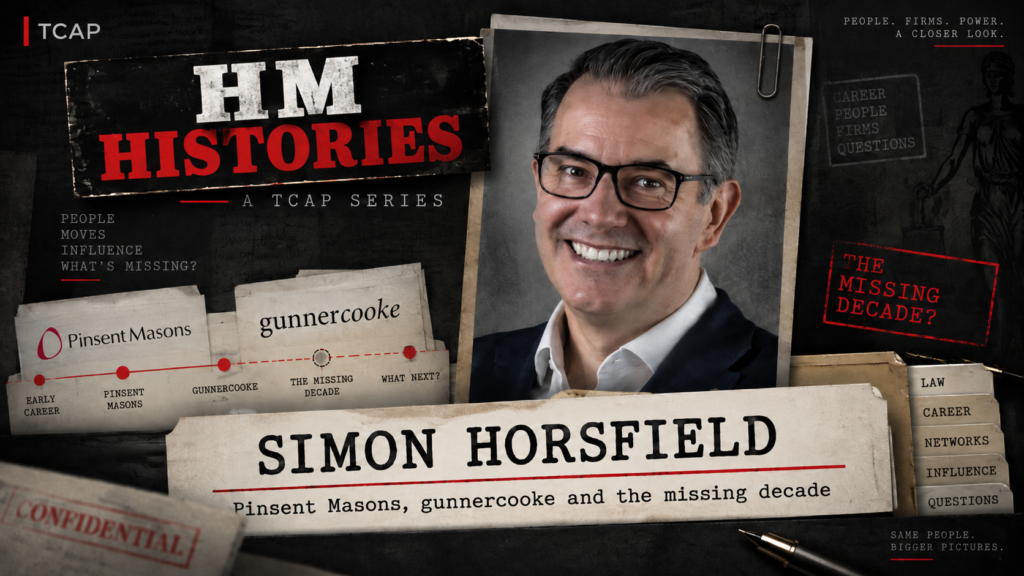
Welcome back to HM Histories. Simon Horsfield’s Pinsent Masons chapter takes us somewhere TCAP readers have already visited through Jiten’s Jobs. First came the employment lawyers facing redundancy. Then came the invented legal wording that reached the High Court. Now we return through Horsfield’s career history, because the most revealing part of this fiasco happens after the judge notices the bollocks. The firm gets an opportunity to explain itself, and the explanation needs its own explanation.
Professional prestige travels beautifully. A large firm’s name goes onto a biography, joins the next firm’s sales pitch and continues earning its keep long after the lawyer has moved on. HM Histories follows that name back to the institution behind it. In this case, the destination is a business selling expert judgment whose correspondence managed to mislead a court twice. Welcome to the Bullshit Correction Department, where the first thing requiring correction is the belief that the letterhead has checked the letter.
Simon Horsfield’s Pinsent Masons Connection
By January 2014, Simon Horsfield was leaving Pinsent Masons for gunnercooke. Contemporary reporting identified him as a Pinsent partner and head of its Manchester employment team. Today, Horsfield Menzies presents him as an employment partner advising HR directors, businesses and senior executives on workplace risk, organisational change and departures. The institutional connection is therefore substantial. Pinsent was somewhere he held senior responsibility, and a recognisable stop on the route to the firm carrying his name.
The court episode came twelve years after that departure, in 2026. Our earlier Jiten’s Jobs articles reached Pinsent through Kotecha’s employment-law career; Simon’s route brings us back through the partnership. These are two biographies leading to the same institution. That is useful continuity, because a CV supplies the flattering version of a former employer: scale, experience, reputation. A public judgment sometimes supplies the part of the tour where the lift doors open onto a spectacular fucking mess.
The Name Above The Door
Consider the scale of the operation. In August 2026, Pinsent Masons announced unaudited annual revenue of £703 million and profit per equity partner of £740,000. Its results described investment in people, premises and technology, alongside an Innovation & Change Board and a strategic partnership with legal-AI provider Legora. This is an institution with the resources to build systems, train lawyers and check what leaves the building. Reading the legislation should sit comfortably within the budget.
Those numbers sharpen the absurdity. A client buying professional expertise is paying for somebody to notice when the answer has no foundation. The expensive part ought to be the judgment, rather than the upholstery around its absence. Yet a large organisation can put an answer through several desks and mistake its itinerary for an inspection. In this case, the cock-up travelled business class; nobody checked its passport.
Pinsent Masons AI Failures: The First Letter
The underlying case, Cork v Smith, concerned a routine application to transfer an insolvency practitioner’s appointments. When ICC Judge Mullen queried the power to release a liquidator from liability, Pinsent’s letter of 30 March 2026 supplied purported statutory wording. A junior solicitor, identified as Lawyer A, had obtained it through the firm’s AI pilot. The cited provision did not contain it. The machine had furnished the legal argument with a load-bearing wall that existed only in the drawing.
As Jiten’s Jobs previously explained, the firm already understood the danger. Its June 2025 public guidance told lawyers to verify AI research against authoritative sources and ensure that juniors understood their obligations. This makes the familiar technology excuse particularly threadbare. Pinsent had published the warning before becoming the example. Somewhere between explaining good practice to the market and performing it on a live matter, the safety instructions became promotional literature.
Everybody Above You Has Approved The Shit
The first letter passed through partner Steven Cottee and senior associate Samantha Poulton. Cottee described the documents as “good to go.” Poulton subsequently approved the letter as “fine.” Neither had checked the invented wording against the rule. Her review was cursory because she understood that the partner had already checked it. Here was the great professional safety net, with each knot assuming the next knot would hold.
There is something almost magnificent about the administrative efficiency. Doubt goes in at the bottom; confidence comes out at the top. Along the way, several job titles touch the document, yet the central proposition escapes inspection. Bullshit does not become research because it has passed through a partner’s inbox. Still, the stamp comes down, the email moves on and the same untested shit acquires another layer of respectability. By the time it reaches court, the firm’s name has done the work that reading should have done.
Please Remove The Apology
The April drafting exchanges deserve a closer look. After the court challenged the wording, Lawyer A went back to the AI. One proposed response contained an apology. The junior replied: “I don’t think we should apologise – no.” Later, Poulton required an apology and the eventual letter included one. The sequence matters: while the central legal assertion was falling apart, the drafting process spent time deciding how regretful the firm should sound.
There is your dark little office comedy. A machine has helped put imaginary law before a judge, then a human asks it to take the contrition out. For Christ’s sake, the facts have already broken the window. Editing the apology is rearranging the blinds. The problem needs someone to establish what happened, with the evidence open in front of them. Instead, the conversation keeps returning to the presentation of an answer that still needs investigating.
The Bullshit Correction Department Gets To Work
Poulton assumed the original wording reflected research assembled from several provisions. She asked for an explanation of that reasoning, and Lawyer A copied her instructions into the AI. The system then helped supply the account. Pinsent’s second letter, dated 14 April and sent the following day, presented the invented passage as a “summary conclusion.” The judge’s assessment was that this constructed a rationale after the event and put further misleading information before the court.
First came a source problem. Then the second letter gave it a backstory. That is why this deserves another visit: the repair process can become more revealing than the original failure. Once an institution assumes its answer must have been reasonable, the task quietly changes. With its head up its own arse, the process starts looking for a respectable route by which the wrong answer might have arrived. Before long, a crock of shite has an itinerary.
An Apology Cannot Verify An Explanation
Poulton approved the second letter without referring it to Cottee. She later accepted that she had taken the wrong approach and failed to review it with sufficient care. The judge accepted that neither senior lawyer intended to mislead the court, and recognised their later candour. However, he criticised the failure to investigate properly when the error emerged. A proper explanation and apology, he said, might have ended matters with Pinsent paying its clients’ costs for the first letter.
This is an ugly institutional lesson precisely because it requires no criminal mastermind. Ordinary assumptions can do the damage. A junior must have researched it; a partner must have checked it; an explanation must exist because the previous letter looked so damned certain. Meanwhile, polished wording creates the feeling of control. You can put “sorry” into a document and still leave its account of events unreliable. Manners are pleasant, but they are a piss-poor substitute for finding out.
The Judge Had Other Work To Do
These applications are normally uncontested, so there was no opposing lawyer waiting to expose the problem. Mullen had to check the material himself. Irwin Mitchell subsequently took over for the applicants, and Pinsent agreed to meet the additional costs its former clients incurred. The judgment publicly admonished the firm, Cottee and Poulton. Pinsent had already reported itself to the SRA; the judge required it to send the regulator the judgment within two working days. Regulatory findings and any sanction were for the SRA to determine.
That is the practical cost of this nonsense. A routine matter acquired a dispute about whether the court could trust the solicitors’ paperwork. Time went into explanations, evidence and a hearing that the underlying application should never have needed. Professional assurances are supposed to help a court get through its work. Here, they created more of it. The public justice system became the complaints desk for a product that should have passed inspection before dispatch.
Twenty-Six Days Later, Another Sales Pitch
Readers of Jiten’s Jobs : Pinsent Masons II – The Rule That Didn’t Exist will remember the next date. On 17 June 2026, twenty-six days after judgment, Pinsent announced Employment Tribunals Reimagined. Its proposition combined employment expertise, generative-AI workflows and managed legal services. The firm promised lawyer supervision and retained responsibility for quality. Meanwhile, the launch material identified employees’ growing use of AI to produce lengthy grievances and claims as one source of pressure on the system.
What a bloody accommodating market. When employees use AI, the resulting paperwork helps explain the problem employers face. When the law firm uses it, the technology helps explain the service employers should buy. Of course the advertised human supervision has to mean something. That is the entire commercial promise. After Cork v Smith, a client would be entitled to ask who checks the output, what they check it against and how the firm knows they have actually done it. A reassuring adjective will not open the source for you.
HM Histories: Keep The Receipts
This is where Simon Horsfield’s Pinsent Masons history belongs in the wider TCAP record. Jiten’s Jobs already opened the firm’s employment and AI files. HM Histories brings another senior career connection into view and keeps the institutional record attached to the name. Biographies trade on the authority of former employers; scrutiny should be allowed to follow the same route. The useful question is what that authority rests on when someone finally asks to see the work.
Horsfield Menzies sells senior experience and a partner-led service. Those are meaningful promises only when the work supports them. Pinsent’s episode gives every buyer of professional reassurance a beautifully unpleasant test: does another layer of seniority mean another layer of checking? If it merely means another person feeling confident, the extra title is just priority boarding for the same bad answer. The poor bastard relying on it still arrives at the wrong destination.
So keep the career history beside the public record. Let the firm’s advice sit beside its conduct and the sales promise beside the work delivered. A prestigious name should survive that comparison without demanding special treatment. Pinsent Masons managed to send imaginary legal wording into court, then send an explanation that made matters worse. Somewhere beneath all the technology, titles and commercial polish sat a task so basic it barely deserved a meeting: open the fucking source and read it.
Lee Thompson – Founder, The Cummins Accountability Project
Sources
- TCAP – Jiten’s Jobs : Pinsent Masons – When The Employment Lawyers Get Made Redundant, 9 September 2026.
- TCAP – Jiten’s Jobs : Pinsent Masons II – The Rule That Didn’t Exist, 15 September 2026.
- Bdaily – Manchester Law Firm Add Ten Partners, 31 January 2014: Horsfield’s move from Pinsent Masons, where he was a partner and Manchester employment head.
- Horsfield Menzies – Simon Horsfield: employment partner, HR advisory work and senior executive practice.
- Horsfield Menzies – Senior Executives: the firm’s partner-led service proposition.
- The National Archives – Cork v Smith [2026] EWHC 1199 (Ch), 22 May 2026: the full judgment. Paragraphs 45, 54-64 and 69-95 cover the approvals, apology exchanges, second letter, judicial assessment and regulatory outcome.
- Legal Futures – Junior Solicitor Used AI To Draft Misleading Letters To Court, 26 May 2026: supervision, the second explanation and the consequences.
- Legal Cheek – Pinsent Masons Slammed By Judge Over Junior Lawyer’s AI Blunder, 26 May 2026: the misleading correspondence and the firm’s response.
- Pinsent Masons – English High Court Highlights That Lawyers Using AI Must Ensure Accuracy, 17 June 2025.
- Pinsent Masons – Employment Tribunals Reimagined launch, 17 June 2026: AI workflows, supervision and the firm’s explanation of pressure on the tribunal system.
- Pinsent Masons – FY26 Results, 19 August 2026: unaudited revenue, profit per equity partner and technology investment.