
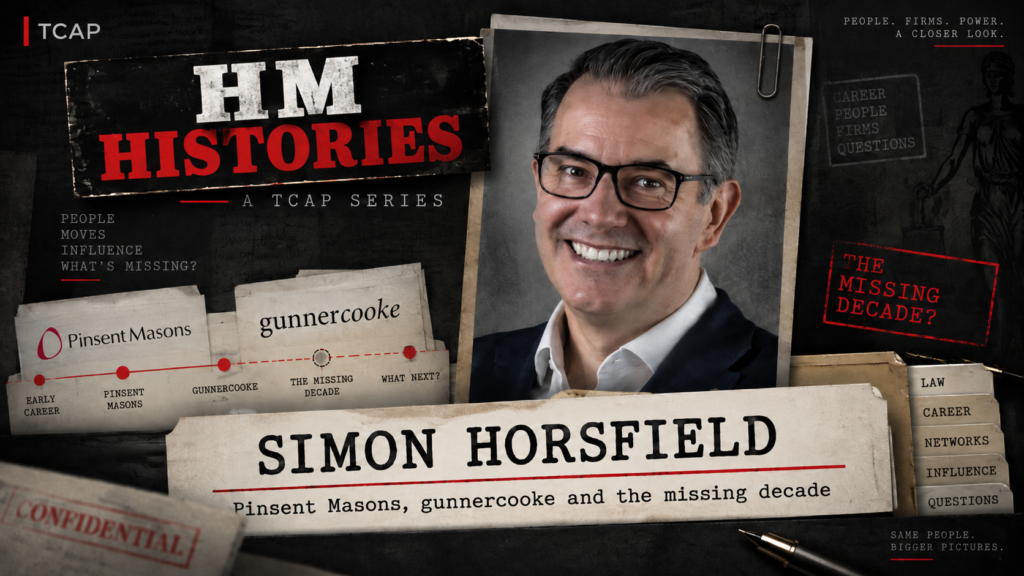
The paper trail for Simon Horsfield at Vaudreys begins with a trainee solicitor’s signature in 1998. Before the partnership titles, boardroom advice and boutique branding, there was a young lawyer putting his name on company formation paperwork. Professional pedigree would come later, aHM Histories : Simon Horsfield At Vaudreys – Bright Eyes And An Ugly Family Tree
long with the polished bollocks that makes every successful career sound like a public service. Picture the bright eyes, the bushy tail and the belief that entering a respectable profession means joining something worthy of respect. Then follow the firm through its mergers. Some of the later court findings make that professional family tree look bloody uncomfortable.
We have already visited Horsfield’s Pinsent Masons chapter in HM Histories. That piece examined the institution behind a prestigious career entry and found a spectacular mess involving imaginary legal wording. Now we rewind to his earliest documented firm connection. The route takes us through Vaudreys and into DAC Beachcroft, where the record includes a settlement message a judge called attempted blackmail.
Simon Horsfield At Vaudreys: The 1998 Paper Trail
Companies House holds the incorporation documents for VOM 98103 Limited, filed on 14 May 1998. The paperwork names Vaudreys as the submitting firm and carries an SPH reference. Another page identifies Simon Philip Horsfield as a trainee solicitor. His signature is dated 29 April 1998. Together, those details provide a contemporary connection between Horsfield, his trainee status and the Manchester practice.
That is our starting point. An exact joining date would require further evidence, but the spring 1998 connection is sitting in a signed document. There is something satisfying about finding a professional origin story in the administrative plumbing. Biographies give you the impressive career arc. The old paperwork cuts through that varnished shite. It gives you the young bloke holding the pen, years before his surname goes above an employment law firm’s door.
The Firm Changes Names, The History Stays Attached
Vaudreys dated back to 1879. In 1998, it merged with Wansbroughs Willey Hargrave. The following year brought a merger with Beachcroft Stanleys, creating Beachcroft Wansbroughs. That practice became Beachcroft LLP in 2006, then merged with Davies Arnold Cooper in 2011 to form DAC Beachcroft. Bristol Law Society set out this lineage during the successor firm’s 250th anniversary celebrations in 2012.
So the history has a clear route. Our two main cases concern the later DAC Beachcroft practice, well after Horsfield’s documented trainee connection. Institutions happily wheel out their ancestors when longevity helps sell the service. Fair enough. However, the family album also has room for the occasions when a judge looked at the work and found something considerably less flattering. Heritage should survive a visit to the less ceremonial parts of the archive.
2015: Pay More, Or Your Life Gets Complicated
The Ferster litigation involved three brothers and an online gaming business. DAC Beachcroft acted for Stuart and Warren Ferster in their dispute with Jonathan. After an unsuccessful mediation, a message conveyed through the mediator on 29 April 2015 sought a higher price for their shares. Alongside that demand came threats involving imprisonment, Jonathan’s partner and destruction of his business reputation. The message allowed 48 hours for settlement.
Fuck me, that is a negotiating atmosphere. There is the commercial proposal, and beside it the prospect of your personal life being shoved into the machinery. A deadline starts ticking. Your partner enters the picture. Liberty and reputation acquire a place on the price list. Calling the encounter a settlement discussion does precious little to improve the view from the receiving end.
2015-2016: The Judge Opens The Envelope
In her December 2015 ruling, Mrs Justice Rose said: “I am in no doubt that this was an attempt at blackmail.” She observed that the email appeared to have been drafted by lawyers. When DAC Beachcroft subsequently sought to explain the message, she interpreted its response as recognition of the impropriety and an attempt to repair matters. The ruling allowed Jonathan to use the email in his civil proceedings.
Meanwhile, the brothers argued that settlement privilege should protect the communication. On 12 July 2016, the Court of Appeal dismissed their appeal. It agreed that the threats exceeded proper negotiating conduct and upheld the decision admitting the email under the exception for unambiguous impropriety. The threatened consequences had become leverage for extracting more money.
The respectable wrapper deserves as much attention as the threat. Solicitors, a mediator and a privileged negotiating setting surrounded this communication. Yet the judicial scrutiny reached what the message actually did. A threat can acquire an impressive distribution list and remain a threat. The respectable handling only makes the failure more embarrassing. Bollocks gains no special immunity because someone forwards it politely.
2021-2024: An Ordinary Accident Gets A Fraud Label
A later case supplied another ugly encounter with judicial scrutiny. In Thakkar v Mican, DAC Beachcroft represented the defendants in road accident litigation. In July 2021, the trial judge refused permission to add allegations of fundamental dishonesty. She specifically questioned the firm’s fee handler for putting that label on an ordinary accident dispute. At trial in April 2022, the claimants won.
The judgment also records an insurer’s investigator warning an independent witness’s uncle that the witness might face an accusation of fraud. After hearing about that warning, the witness withdrew cooperation with the investigator. The trial judge later criticised the unnecessary costs and the risk of deterring public-spirited witnesses. A person helping establish what happened had found himself contemplating trouble for getting involved.
Serious Allegations, Surprisingly Little Restraint
The claimants subsequently lost their appeal seeking additional indemnity costs for the disputed pre-trial period. In May 2024, the Court of Appeal upheld the trial judge’s discretion. Moreover, the Lady Chief Justice criticised unnecessary serious allegations on both sides. Her criticism reached the claimants’ solicitors too.
That broader finding matters. A profession can become so accustomed to escalating a dispute that restraint starts looking like a missed commercial opportunity. Meanwhile, the people caught inside the argument pay in money, time and anxiety. Serious allegations demand serious grounds. Otherwise, the courtroom inherits speculative crap, and the ordinary business of establishing facts becomes a pissing contest with a costs budget.
There is little glamour in that picture. Someone has suffered an accident. Witnesses disagree. Lawyers need to test the accounts. Instead, the language grows teeth, the correspondence gets hotter and everyone requires more professional assistance to survive the professional assistance already supplied. What an efficient little market for aggravation.
From The Trainee’s Signature To Horsfield Menzies
Horsfield later became a Pinsent Masons partner and moved to gunnercooke in January 2014. Eventually, his name became part of Horsfield Menzies. Today, HM’s profile presents him as calm, commercially minded and willing to explore early dispute resolution. It also describes him as “tough when needed,” while promising employer clients “peace of mind”. For senior executives negotiating departures, it says he works to ensure that “nothing is left on the table.”
Those are revealing priorities to sell. Peace of mind has a purchaser. Toughness has an intended beneficiary. Across employment litigation, the person paying for the advice and the person receiving the pressure can experience the same professional service very differently. The brochure knows whose arse belongs in the comfortable chair. TCAP keeps an eye on the poor bastard standing opposite it.
Did Vaudreys’ trainee paperwork give us an early glimpse of a future founding partner of one of Britain’s most diabolical employment law firms? There is Horsfield’s signature in 1998, and there is Horsfield Menzies carrying his name today. Meanwhile, Vaudreys’ successor has acquired its own deeply unpleasant court record. This chapter follows that earlier career connection and the later institutional history.
The professional pedigree is available for admiration. Its history is available for scrutiny. We have already opened the Pinsent file. Now this earlier connection leads to a successor practice whose lawyers featured in an attempted-blackmail episode and an ordinary injury dispute inflated with dishonesty allegations. Fuck the ceremonial version. A legal family tree should come with the difficult judgments attached. Then, when a firm sells experience, readers can see exactly what institutional history is doing the selling.
Lee Thompson – Founder, The Cummins Accountability Project
Sources
- Companies House: VOM 98103 Limited Incorporation Documents, 14 May 1998
- The History Of DAC Beachcroft – Bristol Law Society
- Interactive Technology Corporation Ltd v Ferster & Others – Mrs Justice Rose’s Ruling, 21 December 2015
- Ferster v Ferster & Others – Court Of Appeal Judgment, 12 July 2016
- Hiren Thakkar & Others v Ioan Mican & Another – Court Of Appeal Judgment, 20 May 2024
- Manchester Law Firm Add Ten Partners – Bdaily, 31 January 2014
- Simon Horsfield – Horsfield Menzies Partner Profile
- HM Histories : Simon Horsfield – Pinsent Masons And The Bullshit Correction Department