
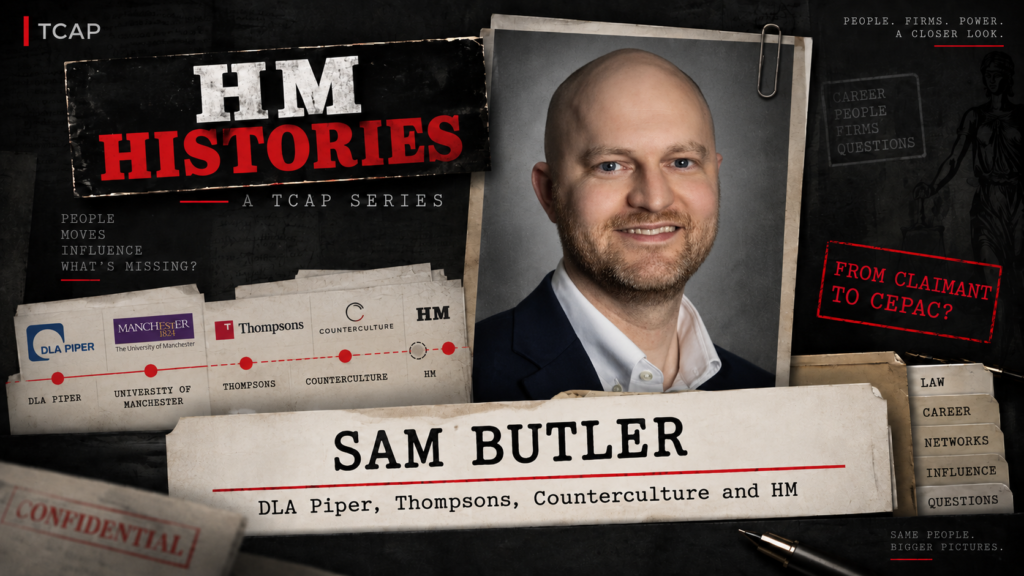
Sam Butler at Manchester takes HM Histories out of DLA Piper’s billing empire and into the University of Manchester’s in-house legal team. Our first chapter examined the firm that launched his legal career. This time, the employer has lecture theatres, halls of residence and a charitable mission. However, its institutional history also includes fencing that outraged students and pay deductions that enraged staff. Higher education can produce some impressively low instincts once people start challenging the management.
The university describes its purpose as advancing education, knowledge and wisdom for public benefit. Lovely ambition. Yet wisdom becomes harder to locate when a fence arrives before an explanation, or a dispute over work becomes a threat to someone’s entire salary. Manchester supplies a particularly instructive collection of these contradictions. The paperwork lets us watch concern for people acquire an operational plan, a payment deadline and a bloody enforcement budget.
Sam Butler At Manchester: The Spring 2020 Move
A contemporary document anchors this career stop. Liverpool University’s council minutes for 20 May 2020 record that Butler stood down from its council at the end of April. He did so to avoid a conflict arising from his imminent employment by the University of Manchester. Meanwhile, HM’s later career interview supplies the sequence: DLA Piper, twelve months in Manchester’s legal team, then Thompsons Solicitors. Butler says the Manchester work largely concerned the legal complexities of Covid.
That places the move in spring 2020, with a pandemic already rewriting university life. Students faced disrupted study, restricted social contact and uncertainty over accommodation. An in-house legal department had plenty to consider. However, the institution’s decisions also had consequences beyond the contractual plumbing. A university can explain its powers beautifully and still make the people living under them feel like an administrative nuisance.
None of the records examined here identifies Butler as the adviser on the controversies below. His employment supplies the career connection; the university supplies the institutional history. The 2020 material concerns that pandemic chapter, while the 2023 disputes belong to its later record. With the chronology established, we can inspect the employer without stuffing an unsupported allegation into Butler’s briefcase. Luckily, as it’ll likely be already brimming with binoculars, a phone with a sock over the mic to muffle his voice and a laptop with TCAP’s X feed open.
November 2020: Welcome To University, Mind The Fence
On 5 November 2020, Manchester began installing fencing at its Fallowfield halls. That evening, vice-chancellor Nancy Rothwell apologised for the distress it caused and announced removal from the following morning. Her statement explained that the aim was security, particularly restricting access by non-residents. It said students were never meant to be prevented from entering or leaving. Nevertheless, installing the thing before adequately explaining it had already produced a spectacular shitshow.
Consider the scene. Young people come to university expecting some independence, then discover management assembling barriers around their accommodation. Meanwhile, the institution calls this a safety measure. Of course security matters, but the people affected should enter the conversation before the contractor enters the site. Otherwise, pastoral care starts resembling crowd control with a prospectus, and the reassuring language has a distinctly unpleasant rattle.
The subsequent inquiry recorded student concerns about feeling caged, restricted movement and neglected wellbeing. It also described a protest involving more than 1,000 students at its peak. Those reactions belong in the account because they explain the damage management needed to repair. A decision can carry benign intentions and still deliver a piss-poor experience. By then, the communications team has more to do than explain where the gates are.
The Inquiry Finds The Administrative Bollocks
The inquiry’s decision-making account is especially revealing. It found that the senior leadership meeting had received no detailed discussion of the approach, including risks, and had not been asked to approve fencing. Moreover, the plan expanded beyond its original perimeter-security purpose. Students had not been engaged. The report identified a missed opportunity to pause, while communications staff did not feel empowered to challenge the timetable.
That is a miserable answer from an institution built around questioning things. Somewhere between the seminar room and the management meeting, critical thinking apparently lost its staff pass. A deadline gained authority, an email exchange supplied momentum, and the people preparing the message felt unable to interrupt. Consequently, the organisation moved faster towards a physical barrier than towards a useful conversation. What a sodding achievement.
The lesson extends beyond this campus. Procedures need people who can challenge a bad decision before it becomes everybody else’s problem. Otherwise, each department completes its assigned task while the combined result makes the whole institution look like an arrogant bugger. Manchester’s inquiry gives that failure concrete form. You can admire the efficiency of putting up a fence, or ask why the organisation struggled to stop itself.
The Rent Reduction Comes With A Rather Large Percentage
Later that November, the university agreed a 30% accommodation reduction for the first semester, covering September 2020 to 31 January 2021. Its announcement credited negotiations with the Students’ Union and elected halls representatives. Moreover, it acknowledged that restricted facilities had affected the student experience. The agreement improved on an earlier two-week reduction. Students could also break their accommodation contracts without a financial penalty.
That outcome deserves its proper place. Students secured a substantial concession, and management agreed to it. However, the percentage also gives some scale to the disagreement about what residents were receiving. The university itself acknowledged the diminished experience. When the facilities and freedoms shrink, demanding a corresponding change to the bill is hardly some outrageous attack on civilisation. It is the customer noticing that the bloody product has changed.
The announcement also promised better handling of maintenance issues, more usable spaces and further meetings. Thus, the settlement addressed both money and daily life. That is what a useful institutional response looks like: specific changes people can recognise. Nevertheless, the contrast with the fencing episode remains brutal. A conversation helped produce agreement; a hurried barrier produced anger. Universities should be able to work out which approach requires less remedial bollocks.
After That Career Stop: The 2023 Enforcement Bill
The accommodation argument returned in 2023. Manchester’s Students’ Union supported rent-strike campaigners and recognised concerns about poor living conditions. Meanwhile, occupiers took over university buildings. ITV reported that bailiffs physically evicted students from the Simon Building after a 38-day occupation, at a cost exceeding £40,000. The university said it enforced a court order on 22 March after repeated requests to leave, citing disruption and safety concerns.
The court order belongs in the story, as does the university’s explanation. Even so, an enforcement budget tells readers something concrete about institutional priorities. Affordability and living conditions were the campaign’s concerns; removing occupiers became a purchase the institution could authorise. Here, the discussion acquired professional muscle and an invoice. That is a grim little development for people who hoped their accommodation complaints might produce a more useful expenditure.
There is also a difference between ending an occupation and answering the grievance behind it. Management may regain a room while the underlying argument continues outside. Consequently, an expensive eviction can deliver a neat operational result and leave a rotten relationship behind. TCAP’s objection is to that narrow definition of success. Getting the building back should hardly exhaust the ambitions of an institution supposedly advancing wisdom.
Staff Discover What Organisational Development Can Cost
The same year brought a sharper employment dispute. In April 2023, Manchester announced that it would withhold 50% of normal salary from staff participating in a marking and assessment boycott. Its stated position was that it did not accept partial contractual performance. Meanwhile, participating staff could continue other duties. The institution presented the half-pay deduction as an exercise of discretion, while reserving the option to increase it.
On 7 June, it announced escalation from 12 June. Staff whose boycott participation emerged after they failed to report it by the deadline faced 100% withholding from that date. The same measure applied to collecting exam scripts and then withholding marking through the boycott. Those who declared participation retained the 50% deduction. Therefore, this was a policy with specified triggers, rather than a blanket announcement that every participant would lose all pay.
Nevertheless, the pressure is obvious. A worker needs wages for rent, food and ordinary survival. Halving them already gives an employment dispute a vicious domestic afterlife; threatening the whole salary raises the stakes considerably. The announcement acknowledged the right to take industrial action, yet attached financial consequences capable of making that right painfully difficult to exercise. The polite prose does nothing to soften the bastard arithmetic.
The Minutes Explain What The Deduction Measured
Manchester’s negotiating committee minutes for 4 July 2023 sharpen the picture. UCU challenged the proportionality of the deductions because marking did not account for half a member’s work. The university explained that its calculation reflected the boycott’s serious impact and the work needed to mitigate it, rather than time spent on marking. Moreover, management said it had obtained senior legal advice and considered its approach lawful and proportionate.
Now the institution’s own account gives us the argument to examine. Management measured the consequences of disruption; the union questioned the relationship between withheld work and withheld pay. That distinction matters because somebody still doing other duties could lose half their income. TCAP regards that approach as punitive. Calling it proportionate does not settle the argument when the employee’s remaining work continues and the household budget gets hammered.
The minutes also recorded that a court challenge could take years, alongside disagreement over the tone of management communications. Meanwhile, the financial pressure operated in the present. That imbalance is ugly as fuck: the deductions have an immediate effect, while resolving a legal dispute may take much longer. Institutional confidence becomes considerably easier to maintain when the other side must keep paying for life while waiting to challenge the calculation.
A Settlement, Then The Next Career Chapter
The later outcome matters too. Manchester’s governors recorded that the local union called off strike action on 25 September 2023 after accepting a settlement under which 25% of participating staff’s pay would remain withheld. That reduced the original deduction. It was a negotiated compromise, however, rather than a court ruling on the policy’s legality. The dispute ended with a smaller financial loss still attached to participation.
Return, then, to Sam Butler at Manchester. His career interview presents a year spent navigating Covid’s legal complexities. The employer’s wider record shows why institutional complexity deserves scrutiny: student safety became a botched fencing project, accommodation grievances required negotiation, later protests brought enforcement costs, and an employment dispute turned salary into a pressure point. The dates differ, but each episode tests how management treats people who challenge it.
Our DLA chapter examined a commercial law firm. Manchester adds the university that can discuss public benefit while reaching for barriers, enforcement and payroll deductions. TCAP’s judgement is that its lofty purpose makes those choices more embarrassing, because it should understand the human consequences better. The next stop is Thompsons, where Butler says he moved into employee and trade-union representation. For now, Manchester’s contribution to this career map comes with the fence diagram and the pay-withholding policy attached. Quite the fucking educational package.
Lee Thompson – Founder, The Cummins Accountability Project
Sources
- HM Histories: Sam Butler At DLA Piper – Churn That Bill, Baby
- Horsfield Menzies: Welcome Sam Butler – His Career Journey
- University Of Liverpool: Council Minutes, 20 May 2020
- University Of Manchester: Statement And Apology From The President And Vice-Chancellor, 5 November 2020
- University Of Manchester: Fallowfield Fencing Inquiry Report, 30 November 2020
- University Of Manchester: Further Rent Reduction And Action To Improve Student Accommodation
- University Of Manchester Students’ Union: Student Occupations
- ITV News: Manchester University Rent Strikes – Did The Student Occupations ChangTCAe Anything?
- University Of Manchester: Guidance And Reporting For Markingtc And Assessment Boycott, 19 April 2023
- University Of Manchester: A Message For Staff Participating In The Marking And Assessment Boycott, 7 June 2023
- University Of Manchester: UCU Negotiating Committee Minutes, 4 July 2023
- University Of Manchester: Board Of Governors Minutes, 11 October 2023
- University Of Manchester : Charitable Status And Public Purpose