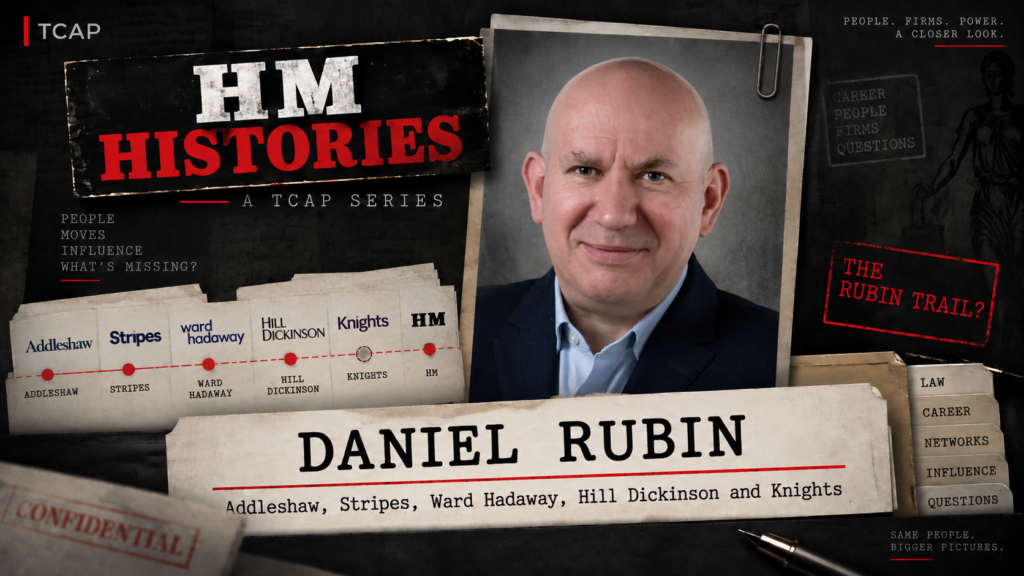
Daniel Rubin at Ward Hadaway takes HM Histories into the business of speaking up, shutting up and looking splendid afterwards. His former firm published advice explaining that confidentiality clauses cannot prevent protected whistleblowing. Later, two of its solicitors received warnings over wording in ambulance-service settlement agreements. By 2026, the firm was sponsoring that service’s staff awards. The event’s name? In the Spotlight. Sometimes the institutional piss-taking arrives with its own lighting technician.
We have already followed Rubin through Addleshaw Goddard and Stripes, including the latter’s place in the miners’ compensation industry. Now another respectable name on the CV opens another distinctly uncomfortable file. For a profession so fond of selling judgement, it produces a remarkable amount of paperwork that requires explaining afterwards. Fortunately, TCAP remains available to interrupt the fucking slideshow.
Daniel Rubin At Ward Hadaway: The Career Connection
The contemporary record puts Rubin at Ward Hadaway before his move to Hill Dickinson in 2014. Commercial News Media reported that move on 2 May; the Law Society Gazette followed in June. Both named Rubin and David Parry as arrivals from Ward Hadaway. That establishes our next documented stop after Stripes, although the sources reviewed do not establish his precise joining date.
Rubin had left before the NHS events examined here, and these records do not identify him as an adviser on them. This chapter examines the later history of his former employer. Meanwhile, the career announcements supply the usual professional fanfare: expertise, connections and opportunities for growth. Read enough of this stuff and every departing partner sounds like a fucking national infrastructure project. Someone changes offices; the trade press practically cuts a ribbon.
2019: The Firm Had Already Explained The Problem
On 20 May 2019, Ward Hadaway published an article called Misuse of confidentiality clauses. It explained that existing legal limits protected whistleblowing. The piece also described the government’s concern that employers could use confidentiality wording to intimidate harassment or discrimination victims into silence. In other words, the firm understood both the legal boundary and the practical danger of making people think they could not speak.
Ward Hadaway’s published explanation recognised the problem. Consequently, the later story cannot hide behind the suggestion that whistleblowing rights occupied some undiscovered corner of employment law. The firm had already put the bloody signpost on its own website. Apparently, producing the signpost and following it required separate departments.
Patient Safety Meets The Exit Agreement
Paul Calvert raised concerns about North East Ambulance Service, known as NEAS. His later evidence to Parliament describes concerns beginning in 2018 and public disclosures in 2022. The dispute concerned patient safety and what families and coroners learned about deaths. These are questions with consequences far beyond the comfort of a management meeting. After all, people needed to understand what had happened to someone they loved.
In November 2022, the Guardian reported an SRA investigation into Ward Hadaway’s work on Calvert’s proposed settlement. Consider the priorities in that situation. Alongside the urgent business of answering difficult questions, someone now has to negotiate their own departure. Meanwhile, the institutional machinery keeps running. An employment exit can acquire a neat administrative timetable while the questions that prompted it remain painfully unresolved.
For TCAP, that is where the professional vocabulary starts to curdle. Resolution sounds wonderful when everybody agrees on what needs resolving. However, a worker’s departure and an institution’s accountability are different problems. An exit agreement can conclude an employment relationship while leaving the public-interest questions standing outside in the rain. The organisation gets a completed transaction; everyone else still wants a straight answer.
2023: What The Independent Review Found
Dame Marianne Griffiths’ review examined nine proposed settlement agreements from April 2020 onwards. It identified two containing inappropriate non-disclosure provisions in circumstances centred on safety concerns. One agreement took effect. The other underwent amendment, never took effect and was withdrawn. The review also recorded NEAS’s acceptance that one agreement could have appeared to restrict speaking up.
Investigators found no evidence of inappropriate use of public funds in reaching the settlements. Moreover, the review recognised useful earlier work by Ward Hadaway: the firm’s 2019 reviews had identified problems with coronial processes and supported staff concerns. That makes the later drafting controversy particularly uncomfortable. Knowledge of the underlying difficulties existed within the firm. The problem had already received professional attention.
NEAS apologised to the families after publication. Its response described stronger investigation procedures, improvements to coronial reporting and greater resources for staff to raise concerns. Those changes were necessary. Nevertheless, the original predicament remains appalling: families seeking answers, staff raising concerns and settlement wording capable of making an already difficult situation worse. A decent system should make candour easier than calculating the risks of opening your mouth.
2024: Warnings, An Error Of Judgement And No Breach Finding
Chronicle Live reported on 21 June 2024 that the SRA had warned two Ward Hadaway solicitors. According to that report, the regulator found wording that “attempts to deter or impede the claimants from pursuing protected disclosures.” However, it treated the drafting as an “error of judgement,” found it was not deliberate and found no breach of professional obligations. The warnings would remain on the solicitors’ records.
Ward Hadaway said its lawyers had cooperated fully and emphasised the closure without a breach finding. That outcome still leaves an ugly practical question: how did drafting like this reach whistleblowers in the first place? The firm’s published guidance makes the discrepancy especially embarrassing.
An error of judgement sounds almost cosy. Someone chose the wrong wine; perhaps the conference badges arrived in Comic Sans. Here, however, the stakes included people’s willingness to speak about patient safety. What a grubby fucking context for such a comfortable little phrase.
A Clause Does Not Need To Win In Court To Cause Trouble
The SRA’s published NDA warning notice addresses this practical danger. It says agreements must not give people the impression that protected reporting is prohibited. Its guidance also warns against excessive reliance on templates and requires proper attention to individual circumstances. The professional task therefore extends beyond knowing which clauses a court might eventually enforce. Lawyers must consider what their wording communicates to the person receiving it.
Imagine trying to read an agreement while your job, income and professional future already feel unstable. Every qualification matters. So does every apparent restriction. Meanwhile, a lawyer may see drafting to negotiate; the recipient may see another expensive fight waiting to happen. That imbalance gives legal language its force. As a result, a document can become a remarkably effective little bastard without ever reaching a courtroom.
2026: Everybody Into The Spotlight
Then comes the publicity department’s contribution. NEAS announced Ward Hadaway as a silver sponsor of its 2026 In the Spotlight Awards, returning for a second year. The ceremony took place at Hardwick Hall Hotel in Sedgefield on 19 June. Afterwards, the trust’s coverage quoted a Ward Hadaway representative celebrating the evening and the achievements of staff.
Frontline workers deserve recognition for difficult, valuable work. The institutional juxtaposition still deserves a raised eyebrow sharp enough to open an envelope. A firm connected with the whistleblower-clause controversy now helped sponsor an event built around recognition. Bloody hell. The spotlight appears considerably easier to arrange when it comes with a hotel booking and a celebratory programme.
Sponsorship gives a business a flattering place in the photograph. By contrast, historical scrutiny asks what else belongs in the frame. Those are different editorial choices, and TCAP knows which one interests us. Put the applause alongside the drafting history. Let readers see both. A corporate logo above an awards stage does not make the earlier documents disappear, however uplifting the evening.
Rubin’s CV Gets The History Attached
Today, Horsfield Menzies presents Rubin as a pragmatic employment lawyer advising on restructuring, redundancies and sensitive executive matters. His profile stresses “reputation management and investor confidence.” There is the commercial priority, displayed without embarrassment. The man gets a polished professional portrait; the institutions on his CV get to contribute their prestige. HM Histories supplies the parts of those institutions’ records that the portrait leaves outside the frame.
Rubin’s corporate brochure voice remains a particularly rich source of irritation. Human upheaval becomes strategic change. Difficult departures become sensitive issues. Every sharp edge arrives wrapped in enough managerial bollocks to furnish a regional conference centre. Following Daniel Rubin at Ward Hadaway means looking past that finish and asking what the employer’s public record actually contains.
This time, it contains published advice about confidentiality, the later controversy and a subsequent awards sponsorship. That history belongs alongside the prestigious name in the professional sales pitch. Rubin can keep the management-consultant patter. His CV has collected respectable institutions; their public records have no obligation to flatter him. Meanwhile, TCAP will keep pointing the spotlight at the parts that make the corporate photographer mutter, oh shit.
Lee Thompson – Founder, The Cummins Accountability Project
Sources
- TCAP : Daniel Rubin At Addleshaw Goddard
- TCAP : Daniel Rubin At Stripes
- Commercial News Media: Rubin And Parry Move From Ward Hadaway To Hill Dickinson, May 2014
- Law Society Gazette: New Appointments At Hill Dickinson, June 2014
- Ward Hadaway: Misuse Of Confidentiality Clauses, May 2019
- UK Parliament: Paul Calvert’s Written Evidence, November 2025
- The Guardian: Investigation Report
- UK Parliament: Independent Review Of North East Ambulance Service, July 2023
- NEAS: Response To The Independent Review, July 2023
- Chronicle Live: Warnings Over Whistleblower Settlement Clauses, June 2024
- Solicitors Regulation Authority: NDA Warning Notice
- NEAS: Ward Hadaway’s 2026 Awards Sponsorship
- NEAS: In The Spotlight Awards 2026
- Horsfield Menzies: Daniel Rubin’s Partner Profile