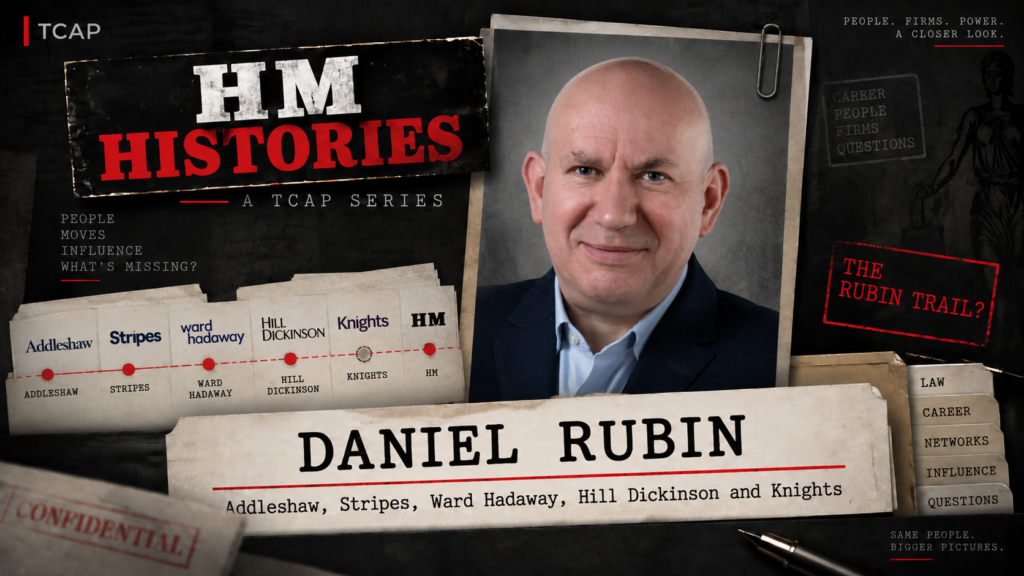
Daniel Rubin at Stripes Solicitors is the next stop in HM Histories. Our first chapter followed his decade at Addleshaw Booth and Addleshaw Goddard, where the corporate thesaurus occasionally worked harder than the photocopier. Now the career map moves to a smaller Manchester practice and the less glamorous machinery beneath compensation claims. Injured workers enter looking for redress. Around them, an industry starts counting fees, funding obligations and slices of profit.
On 23 September 2009, TheBusinessDesk reported that Rubin had joined Stripes as director of employment. He arrived from Addleshaw Goddard, where he had reached managing-associate level, with the announcement promising a better value proposition for clients. Meanwhile, Stripes already had a history involving miners’ compensation and industrial-disease work. Better value sounds lovely. Therefore, the next question is who gets the value and who feeds the bloody machine.
The earlier conduct examined here predates Rubin’s arrival. We have not established that he handled it or participated in the later litigation. His CV supplies the connection; this chapter examines his employer’s record. With that boundary in place, the sales language can step aside and let the paperwork elbow its way through the marketing shite.
Before Daniel Rubin At Stripes: The Miners List
On 22 April 2004, minister Nigel Griffiths answered a parliamentary question about solicitors and deductions from miners’ compensation. His answer named Stripes among firms removed from the government website because they had failed to respond to refund correspondence or had asked for removal. The wider answer also discussed firms that said they would not repay. However, it did not specify which explanation applied to Stripes or establish its eventual repayment position.
That is an awkward entry in any professional history, however much corporate waffle you shovel over the bastard. A firm handling injured workers’ claims appeared in Parliament’s argument over returning money to miners and their widows. That deserves a place beside the polished career announcement, with its awkward details intact. Institutional history includes the uncomfortable correspondence, even when the recruitment department would rather file it beneath miscellaneous bollocks and staple the drawer shut.
Griffiths said ministers had asked firms that unfairly took part of compensation to refund it. He also reported the Law Society’s view that double charging was unlikely to be justified and could amount to inadequate professional service. The official language wore sensible shoes and kept its swearing to itself. Beneath it stood a much rougher question: after the worker had paid with their health, why the hell should the compensation face another appetite?
The Taxpayer Had Already Paid For Representation
Start with what these schemes were supposed to achieve. The government took responsibility for British Coal’s personal-injury liabilities in 1998. Compensation followed findings of negligence involving coal-dust lung disease and vibration white finger. Former miners and bereaved families sought redress for damaged lungs and hands. Consequently, this was not some speculative punt dressed up as litigation. People wanted compensation for harm that their working lives had already delivered.
In 2007, the National Audit Office said the expected administration bill included £1.3 billion for claimants’ legal fees. Its report also explained that the department had expected its payments to cover solicitors’ costs without additional charges to claimants. The wider double-charging controversy therefore involved an especially ugly possibility: public money paid for representation, while some solicitors also took money from the compensation. Two helpings from one person’s injury. What a professionally presented piss-take.
The objection is simple. Paying a lawyer for useful work is reasonable. Making the injured person understand every financial obligation is essential. However, a system that needs ministers to chase refunds has already travelled a long way from the reassuring handshake. By then, somebody’s promise of help has acquired small print, and the small print has developed a fucking appetite.
Stripes Had A Place At The Fee Table
A parliamentary answer published on 20 July 2009 listed £694,656 in costs paid to Stripes under the coal-health schemes. The breakdown was £632,696 for lung-disease claims, £49,160 for vibration-white-finger claims and £12,800 for miscellaneous claims. Thus, shortly before Rubin’s appointment announcement, the official record showed a substantial financial connection between his next employer and industrial-injury work. These figures record government payments for representation.
Nevertheless, the figure gives the earlier refund-correspondence list commercial context. Stripes participated in a market where the government paid legal costs, while its name also appeared in the controversy over returning money to claimants. Both facts deserve daylight. A slick biography can describe expertise in industrial disease until the marketing department is blue in its sodding face; a fuller history should also ask how the money moved and whether the client understood every stop it made.
There is something distinctly grim about the professional vocabulary here. First, a worker’s damaged health becomes a practice area. Then their case becomes work in progress. Eventually, the fee becomes revenue. None of those accounting terms is inherently improper, but collectively they can make a human being disappear behind a spreadsheet. That is why transparency matters more than another bastard slogan about putting people first.
A Claims Factory With A Financial Timer
The Court of Appeal’s 2012 judgment in Duffy v Stripes Solicitors exposes another part of the business. Mr Duffy worked at Stripes from January 2005 to March 2007, handling industrial-disease cases, including hearing-loss claims. Through the Veras scheme, funders lent claimant clients money for case expenses, while the solicitor promised to reimburse the funder. Stripes usually had 120 days to return an unpromising case and avoid liability beyond an administration charge.
After Veras encountered financial difficulties, its claims passed to Impact, which sued Stripes for a stated £564,000. Settlement required repayment of loans and interest on successful cases, rather than unsuccessful ones. Separately, Stripes secured trial awards against Duffy of just over £61,000 and a further £14,000-odd. The Court of Appeal described a three-week trial. Stripes therefore had substantial success against its former employee.
Even so, the machinery deserves scrutiny. Referrals, loans and reimbursement promises surrounded the injured person’s claim, while the practice faced a financial clock of its own. Access to justice came with an assembly line behind the consultation room. The professional brochure should show the gears alongside the sympathetic face. Calling the service pragmatic and sticking a fucking logo on it explains none of those obligations.
When The System Costs More Than The Compensation
The Public Accounts Committee supplied the wider indictment in 2008. For every £2 paid in compensation across the schemes, more than £1 went on administration. Moreover, around 69% of recipients under the lung-disease scheme received less compensation than the average cost of administering a claim. The committee criticised weak fee negotiations and additional charges that some firms had not properly explained. That is a damning account of the system in which Stripes participated, rather than a finding about every one of its files.
Think about the priorities those figures expose. Compensation exists because somebody suffered harm. Yet the machinery built around that harm can consume more than the payment reaching the person. The queue becomes a workload, the workload becomes a budget, and the budget develops a constituency fiercely interested in its own survival and fucking remuneration. Meanwhile, the claimant waits for this self-important bugger of a system to finish congratulating itself on being indispensable.
That is the shit this profession should have to explain without hiding behind complexity. An injured worker needs competent advice and fair terms, without another load of commercial bollocks obscuring either. They do not need a compensation economy that treats their loss as the starting material for everyone else’s commercial arrangements, then serves up bullshit about professional prestige. Once the process grows that expensive, professional confidence is no answer. Show where the money went, explain the deductions and stop expecting polished stationery to settle the argument.
Better Value, With The History Attached
Rubin’s present Horsfield Menzies profile describes a pragmatic employment lawyer and emphasises reputation management and investor confidence. Read against this career stop, that language raises a familiar question about whose experience defines commercial success. After all, a client wants a useful result. Meanwhile, a practice wants a viable business. Those interests can align. However, the paperwork must show where they separate, especially when compensation represents damaged health rather than somebody’s spare cash.
Much later, Stripes Solicitors Limited entered creditors’ voluntary liquidation, with liquidators appointed on 8 July 2021. The published notice supplies the corporate endpoint; it does not attribute the liquidation to these earlier matters. However, it completes a history considerably less tidy than an appointment announcement. The firm’s record includes the miners’ refund-correspondence list, substantial publicly funded claims work and litigation revealing the financial structures behind industrial-disease cases.
Daniel Rubin at Stripes therefore gives HM Histories a different kind of commercial education. Addleshaw supplied the corporate thesaurus; this stop exposes the claims factory. Injured workers needed redress, while the surrounding industry needed fees, funding and viable files. TCAP’s judgement is that the human purpose deserved far more weight than the machinery and its bloody appetite. Calling the arrangement a value proposition does not explain who got the value. It just puts a better suit on the same bloody question while the industry admires its own reflection.
Lee Thompson – Founder, The Cummins Accountability Project
Sources
- TCAP: Daniel Rubin – Addleshaw Goddard’s Corporate Thesaurus
- TheBusinessDesk: Appointments – Rubin in at Stripes
- Hansard: Miners’ Compensation, 22 April 2004
- National Audit Office: Coal Health Compensation Schemes
- Public Accounts Committee: Coal Health Compensation Schemes, 2008
- Hansard: Industrial Diseases – Compensation Costs, 20 July 2009
- Court of Appeal: Duffy v Stripes Solicitors, 2012
- The Gazette: Stripes Solicitors Limited – Appointment of Liquidators
- Horsfield Menzies: Daniel Rubin