
The BHF Cepac connection appears in Cepac’s 2026 portfolio as a British Heart Foundation Christmas-card display. Behind the seasonal goodwill sits a supplier whose recruitment account needs checking against my WhatsApp exchange, Maria Walker’s email and its own ET3. BHF publishes ethical purchasing requirements and disability-inclusion commitments. Now comes the practical question: how far do those values travel into the companies behind the cardboard?
Christmas Cards Have A Manufacturer
Charity Christmas cards perform a comforting double act. Somebody receives a robin, somebody else receives research funding, and the purchaser briefly feels that December’s spending has acquired a moral purpose. However, even goodwill needs somewhere to stand. In Cepac’s 2026 point-of-sale portfolio, a British Heart Foundation display holds Christmas cards beneath a star-shaped topper. The company has put the charity’s name in its own shop window.
The photograph appears on the portfolio’s third page, among freestanding display units. BHF branding and its Christmas-card web address identify the work. That establishes the BHF Cepac connection shown in the document. The photograph itself carries no project date, so the portfolio’s year cannot magically become the commissioning date. BHF’s records can establish when the work happened, who ordered it and whether an agency sat between the charity and Cepac.
That is the first useful enquiry. Meanwhile, the display supplies a fair reason to examine the standards behind the association. A charity can commission cardboard, or commission somebody who commissions cardboard, without procuring immunity for its manufacturer. Goodwill is not bubble wrap for awkward questions. The cards may arrive with little envelopes, but the supplier’s recruitment file deserves something considerably more substantial than a polite seasonal covering note.
BHF Cepac And The Small Print
BHF’s published supplier terms put ethical obligations inside purchasing. Clauses 5.1.6 and 5.2.8 require goods and services to comply with its Code of Practice. Acceptance can arise through written notice or an act fulfilling the purchase order. Meanwhile, clause 7.1 provides remedies for material non-compliance with the relevant supply requirements, including rejection, replacement, refund and termination. The charity has written consequences into the arrangement.
The BHF Cepac review therefore starts with the terms governing this particular work. Identify the buyer, the date and the applicable code. Then establish what assessment took place and which company accepted the obligations. Published terms show how BHF describes its purchasing system; the actual project records show how that system reached this display. Procurement should be able to connect the two without requiring three consultants and a fucking commemorative lanyard.
This matters because corporate ethics often become most elusive at the point somebody asks who agreed to do what. Suddenly, everybody remembers a beautiful aspiration and nobody remembers the contract. Here, BHF has already supplied the useful vocabulary: goods, services, compliance and remedies. The remaining job is to apply those words to a real commissioning chain, then establish what the evidence requires. A supplier code should survive contact with a supplier.
The Code Does Not Stop At The First Invoice
BHF’s September 2026 modern slavery statement describes a wider ethical procurement system. Its Ethical Code of Practice covers contracted third parties, which must require the same principles through their supply chains. In addition, the statement says new suppliers, contractors and partners must sign the code, with standard contractual references. It also describes risk assessments, supplier visits and specialist audits across the New Goods supply base.
Those commitments give the enquiry a route through any intermediary. For example, who commissioned the stand, and did the code reach the manufacturer? What information did the relevant buyer check? Which team would assess a concern about recruitment or complaint handling? The statement identifies procurement machinery capable of asking questions beyond the first invoice. This article puts a recruitment dispute before that machinery; it makes no allegation of modern slavery.
Separately, BHF’s sustainable-partnerships page says alignment includes how partners protect people through their supply chains. Therefore, the principle reaches further than counting recyclable sheets and congratulating the cardboard. People also enter factories through recruitment systems. A purchasing policy that follows the fibres but loses interest in the humans would be a remarkably elaborate piece of bollocks. BHF’s own wording gives it every reason to examine both.
Interview Next Week
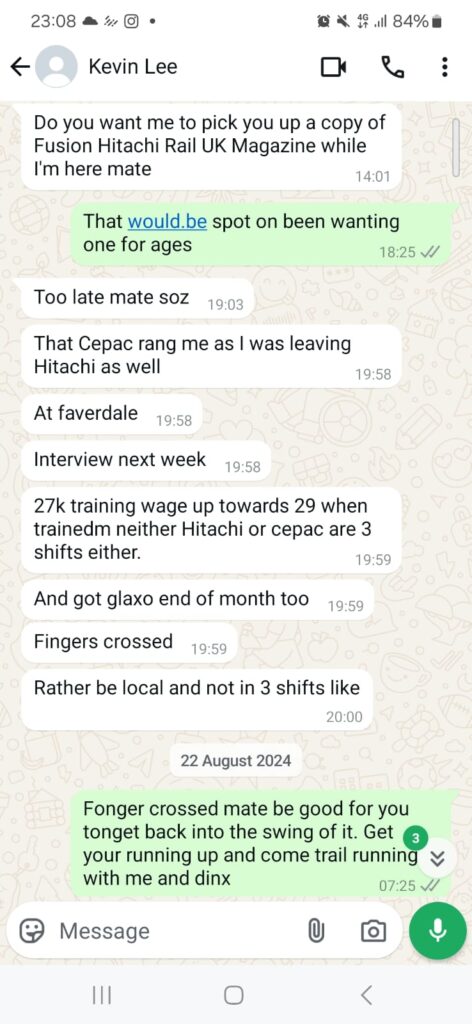
On 21 August 2024, Page Outsourcing called me about a production role at Cepac. During that conversation, Page offered an interview for the week after the bank holiday. We discussed a £27,000 training wage rising towards £29,000. I explained that my employment gap involved treatment for my mental health. Page would pass my details on and call again to agree the exact interview time.
Afterwards, I messaged a friend: “Interview next week” and “27k training wage up towards 29”. The recipient kept the exchange and later supplied a supporting witness statement. Those messages recorded my understanding immediately after the call. They were my account to a friend, rather than a written offer from Page. At that point, however, there was no complaint to embellish and no tribunal case to construct. I thought I had an interview.
The promised confirmation never arrived. Consequently, the same-day exchange now gives an investigator something concrete to compare with the agency’s call records and candidate history. Both the interview and the wage discussion appear in it. A retrospective explanation needs to account for those details. Corporate arse-covering usually benefits from a foggy timeline; here, the first entry already has a date.
Maria Walker Supplies The Explanation
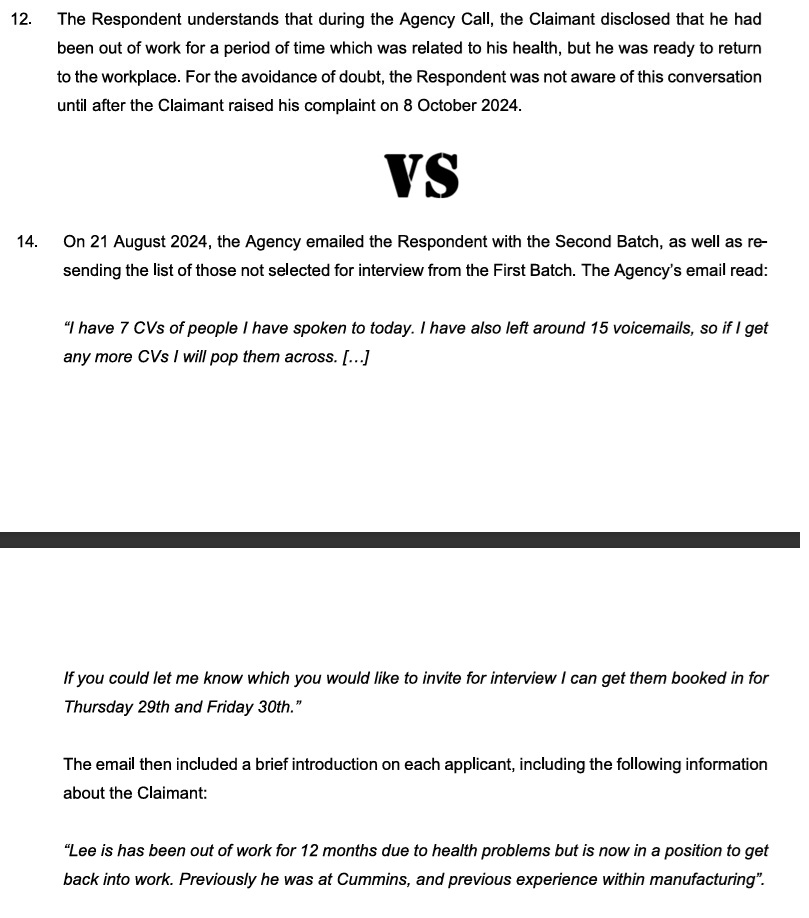
At 04:35 on 8 October 2024, I complained directly to Cepac. Specifically, my email described the interview offer, the planned timing, the missing confirmation and the mental-health disclosure. Therefore, the company had a specific sequence to investigate. It could ask Page what the recruiter said and compare that answer with the candidate’s recorded status.
Maria Walker, Cepac’s HR Business Partner, replied at 09:51. She said the agency screened candidates before sending CVs to the recruiting manager for final shortlisting. My CV had gone across, but I had not made the shortlist. Moreover, she said the manager would not have known about the mental-health issues discussed with Page. Her apology concerned the agency’s failure to explain that I had not secured an interview.
Walker called the discrepancy “confusion”. However, she had not seen the WhatsApp exchange when she answered. That leaves a straightforward question: what checks supported her explanation? An offered interview and an unsuccessful shortlist need somebody to reconcile them. Meanwhile, the applicant receives the confusion label and the company receives an apparently tidy conclusion. It is a piss-poor investigation if the label does all the work that the underlying records should perform.
August Arrives Inside The October Story
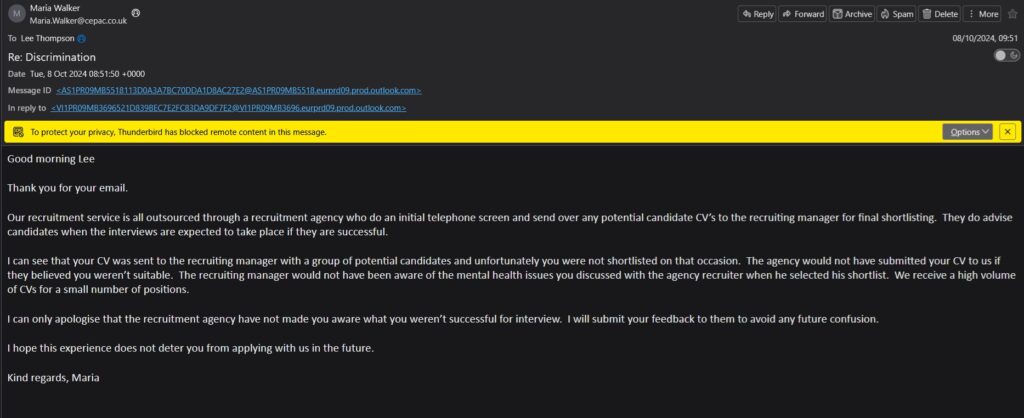
Cepac’s ET3 adds an earlier communication. Paragraph 12 places the company’s awareness of the agency conversation about my health-related employment gap after the October complaint. However, paragraph 14 describes an email that Page sent to Cepac on 21 August, the day of the recruitment call. That email introduced candidates, including me.
My entry said I had been out of work for twelve months because of health problems and was ready to return. It also mentioned my Cummins employment and manufacturing experience. Therefore, Cepac’s own pleading places health-related information inside an August email to the company. The distinction between knowing about a conversation and receiving information from it needs examination. In particular, a reviewer should trace the actual recipients, circulation and use of that email.
Who saw it before the shortlist decision? What did the recruiting manager receive? When did anybody change my candidate status? Together, those records can establish individual knowledge and the selection process. The BHF Cepac enquiry has a dated communication to follow, rather than an argument to settle through impressions. Paragraph 14 does not explain the entire recruitment decision. It does make another reassuring shrug look bloody inadequate.
BHF Knows What Disability Inclusion Requires
BHF’s recruitment website describes its membership of the Business Disability Forum and work to remove barriers. It lists anonymised applications and unconscious-bias training for hiring managers. Meanwhile, its onboarding process encourages new colleagues to identify disabilities, long-term conditions and support needs, allowing adjustments and equipment from the start. The charity also reports winning the 2025 In-House Recruitment Award for Best EDI Strategy.
That gives BHF practical experience to bring to this file. Its own employment practices concern its workforce; the supplier code determines the contractual expectations elsewhere. Nevertheless, the underlying question travels perfectly well. When somebody discloses a health-related employment gap during recruitment, how does the organisation ensure that the information leads to fair treatment? Which records demonstrate the answer when the candidate disputes the outcome?
The BHF Cepac case puts that question into a specific chronology. An interview discussion, a disclosure, a missing confirmation, Walker’s explanation and the August email all require attention. BHF knows enough about inclusion to recognise why the sequence matters. Otherwise, disability awareness becomes an award-winning reception desk with a trapdoor behind it. Lovely welcome, excellent training slides, and then the supplier’s candidate drops into the administrative shit below. Follow the process all the way through.
Michael Page Supplies The Blackout Edition
Page holds the recruitment records from the other end. My data-access request sought application material, call information and correspondence with Cepac. However, its response removed names and parts of correspondence, citing third-party information. TCAP’s Page Partners investigation sets out the disclosure and the internal handling of my complaint. As a result of those gaps, tracing who said what became considerably harder.
A properly authorised review can examine complete records confidentially and consider other people’s data rights. That is why procurement should seek the underlying chronology, rather than treat my redacted copy as the limit of the available evidence. Somebody at Page knows who occupied the spaces beneath the black ink. Meanwhile, a candidate trying to reconstruct a recruitment decision receives the organisational equivalent of a jigsaw with half the bastards face down. BHF can ask how an investigator would obtain the information needed to test the account.
Horsfield Menzies Checks The Appointments
During the litigation, Horsfield Menzies contacted my medical centre about appointment availability. Acting for Cepac, the firm used that information to oppose a postponement. In other words, the arrangements for obtaining medical support had become material for the opposing lawyers’ procedural argument. The correspondence deserves examination: what did they ask, why did they ask it and how did they use the answer?
My disability includes emotional dysregulation under stress. Meanwhile, the correspondence, complaints and publications produced during the dispute became material for a case about my conduct. I experienced a cycle of pressure followed by the collection of my reactions for use against me. Trying to pursue a discrimination complaint while that machinery gathered speed was a bastard of a position to occupy.
Consequently, an ethical assessment needs the sequence around each escalation. Read what preceded the angry message, what participation support I sought and how the respondents answered. A bundle can preserve the reaction while leaving the reader poorly informed about its cause. Procurement should be capable of asking for both. Otherwise, the complaint process becomes a wonderfully efficient machine for documenting distress while learning remarkably little about the conduct that prompted the original complaint.
Newcastle Changed The Subject
TCAP’s Newcastle Tribunal investigation sets out my complaints about misdirected correspondence, access to the case file and the handling of participation concerns. Those matters form part of my challenge to the process. They affected the conditions in which I tried to advance the discrimination claim, including the pressure surrounding the decisive hearing.
Meanwhile, the proceedings increasingly revolved around my language, persistence and criticism. The recruitment dispute acquired a second file: the complainant himself. Readers encountered the anger, the emails and the publishing history. However, none of those things could establish what Page said during the August call. Nor could they identify which health information reached the recruiting manager before the shortlist decision.
This is where an independent examination needs discipline. Follow the recruitment evidence, then assess the subsequent conduct dispute in its proper context. Otherwise, the loudest part of the file consumes the question that created it. The company gets an extensively catalogued critic, while the critic still cannot obtain a clear account of the missing interview. That is an extraordinary amount of paperwork to generate around a question nobody has fucking answered on its merits.
The Schedules Exceeded £50,000. The Order Was £20,000
The Tribunal proceeded in my absence on 24 April 2026. Its judgment found my conduct of the proceedings unreasonable, scandalous and vexatious, struck out the claims and ordered me to pay Cepac £20,000. I challenge the process and reasoning behind that outcome. The judgment also acknowledges that strike-out denied me a hearing on the merits of the underlying claims.
The respondents’ combined costs schedules exceeded £50,000. That figure concerns the schedules across the respondents; the order payable to Cepac was £20,000. The distinction matters. Neither sum supplies a determination about the recruitment decision, the offered interview or the treatment of the health information. Therefore, the BHF Cepac review needs to examine those questions on the evidence relevant to them.
A supplier can accurately report the procedural outcome and still leave an ethical enquiry with substantial work to do. Procurement should read what the judgment decided, then identify what remains unresolved. Turning a conduct-based strike-out into a universal certificate of good recruitment would be bullshit by extrapolation. The judgment has a scope. Accordingly, a buying decision informed by ethical standards needs somebody willing to understand it.
What A BHF Cepac Review Needs
Start with the commercial route. BHF can identify the display’s commissioning date, the purchasing entity, any intermediary and the applicable ethical terms. It can also establish whether further work followed or the relationship ended. Those answers would locate the enquiry in the right contracts and period. Cepac’s portfolio provides the visual connection; the companies’ records provide the detail.
Next, obtain Page’s call notes, any retained recording, candidate-status history and the August email with its recipients. Seek Cepac’s shortlist records and the material Walker considered before replying. Compare the results with the WhatsApp exchange and supporting witness statement. Then examine the complaint correspondence, medical-centre contact and handling of personal information. Give each finding an identifiable evidential basis.
Finally, explain what the applicable standards require in light of those findings. Corrective action, further investigation or another reasoned outcome should follow an actual assessment. In practice, somebody needs to own the review, set a timetable and explain what they can disclose. An exercise that achieves fuck-all beyond obtaining the supplier’s reassurance would leave the central questions exactly where Walker left them in October 2024.
Goodwill Must Survive The Stockroom
The BHF Cepac file brings together a branded display, published procurement commitments and three recruitment exhibits. Each contributes something different. The portfolio identifies work that BHF can trace. My message preserves the same-day account. Walker supplies the company’s explanation, while the ET3 identifies an August email carrying health information. The original records can establish how those pieces fit.
BHF’s purpose makes this an especially worthwhile question. People buy charity cards because they want their spending to help somebody. They are entitled to expect serious thought about the organisations behind the product. That does not require them to adjudicate a tribunal case at the till. It requires the charity to operate the ethical purchasing system it describes, including when the enquiry becomes uncomfortable.
So follow the commissioning chain and open the recruitment file. Ask which standards applied, what the records show and what action the findings justify. After all, a manufacturer found space for the BHF logo in its portfolio. BHF can find space for these questions in its procurement process. Christmas goodwill should survive a trip through the stockroom. Otherwise, the star on top of the display is doing rather more ethical work than the people who authorised the purchase.
Lee Thompson – Founder, The Cummins Accountability Project
Sources
- Cepac: Point-Of-Sale Portfolio 2026, British Heart Foundation Christmas-Card Display On Page 3
- British Heart Foundation: Supplier Terms And Conditions
- British Heart Foundation: Modern Slavery Statement, September 2026, Including Its Ethical Procurement Commitments
- British Heart Foundation: Our Plans For Sustainable Partnerships
- British Heart Foundation: Belonging At BHF, Disability Inclusion And Recruitment
- TCAP: KFC II, Maria Walker And The Interview Evidence
- TCAP: Page, Cepac And The Redacted Data-Access Correspondence
- TCAP: Newcastle Employment Tribunal, Deliberate Maladministration
- Employment Tribunal: Thompson v Cepac Limited And Page Outsourcing UK Limited
- TCAP case records: WhatsApp exchange dated 21 August 2024; supporting witness statement dated 20 February 2025; complaint and Maria Walker reply dated 8 October 2024; Cepac ET3; Page data-access correspondence; respondent costs schedules and medical-centre correspondence.