I asked Cummins for somebody neutral because I had completely lost faith in its Darlington HR operation. An earlier grievance investigation had produced meeting minutes containing statements I never made, while the appeal officer subsequently revealed that she had personally selected the original investigator. Later, when my mental health deteriorated and I needed help returning to work, the company’s response seemed increasingly concerned with finding reasons why I shouldn’t. After another supposedly fresh HR adviser refused to remove largely irrelevant questions from an Occupational Health referral, I demanded somebody else. Cummins supplied Michael Abbott, a senior HR adviser based in Milton Keynes. He arrived by email, almost immediately progressed capability proceedings and subsequently expanded the medical questioning into my behaviour. Only when I examined his employment history did an interesting connection emerge. Cummins’ own pension newsletter would eventually provide the documentary evidence. Apparently, corporate neutrality can be manufactured by moving the same fucking people around the map.
It Started With McCaughtrie, Not Michael Abbott
The origins of this story go back to April 2021, following an incident involving Darlington shift manager Neil McCaughtrie. After a disagreement concerning workplace management, I was instructed to undergo a for-cause drug and alcohol test. I refused what I considered an unjustified and humiliating exercise, was told to leave the site and subsequently raised a formal grievance.
That was my first meaningful encounter with Natalie Morton and Nicola Teasdale. Morton was appointed to investigate the grievance, while Teasdale became involved in the subsequent appeal process. I expected the investigation to establish what had happened, examine whether Cummins had followed its procedures and produce a reasoned conclusion. Instead, Morton found the allegations unsubstantiated. When I eventually obtained the minutes of my investigatory meeting, the official record contained statements I had never made.
Some of the wording was the complete opposite of what I had explained. Important objections were missing, while other passages appeared in the first person despite bearing little resemblance to my actual account. I challenged the document, requesting explanations for the discrepancies and omissions. Rather than resolve the accuracy problem, Morton directed me towards the appeal procedure.
Her later tribunal statement acknowledged that she had not checked the interview notes with me before delivering her findings. Apparently, confirming what the complainant actually said wasn’t considered essential before rejecting the complaint. The fucking verdict, however, arrived fully assembled.
Nicola Teasdale And The Investigator She Chose
The appeal delivered another revealing moment. During the proceedings, Teasdale explained that she had personally selected Morton because Morton worked in a different area of the business. The distinction was evidently intended to provide some separation from those involved in the original incident.
Unfortunately, Teasdale was also hearing the appeal against Morton’s findings. The person reviewing the grievance outcome had personally selected the investigator responsible for producing it. That struck me as an extraordinary arrangement, particularly when my complaint concerned the accuracy of the record used to reach the original decision.
I wasn’t merely unhappy with a grievance being rejected. I was disputing an official document that attributed words to me which I had never spoken. Morton hadn’t verified those notes before making her decision, and Teasdale’s explanation exposed how the investigation had been arranged. A different department was apparently enough to satisfy Cummins’ concept of neutrality.
That incident mattered because it established an early pattern in my dealings with the company. Management seemed comfortable appointing somebody from elsewhere in the organisation, treating that separation as reassuring and expecting the employee to accept the outcome. The actual selection process attracted considerably less attention.
The appeal officer had picked the original investigator.
Cummins’ idea of independence was already looking like a fucking management rota.
An Exit Offer I Had No Intention Of Accepting
The grievance was not the end of my difficulties. Some time passed, my health deteriorated and further disputes developed concerning sickness absence and the company’s response to my medical conditions.
In August 2022, following an initial return to work, Teasdale became involved in discussions about ending my employment via Gemna Pednk and through a financial arrangement. Annoyed and a little bit hurt, I refused. I had a permanent job, enjoyed the money and valued the friendships I had made at Darlington. And I had no intention of disappearing because management found the employment relationship inconvenient.
That encounter added another layer to my assessment of her involvement. Teasdale had already selected Morton to investigate my grievance, subsequently dealt with its appeal and then appeared in discussions about my departure. I understood those events as part of a developing pattern, even though Cummins treated them as separate HR procedures.
When my mental health deteriorated further, the earlier experiences mattered enormously. I was not entering another HR process with an untouched reserve of trust. The company had already given me substantial reasons to question its records, its decision-making and the apparent independence of those administering its procedures.
By late 2022, I needed practical assistance returning to work. Instead, the company’s handling of Occupational Health was becoming another protracted dispute.
And the fucking revolving door of HR personnel was only getting started.
Occupational Health: Nineteen Questions And The Wrong Illness
My current absence concerned depression and anxiety. Cummins already possessed recent Occupational Health reports addressing my IBS, including recommendations about workplace adjustments. I maintained that those recommendations remained suitable. The immediate question was how to facilitate a safe return in light of my mental-health difficulties.
The company, however, prepared another referral containing nineteen questions. My contemporaneous count identified seven relating to IBS and only five directly addressing the mental-health condition responsible for my absence. Previous reports had already covered matters such as toilet access, drinking water and the practical adjustments required for my bowel condition.
I didn’t object to legitimate medical enquiries. I objected to Cummins repeatedly reopening matters that had already been assessed while failing to concentrate on the illness keeping me away from work. The company appeared determined to obtain another comprehensive examination of my medical history, even though its existing reports addressed the physical condition it kept revisiting.
Meanwhile, returning to work remained conditional upon further Occupational Health involvement. My company sick pay had expired, and the financial pressure was becoming serious. I was trying to resolve the obstacles preventing my return while Cummins continued insisting upon a referral whose relevance I disputed.
The result was a particularly unpleasant administrative arrangement. I couldn’t return without satisfying the company’s medical process, yet the questions within that process were themselves the subject of the disagreement.
The business had managed to turn the route back to work into another fucking obstacle course.
Nicole Newall: Fresh Signature, Same Instructions
After I had repeatedly challenged Darlington’s handling, HR responsibility passed to Nicole Newall, a senior adviser based in Huddersfield. She introduced herself on 3 November 2022. Here, supposedly, was an opportunity for somebody outside the local operation to approach the situation with a fresh perspective.
Unfortunately, the change of personnel did little to alter the underlying requirements. Newall initially explained that she lacked access to my earlier IBS reports. I supplied them, expecting the redundant medical questions to be removed or appropriately reconsidered. Instead, she removed one broad question and retained most of the disputed material.
Her explanations were particularly frustrating. Newall initially suggested the questions existed because she hadn’t seen the previous reports. Later, she explained that the Darlington team responsible for preparing the referral had access to that material. The reason for including the questions had changed, but the questions themselves largely survived.
My GP wrote on 25 November 2022, confirming that my IBS was controlled and that the immediate issue concerned my mental health. The letter also addressed a phased return. Nevertheless, Cummins continued insisting upon further Occupational Health advice covering the same digestive condition.
So what had actually changed by transferring the file to Huddersfield? The company had introduced a different HR adviser, but Darlington’s requirements still governed the referral. My objections remained unresolved, my return remained blocked and the correspondence became increasingly hostile.
I had asked for an independent approach to the problem. What arrived was another employee administering essentially the same instructions.
Eventually, I asked for somebody else.
Michael Abbott Arrives From Milton Keynes – By Email
On 5 December 2022, Michael Abbott introduced himself as the next senior HR adviser responsible for my case. He was based in Milton Keynes. There was no grand arrival at Darlington, no independent investigator walking through the factory gates and no face-to-face exercise in rebuilding trust.
Abbott simply took over the email correspondence.
I explained the position again. My absence concerned depression and anxiety, while Cummins had been insisting upon medical questions about IBS despite previous reports and the more recent GP letter. The dispute was not about whether the company could ever seek Occupational Health advice. It was about the relevance of its questions, the evidence already available and the increasingly damaging consequences of preventing my return.
Three days after introducing himself, Abbott invited me to a Capability Review meeting. The purpose included considering whether Cummins could continue employing me. Whatever optimism might have accompanied another change of contact evaporated almost immediately.
I had requested somebody who could examine the breakdown in trust and help resolve the obstacles to returning. Instead, my new correspondent was already progressing a procedure capable of ending my employment.
Cummins might describe that as the normal operation of its sickness-absence policy. From where I was standing, it looked like another stage in the same trajectory. The company had changed the person administering the process without addressing the concerns that had made the process intolerable.
Milton Keynes had replaced Huddersfield on the correspondence.
The fucking destination appeared unchanged.
From Medical Questions To A Behavioural Rap Sheet
Abbott’s subsequent involvement made the Occupational Health dispute considerably more disturbing. I had spent weeks challenging questions about a condition that was not responsible for my current absence. Rather than narrowing the referral appropriately, he later expanded the material into my conduct, correspondence and reactions to Cummins’ treatment.
The additional referral documented the volume of emails I had sent, their tone, disputes about meetings and other matters the company regarded as behavioural concerns. It also asked whether aspects of my behaviour might be linked to my mental-health conditions and what behaviour could be expected as a consequence.
That was precisely the direction I had feared.
My responses to a prolonged employment dispute were being assembled into what looked like a character assessment. The volume of correspondence became a statistic, disagreements became behavioural material and my medical condition became a proposed explanation for why I was challenging the company so persistently.
I was already diagnosed with depression and anxiety. Cummins knew that stressful situations affected my mental health, while its handling of the employment relationship had become a source of considerable distress. Yet the expanded referral appeared more useful for documenting an allegedly difficult employee than identifying a practical route back to work.
In my assessment, Abbott was constructing a rap sheet under the respectable heading of Occupational Health. The subject was supposed to be medical support, but the document increasingly resembled a catalogue of reasons why Cummins might wish to dispense with me.
TCAP has previously examined the referral in detail. This article concerns something different: the supposed neutrality of the person administering it.
Because, after the correspondence deteriorated, I began looking into Abbott’s professional history.
And something caught my fucking attention.
Thornaby: A Familiar Place Appears
Abbott’s publicly indexed LinkedIn history, appearing under the abbreviated name Michael A., included employment in the Stockton-on-Tees area. That stood out immediately because I knew Cummins’ North East HR arrangements extended beyond Darlington.
I remembered Morton telling me that she had previously worked at the small Cummins office in Thornaby. My mam worked next door at TUI, making the location particularly familiar. Abbott had also worked there before the relevant team subsequently moved to Darlington.
I couldn’t establish precisely when Abbott moved to Milton Keynes, nor where he originally came from. Those details were secondary. What interested me was the possibility that the supposedly fresh HR contact had previously worked in the same small North East operation as Morton.
The connection wasn’t something I had invented after the event. I remembered the Thornaby office, knew about Morton’s employment history and could see Stockton-on-Tees appearing in Abbott’s professional background.
That prompted a closer look at their wider corporate involvement.
A shared former workplace doesn’t establish collusion, and it doesn’t mean every employee who once worked in the same office must be excluded from another’s HR case. Nevertheless, I had specifically requested separation from people and processes that had destroyed my confidence in Darlington.
The supposed geographical reassurance was already looking rather thin.
Then Cummins supplied something more interesting than another LinkedIn entry.
It had published the connection itself.
Page Fifteen: The Fucking Pension Newsletter
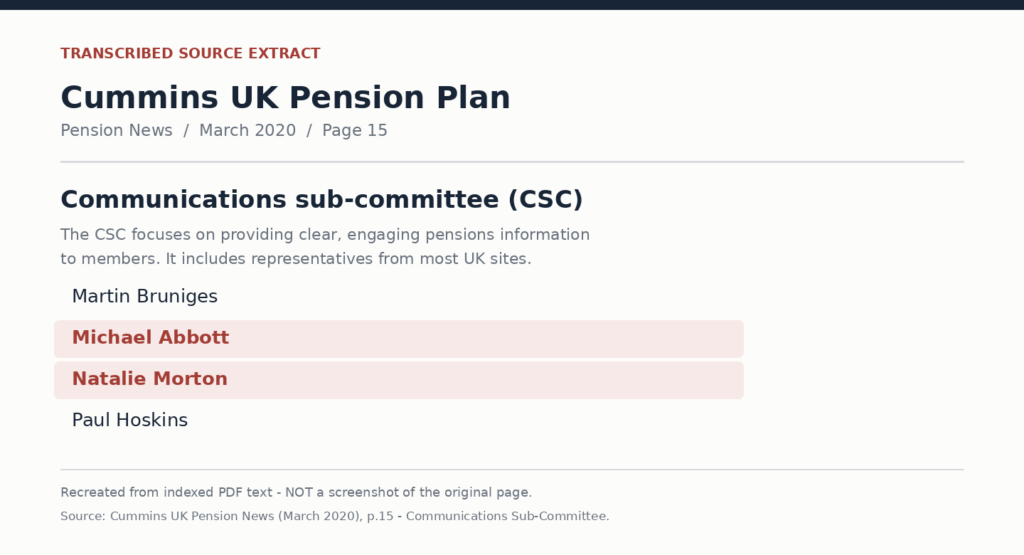
Cummins UK Pension Plan published its Pension News newsletter in March 2020. Page 15 contains a section headed Communications Sub-Committee (CSC), explaining that the group provided pensions information and included representatives from UK company sites.
Beneath that explanation sits the membership list.
Among the names are Michael Abbott and Natalie Morton, appearing consecutively.
There it is. Not an anonymous tip, somebody’s theory about an old office or a conveniently edited social-media screenshot. Cummins’ own publication records both individuals as members of the same formal committee more than two years before Abbott became responsible for my employment case.
The newsletter doesn’t establish how closely they worked, whether they attended every meeting together or whether either ever discussed my circumstances with the other. What it does establish is a documented professional connection within the company.
And it sits alongside the earlier Thornaby history that initially caught my attention.
That is why the discovery matters. My original grievance had been investigated by Morton, whose meeting record I subsequently challenged. After losing faith in Darlington, I requested somebody neutral. The company eventually assigned Abbott, whose handling of the Occupational Health correspondence immediately reinforced my concerns.
Only later did I discover that Cummins had recorded both names together in an entirely unrelated corporate publication.
The connection was sitting there in plain sight.
Cummins didn’t need an investigator to uncover it.
Somebody had already fucking typeset it. Here you are, folks!
The Teasdale Question
That brings us back to Nicola Teasdale.
During my earlier grievance appeal, she acknowledged selecting Morton because Morton worked in another area of the business. By November 2022, the tribunal’s written reasons also record Teasdale and Gemma Penk agreeing that somebody fresh should take over responsibility for my HR case.
Nicole Newall was appointed, followed by Abbott after I requested another change.
Who specifically selected Abbott remains unclear. The written reasons record the handover from Newall but do not identify everyone involved in deciding that Abbott should assume responsibility. My suspicion is that Teasdale may have influenced the appointment, given her earlier role in selecting Morton and her position within the HR structure.
That is an educated inference, not something the available appointment records establish.
Nevertheless, the underlying selection process deserves scrutiny. Cummins had already demonstrated how it could appoint somebody from another area of the company and present that arrangement as sufficient separation from the original dispute.
With Morton, Teasdale had personally selected the investigator and then dealt with the appeal. Later, another supposedly fresh series of HR contacts arrived while the underlying Occupational Health requirements and capability proceedings continued.
The names changed, the offices changed and the emails acquired different signatures. Yet the central disagreement travelled with the file.
From my perspective, the business was remarkably accomplished at moving responsibility around without addressing the fucking substance.
What Cummins Didn’t Know I Knew
There is one final detail that makes the Thornaby discovery particularly satisfying.
I never told Cummins that I knew.
And I didn’t confront Abbott with the Thornaby connection during our correspondence. I didn’t announce that I was examining his earlier professional history or explain what I had discovered about his connection to Morton.
As far as my dealings with the company were concerned, that particular line of scrutiny remained unspoken.
The employment proceedings eventually concluded, Cummins defended its decisions and the tribunal accepted the company’s case. I disagreed with that outcome and have challenged aspects of the reasoning and procedure through the appellate process.
But there was no grand confrontation in which I revealed the Thornaby history and demanded an explanation for Abbott’s appointment. I had already experienced the earlier grievance, the disputed minutes, Teasdale’s selection of Morton, the unsuccessful attempt to arrange my departure and the subsequent Occupational Health disputes. And tribunals are difficult when the liars are the one’s compiling the bundle – word to the wise.
I knew what those experiences had taught me about Cummins’ management processes.
The career-history discovery added another dimension. The pension newsletter provided independent documentary support for a connection I considered relevant to the company’s handling of my case.
And I simply kept that information.
Until now.
Neutrality Isn’t A Postcode
The sequence is straightforward. After the McCaughtrie incident, Morton investigated my grievance and produced findings based on minutes I disputed. Teasdale subsequently revealed that she had chosen Morton for the investigation and later became involved in discussions about my departure.
When my health deteriorated further, I requested someone outside Darlington because I no longer trusted the local HR operation. Newall arrived from Huddersfield but largely retained the medical questions prepared within that operation. After I challenged her refusal to make the amendments I sought, Abbott took over by email from Milton Keynes.
Within days, he was progressing capability. His subsequent Occupational Health referral broadened the questioning into my conduct and reactions to the dispute. I regarded that as further evidence that the process was being directed towards dismissal rather than a supported return.
Then came the professional history, the recollection of Thornaby and the official Cummins pension newsletter placing Abbott alongside Morton on the same committee in March 2020.
Serving on a committee together does not establish that they conspired against me. It does, however, establish a pre-existing professional connection that was relevant to my concerns about whether the new appointment offered meaningful separation.
That is what Cummins’ own document adds to the story.
I asked for neutrality because I had lost faith in the people and processes handling my employment. What I experienced was a succession of internal HR advisers, continuing medical disputes and an escalating capability process. The latest supposedly fresh contact turned out to have professional connections within the same network I had been trying to escape, Named alongside each other in a fucking brochure!
Perhaps Cummins considered those connections immaterial. Perhaps nobody checked them. Or perhaps the only consideration was finding another employee willing to take over a difficult file. A character flaw Cummins calls “having a conscience”.
The company’s own documents don’t answer those questions.
They do, however, make the geographical theatre considerably less convincing.
And here’s the part Cummins might find particularly interesting: I never told them I knew about Thornaby. I never raised Abbott’s previous connection to Morton.
I’ve simply kept the information until now.
Their own fucking pension newsletter can make the introductions. But I’d expressively advise most people to politely decline
Lee Thompson – Founder, The Cummins Accountability Project
Sources
- Cummins UK Pension Plan – Pension News, March 2020, Page 15 (Official Newsletter Archive)
- Employment Tribunal – Thompson v Cummins Ltd, Written Reasons, Case 2501831/2022
- LinkedIn – Michael A., Cummins Inc., Professional History
- TCAP – Natalie Morton : The Cooked Grievance Process And Nicola Teasdale’s Freudian Slip
- TCAP – Nicole Newall : Seven IBS Questions And One Very Upset HR Adviser
- TCAP – Michael Abbott : Turning My Breakdown Into A Fucking Case File
- TCAP – Cummins Ethics Complaint : Don’t Speak Up