
Cepac won an award for a PepsiCo Walkers display and still promotes Walkers-branded work in its 2026 portfolio. Meanwhile, PepsiCo’s supplier code expressly puts legal action and intentional reputational harm inside its definition of retaliation. That gives the WhatsApp receipt, Maria Walker’s email, Cepac’s ET3 and the subsequent campaign against the complainant somewhere rather specific to land. Maximum crunch. Awkward ingredients.
The Award Came With A Customer Name
Cepac knows how to make a packet of crisps look important. Give it some printed board, a shop floor and a product launch, and suddenly the potatoes have their own architectural practice. On 8 December 2020, the company announced an award for a freestanding display it designed for PepsiCo’s Walkers Max Double Crunch. It celebrated a unit that could spring into shape in under twenty seconds. Apparently, certain things at Cepac can happen promptly.
That announcement names PepsiCo and the product. Moreover, Cepac’s 2026 display portfolio includes a separate Walkers MAX/KFC counter display on its fourth page. The older announcement establishes a named commercial project; the newer portfolio shows Cepac continuing to advertise Walkers-branded work. PepsiCo can confirm the present contractual position and the relevant purchasing entity. The portfolio’s date does not date every project inside it.
However, the connection is substantial enough to put a precise question to the brand owner. What happens when evidence about a display supplier concerns both a disability-discrimination complaint and the treatment of the person who raised it? PepsiCo has already written an unusually pertinent answer. It sits in the small print, where the grown-ups supposedly keep the machinery that makes the big promises work.
PepsiCo’s Supplier Code Has A Retaliation Clause
Clause 16 gives the PepsiCo Cepac supplier code question its sharpest edge. PepsiCo’s August 2025 revision requires supplier grievance processes covering workers and third parties. It also requires an express prohibition on retaliation over good-faith concerns. Its examples include “legal action, economic retaliation, intentional reputational harm”, alongside threats and intimidation.
Elsewhere, Clause 4 rejects discrimination and harassment, with employment decisions resting on qualifications, skills, performance and experience. Clause 13 provides for reasonable audits and targeted assessments following notice. Compliance forms part of supplier contracts and purchase orders. These provisions give PepsiCo a route from receiving a complaint to examining the records behind it.
Therefore, the question does not end when someone says that solicitors handled the matter. PepsiCo itself recognises that legal machinery can form part of retaliation. A letterhead cannot disinfect the purpose of everything written underneath it. Equally, defending proceedings does not automatically establish a breach. The task is to examine what happened, why, and whether it punished the raising of a good-faith concern.
That distinction is the whole bloody point. A code which names the danger needs an assessment capable of recognising it. Otherwise, Clause 16 becomes an unusually elaborate crisp packet: plenty of reassuring print, a satisfying rustle, and an awful lot of air where the substance should be.
The Interview Existed Before The Dispute
On 21 August 2024, Page Outsourcing called me about a production role at Cepac. The caller offered an interview for the week after the bank holiday. We discussed a £27,000 training wage, rising towards £29,000. During the call, I explained that mental-health problems lay behind my employment gap. Page said a further call would settle a mutually suitable interview time. No confirmation followed.
Meanwhile, I had told a friend about the conversation. My WhatsApp message that same day recorded “Interview next week” and “27k training wage up towards 29”. Those are my words to the recipient, not a written offer from Page. Their value lies in the timing: an ordinary account of an interview and salary discussion, before the dispute acquired pleadings, costs schedules or a professional audience.
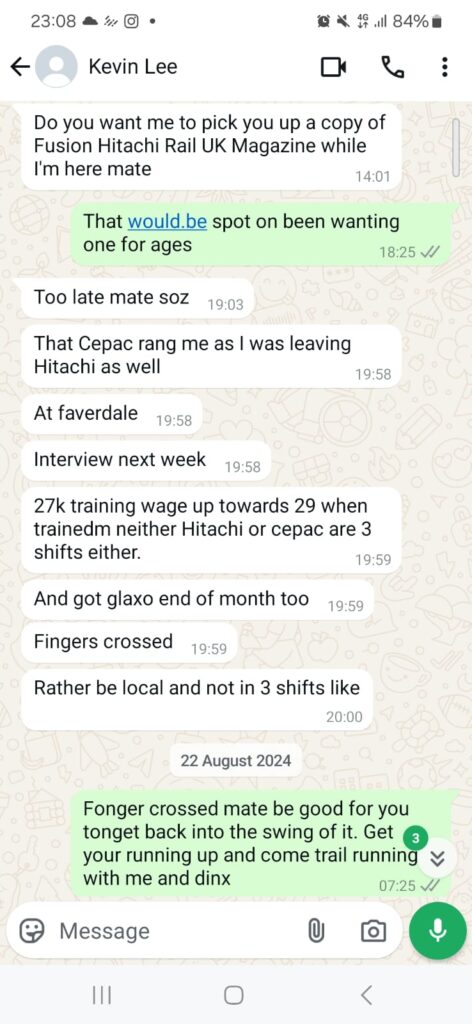
The recipient’s statement, dated 20 February 2025, supports the exchange’s origin and context. Consequently, an investigator has a specific account to compare with the recruitment records. What did the caller offer? Which candidate status followed? Above all, why did the promised confirmation disappear? The message cannot answer every question, but it makes the questions harder to shrug into the nearest bin.
Maria Walker Supplies A Different Flavour
At 04:35 on 8 October 2024, I emailed Cepac about the missing interview. My complaint described the call, the promised follow-up and the mental-health disclosure. Maria Walker, Cepac’s HR Business Partner, replied at 09:51. Her answer said my CV had reached the recruiting manager, but I was “not shortlisted on that occasion”.
According to Walker, the manager would not have known about my mental-health discussion with Page. The agency had apparently failed to explain that I had not secured an interview. Thus, an offered interview in my account became a shortlisting rejection in hers. Confusion supplied the seasoning. Nobody had yet explained how the main ingredient changed.
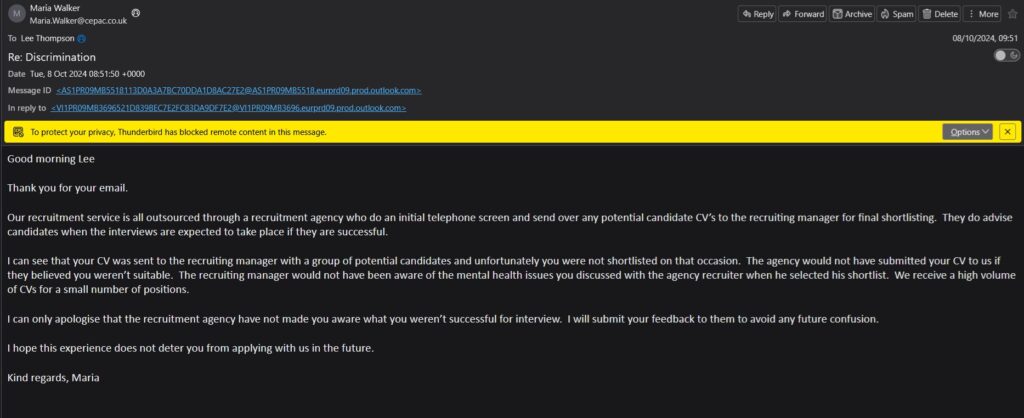
Walker answered before seeing the contemporaneous message. Therefore, her explanation needs comparison with the record it did not address. Who told her that no interview had been secured? What did she examine before replying? A credible review would trace the answer back to its source, rather than treating an HR signature as a certificate of nutritional accuracy.
The KFC II article brought that chronology together. PepsiCo now has the same practical choice: examine the competing accounts, or leave the contradiction sitting underneath a display designed to make something else look irresistible.
The Health Information Reached Cepac
Cepac’s ET3, its pleaded response to the tribunal claim, adds another document to the pile. Paragraph 12 places its awareness of the detailed recruitment conversation after my October complaint. Yet paragraph 14 identifies an email from Page to Cepac on 21 August. That email conveyed that I had spent around twelve months out of work because of health problems and was ready to return.
Receipt by the company does not identify every person who read the information. Nevertheless, Cepac’s own account puts health-related information inside the recruitment chain on the day of the call. The next questions concern recipients, access and decisions. They do not require a seminar on the philosophical meaning of knowing things.
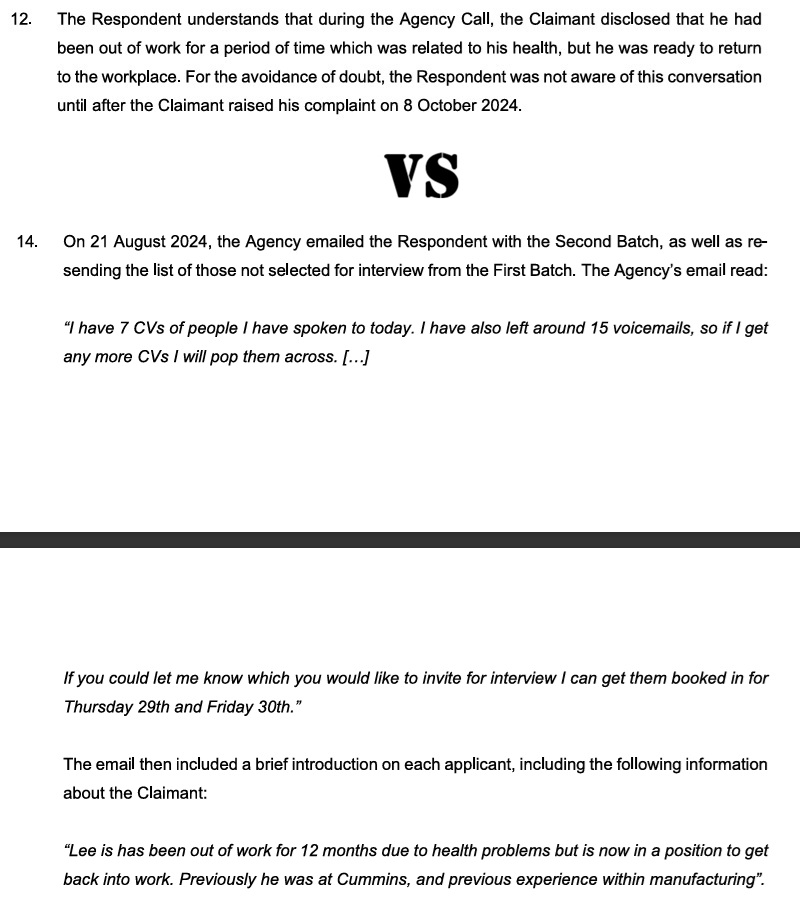
PepsiCo should ask for the email and the surrounding recruitment record. In particular, it should establish who received it, who assessed my application and what information informed that assessment. Compare those answers with Walker’s explanation and the WhatsApp. The paperwork already provides the starting points.
This is where corporate bullshit becomes measurable. A broad assurance about what a manager would have known must survive contact with the actual message trail. If the records support the assurance, show how. If they expose a different sequence, deal with that sequence. The supplier’s confidence is not a substitute for the contents of its inbox.
Michael Page’s Black Bars Join The Packet
Page also belongs in this examination. Its data-subject-access response contained redacted names and passages, with third-party information cited as the reason. The material is covered in Page Partners : Cepac Limited – Redactions, Panic Calls And The Disabled Candidate They Googled. That record also concerns Page looking into my tribunal history after I complained.
Redaction can protect other people’s information. However, black bars do not resolve the underlying recruitment questions. Page still has an account to give of its call, its communication with Cepac and the change between an interview discussion and a rejection explanation. A disclosure response should not become the point at which everybody politely agrees that the missing detail must be somebody else’s problem.
Meanwhile, the direction of curiosity deserves scrutiny. Once I challenged the recruitment outcome, my history became material for investigation. The original question remained what happened to this application. Following the complainant around the internet does not reconstruct the conversation in which the interview arose.
PepsiCo need not decide the lawfulness of each blackout to understand the practical issue. It needs a coherent account from the companies that handled the recruitment, supported by the relevant records. Otherwise, the exercise becomes a particularly shifty party game: guess the candidate’s supposed defects while the answer about his application remains under a black fucking rectangle.
Then My Medical Centre Entered The Proceedings
The later handling of the dispute is why Clause 16 matters. Horsfield Menzies, acting for Cepac, contacted my medical centre about appointment availability. The firm then used that information to oppose a postponement. This concerned the availability of appointments, not access to my full medical records. Nevertheless, my route to medical support had become material for the opposing solicitors.
Alongside that pressure, correspondence, complaints, blog material and social posts supplied ammunition for a case about my conduct. I was a disabled litigant in person, whose emotional dysregulation in stressful situations arises from disability. The tribunal needed to understand that context. Instead, the proceedings increasingly revolved around the reactions themselves, while the recruitment questions waited behind them.
I regard that handling as bullying. The objection concerns concrete acts and their cumulative effect: medical enquiries, opposition to postponement and the use of distressed responses against the person seeking a hearing. PepsiCo can examine the correspondence and the medical context. It need not settle for either a solicitor’s polished summary or my description of how the experience felt.
However, an assessment which collects the reaction and discards the pressure is already missing half its subject. The result resembles a packet whose ingredients list reads simply: difficult claimant. Conveniently absent are the conditions in which that claimant deteriorated. What a handy little recipe for making the person with the complaint become the contaminant.
More Than £50,000 And A Closed Merits Route
The tribunal’s judgment records that Cepac’s combined costs schedules exceeded £50,000. Its representative limited the costs application to £20,000 to avoid a detailed assessment. Following the hearing on 24 April 2026, which proceeded without me, the tribunal struck out the claims and ordered £20,000 in costs payable to Cepac.
Its findings were adverse to me. The tribunal described my conduct as unreasonable, scandalous and vexatious, and found that a fair trial was no longer possible. It also said my comments about the solicitors had no reasonable foundation. Those conclusions belong in the account. My challenge is that the process and its treatment of disability, pressure and participation produced a profoundly unfair assessment. The only thing that seemed to lack foundation was Andy’s ability to Judge. With Pervert Judge Simpson gone, it’s probably only a matter of time before this piece of shit too. Come on Newcastle, you can do it, Flush the cunt.
The Newcastle maladmion nistration article sets out that argument and the procedural history. Crucially, the outcome did not determine whether disability discrimination occurred in recruitment. No merits decision resolved the promised interview, the health-information route or the competing accounts of shortlisting.
Consequently, a supplier review has to read what the judgment decided. It cannot quietly convert a strike-out over conduct into a finding that the recruitment was sound. That conversion would be a procurement conjuring trick: put the wrong question in the bag, shake vigorously, and produce a clean bill of health. The financial bill was real enough. The answer to the recruitment complaint still requires the recruitment evidence.
Good Faith Needs More Than A Manners Test
PepsiCo revised the code in August 2025, after the recruitment events and before the decisive April 2026 hearing. That chronology matters. The later wording should not masquerade as a clause proved to govern every act in 2024. It does, however, state the standard PepsiCo now publishes for assessing suppliers and concerns about their conduct.
A proper assessment would distinguish the original complaint from later expression, and both from the steps taken in response. Was there a genuine concern supported by contemporaneous material? Which actions addressed that concern? Where did the proceedings move towards penalising the complainant, and what justified those steps? Those questions permit an answer. A caricature of an angry man does not.
The WhatsApp, complaint email and ET3 remain relevant regardless of anybody’s opinion of my vocabulary. Conversely, the tribunal’s criticism remains relevant when examining the litigation. Both belong on the desk. A serious inquiry can consider an adverse judgment without pretending it answered questions it never reached.
That is why a manners test would be such a piss-poor substitute for scrutiny. An applicant does not retroactively lose the existence of his interview account because he later swears. Nor does a company establish the accuracy of its recruitment explanation by employing someone who writes courteous letters. The relevant distinction is between an account that survives examination and one that survives because nobody examines it.
PepsiCo Also Names Legal Attacks
PepsiCo’s separate Human Rights Defenders Statement reinforces the point. Updated in August 2025, it rejects retaliation over good-faith human-rights concerns, including physical or legal attacks. It expects suppliers to share those commitments. Where clear evidence links a supplier’s conduct to adverse impacts on defenders’ rights, its stated response can include remedy and termination of the relationship.
That is a serious promise. Applied here, it calls for examination of whether the response to a disability-rights complaint crossed the line PepsiCo itself draws. The presence of litigation is the beginning of that inquiry, not its conclusion. Equally, the existence of a court order should not make the surrounding conduct invisible to a customer’s own standards.
Meanwhile, PepsiCo’s human-rights reporting describes a global office and a Speak Up route available beyond its own employees. Suppliers and other external stakeholders can raise concerns. Therefore, this complaint does not need an imaginary employee number to become intelligible to the organisation. PepsiCo has identified both an entry point and people responsible for the subject.
What those people need is the record. Sending it straight back for an untested supplier reassurance would produce a lovely circular arrangement: the subject of the complaint supplies the answer, and the customer congratulates itself on asking. A complaints mechanism should be capable of something more ambitious than teaching an allegation to chase its own arse.
The Quiet Mancunian And The Paragraph In The Judgment
HSA’s own company listings include Cepac and Longulf. That establishes the business connection behind another source in this story: Anthony C Heaford, who publishes as The Quiet Mancunian. His account predates my recruitment dispute. It did not spring into existence because a rejected applicant acquired a WordPress password and a grudge.
In his report dated 15 May 2023, Heaford alleges that Dirhem Abdo Saeed financed and hosted Khalid Sheikh Mohammed in 1997. He connects that allegation to machinery purchased through Longulf and a September 1997 installation trip to Yemen. During that trip, he says, he met a man he identifies as Mohammed inside HSA’s headquarters compound in Taiz.
These are Heaford’s allegations, which I have not independently verified. His report acknowledges that official documents concerning Mohammed or 9/11 do not name Dirhem; the accusation rests on Heaford’s claimed firsthand knowledge. Meanwhile, HSA’s ownership of Cepac establishes a corporate relationship, not proof of the alleged criminal conduct. Horsfield Menzies, from their office close to where a radicalised Islamist killed and maimed children, thinks I should stumble on a revelation like this and protect their client. I wonder if any of those who lost loved ones in that bombing are so keen as to keep the allegation under wraps for their client.
Paragraph 110 of the tribunal judgment records my 8 December 2025 post alleging links between Cepac and 9/11 funding. However, that paragraph does not examine Heaford’s underlying account. Judicial disapproval is not a fucking fact-check. Readers can inspect his source and TCAP’s earlier discussion for themselves.
For PepsiCo, the question is how it assesses serious public allegations concerning a supplier’s wider group. Which claims withstand checking, which fail, and why? Those answers require examination of sources. A note about the complainant’s manners will not do the job.
Procurement Can Ask Questions That Have Answers
PepsiCo should first identify the commercial relationship behind the Walkers work, including its dates and current status. Then it can name the team responsible for reviewing the evidence and explain which standards apply. That would turn an argument about corporate values into a task with an owner, instead of another laminated aspiration drifting around the purchasing department.
The documentary questions follow naturally. Establish what Page offered on 21 August and what it sent to Cepac. Trace the health-related email to its recipients and the recruitment decision. Next, identify what Maria Walker checked before answering my complaint. Ask the companies to explain any differences between their records and the contemporaneous WhatsApp.
The later review needs the medical-centre correspondence, postponement material, conduct submissions, costs schedules and judgment. Those documents allow examination of purpose and sequence, rather than a competition between adjectives. The same review should consider the disability context and explain how it assesses good faith and alleged retaliation.
Finally, PepsiCo should give a reasoned outcome and identify any corrective action. It can protect personal information while still explaining its conclusion. None of this requires it to announce a verdict before reading the file. It requires the brand owner to do the work its public commitments invite. Procurement can count cartons; it ought to manage a chronology without falling into the fucking hopper.
The Complaint Is Part Of The Contents
Cepac’s Walkers work gives this article its commercial foundation. The WhatsApp, Maria Walker email and ET3 give it its recruitment questions. The subsequent proceedings supply a second issue: how the company and its representatives treated the person who pursued those questions. PepsiCo’s own wording makes that second issue impossible to dismiss merely because it involves lawyers.
A supplier code earns its keep at precisely this awkward point. Anybody can endorse fair treatment while the applicant remains hypothetical and the conference biscuits are still warm. The test arrives with an actual person, an uncomfortable file and a disagreement that buying another pallet will not resolve. That is when values either guide a decision or start looking suspiciously like decorative packaging.
PepsiCo can establish the relationship, read the documents and explain what follows. If its assessment rejects the complaint, the reasons should address the evidence. If it identifies a problem, the response should reach the conduct that caused it. Either way, a substantive answer would be worth more than a warehouse of earnest slogans about doing the right thing.
The Walkers display won praise for opening in seconds. Here is the less glamorous challenge: open the file. Clause 16 is already in the packet. PepsiCo can now show whether there is anything inside the bastard thing besides air.
Lee Thompson – Founder, The Cummins Accountability Project
Sources
- Cepac: Winning Time For Cepac At UK Packaging And POPAI Awards
- Cepac: Our 2026 Portfolio
- PepsiCo: Global Supplier Code Of Conduct
- Human Rights Defenders Statement: PepsiCo
- PepsiCo: Human Rights
- TCAP: The Cepac Files : KFC II – Maria Walker And The Interview Receipt
- Page Partners: Cepac Limited – Redactions, Panic Calls And The Disabled Candidate They Googled
- TCAP – Newcastle Employment Tribunal : Deep Dive – Deliberate Maladministration
- Employment Tribunal: Thompson v Cepac Limited And Page Outsourcing UK Limited
- HSA Group: Our Companies
- The Quiet Mancunian: Khalid Sheikh Mohammed’s Hosts & Financiers
- TCAP : The Cepac Files – Why I Believe The Quiet Mancunian