
There is an ancient British tradition of explaining that everybody can succeed through hard work. Ideally, somebody from the executive floor delivers this advice while quietly removing the ladder. Recruitment brochures celebrate diversity, corporate websites promise opportunity, and consultants deliver inspirational presentations about merit. Meanwhile, the people with the right connections are already upstairs drinking coffee. Everybody else is trying to understand why the lift requires a surname, a professional introduction and something resembling a hereditary fucking password.
Class is a curious institution in Britain. We pretend it no longer matters, yet recognise it immediately when somebody opens their mouth. Mention family connections, private education or inherited advantages, and the room becomes uncomfortable. Start attaching numbers to those advantages, and somebody in HR develops an urgent concern about statistical complexity. Apparently, a multinational corporation can calculate the lifetime value of somebody purchasing biscuits. Measuring whether working-class employees reach senior management, however, threatens the foundations of administrative fucking civilisation.
The First-Ever Report That Wasn’t
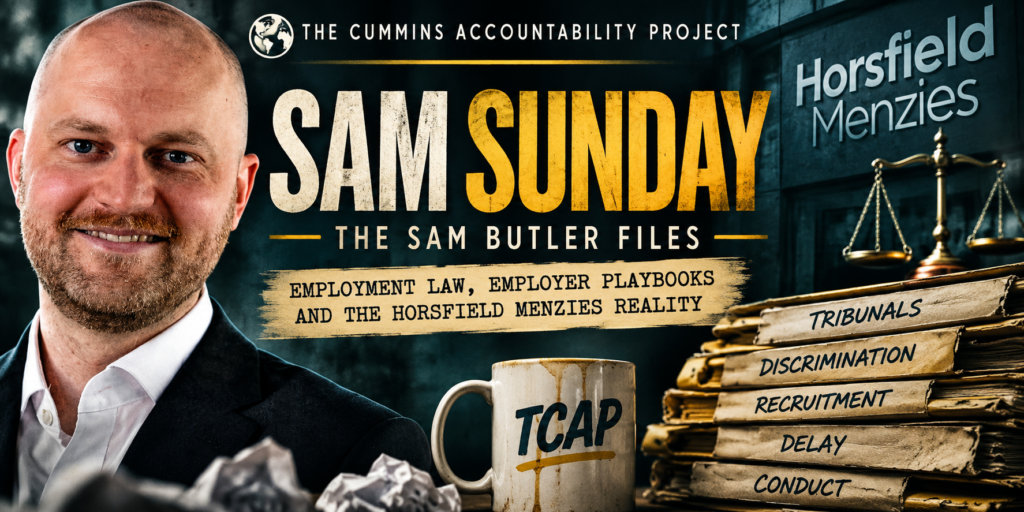
Welcome back to Sam Sunday, where corporate enlightenment encounters a spreadsheet and the professional literature of Horsfield Menzies receives another examination. Today’s specimen is Sam Butler, whose article The Co-op’s Landmark Socioeconomic Pay Gap Report appeared on 25 July 2024. Butler discusses Co-op’s decision to publish information about earnings differences between employees from different family backgrounds. His socioeconomic pay gap analysis praises the initiative and recognises the importance of social mobility. It also raises concerns about additional workplace classifications, disclosure requirements and competing equality priorities.
Unfortunately, the historical introduction contains a problem. Butler describes Co-op’s publication as the “first-ever Socioeconomic Pay Gap Report in the UK”. He subsequently reinforces the impression that the company achieved something unprecedented in Britain. That is a considerably larger claim than Co-op itself made. The retailer deserved recognition for its initiative, but socioeconomic reporting already existed. Another major British organisation had published comparable data almost three years earlier. The employment-law newsletter had scarcely removed its coat before somebody needed to summon a fucking archivist.
KPMG Was Already Upstairs Drinking The Champagne
On 9 September 2021, KPMG published socioeconomic pay-gap data covering differences between employees from different backgrounds. The accountancy firm worked with the Bridge Group, which announced the development the following day. Its analysis used parental occupation to examine socioeconomic disadvantage within the organisation. KPMG also established ambitions concerning working-class representation in senior leadership. This was no obscure exercise hidden inside an abandoned filing cabinet. The research attracted professional attention, entered the public discussion and remained available for anybody checking the historical record.
September 2021 precedes July 2024 by almost three years. That makes Butler’s claim about the first national report difficult to sustain. Co-op’s achievement was becoming the first UK retailer to publish such information. It was not the first British organisation. The distinction matters because KPMG had already examined class, published findings and undertaken further research. Perhaps the employment-law publishing industry operates under a special calendar. Events only become historical once somebody in the legal department notices them. KPMG started measuring class in 2021, Co-op contributed important retail evidence in 2024, and Sam arrived to announce that history had finally fucking begun.
The Difference Between A Milestone And A Coronation
None of this diminishes Co-op’s achievement. The company published useful information, identified differences in earnings and leadership representation, and committed itself to further social-mobility work. Voluntary transparency can expose problems that organisations might otherwise overlook. Co-op’s chief executive, Shirine Khoury-Haq, described the initiative as a first among UK retailers. That was a meaningful milestone without any need for embellishment. The company’s own announcement therefore supplied the necessary qualification for professional commentary.
Butler removed that qualification and transformed a retail-sector first into a national first. The alteration illustrates why precise language matters, even when the underlying discussion is broadly sympathetic. Employment solicitors understand that small differences in wording can produce substantial differences in meaning. Contractual disputes and statutory interpretation frequently turn on such distinctions. The same discipline should apply to public commentary. Nobody needed to undermine Co-op or pretend KPMG’s earlier work never happened. One additional word would have preserved the chronology. Apparently, retailer became an unacceptable obstacle to an uplifting fucking introduction.
Five-Point-Two Per Cent: The Polite Little Number
Co-op’s original report identified a mean socioeconomic pay gap of 5.2%. Its median gap stood at 0.2%. Those figures measure different aspects of the earnings distribution. The mean compares average hourly earnings and responds more strongly to unusually high salaries. The median compares the middle values of the respective distributions. A small median gap can therefore coexist with a larger mean gap. This becomes particularly relevant when senior employees receive substantially higher pay than the wider workforce.
Co-op acknowledged that colleagues from lower socioeconomic backgrounds were less likely to progress into senior leadership. That is why its report cannot be reduced to a comparison of hourly rates. An organisation might pay everyone performing a particular job equally while maintaining an unbalanced management structure. Butler recognises the importance of senior representation, but his comparison with some gender pay-gap figures risks providing false reassurance. The serious question concerns the distribution of opportunities. Why does the social composition change as employees move upwards? The working class may occupy much of the building while remaining conspicuously absent from the fucking executive suite.
The Median Has Been Acquitted. The Class System Remains At Large.
Imagine a company employing thousands of people on standard hourly rates. Workers from different backgrounds might receive similar wages for comparable roles. Its median socioeconomic gap could therefore appear negligible. Now examine the directors, executives and highly paid professional positions. If employees from privileged families occupy more of those roles, the overall earnings distribution changes. The mean gap may reveal something the median alone cannot explain. Neither measure is inherently dishonest. Both require an understanding of the workforce beneath the figures.
A socioeconomic gap does not automatically prove unlawful discrimination. Differences may reflect several factors, including location, experience, recruitment patterns and career progression. Each possibility requires investigation. Nevertheless, the figures can identify imbalances worth examining. Co-op’s report offered value because it looked beyond a reassuring headline number. The real issue concerns access to senior positions and how employees progress towards them. Similar wages among people occupying lower grades do not establish equal opportunity throughout an organisation. At some point, somebody needs to inspect the fucking lift rather than admire the polished reception area.
The Executive Lift Has An Interesting Passenger List
Co-op’s subsequent report covering 2024, published in 2025, provided further evidence. Among executives represented in its socioeconomic dataset, 100% came from professional backgrounds. At director level, 46% came from professional backgrounds and 32% from lower socioeconomic backgrounds. The remainder belonged to intermediate categories. Among senior managers, professional backgrounds accounted for 58%, compared with 32% from lower socioeconomic backgrounds. These figures appeared after Butler’s article. He could not have discussed evidence that did not yet exist, and criticising him for that omission would be unreasonable.
The later data nevertheless demonstrates why the original subject mattered. The executive figure concerns the reporting dataset, not every executive Co-op has ever employed. Voluntary disclosure and small leadership groups can also influence the results. Those qualifications must accompany any interpretation. Even so, the recorded pattern raises obvious questions about advancement. A company can employ substantial numbers of working-class people without reflecting that background in its executive leadership. The workforce keeps the operation functioning while the highest offices appear socially different. The report does not prove wrongdoing. It does suggest that somebody should investigate the fucking staircase.
Forty-Eight Per Cent Of The Workforce Testifies
Co-op’s first report drew upon voluntary socioeconomic information supplied by approximately 48% of its workforce. That created a substantial evidence base, although many employees had not participated. People may decline disclosure for perfectly legitimate reasons. Some dislike discussing their childhood circumstances, while others worry about privacy or confidentiality. The categories may also seem unfamiliar or irrelevant to their employment. Employers collecting such information should explain its purpose and establish proper safeguards. Nobody should have to reveal family details merely because management has discovered a fashionable statistical hobby.
Incomplete participation, however, does not justify abandoning the exercise. Co-op recognised the importance of improving disclosure and reported progress by July 2024. Its overall completion rate had risen to 72%. That development suggests organisations can improve participation through clearer communication and greater confidence. The objective is reliable evidence gathered responsibly. Otherwise, a company could celebrate social mobility while knowing remarkably little about its leadership’s social composition. The resulting strategy would resemble a medical examination conducted without a stethoscope. Apparently, the fucking patient might feel labelled if somebody attempted to establish what was wrong.
Tell Us What Your Father Did When You Were Fourteen
Socioeconomic measurement often uses questions that seem unusually personal. Co-op adopted an established approach involving parental occupation. Employees were asked about the main household earner’s job when they were approximately fourteen. At first glance, this resembles corporate genealogy. Why should HR care whether somebody’s mother worked in retail or their father drove a lorry? The relevance becomes clearer when childhood circumstances enter the discussion. Financial stability, educational resources and professional connections can influence opportunities long before adulthood.
Parental occupation provides one method of examining those patterns across large groups. It does not determine an individual’s intelligence, character or professional worth. Somebody from a working-class family can achieve extraordinary success. Equally, privileged beginnings do not guarantee an easy life. The classifications are statistical tools, not moral verdicts. Their purpose is to investigate whether childhood circumstances remain associated with adult opportunities. Unfortunately, Britain possesses such magnificent anxiety about discussing class that collecting this evidence can sound like a proposal to restore the fucking hereditary peerage.
Sam Butler Discovers The Danger Of Labels
Towards the conclusion of his article, Butler discusses additional workplace “labels” and the complications of socioeconomic reporting. He also raises concerns about disclosure requirements and potentially diluting existing equality initiatives. Some of those worries deserve serious consideration. Additional data collection requires administration, confidentiality safeguards and coherent methods of interpretation. Employers must avoid reducing individuals to crude categories. They should also examine how different forms of disadvantage interact. Nobody benefits from collecting personal information without a clear purpose or useful outcome.
The difficulty begins when identifying a disadvantage becomes confused with creating it. Working-class barriers existed before researchers developed spreadsheets capable of recording them. An applicant without professional connections may struggle to enter an industry regardless of HR classifications. A worker facing slower promotion does not acquire that disadvantage because someone measures their background. Recording the problem might expose it, but removing the category will not necessarily eliminate it. A hospital could stop counting infections tomorrow. The fucking bacteria would remain delighted with the arrangement, although the annual report might look considerably more reassuring.
The Social Mobility Ambassador Enters The Morgue
Here the story develops a particularly interesting complication. Sam Butler previously served as a Social Mobility Ambassador for the Law Society. This was a genuine appointment within a programme encouraging people from non-traditional backgrounds to enter the profession. The Law Society’s published account describes Butler as a first-generation university student. He grew up without knowing lawyers and encountered professional environments that others understood more readily. Establishing contacts, securing experience and learning unfamiliar professional expectations required additional effort. Those observations demonstrate a personal understanding of the barriers that socioeconomic research attempts to identify.
His experience should not become a target for ridicule. Entering the profession without established connections represents a genuine achievement. Helping others overcome similar obstacles also deserves recognition. That background makes his reservations about additional labels more interesting, rather than automatically hypocritical. Someone familiar with those barriers has particular reason to understand why organisations might measure their effects. Supporting social mobility and questioning reporting methods are not necessarily contradictory positions. Nevertheless, the tension deserves examination. The man who knows the professional staircase can be difficult to climb has begun worrying about the administrative consequences of counting how many people reach the fucking landing.
The Ambassador’s Badge Outlived The Programme
The Law Society states that its Social Mobility Ambassadors programme operated from 2015 until 2023. Its website now describes former participants. Horsfield Menzies, however, continued using present-tense language about Butler’s ambassador role in the biography available in 2026. That discrepancy may simply reflect outdated website text. It does not establish deliberate misrepresentation or undermine his genuine participation. Professional biographies often retain descriptions after programmes or appointments end. The distinction is chronological rather than an allegation about character.
Nevertheless, the inconsistency makes an appropriate companion to the mistaken historical first. Butler’s article promotes a retailer’s achievement into a national milestone. His firm’s biography retains present-tense language for a programme that ended years earlier. Neither discrepancy requires an elaborate theory of wrongdoing. Both admit straightforward explanations, including insufficient updating or checking. Yet professional commentary depends upon accurate records and precise chronology. Employment lawyers regularly explain those principles to clients. Perhaps the same enthusiasm could occasionally extend to their own fucking webpages.
A Class Background Is Not A Professional Character Defect
Socioeconomic reporting should not imply that privileged employees lack merit. Nor should it suggest that everyone from a working-class family deserves automatic advancement. Those conclusions would undermine the principle of fair opportunity. Individuals differ in ability, experience, ambition and personal circumstances. Family background may influence available opportunities without determining the outcome of every life. The proper question concerns systematic patterns. Do certain backgrounds create advantages or obstacles that employers can identify and reasonably address? That requires evidence rather than assumptions about individual character.
Butler’s history demonstrates why the distinction matters. He entered the legal profession despite lacking some connections enjoyed by his contemporaries. His success shows that less privileged beginnings do not prevent achievement. It also invites questions about others who encounter similar barriers and never reach that destination. If an aspiring solicitor requires extra time to establish professional networks, comparable difficulties may exist elsewhere. Employers should examine whether recruitment and promotion procedures reproduce those advantages. The classifications are not the enemy when used responsibly. The objective is to ensure that a person’s family circumstances do not quietly determine which professional doors they can fucking open.
The Tenth Protected Characteristic That Never Arrived
Co-op’s initiative also contributed to debate about stronger legal recognition for socioeconomic background. The company supported consideration of adding it to the Equality Act’s protected characteristics. That proposal must be distinguished from the existing law. Section 4 of the Equality Act 2010 lists nine protected characteristics. Socioeconomic background is not one of them. Section 1 provides a separate duty concerning socioeconomic disadvantage in certain public-sector strategic decisions. It does not create a general prohibition on private employers discriminating against employees because of class.
In October 2025, the Government confirmed that it had no plans to add another protected characteristic. It separately discussed the socioeconomic duty in England. Those mechanisms raise different legal questions. Mandatory pay-gap reporting concerns transparency, while discrimination protection concerns substantive legal rights. Public-sector duties have another purpose and scope. Butler’s concerns about additional reporting could have benefited from more attention to those distinctions. Employers might publish socioeconomic figures without becoming subject to a new protected-characteristic regime. The law does not treat every equality proposal as another item from the Government’s fucking stationery cupboard.
Recording Inequality Is Not Proving Discrimination
A socioeconomic pay-gap report cannot independently establish unlawful discrimination against particular workers. Aggregate differences may reflect recruitment, working arrangements, seniority, experience or geographical distribution. Researchers must examine the circumstances before drawing conclusions about causes. A statistical disparity should not automatically become an allegation of deliberate prejudice. That caution matters when categories involve broad comparisons across substantially different jobs. Reliable reporting identifies questions requiring investigation rather than delivering instant verdicts about individual employers.
Those limitations do not make the figures worthless. Organisations can use them to examine promotion rates, development opportunities and workforce representation. Without evidence, senior leaders may rely heavily on their assumptions about fairness. Managers may sincerely believe that everyone receives equal opportunities and advancement depends entirely on merit. Those beliefs do not establish that the outcomes support them. Proper reporting allows employers to test their self-image against observable patterns. Some disparities may have explanations unrelated to wrongdoing. Others may reveal obstacles worth addressing. Either finding offers more value than assuming everything is fucking marvellous because nobody bothered to count.
KPMG Followed The Class Trail Beyond The Pay Packet
KPMG’s work demonstrates why Butler’s historical error matters beyond the publication date. The firm continued its research after releasing socioeconomic pay-gap figures in 2021. In 2022, it worked with the Bridge Group on an analysis involving approximately 16,500 colleagues. The research examined how family background related to progression through the organisation. It found that employees from the lowest socioeconomic backgrounds took approximately 19% longer to reach the next grade. The comparison concerned colleagues from more advantaged backgrounds. This was a measure of career progression rather than a simple snapshot of wages.
That distinction matters because inequality can develop long before it becomes visible in salary figures. Promotion, professional networks and access to influential assignments can shape later earnings. An employer might recruit people from diverse backgrounds while maintaining barriers to advancement. KPMG’s findings did not prove every difference arose from prejudice. They did identify a progression disparity worthy of investigation. By July 2024, socioeconomic research had therefore moved well beyond initial pay-gap publication. Butler’s claim did not merely overlook an obscure precedent. An entire phase of professional research had already fucking happened, complete with statistics, findings and recommendations.
October 2026: The Class Ceiling Sends Another Invoice
More recent evidence has reinforced the importance of the subject. On 29 October 2026, the Social Mobility Commission published updated analysis of young adults aged 25 to 29. It compared earnings across socioeconomic backgrounds while accounting for qualification levels. Across 2023–2025, those from higher professional backgrounds earned 23% more than comparable young adults from lower working-class backgrounds. The analysis concerned people with the same level of qualification. The Commission’s latest figures also showed a widening hourly gap in its most recent comparison.
These findings concern the wider labour market. They are not specific to Butler, Co-op or Horsfield Menzies. Nor do they prove that every individual employer deliberately discriminates against working-class applicants. They show something broader and more troubling. Family background remains associated with substantial earnings differences even after considering one important explanatory factor. Comparable qualification levels do not automatically produce comparable outcomes. Apparently, the meritocracy has developed an accounting problem. Two people can possess similar credentials while their family circumstances remain associated with different earnings. The old class system has survived modernisation and retained its fucking executive parking space.
The Meritocracy Has A Private Lift
British institutions adore the language of merit. Employers recruit the best candidates, universities reward talent, and professional organisations celebrate perseverance. Promotion supposedly follows ability, experience and performance. Those principles are attractive, and many people genuinely attempt to uphold them. Problems arise when organisations confuse the existence of meritocratic policies with proof of meritocratic outcomes. Professional connections can influence who hears about opportunities. Financial resources can affect access to unpaid experience or relocation. Familiarity with professional environments may help applicants navigate interviews and expectations.
None of these advantages guarantees success, but they can accumulate. Imagine a building whose management proudly announces that every floor is accessible. The staircase exists, the lift has buttons, and nobody has formally excluded working-class applicants. Unfortunately, some visitors arrive knowing the lift operator. Others spend years discovering where the fucking entrance is. Socioeconomic reporting cannot remove those imbalances by itself. It can, however, help organisations examine whether their stated commitment to opportunity matches the results. The problem is not that privileged people succeed. It is whether capable people from other backgrounds encounter barriers that employers could reasonably reduce.
The Administrative Burden Of Discovering The Truth
Butler’s reservations about reporting complexity are not entirely misplaced. Reliable socioeconomic analysis requires sensible categories, appropriate data protection and employee confidence. Organisations also need expertise to distinguish meaningful findings from misleading comparisons. Incomplete disclosure can distort the results, while poorly designed questions may confuse employees. Collecting sensitive information without explaining its purpose can damage trust. Businesses should not create elaborate reports merely to decorate their websites. Data collection has little value when management refuses to investigate the problems the figures reveal.
Nevertheless, employers already collect enormous quantities of commercial information. They analyse profitability, productivity, customer behaviour and employee turnover. Sophisticated dashboards track sales and forecast demand. Organisations justify considerable investment in those exercises. Yet when somebody suggests examining the backgrounds of senior employees, concerns about labels and complexity suddenly become urgent. The contrast is revealing. A retailer can calculate the profitability of individual products to a fraction of a percentage point. Examining who reaches the executive committee, however, may apparently threaten the fucking foundations of statistical civilisation.
Equality Is Not A Competition For The Last Biscuit
Butler also worries about diluting attention to existing equality gaps. That concern deserves consideration because employers possess finite resources. They cannot undertake every initiative without assessing cost, effectiveness and competing priorities. Yet different disadvantages can overlap. Co-op’s reporting recognised particularly significant disparities affecting women from lower socioeconomic backgrounds. That illustrates the value of examining family circumstances alongside other characteristics. Socioeconomic data can complement existing analysis rather than necessarily replacing it.
An employer examining only gender may overlook important differences among women from different backgrounds. Equally, analysing class without considering other characteristics may miss significant patterns. The objective should be to understand those relationships and direct resources towards useful action. Reporting alone does not guarantee improvement, and organisations should explain how their findings influence decisions. But overlapping disadvantages are reasons for better analysis, not automatic arguments against collecting information. Otherwise, workplace equality becomes a charity raffle. Every unfortunate bastard must compete for the last available biscuit while the executive committee congratulates itself on another successful inclusion campaign.
The Real Test Comes After Publication
Co-op’s initiative deserves neither automatic canonisation nor cynical dismissal. Voluntary publication demonstrated a willingness to expose internal disparities to scrutiny. That matters, particularly where the findings identify problems with senior representation. Nevertheless, releasing a report does not prove that an organisation has solved the issues it measures. The real test concerns what happens afterwards. Do recruitment practices improve? Are development opportunities accessible? Can employees from less advantaged backgrounds progress fairly? Subsequent reporting should help answer those questions.
Co-op has continued publishing broader pay-gap information, creating opportunities to examine progress. That continuity provides more value than a single celebratory announcement. Initial figures establish a baseline, and later reports reveal whether patterns change. Employers should then explain what action they have taken. Without meaningful follow-up, transparency can become another public relations exercise. A business does not deserve permanent sainthood because it has measured an inequality. Hospitals do not receive medals merely for discovering that patients sometimes become ill. Somebody must examine what happens next, rather than publishing another fucking brochure declaring victory.
Sam Sunday: The Class Ceiling
There is something exquisitely British about recognising class almost instinctively while resisting attempts to measure its consequences. Accents, schools, neighbourhoods and family connections remain familiar social signals. Yet institutions can discuss opportunity as though every applicant arrives with identical resources. The great British meritocracy remains a beautiful ideal, provided nobody examines the machinery behind the curtain. Once the figures appear, awkward questions become harder to avoid. Who enters the organisation, who advances, and whose qualifications translate into higher earnings? Which employees find the executive lift easiest to operate?
Sam Butler recognises the importance of socioeconomic inequality and praises Co-op’s transparency. Those points deserve acknowledgment, as does his participation in the Law Society’s social-mobility programme. Nevertheless, his article contains a demonstrably inaccurate historical claim. It also raises concerns about additional classifications and reporting complexity. KPMG had already published socioeconomic figures in 2021, while Co-op’s genuine milestone concerned retail. Subsequent research has revealed further differences associated with family background. The issue is not whether Butler personally supports social mobility. His record provides evidence that he does. The question is whether his professional commentary gives the subject the historical precision and analytical depth it fucking deserves.
The Door Marked Merit
Butler’s own background makes this argument particularly interesting. He entered the legal profession without established family connections and understood the difficulties of unfamiliar professional environments. His participation in a programme helping others overcome those barriers deserves recognition. That experience also makes his reservations about additional labels worth testing against the evidence. The classifications themselves are not necessarily the enemy. Used responsibly, they can identify obstacles without reducing individuals to stereotypes. If employers discover slower progression among capable people from disadvantaged backgrounds, they should investigate the causes. The appropriate response is to examine the route, not complain that somebody has measured the fucking staircase.
Co-op did not invent socioeconomic reporting in 2024. KPMG had begun that work years earlier, and later research examined career progression as well as earnings. The Social Mobility Commission’s updated figures provide further evidence of persistent differences. None of this proves that every workplace disparity results from discrimination. It does demonstrate why class cannot be dismissed as an administrative inconvenience. Working-class people do not need another motivational lecture about how hard work opens doors. They need institutions willing to examine whether those doors actually open. Better evidence cannot guarantee equality, but ignorance is a remarkably poor substitute.
The First-Ever Claim Goes Into The Ground
Meanwhile, Horsfield Menzies has supplied a near-perfect introduction to the problem. Its article acknowledges the importance of class while misidentifying a retail-sector milestone as a national first. The British class ceiling was never waiting for an employment-law newsletter to announce its existence. It had already stood for generations, polished by institutions insisting everybody enjoyed the same opportunities. Yet their executive lifts remained conspicuously crowded with passengers from professional backgrounds. Employers can debate reporting obligations, privacy and overlapping equality initiatives. Those concerns deserve examination, but they cannot make documented disparities disappear.
The historical record remains equally stubborn. KPMG published socioeconomic pay-gap information almost three years before Co-op’s announcement. The retailer made a genuine contribution, and its work deserved accurate recognition. Butler could have celebrated that achievement without rewriting the chronology. Instead, the professional commentary supplied a supposed national first that the evidence cannot sustain. What a magnificent little monument to the importance of checking your sources before delivering a sermon about corporate progress. SAM SUNDAY. THE CLASS CEILING REMAINS. THE FIRST-EVER CLAIM DOESN’T.
Lee Thompson – Founder, The Cummins Accountability Project
Sources
- Horsfield Menzies – Sam Butler: The Co-op’s Landmark Socioeconomic Pay Gap Report
- Co-op – First UK Retailer To Publish Socioeconomic Pay Gap Report, 10 July 2024
- Bridge Group – KPMG Launches Socioeconomic Background Pay Gap Report, 10 September 2021
- KPMG – Social Mobility: Towards A Fairer And More Equitable Workplace
- KPMG – Historical Pay Gap Reporting
- Co-op – 2024 Pay Gap Report, Published 2025
- The Law Society – Social Mobility Ambassadors, Including Sam Butler
- Horsfield Menzies – Sam Butler: Professional Biography
- Social Mobility Commission – Direct Effect Of Social Origin On Earnings, 29 October 2026
- Social Mobility Commission – State Of The Nation 2025
- Equality Act 2010 – Section 4: Protected Characteristics
- UK Parliament – Government Response On Adding Socioeconomic Status As A Protected Characteristic, October 2025