
There is a remarkable invention lurking inside the British labour market. It lets businesses summon workers at short notice and sometimes cancel their shifts without paying for the inconvenience. The electricity company still wants its money. The landlord remains unmoved, and childcare providers rarely accept operational uncertainty as legal tender. Yet an unpredictable workforce can look wonderfully efficient inside the employer’s accounts. Somebody else absorbs the consequences. Those costs do not disappear when a manager changes the rota. They land in households already struggling to keep their heads above water.
Imagine a restaurant cancelling Thursday’s shift after its bookings collapse. The worker has already arranged transport, organised childcare and calculated whether the wages will cover the rent. Management removes eight hours from the rota. Meanwhile, the employee removes dinner from the shopping list. Under some existing arrangements, nobody has necessarily broken the law. The accountant can report an encouraging reduction in labour expenditure. What an absolutely beautiful fucking system. The employer retains its flexibility, the worker inherits the uncertainty, and the household budget receives a compulsory appointment with the undertaker.
The Collection Plate Is Already Empty
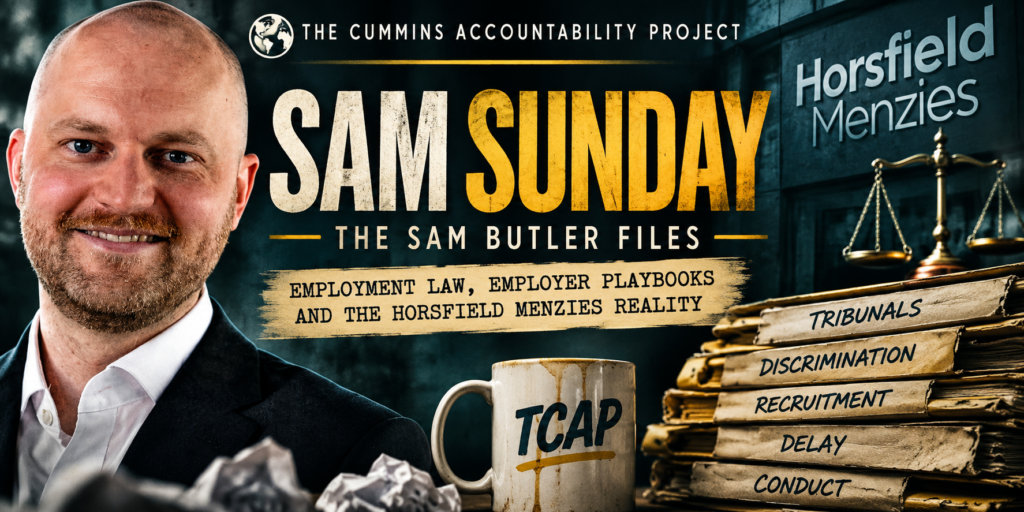
Welcome back to Sam Sunday, where the Reverend Sam Butler of Horsfield Menzies has discovered the price of employment security. His article Zero-Hours Reforms Could Cost Businesses £300M appeared on 26 August 2026. It examines the financial consequences of changing Britain’s approach to unpredictable working hours. The figures originate from government analysis, and Butler explains several important distinctions accurately. His most revealing observation concerns something rather less glamorous than the headline. Employers may eventually have to pay for flexibility they currently enjoy at little or no direct cost. There it is, sitting in the employment-law newsletter like a confession somebody accidentally included in the accounts.
The question isn’t simply what these rights might cost employers. What have workers already paid because those protections were missing? And why does financial damage suddenly command attention when the invoice reaches the corporate accounts department? The consequences existed long before the Government proposed these reforms. Households experienced them through disrupted arrangements, missing wages and the exhausting uncertainty of waiting for work. Now the bill threatens to arrive somewhere with a finance director, and everybody has discovered an urgent interest in fucking economic accountability.
Three Hundred Million Pounds And A Corporate Funeral
Butler begins with a sum large enough to make a finance director clutch the edge of the desk. Government assessments suggested direct annual employer costs between £350 million and £2.9 billion. After accounting for monetised benefits, estimated net annual costs ranged from approximately £300 million to £1.4 billion. Those figures are substantial. Employers in hospitality, retail, care and leisure face genuine operational difficulties. Customer demand changes, margins can be thin, and staffing requirements rarely remain perfectly predictable. Anyone claiming workforce planning costs nothing has probably never attempted to run a restaurant or organise a distribution operation.
Nevertheless, an impressive number of zeroes does not automatically produce a complete economic argument. Butler’s headline places the potential employer burden at the centre of the discussion. The proposed reforms concern guaranteed-hours offers, reasonable shift notice and payments for qualifying cancellations or changes. Part of the impending financial catastrophe therefore involves telling people when they are expected to work. In certain circumstances, businesses may also have to compensate them when plans change. Somebody alert the Archbishop. The labour market has developed a terminal case of basic contractual reciprocity, and the accountants are already preparing the fucking funeral arrangements.
The Worker Already Had An Invoice
The central distinction concerns the difference between creating a cost and recognising one somebody else already bears. When an employer cancels a shift, the business may save the wages. The worker, however, may already have incurred expenses. Transport arrangements, childcare commitments and reserved time do not necessarily disappear when a manager presses delete. Neither does the requirement to pay rent, buy food or meet household bills. From the employer’s perspective, the cancellation might represent an efficient staffing adjustment. For the worker, the same decision can create a financial hole that no amount of corporate enthusiasm will repair.
Economists recognise that decisions can impose costs on people who have little control over them. Employment relationships add the complication of unequal bargaining power. A supermarket can adjust staffing according to projected demand. An employee cannot ordinarily telephone their mortgage provider and announce that repayment depends on Thursday’s vegetable sales. The financial burden has merely migrated into somebody else’s household. Management calls the arrangement operational efficiency, while the employee calls it missing wages. Only one of those descriptions usually receives a favourable fucking PowerPoint presentation at the quarterly review.
October 2024: Sam Discovers The Human Being
Here is where the story becomes interesting. Butler had already discussed zero-hours contracts in an article published on 29 October 2024. His earlier piece, Employment Rights Bill: In Depth Series – Zero Hours Contracts, examined the proposed protections in detail. It acknowledged financial instability, inadequate hours, last-minute scheduling and difficulties arranging childcare. Butler also referred to Living Wage Foundation research and recognised that many zero-hours workers wanted additional hours. Greater certainty could improve their ability to organise ordinary life. The article was hardly a revolutionary manifesto demanding the redistribution of the managing classes’ country houses. Nevertheless, it kept the worker’s predicament visibly inside the frame.
That earlier publication also contains a statistical distinction worth identifying. Butler described the Living Wage Foundation’s 59% figure as applying to zero-hours workers. The underlying research examined a broader group with variable working hours. It included shift workers, agency workers and employees on zero-hours arrangements. Evidence about that mixed population should not automatically become a finding about one contract type. Still, the essential problem was clear. Workers faced insecurity because employers could change schedules with little warning. Twenty-two months later, Butler returned with a headline that found £300 million worth of reasons to worry about the employer. The same uncertainty had apparently become more urgent once the bill started travelling in the other fucking direction.
August 2026: Sam Finds The Price Tag
The August article does not deny that insecure work creates problems. Butler acknowledges the objective of ending one-sided flexibility. He also correctly explains that the legislation does not simply abolish zero-hours contracts. His discussion recognises potential benefits for workers and the intended purpose of the proposals. The interesting development lies in the emphasis. In 2024, the commentary explored unstable income, insufficient hours and disrupted family arrangements. By August 2026, the principal attraction had become the cost of imposing greater predictability on businesses. Both articles concern the same employment practices, but their headlines direct attention towards different parties.
Workers’ financial difficulties did not suddenly appear when the Government began considering new protections. They existed when Butler wrote his earlier article. What changed was the prospect that employers might carry more of the risk. That is a natural subject for an employment-law briefing approaching regulatory implementation. Yet it also exposes a revealing contrast. On one side sits the worker, calculating whether they can afford groceries. Opposite stands a corporate adviser, explaining what security might cost the business. The numbers have finally become important enough to give the accountant a fucking nosebleed.
The Most Revealing Sentence In The Newsletter
Butler’s August article contains an observation more illuminating than its headline. Employers may have to start paying for flexibility previously obtained at little or no direct cost. That is the underlying economic argument stripped of its ceremonial clothing. Existing arrangements can let companies respond rapidly to changes in demand. Businesses may do so without carrying the full financial burden of keeping workers available. A cancelled shift can create substantial consequences for an individual while costing the organisation relatively little. The proposed protections alter that distribution through guaranteed-hours offers, notice requirements and possible compensation for qualifying cancellations.
Not every additional employer expense represents money transferred directly to workers. Businesses will also face genuine planning and administrative costs. Nevertheless, compensation for a previously unpaid cancellation creates a particularly revealing change. The employer can no longer necessarily transfer the entire loss onto the person expecting to work. Economic uncertainty does not disappear; responsibility for some of it changes hands. Butler identifies that mechanism himself, making his employer-cost headline especially interesting. Somewhere in the professional literature, a corpse has climbed from the coffin and handed the undertaker his own fucking invoice. Nobody disputes the bill exists. Perhaps somebody should ask who has been paying for the burial arrangements until now.
The Shift That Disappeared At Six In The Morning
Unpredictable hours produce consequences beyond the immediate wage calculation. A person expecting to work might decline another opportunity, arrange transport or organise childcare. They may also restructure their entire day around the employer’s requirements. If the business cancels the shift, those earlier decisions can already have imposed costs. Sometimes the employer has legitimate commercial reasons. A hotel might lose a major booking, or a restaurant might close unexpectedly. Care providers can face urgent staffing changes outside their control. Such circumstances complicate the operational question, but they do not erase the worker’s loss.
Employment contracts may offer both parties flexibility in theory. In practice, one side often controls the rota and the availability of future work. A person with savings and alternative income may genuinely welcome irregular hours. Somebody living from one weekly payment to the next may experience permanent financial suspense instead. The contractual document can look identical while the consequences differ enormously. Once the shift disappears, management may retain the luxury of discussing operational requirements. The worker must discover whether the landlord feels equally enthusiastic about unforeseen fucking commercial developments.
The Living Wage Foundation’s Unpleasant Arithmetic
The Living Wage Foundation examined the experiences of people working variable hours. Its 2023 research found that 59% had received less than a week’s notice of work. Thirteen per cent had received less than twenty-four hours’ notice. Approximately a quarter had experienced an unexpected shift cancellation. Among those affected by cancellations, 90% did not receive full payment, while 26% received nothing. These findings concern the surveyed population of variable-hours workers, not exclusively zero-hours employees. Nor should anyone present them as measurements of every arrangement existing in November 2026. Their importance lies in documenting what unpredictable work can mean for household finances.
A cancelled shift is not simply an empty square on an employer’s spreadsheet. For somebody relying on the wages, it can mean falling short of an essential payment. The Foundation also examined additional costs caused by insecure scheduling. Twenty-seven per cent of affected workers reported higher travel costs, while 17% reported increased childcare costs. Imagine presenting that arrangement as a corporate loyalty scheme. Work unpredictable hours, incur additional expenses, receive uncertain wages and collect absolutely no fucking reward points. Management obtains labour when required, while the worker effectively purchases the privilege of remaining available.
The Six-Hundred-Pound Ghost In The Accounts
The Living Wage Foundation gave those additional expenses a particularly suitable name: the insecurity premium. Among workers reporting extra costs, some faced expenditure exceeding £50 monthly. That amounts to more than £600 annually. This is not a universal charge imposed on everyone with variable hours. It describes a burden experienced by some respondents in the research. The mechanism is what matters. Employers see the cost of arranging shifts. Workers may incur separate expenses while adapting their lives to those arrangements. Last-minute childcare can cost more, inconvenient travel creates difficulties, and irregular earnings make budgeting harder.
Six hundred pounds may look modest beside the billions circulating through government impact assessments. For somebody barely covering essential bills, however, it can represent a substantial financial burden. The money might otherwise support savings, utilities or ordinary family life. Yet corporate commentary rarely begins with the headline WORKERS COULD ALREADY BE PAYING HUNDREDS FOR SOMEBODY ELSE’S FLEXIBILITY. Apparently, that particular invoice lacks boardroom glamour. There is no executive summary or consultant explaining the urgent need for strategic mitigation. Just another household short of money, with the financial resilience of a fucking biscuit left overnight in a cup of tea.
The Great Billion-Pound Cancellation Panic
The Government’s August 2026 analysis produced figures large enough to attract substantial attention. Depending on the eventual design, direct annual costs could approach £2.9 billion. The indicative central estimate stood at approximately £1.1 billion. Higher-cost scenarios included substantial payments for shifts cancelled, shortened or moved at short notice. But not every element of that expenditure represents the same economic effect. Payroll changes and additional administration consume resources. Compensation for cancelled work, however, also creates income for the recipient. Some effects therefore involve transfers between parties, while others concern resource costs or changes in behaviour.
That distinction complicates claims about money disappearing from the national economy. An employer paying compensation incurs an expense, but the worker receives corresponding income. The payment does not automatically represent an equivalent destruction of economic welfare. Businesses may still respond through altered staffing practices, reduced opportunities or higher prices. Those consequences also deserve examination. Serious analysis must distinguish additional resource costs from income transfers and wider behavioural effects. Otherwise, a wonderfully alarming figure emerges by calculating the price of no longer transferring every loss to workers. The accountant sees a billion-pound catastrophe. The employee might finally receive their fucking shift payment.
The Net Cost That Isn’t The Whole Story
Butler reports estimated net annual costs between approximately £300 million and £1.4 billion after monetised benefits. That qualification matters, but it cannot settle the question of wider economic value. Government assessments acknowledge substantial uncertainty about the reforms. Some benefits remain difficult to express in monetary terms. Greater predictability may reduce stress, improve budgeting and make childcare easier to organise. Those benefits do not become imaginary because an economist cannot assign them a reliable price. Equally, business expenses remain real because the policy pursues worthwhile objectives. A complete assessment needs both sides of the argument.
The problem arises when debate presents a precisely estimated employer cost beside less visible worker benefits. One side occupies a prominent column in the spreadsheet. The other may disappear into a footnote about difficulties in measurement. For an imaginative accounting department, the possibilities are magnificent. Record £10,000 in compliance expenditure immediately. Put improved financial stability under difficult to quantify, then announce the approaching economic apocalypse. The calculations may remain legitimate within their assumptions while the headline tells an incomplete story. It resembles pricing lifeboats while leaving the value of the passengers in an unpriced appendix. What a fucking triumph of maritime accounting.
Even The Government’s Referees Wanted More Evidence
The Regulatory Policy Committee examined the Government’s August 2026 options assessments. It identified significant questions requiring further work. The Committee considered the revised assessments fit for consultation purposes, not definitive endorsements of every assumption. Its opinions discussed uncertainty around worker benefits, employer flexibility and possible growth impacts. They also highlighted administrative burdens and the implications for smaller businesses. Further analysis was needed to distinguish genuine compliance costs from other economic effects. The documents were therefore useful for consultation, but they did not establish a final bill for an entirely settled scheme.
The eventual outcomes depend on details such as eligibility, notice requirements and implementation. Butler acknowledges those uncertainties, and his article deserves credit for doing so. Nevertheless, the dramatic employer-cost headline inevitably attracts more attention than the qualifications beneath it. The figures remain estimates across possible regulatory scenarios. Perhaps the employment-law profession should organise a funeral for premature certainty. Unfortunately, the attending economists would probably insist on calculating the administrative cost of the coffin. Someone would then commission an impact assessment of the procession and charge the bereaved a fucking consultancy fee.
The Small Business Cannot Pay Its Bills With Rhetoric
Small businesses do not necessarily possess the resources available to national chains. A modest restaurant may struggle with unpredictable demand. A small care provider might face urgent staffing changes and limited financial reserves. Some firms lack dedicated HR departments or sophisticated scheduling systems. The Regulatory Policy Committee recognised that smaller businesses could face disproportionate burdens. These concerns deserve serious examination. Poorly designed regulations can create unintended consequences, and workers do not benefit when viable employment opportunities disappear unnecessarily. Recognising that possibility is not a betrayal of employment rights. It is part of designing rules that can actually function.
Yet commercial constraints do not establish that every existing transfer of risk should survive unchanged. A difficult business model can still impose unreasonable burdens on its workforce. The question concerns how those costs should be shared. A small restaurant might genuinely struggle to guarantee forty hours each week. That does not automatically explain why an employee should bear every consequence of last-minute cancellations. One issue involves operational flexibility; another concerns who pays when plans collapse. Confusing them turns a legitimate business concern into an excuse for leaving workers permanently suspended above a financial fucking trapdoor.
Not Every Zero-Hours Worker Wants A Coffin With Guaranteed Hours
Zero-hours arrangements can genuinely suit people who want to accept or decline irregular work. Students, semi-retired employees and people with changing availability may prefer flexible arrangements. Their preferences deserve respect. Butler correctly emphasises that the Employment Rights Act 2025 does not simply prohibit zero-hours contracts. It establishes a framework for guaranteed-hours offers to qualifying workers. Those workers can decline offers they do not want. Other provisions concern reasonable notice and payments for qualifying cancellations, with important details left to regulations. The aim is not to force every worker into an identical pattern.
As of 1 November 2026, the specific zero-hours and low-hours protections had not commenced. ACAS had not announced an implementation date for those changes. That matters because a future statutory right is not automatically enforceable before commencement. More fundamentally, genuine flexibility requires genuine choice. A student freely accepting occasional shifts occupies a different position from someone needing consistent income without receiving guaranteed hours. Both might hold the same contractual document. One experiences freedom, while the other remains available to an employer guaranteeing precisely fuck-all. The label cannot tell us whether the arrangement serves the worker.
The Agency Worker Waiting In The Side Chapel
Agency arrangements introduce further complications. The relationship may involve a worker, an employment business and the organisation receiving the labour. That creates questions about who should offer guaranteed hours or provide reasonable notice. Responsibility for cancelled shifts also requires careful allocation. Butler’s October 2024 article recognised that agency workers can face insecure arrangements. At that stage, uncertainty remained about their inclusion in the proposals. Subsequent legislative developments and the 2026 consultation addressed agency work more directly. Those changes represent genuine policy developments rather than inconsistencies Butler should somehow have predicted two years earlier.
The practical issues remain substantial. An agency worker might not know whether another assignment will appear next week. A care provider may genuinely require temporary cover, while an intermediary must coordinate the arrangement. Each participant faces different pressures, but the worker’s financial uncertainty remains real. Declaring that additional rights carry costs does not explain how those responsibilities should be shared. It merely establishes that existing arrangements may change. The worker still needs to eat, the care provider needs staff, and the employment-law profession remains capable of producing seventeen fucking pages explaining why administrative clarity requires another consultation.
The Rota Is A Choice Made By Somebody
Corporate commentary often presents workplace practices as natural phenomena. Shifts change, hours fluctuate and employers encounter operational pressures. Eventually, the whole process resembles a weather forecast where nobody controls anything. Yet rotas rarely write themselves. Managers estimate demand, establish staffing requirements and allocate opportunities. Businesses develop contracts that reflect their preferred arrangements. Those decisions may be reasonable, commercially necessary or occasionally unavoidable. Nevertheless, they remain decisions made within organisations, with consequences for people who depend on the resulting hours. The question is whether those consequences could be shared more fairly without imposing disproportionate costs elsewhere.
Butler’s observation about the price of flexibility recognises that existing arrangements can favour employers. That should begin the economic examination rather than appear as an incidental point beneath a dramatic headline. Instead, employer-facing debate often becomes particularly animated when legislators propose redistributing some of that advantage. A familiar scheduling practice suddenly becomes a threatened business model. Flexibility acquires a precise financial value, and the nation discovers that economic disruption is terribly serious. Apparently, the disruption matters most when it reaches the fucking employer rather than the worker awaiting next week’s rota.
The Cost Of Doing Nothing Was Never Zero
Arguments about zero-hours reform often treat existing arrangements as a neutral baseline. Yet current practices already distribute costs across businesses, workers and households. Employers may cancel shifts without compensating every affected employee. Workers can lose expected income and face difficulties organising transport or childcare. Some people genuinely welcome irregular schedules. Others tolerate them because their alternatives are worse. The Living Wage Foundation documented several of these problems, while Butler acknowledged the resulting instability in 2024. Those consequences existed before anyone proposed changing the legislation. The absence of a new regulatory cost did not mean the absence of existing financial burdens.
Government assessments subsequently examined how additional rights might change that distribution. The cost of reform cannot be understood fully without considering the arrangements being reformed. A system can appear inexpensive for employers because somebody else pays part of the price. That burden becomes particularly severe when workers lack savings or negotiating power. Nobody needs a conspiracy involving employment lawyers and their clients to understand the arithmetic. Sometimes the most profitable arrangement does not eliminate an expense. It simply ensures that somebody with less power receives the fucking invoice.
The Greatest Trick Was Calling It Free
Butler’s August article encourages employers to review contracts, working patterns and scheduling practices. That is sensible professional advice. Businesses should understand forthcoming rules and prepare for their potential obligations. Yet such an examination may reveal more than a list of compliance tasks. An organisation offering substantial regular hours without guarantees may discover a dependence on contractual uncertainty. Another that frequently cancels shifts without payment may find those cancellations embedded in its operating model. Meanwhile, an employer already providing predictable schedules could face substantially different adjustment costs. The distinction matters because businesses do not all operate alike.
The variety of possible outcomes strengthens the case for examining actual practices. It does not justify treating every projected expense as an identical corporate injury. Butler’s most revealing observation concerns the price of flexibility. Follow that issue far enough and the question becomes uncomfortable. Does the business genuinely require uncertain staffing, or has it become accustomed to avoiding responsibility for cancelled work? Sometimes both considerations may apply. But where the second dominates, the supposed saving may represent something less impressive than operational efficiency. It may simply be the cost the employer has avoided while somebody else absorbs the fucking inconvenience.
Sam Sunday: The Invoice For Corporate Convenience
There is something exquisitely bleak about discussing employment security as though uncertainty previously existed without cost. Workers had already encountered the bill. They simply lacked the luxury of expressing it in a government impact assessment. Unpredictable wages, cancelled shifts and disrupted arrangements were familiar problems long before August 2026. Research had documented their consequences. Then the Government proposed transferring more responsibility towards employers, and the figures suddenly became an existential question for business. A longstanding household problem had finally reached the accounts department, where apparently it received the full ceremonial treatment of an impending fucking economic catastrophe.
Sam Butler did not invent that contradiction. His articles help expose it. In 2024, he described the difficulties facing workers and discussed possible benefits of reform. By August 2026, his commentary examined the potential employer costs. The later article contained the central insight: businesses may need to pay for previously inexpensive flexibility. That observation deserves more attention than the headline. It explains why reform may seem costly to one party while potentially reducing insecurity for another. An employer’s balance sheet cannot substitute for a complete assessment of economic welfare, however enthusiastically somebody waves a spreadsheet at the congregation.
When The Invoice Changes Hands
The Government must establish workable regulations. Employers have legitimate concerns about compliance, staffing and changing demand. Workers differ in the arrangements they prefer, and not every irregular-hours contract represents exploitation. None of those considerations removes the underlying question about financial risk. A cancellation may save a business money while reducing expected wages. Reliable notice may require extra planning while helping a household avoid unnecessary expenditure. Guaranteed-hours offers could constrain some employers while providing greater security to eligible workers. These are real trade-offs requiring careful assessment, not simplistic slogans about virtuous employees and wicked businesses.
The fundamental issue is who carries the consequences of decisions made elsewhere. Workers have spent years calculating those consequences at their kitchen tables. They have done so without corporate finance departments or specialist consultants. Rotas change while rents remain fixed, and childcare arrangements can outlive cancelled shifts. Some employees welcome the uncertainty, while others endure it for lack of alternatives. Their circumstances differ, but the allocation of risk remains important. That deserves more attention than a dramatic headline about the enormous expense of introducing the fucking protections.
The Kitchen Table Receives The Bill
And so the story returns to somebody waiting for confirmation that next week’s hours will actually materialise. Management has its forecasts, advisers have their regulatory assessments, and ministers have their estimates. The household has an electricity bill and a landlord. Neither is particularly interested in the complexities of workforce optimisation. These reforms cannot remove every uncertainty from employment. They may also create difficult decisions for businesses and policymakers. Nevertheless, they can force a more serious discussion about the financial risks faced by workers with limited control over their schedules.
When an employer finally faces the prospect of paying for some of that uncertainty, the newsletter announces the cost. Perhaps the expense will be substantial. The eventual rules may require careful adjustment to avoid unintended consequences. But the figures do not arise in an economic vacuum. Somebody has already been carrying the burden, often without compensation and sometimes without enough money for ordinary necessities. The employer has finally discovered an invoice, but the worker has been living inside it for years. What a magnificently fucked-up accounting convention, and what a suitable subject for another Sunday sermon. SAM SUNDAY. THE FLEXIBILITY WAS NEVER FUCKING FREE.
Lee Thompson – Founder, The Cummins Accountability Project
Sources
- Horsfield Menzies – Sam Butler: Zero-Hours Reforms Could Cost Businesses £300M
- Horsfield Menzies – Sam Butler: Employment Rights Bill – In Depth Series: Zero Hours Contracts
- Department for Business and Trade – Ending One-Sided Flexibility: Zero-Hours Consultation
- Regulatory Policy Committee – Right To Guaranteed Hours: August 2026 Opinion
- Regulatory Policy Committee – Right To Reasonable Notice Of Shifts
- Regulatory Policy Committee – Payments For Cancelled, Moved Or Curtailed Shifts
- Living Wage Foundation – Six Million Face Cost Of Living Crisis In Insecure Jobs
- Living Wage Foundation – Sufficient And Predictable Hours: Policy Briefing
- Office for National Statistics – People In Employment On Zero-Hours Contracts
- ACAS – Employment Rights Act 2025: Changes And Implementation Timetable
- Employment Rights Act 2025 – Zero-Hours Workers Provisions