
Every workplace has its rituals. Somebody brings biscuits on a Friday, somebody else organises the Christmas raffle, and the managing director occasionally delivers a sermon about teamwork while the human resources department operates with all the sensitivity of a medieval torture chamber newly equipped with Microsoft 365. Beneath the motivational posters and promises of an inclusive culture, however, corporate life can become something considerably uglier when management decides that an employee has become a problem. The vocabulary remains reassuringly professional, the correspondence retains its courteous sign-offs, and the administrative machinery continues running with the serene confidence of an institution that has never considered whether it might be part of the fucking problem.
At Akita Systems, that machinery produced an extraordinary sequence of events. A senior employee raised concerns about his treatment, challenged the independence of a grievance investigator who had longstanding personal connections with the managing director and eventually received sixty-two pages of allegations on a Sunday. Two days later, the investigator closed his grievance despite the employee having expressly confirmed that he wanted it pursued. The employee resigned, brought proceedings and succeeded in a constructive unfair dismissal claim. The Employment Tribunal’s written reasons provide a detailed account of how legitimate management concerns became entangled with procedural failures sufficiently serious to destroy the employment relationship.
Sam Butler’s Remote Control And The Actual Corpse
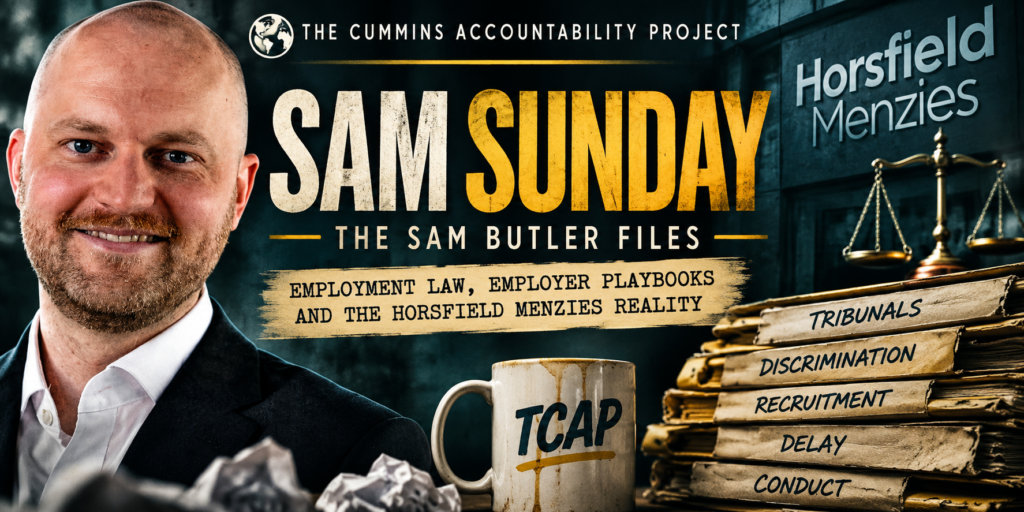
Welcome back to Sam Sunday, where the professional literature of Horsfield Menzies meets the deeply unfashionable practice of reading the entire fucking judgment. Today’s preacher is Sam Butler, whose article Remote Control?, published on 30 May 2025, examines Wicken v Akita Systems Limited. Butler presents the dispute primarily through the lens of hybrid working, managerial expectations and an employee’s request to attend a meeting remotely through Microsoft Teams. The resulting commentary offers employers practical lessons about flexible working, performance management and avoiding premature decisions concerning employees whose conduct causes concern.
Those are legitimate subjects, but the judgment contains a considerably more disturbing narrative than the one suggested by a disagreement over meeting arrangements. It examines a damaged professional relationship, an improvement plan that failed to reach the relevant decision-makers, a grievance investigation whose perceived independence became a central concern and a subsequent sequence of events that ended in resignation. Somewhere beneath the polished employment-law advice lies a corporate horror story in which a senior employee attempts to secure an impartial process while management responds with an investigator connected to the boss and a Sunday dossier large enough to qualify as an independent fucking publication.
Welcome To The Department Of Mandatory Happiness
Ben Wicken joined Akita Systems in March 2014 and progressed from junior network manager to Technical Director. By 2022, he held a senior position in a company whose annual turnover the Tribunal estimated at approximately £6–7 million. The directors had longstanding relationships with one another, creating the sort of closely connected management structure that businesses often describe as a family. Corporate families can be wonderful institutions until somebody begins questioning the behaviour of a senior relative. At that point, the atmosphere can deteriorate from the annual summer barbecue to a particularly unpleasant inheritance dispute, except that the family solicitor has been replaced by an HR consultant carrying a clipboard.
Managing Director Christophe Boudet had concerns about Wicken’s communication, leadership and relationships with colleagues, and the Tribunal accepted that some of those concerns were legitimate. That qualification matters because the case was not about an entirely blameless employee facing an employer whose every criticism lacked substance. Management was entitled to raise concerns and seek improvements. What it could not do was treat those concerns as permission to conduct the ensuing process however it pleased. The legitimacy of a complaint about performance does not automatically confer legitimacy on the method selected to address it, however confidently somebody in senior management explains that the company is acting in everybody’s best fucking interests.
The Gardener, The Webcam And The Wrath Of Management
The relationship deteriorated despite attempts at mediation, and one disagreement concerned Wicken’s request to attend a follow-up meeting remotely. He had work taking place at home, involving arrangements with a gardener, and wanted to participate through Microsoft Teams rather than attend physically. Boudet preferred an in-person meeting and expressed disappointment with the request. Wicken ultimately attended in person, but the encounter became confrontational and added to an already damaged working relationship. The involvement of a gardener gives the episode an almost comic domestic quality, as though an employment dispute capable of generating years of litigation had temporarily wandered into an episode of Gardeners’ World produced by the fucking Inquisition.
There were reasonable arguments on both sides of the original attendance question. Senior colleagues attempting to repair a difficult relationship may benefit from meeting face to face, and Wicken could have communicated his arrangements more effectively. Equally, proposing a Teams meeting does not, by itself, demonstrate professional contempt or an unwillingness to cooperate. The Tribunal recognised shortcomings in Wicken’s communication without finding culpable or blameworthy conduct justifying a reduction in compensation. That is an important distinction, because managerial authority can sometimes inflate a relatively minor disagreement into a grand philosophical confrontation about loyalty. Before long, a webcam preference becomes a challenge to corporate leadership, and a diary conflict has apparently threatened the foundations of Western fucking civilisation.
The Improvement Plan That Never Reached The Board
Following mediation discussions, Wicken developed proposals intended to address concerns about his conduct and professional relationships. These included communicating more openly, greeting colleagues, spending more time with his team and establishing regular meetings with Boudet. The discussions even extended to his professional presentation, including suggestions about wearing his jacket less frequently and considering different clothing. One can almost imagine the accompanying corporate transformation campaign, complete with an inspirational photograph of a man replacing his jacket with a cardigan beneath the slogan AKITA SYSTEMS: TRANSFORMING LEADERSHIP THROUGH KNITWEAR. Nevertheless, beneath the absurdly domestic details lay an employee attempting to respond constructively to criticisms raised by management.
On 16 May 2022, Wicken discussed his proposed improvements with the HR professional assisting the mediation process. The Tribunal subsequently found that those proposals did not reach the directors before they concluded that they had lost confidence in him. This matters because Butler’s article describes a submitted improvement plan that management deemed inadequate, a formulation that suggests the decision-makers had examined the proposals and found them wanting. The judgment reveals a materially different problem: Wicken had communicated proposals, but the directors whose confidence he sought to restore did not receive them before reaching their conclusion. An improvement process becomes rather difficult to defend when the employee supplies an explanation of how he intends to improve and the people making the decision never fucking see it.
The Board Has Lost Confidence Without Reading The Plan
The resulting sequence illustrates the difference between a fair process that reaches an unfavourable conclusion and a process whose conclusion appears to have arrived before all the relevant evidence. Management had concerns about communication, Wicken attempted to communicate proposals for improvement, and those proposals failed to reach the directors before they decided the relationship could no longer continue satisfactorily. This does not establish that every proposal would have succeeded or that management was obliged to restore its confidence regardless of the circumstances. It does, however, undermine the idea that the board had properly evaluated what Wicken proposed before determining that the situation was beyond repair.
The Tribunal recognised that Akita might ultimately have been able to dismiss Wicken fairly for some other substantial reason. Relationships between senior colleagues can break down to a degree that makes continued employment impracticable, even where neither party has committed an especially spectacular disciplinary offence. But a potentially fair reason does not eliminate the requirement for a fair process, and the employer cannot simply leap over the employee’s response because management has grown weary of the discussion. Corporate procedure sometimes resembles a bureaucratic snake swallowing its own tail: the employee receives an invitation to improve, the proposed improvements disappear into the system, and the board concludes that its confidence has been irretrievably destroyed. What a magnificent fucking feedback loop.
Enter The Independent Investigator, Terms And Conditions Apply
Wicken subsequently raised a grievance concerning his treatment, prompting Akita to appoint David Charity, an HR consultant with a longstanding personal connection to Boudet. The two men had known one another for approximately thirty-two years, a detail that naturally assumed significance when Wicken questioned whether Charity could investigate complaints involving the managing director with sufficient independence. Friendship does not automatically establish actual bias, dishonesty or professional misconduct, and the Tribunal did not find that Charity had deliberately falsified the evidence. Nevertheless, an employer confronting a serious objection about perceived independence must consider the appearance of fairness as well as the practical convenience of retaining its preferred consultant.
The Tribunal questioned why Akita had not appointed an independent HR professional after Wicken raised those concerns. That observation reaches the heart of the problem because a grievance investigation requires the employee to have reasonable confidence in the process. An organisation cannot secure that confidence merely by declaring its investigator independent while refusing to engage meaningfully with circumstances that may suggest otherwise. It must examine whether the appointment is appropriate, particularly when the grievance concerns senior management and the employment relationship has already deteriorated. Akita had an opportunity to address the objection but retained Charity, giving the investigation the unfortunate appearance of a members-only club whose chairman was a longstanding friend of the person whose conduct required examination. A beautifully reassuring fucking arrangement.
The Investigator Returns To Represent The Employer
The judgment contains an additional detail that makes the history of Charity’s appointment particularly interesting. Its opening page identifies him as the person representing Akita Systems at the February 2025 Tribunal hearing, years after he had undertaken the disputed investigation. That subsequent role does not retrospectively establish that his original investigation lacked independence, and there is no sound basis for suggesting that appearing for the employer automatically proves prior misconduct. Professionals can perform different functions at different times. Nevertheless, the sequence creates an uncomfortable picture of the relationship between the company, its chosen investigator and the employee whose objections about independence formed part of the case.
Wicken challenged Charity’s suitability to investigate his grievance, Akita persisted with that appointment, and the resulting events helped produce a finding that the employer had fundamentally damaged the relationship of trust and confidence. Years later, the same consultant appeared on the company’s behalf before the Tribunal considering those events. Butler’s article recommends preserving procedural integrity, which is sensible advice, but gives relatively little attention to this unusually revealing history. The difficulty was not simply that a disciplinary or grievance process needed more careful management. It was that the employer had failed to resolve a substantial concern about the impartiality of the person conducting it, then watched the dispute develop into years of litigation. The HR revolving door had become a fucking architectural feature.
The Friday Confirmation That Management Would Overlook
By late June 2022, Wicken remained unfit for work, his solicitors had challenged Charity’s continued involvement and the parties were disputing how the grievance should proceed. On Friday 24 June, Wicken expressly confirmed that he wanted the grievance pursued. His objection concerned the person investigating it rather than any abandonment of the underlying complaint. This distinction is fundamental because an employee who continues to seek an investigation while challenging the investigator’s independence has not necessarily withdrawn the grievance. Treating the two positions as interchangeable would allow an organisation to transform a procedural objection into a reason for avoiding the complaint itself.
The company faced a straightforward question: whether to address the objection about independence and preserve a process in which Wicken could have reasonable confidence. It instead continued along a course that produced an extraordinary sequence of correspondence over the following four days. What began as an opportunity to investigate complaints about management became entangled with allegations against the employee, disagreement about the investigation and increasingly strained relations between the parties. By the end of that weekend, the administrative response had grown so formidable that it seemed less like an attempt to resolve a workplace dispute and more like a corporate funeral conducted by people who had already ordered the fucking coffin.
Sunday Mass Comes With Sixty-Two Pages
On Sunday 26 June 2022, Charity emailed Wicken to confirm a further investigating role involving allegations concerning his conduct, performance and relationship with Boudet. The communication included sixty-two pages of allegations. That number deserves attention not because sending a substantial document on a Sunday automatically breaches employment law, or because the Tribunal found the allegations fabricated, but because of the circumstances in which it arrived. Wicken was off sick, had already questioned the investigator’s independence and had recently confirmed that he wished to proceed with his grievance. The employer’s chosen investigator was now presenting him with a substantial additional body of material concerning his own alleged failings.
There is something almost religious about the timing. Ordinary people spend Sunday preparing dinner, visiting relatives or trying to convince themselves that the approaching working week will not be quite as dreadful as the previous one. At Akita Systems, the Sunday service featured a dossier sufficiently large to occupy an entire evening, delivered within an employment relationship already struggling beneath the weight of distrust. The document’s size was not the legal test, and the judge did not treat the number of pages as independently establishing wrongdoing. But the surrounding circumstances were important, particularly when considered alongside what the investigator did next. The correspondence had acquired the atmosphere of a Sunday sermon delivered by an industrial shredder with a fucking grievance policy.
Tuesday: The Grievance Goes Into The Ground
On Tuesday 28 June 2022, Charity closed Wicken’s grievance on the basis that he had failed to pursue it actively. Four days earlier, Wicken had expressly indicated that he wanted the complaint investigated, while continuing to object to Charity’s involvement. The sequence is difficult to reconcile with the notion that the employee had simply lost interest in the grievance. He had challenged the fairness of the investigation rather than abandoning his underlying concerns, yet the process came to an end through a decision made by the very investigator whose suitability he questioned. What should have been a mechanism for resolving workplace problems had become part of the problems requiring resolution.
The Tribunal found that the grievance closure contributed to a cumulative breach of the implied term of trust and confidence. Wicken regarded that event as the final straw and resigned. The distinction between the Sunday allegations and Tuesday’s decision matters because the Tribunal did not simply conclude that receiving sixty-two pages caused the resignation. Its reasoning examined the employer’s overall conduct, including the failure to address concerns about independence and the handling of the grievance. The closing of the complaint supplied the final event within that sequence. In practical terms, an employee had confirmed his wish for an investigation on Friday, received an enormous dossier on Sunday and discovered on Tuesday that his grievance was finished. Corporate efficiency had reached the point where it could apparently bury the fucking complaint faster than its author could object.
Sam Butler’s Missing Resignation
Butler’s case summary creates a separate problem by describing Wicken as having been dismissed after the deterioration in workplace relations. The Tribunal’s findings establish something more specific: Wicken resigned without notice on 28 June 2022, subsequently succeeding in a claim for constructive unfair dismissal. This was not merely an incidental detail of the chronology. Constructive dismissal involves an employee terminating the contract in response to conduct amounting to a sufficiently serious breach by the employer. The Tribunal must examine the breach, the reason for the resignation and whether the employee acted in a manner consistent with relying on that breach rather than affirming the contract.
Compressing this into a statement that the employer dismissed Wicken obscures the mechanism upon which the successful claim depended. He was not simply removed from employment after a disagreement about Microsoft Teams. He resigned following a series of events the Tribunal considered sufficiently serious to constitute a fundamental breach of contract, with the grievance closure serving as the final straw. An employment solicitor discussing a constructive unfair dismissal case should ordinarily make that distinction clear, particularly when summarising the principal lesson for employers. The judgment supplies a detailed explanation of how the contractual relationship broke down. Butler’s description leaves the reader with a less precise picture of how the employment actually ended, which is an unfortunate omission in an article about the legal consequences of a failed fucking management process.
The Law Does Not Require A Perfect Employee
The judgment also undermines any simplistic account in which Wicken’s success required the Tribunal to regard him as entirely blameless. The judge accepted that management had legitimate concerns and concluded that there was a substantial possibility Akita could have dismissed him fairly for some other substantial reason if it had followed an appropriate process. That assessment recognised the practical difficulties of maintaining an increasingly damaged relationship between senior colleagues. Fairness does not require employers to tolerate every conceivable problem indefinitely, nor does it mean an employee’s communication and conduct become immune from criticism simply because the employer later handles matters badly.
The difficulty was that Akita’s legitimate concerns did not excuse the actions it actually took. The company had to consider relevant material, handle the grievance fairly and avoid conduct that fundamentally undermined the relationship of trust and confidence. Those duties did not disappear when the managing director lost patience. The judge also found no contributory fault justifying a compensation reduction, despite recognising imperfections in Wicken’s behaviour. That distinction should occupy a prominent place in any professional analysis of the case. An employee can communicate imperfectly without providing the employer with a blank cheque to turn a grievance investigation into a fucking procedural obstacle course.
The Compensation Figure And The Price Of Getting It Wrong
The Tribunal’s remedy findings provide another important dimension. It applied a 50% Polkey reduction to reflect the possibility that Akita could have dismissed Wicken fairly through an appropriate process. The judge also applied a 15% uplift concerning the employer’s unreasonable failure to comply with the ACAS Code and made no reduction for contributory fault. By consent, Akita agreed to pay £30,692.35. These figures do not support a claim that the employer had no legitimate concerns, nor do they establish that Wicken would necessarily have remained employed indefinitely if the company had acted correctly. They demonstrate that the manner in which an employer handles a difficult situation can generate substantial liability even where a lawful route to ending the relationship might have existed.
That is a particularly valuable lesson for employers because the consequences did not arise from a single disagreement over a virtual meeting. They emerged from the cumulative treatment of an employee whose relationship with management had already deteriorated. The improvement plan failed to reach the directors, the grievance investigator’s independence became a serious source of concern, and the complaint was closed despite Wicken’s expressed wish to pursue it. Each stage increased the difficulty of repairing the relationship and ultimately contributed to litigation that occupied years of the parties’ lives. Akita might have possessed a defensible management objective, but it reached the Tribunal after taking a procedural scenic route through missing communications, disputed impartiality and sixty-two pages of Sunday fucking correspondence.
The Microsoft Teams Story Was Only The Entrance
Butler ends his article with recommendations concerning hybrid-working requests, communication about performance, managerial training and avoiding prejudgment. Much of that advice is reasonable, and the judgment supports the importance of careful decision-making. The difficulty lies in what the article foregrounds and what it reduces to background detail. A dispute involving constructive dismissal, perceived investigator independence, a missing improvement plan and the closure of a grievance becomes principally an illustration of how employers should handle remote-working expectations. The Teams disagreement certainly formed part of the relationship’s deterioration, but it did not supply the decisive legal explanation for the outcome.
The fuller judgment points towards a more demanding lesson. Employers must do more than announce a commitment to fair processes while retaining arrangements that employees reasonably regard as compromised. Decision-makers need to consider the information supplied in response to their concerns, investigators must inspire confidence in the impartiality of their role, and objections to the conduct of an investigation require proper consideration rather than administrative disposal. Those principles may lack the contemporary glamour of an article about hybrid working, but they concern the foundations of fair workplace treatment. A grievance procedure does not become fair merely because somebody attaches a professional-looking title to the investigator’s email signature. The machinery must actually fucking work.
When Procedure Becomes The Problem
Modern workplaces possess an extraordinary capacity to disguise conflict as administration. A grievance becomes a task to close, an investigation becomes a process to manage, and an employee’s objections become another item of correspondence requiring a response by the next convenient business day. None of those activities is inherently improper. Proper procedure protects organisations and employees alike, creating opportunities to resolve disagreements before they become disputes about the continued existence of the employment relationship. The danger arises when administrators begin treating the completion of their paperwork as evidence of fairness, regardless of whether the person affected has received a meaningful opportunity to participate.
Wicken v Akita Systems illustrates that danger with unusual clarity. The employer had legitimate concerns, the employee had shortcomings, and the working relationship was plainly deteriorating. Nevertheless, Akita was required to respond to those difficulties in a manner consistent with the contractual duty of trust and confidence. Its failure to do so turned the processes intended to manage the dispute into part of the conduct that justified Wicken’s resignation. The Tribunal did not need to invent hidden intentions or conduct a psychological excavation of every person involved. The documentary sequence, findings about procedural fairness and cumulative treatment provided the necessary explanation. Sometimes the administrative record is sufficiently damning without adding another fucking adjective.
The Sixty-Two-Page Benediction
The central chronology deserves to remain in the reader’s mind because it captures the character of the dispute more effectively than any abstract discussion of hybrid-working policy. On Friday 24 June, Wicken confirmed that he wanted his grievance pursued. On Sunday 26 June, Charity sent him sixty-two pages of allegations. By Tuesday 28 June, the investigator had closed the grievance and Wicken had resigned. The Tribunal did not treat the Sunday dossier as automatically unlawful, nor did it find that every criticism of Wicken lacked substance. Instead, it considered the employer’s cumulative conduct and identified the closure of the grievance as the final straw in a relationship already damaged by the company’s handling of the dispute.
That sequence is the real heart of the story, yet Butler’s presentation directs attention towards a meeting that Wicken wanted to attend remotely. The issue was never simply whether Microsoft Teams offered a satisfactory substitute for physical attendance. It was whether a company with legitimate concerns about a senior employee responded fairly when the relationship began to collapse. The Tribunal’s answer was sufficiently clear to sustain a constructive unfair dismissal finding, a compensation award and a detailed examination of how Akita managed its procedures. A legal newsletter that concentrates on the webcam while compressing the resignation and grievance history risks missing the most important parts of the fucking judgment.
The Webcam Was Never The Crime Scene
There is a peculiar comfort in reducing a complicated employment dispute to a recognisable workplace theme. Hybrid working offers a familiar headline, invites general advice about managerial expectations and avoids becoming too deeply entangled in the uglier details of how grievances can fail. But Wicken v Akita Systems deserves more than a warning about remote attendance. It shows how an employer can possess legitimate concerns about an employee and nevertheless conduct itself in a manner that fundamentally breaches the employment contract. It also demonstrates why the appearance of independence, the proper consideration of improvement proposals and the handling of a grievance are not decorative features of employment law. They are safeguards against managerial power becoming self-justifying.
Sam Butler’s article offers employers an introduction to several useful principles, but the judgment exposes a much more substantial failure of workplace administration than his remote-working emphasis suggests. Wicken was not simply dismissed following an unfortunate disagreement about attending a meeting. He resigned after a sequence of events that the Tribunal found had undermined trust and confidence, culminating in the closure of a grievance he had expressly sought to pursue. Before advising employers about where staff should attend meetings, perhaps the more urgent recommendation is to ensure that their grievance procedures do not become the very reason the employment relationship collapses. And for the love of Christ, when an employee confirms on Friday that he wants his complaint investigated, do not interpret that as an invitation to bury it beneath sixty-two pages of Sunday correspondence and declare the fucking matter closed by Tuesday.
SAM SUNDAY. SIXTY-TWO PAGES. TWO DAYS. ONE DEAD GRIEVANCE.
Lee Thompson – Founder, The Cummins Accountability Project
Sources
- Horsfield Menzies – Sam Butler: Remote Control?
- Employment Tribunal – Wicken v Akita Systems Limited, Written Reasons, 25 February 2025
- Employment Tribunal – Wicken v Akita Systems Limited, Judgment, 7 February 2025
- Employment Rights Act 1996 – Section 95: Circumstances In Which An Employee Is Dismissed