
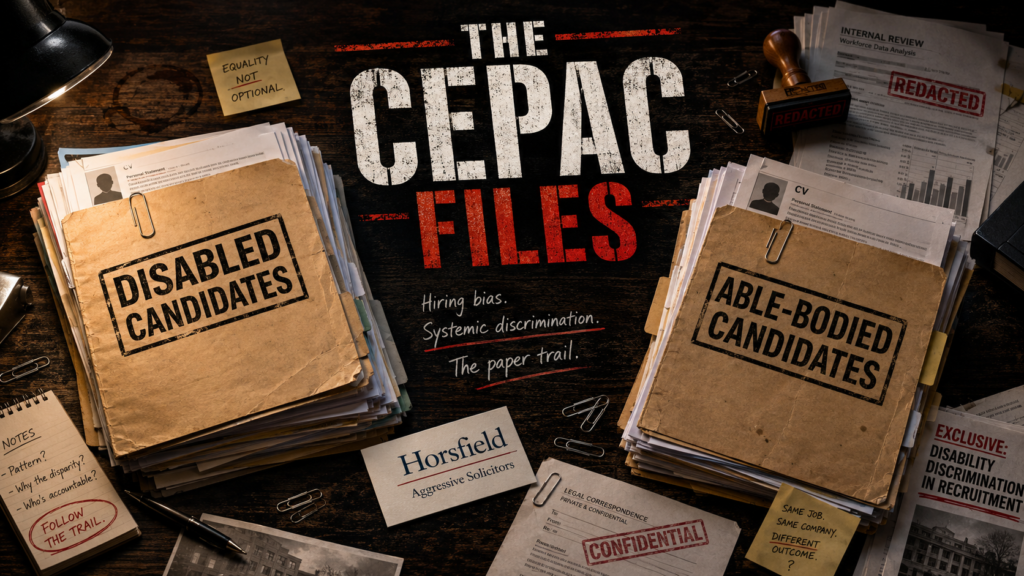
Cepac has another Jameson trophy, and Pernod Ricard has a fresh annual report explaining how it checks suppliers before contracts, purchase orders and renewals. Put those two publications beside the WhatsApp, Maria Walker’s email and Cepac’s ET3. The Pernod Ricard Cepac due diligence question now has a very practical shape: who examines the evidence behind the supplier’s reassuring presentation?
The Cardboard Distillery Has Had A Lovely Evening
A cardboard distillery can apparently get through an awards ceremony without anybody asking an awkward recruitment question. Cepac’s Jameson display has the gates, the barrels and the grand entrance. Its construction invites shoppers into a miniature world of whiskey heritage, where everything looks considered and somebody has thought carefully about moving the pallets. Meanwhile, an actual person can spend two years trying to establish what happened to an interview. The doors work beautifully. The explanation remains stuck.
The 2026 POPAI winners’ register names Cepac Display Doncaster and identifies Pernod Ricard as the client for the Jameson St Patrick’s Distillery Display. Cepac’s corporate announcement celebrates gold in the Wholesale category and names Pernod again. A project post described the display as live across UK wholesale stores for St Patrick’s Day. There is a specific 2026 project here, with the awards organiser, the manufacturer and a named member of the project team identifying the commercial connection.
That is fresh recognition and promotion of the work. It does not establish when Pernod last placed an order or whether another contract remains live today. Those dates belong in the companies’ answer. However, the association continues to earn Cepac public credit. The trophy has arrived wearing the client’s name, so the client’s supplier standards can come through the same fucking door.
Behind The Purchasing Desk
Part One put the ET3 beside Pernod’s brands and supplier promises. Part Two added the WhatsApp, Walker’s explanation and the supplier clause concerning legal attacks on human-rights defenders. Those articles established the questions. This instalment follows the people and procedures that should be capable of answering them.
On 16 September 2026, Pernod filed its 2025/26 Universal Registration Document. Printed page 198 says employees must complete due diligence before a third-party contract, purchase order or partnership renewal. Identified risks go to compliance and sustainable-procurement staff. Depending on the assessment, they recommend measures to address the risk or advise against engagement.
Printed page 221 expressly includes point-of-sale materials in the categories using its Partner Up supplier platform. Since FY25, the report says, supplier standards form part of all transaction terms. Consequently, cardboard displays sit inside the purchasing system Pernod describes. Somewhere behind the theatrical gates, there should be an actual decision process.
The question is what that process did, or will do, with this file. Procurement can establish the relevant entity, project dates, assessment and responsible team. A grand statement about responsible sourcing needs considerably less ceremonial polishing once somebody asks to see the records underneath it.
Before The Trophy There Was A Phone Call
On 21 August 2024, Page Outsourcing called me about a production role at Cepac. During that call, the recruiter offered an interview for the week after the bank holiday. We discussed a £27,000 training wage rising towards £29,000. I also explained that mental-health problems accounted for my employment gap. Page would pass my details on and call again to arrange the interview time.
Afterwards, I sent a friend a WhatsApp message. It recorded “Interview next week” and “27k training wage up towards 29”. These are my words to the recipient, recording my account immediately after the call. At that point, I expected a follow-up about a job. The sprawling legal shitshow had yet to acquire its first invoice.
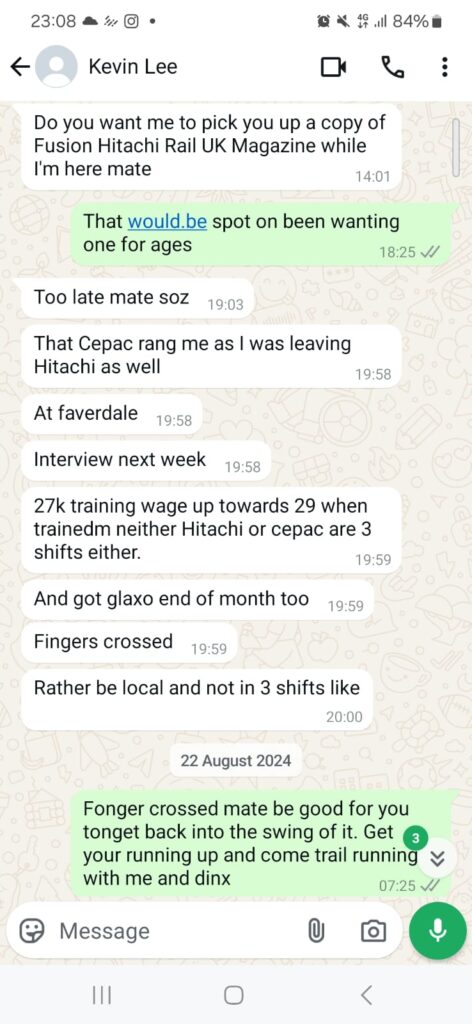
The promised confirmation never arrived. Nevertheless, the exchange survived, and the recipient’s statement dated 20 February 2025 supports its origin and context. Together, they give an investigator something contemporaneous to compare with Page’s call records and candidate history.
What did the recruiter offer? When did the application change status? An investigator can pursue those questions through documents and witnesses. The WhatsApp is useful precisely because it predates the dispute: an ordinary message about an ordinary expectation, before anybody needed a defence.
Maria Walker Supplies A Different Story
At 04:35 on 8 October 2024, I complained directly to Cepac. My email set out the interview offer, the missing confirmation and the mental-health disclosure. Maria Walker, Cepac’s HR Business Partner, replied at 09:51. She said the agency screened candidates before forwarding CVs for the recruiting manager’s final shortlist.
My CV had reached that manager, she said, but I had not made the shortlist. According to her answer, the manager would not have known about the mental-health issues discussed with Page. Her apology concerned the agency’s failure to tell me that I had not secured an interview. The explanation ended with feedback to prevent future “confusion”.
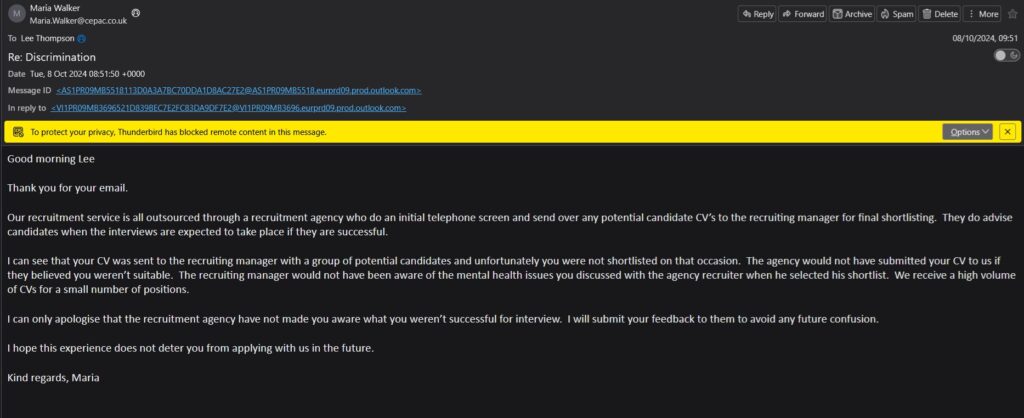
However, an offered interview awaiting confirmation and an unsuccessful shortlist describe different events. Walker supplied her account without seeing my contemporary message. Therefore, the review needs to establish what she checked, who supplied the explanation and what the underlying records show.
Corporate confusion is a remarkably well-fed creature. It eats the discrepancy, shits out an apology and leaves nobody responsible for feeding it. Here, the useful response would identify the actual decision and its timing. Pernod’s supplier review can ask for that evidence without adopting anybody’s preferred story in advance.
Paragraph Fourteen Arrives Seven Weeks Earlier
Cepac’s ET3, its formal response to the claim, provides another dated document. Paragraph 12 says Cepac did not know about the agency conversation concerning my health-related employment gap until after my October complaint. However, paragraph 14 reproduces an email Page sent to Cepac on 21 August. It contained candidate introductions, including mine.
That introduction said I had been out of work for twelve months because of health problems and was ready to return. Consequently, Cepac’s own pleading puts health information in an August recruitment email. An investigator must distinguish receipt by the company from what the recruiting manager actually read and understood.
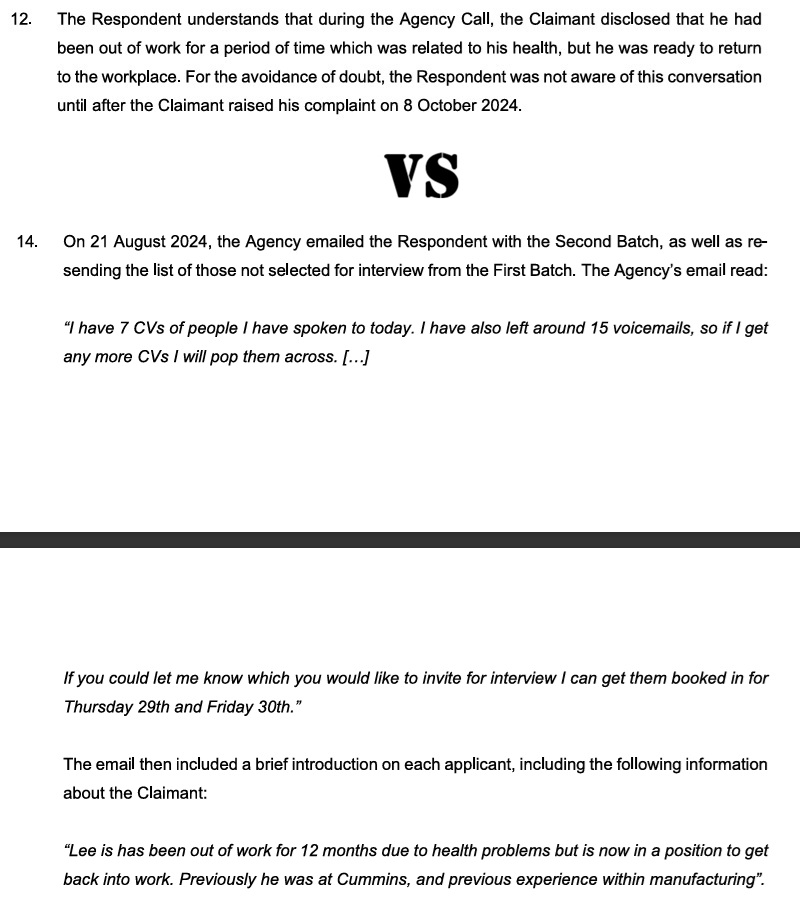
Those distinctions require the original email, recipients, access history and shortlist record. They also require somebody to compare Walker’s assurance with the information that travelled through the recruitment process. General reassurance cannot establish which person saw which document before making which decision.
This is where the Pernod Ricard Cepac due diligence question becomes wonderfully unglamorous. Open the email. Follow the recipients. Establish the decision. Nobody needs to reinvent moral philosophy or commission a scented leadership retreat. The information already has a date; somebody can stop farting around and trace it.
Michael Page Offers The Blackout Edition
Page holds the other end of that trail. Its response to my data-subject-access request contained redacted names and passages, citing third-party information. The disclosed material also concerned enquiries into my tribunal history after I complained. TCAP’s Page investigation sets out that correspondence.
Some redaction can protect another person’s information. Even so, the companies retain the originals and can examine what the blacked-out version leaves unresolved. A supplier review should establish what the records say about the application, the call and the subsequent explanation. Searching the complainant’s background does not reconstruct the recruitment decision.
The resulting contrast is bleakly comic. Once I complained, there was curiosity about my history. Meanwhile, the interview still needed explaining. Somebody had apparently found the batteries for the investigative torch, then pointed the bloody thing at the person asking for help. Pernod can ask for a review that keeps the beam on the relevant records.
The Assessment Needs More Than A Supplier’s Smile
Pernod’s report lists discrimination, harassment and external-stakeholder human rights among the assessment criteria it describes. It also includes follow-up of allegations under the SMETA business-ethics criteria. The company says its Supplier Performance Evaluation process identifies poor performers and documents corrective action. These are specific things a review can examine.
Now apply them to this sequence. A recruiter discusses an interview and salary. Health information enters the recruitment chain. The confirmation disappears. Later, the employer supplies an unsuccessful-shortlist explanation. Three exhibits preserve different parts of that history, and the companies hold the records needed to reconcile them.
A competent assessment would test the competing accounts. It would identify what remains uncertain and seek the missing material. Simply asking Cepac whether everything was fine would produce an exercise with all the investigative depth of a nightclub bouncer interviewing his own reflection.
Nor should the reviewer treat my tone as a substitute for that work. The contents of the email do not change because I swear. A purchasing team can find the prose abrasive and still read the fucking dates. Otherwise, the standard becomes absurdly easy to defeat: make the complainant sufficiently unpleasant to discuss, then leave the underlying question untouched.
Horsfield Menzies Finds The Medical Centre
The complaint’s later handling deserves scrutiny too. Horsfield Menzies, acting for Cepac, contacted my medical centre about appointment availability and used that information to oppose a postponement. The enquiry concerned appointments; it did not give the firm access to my full medical records. Nevertheless, the opposing solicitors had made my route to medical support part of their argument against delay.
Meanwhile, correspondence, complaints and online publications accumulated in the case about my conduct. I was a disabled litigant in person, and emotional dysregulation under stress arises from my disability. Consequently, the surrounding pressure matters when assessing my reactions. Removing that context makes the person’s response look conveniently self-contained.
I regard the medical enquiry and the wider handling as bullying. That is my assessment of identifiable acts which a reviewer can examine in the correspondence and submissions. Pernod need not borrow my vocabulary to ask whether the handling meets its expectations of suppliers. It needs the sequence, the medical context and the parties’ explanations.
The process had a grotesque efficiency. My difficulties generated more material about my difficulties, while the recruitment question waited underneath. An investigator should be able to recognise the difference between examining a complaint and building a fucking annex around the complainant.
What The Tribunal Decided
The hearing proceeded without me on 24 April 2026. The tribunal found my conduct unreasonable, scandalous and vexatious, concluded that a fair trial was no longer possible, and struck out the claims. It ordered me to pay Cepac £20,000. Paragraph 116 records that Cepac’s combined costs schedules exceeded £50,000 and that its representative limited the application to £20,000 to avoid detailed assessment.
Those findings went against me. I challenge the process and reasoning, including the treatment of disability and participation. TCAP’s Newcastle investigation develops that criticism. However, the distinction relevant to procurement is straightforward: the strike-out did not determine whether disability discrimination occurred in recruitment.
Therefore, a supplier reviewer should read the judgment for the questions it decided, then identify the recruitment questions it left unresolved. The costs order does not establish what Page offered on the phone. Nor does it explain what Walker checked or which information the recruiting manager saw.
I object to the transformation of a discrimination complaint into an examination of the complainant’s behaviour. Pernod can assess that handling while also testing the original recruitment account. Accepting the procedural result as an answer to every underlying question would be lazy bollocks dressed in judicial stationery. The paperwork deserves a closer reading than that.
My Mam Is Afraid To Submit A Statement
My mam is afraid to submit a witness statement. She fears that Sam Butler might telephone her GP, enquire about her medical appointments and use whatever information he obtains against her. That concern has a concrete starting point: Horsfield Menzies contacted my medical centre about appointment availability and used the information when opposing a postponement. Consequently, the prospect of contributing evidence now carries a worry about what else the opposing solicitors might investigate without consent.
Pernod’s supplier review should examine that effect too. A witness considering whether to help should not have to weigh her evidence against the prospect of somebody taking a professional interest in her medical arrangements. Yet that is the concern my mam has. The fucking reach of this dispute now extends beyond the applicant and into his family’s willingness to participate. Any assessment of complaint handling that ignores that human consequence would leave out part of the very problem it claims to examine.
The Code Has A Repair Department
Pernod’s October 2025 Supplier Standards prohibit disability discrimination in hiring and address intimidation, harassment and retaliation. They require notification of adverse impacts and provide for assessment and corrective action. Where suppliers show little commitment to preventive or corrective measures, Pernod says it may stop doing business and ultimately terminate the contract.
The policy also addresses attacks, including legal attacks, against human-rights defenders. Part Two examined that clause. Its application here would require a reasoned assessment of the conduct and circumstances; the existence of litigation alone does not settle it. The immediate question is whether Pernod will examine the evidence through the standards it publishes.
That leaves room for practical remedies. Establish what happened, correct inaccurate accounts, address identified failings and explain how recruitment and complaint handling will change. If the evidence does not substantiate a concern, explain why. Either result requires more work than allowing the supplier’s preferred summary to impersonate an investigation.
The new trophy makes the exercise timely. Cepac is publicly celebrating work for Pernod, while Pernod describes a system for assessing suppliers. Both organisations can account for the relevant projects and records. Corporate responsibility becomes rather less impressive when the repair department turns out to be a cupboard containing spare adjectives.
The Quiet Mancunian Is A Separate Source Question
There is also a separate source concerning the wider corporate group. HSA’s own directory lists Cepac and Longulf. Anthony C Heaford, writing as The Quiet Mancunian, alleges in his report dated 15 May 2023 that Dirhem Abdo Saeed financed and hosted Khalid Sheikh Mohammed in 1997. He connects his account to machinery purchased through Longulf and an installation visit to Yemen.
Heaford says he met the man he identifies as Mohammed during that visit. I have not independently verified these allegations. His report expressly acknowledges that official documents relating to Mohammed or 9/11 do not name Dirhem. The documented corporate connection and the existence of Heaford’s account do not prove criminal conduct by Cepac, HSA, Longulf or any individual.
Paragraph 110 of the tribunal judgment records my allegation of a link between Cepac and 9/11 funding. It does not examine Heaford’s underlying account. My earlier article discusses that source. A proper assessment would test the account and seek corroboration and responses, rather than treat either my belief or judicial disapproval as the answer.
That distinction matters to any serious review. These allegations require their own assessment and cannot establish the recruitment complaint. Equally, criticism of me does not perform that assessment. A judge’s raised eyebrow is not a forensic instrument, however expensive the room around it becomes.
Put A Name Against The Decision
Pernod can start by identifying the commercial arrangement behind the Jameson project: the contracting entity, dates, production site and current purchasing status. Next, establish which supplier assessment applied and who owned the decision. Where the relationship continued or renewed, identify the checks supporting that step. This is ordinary procurement information held by the businesses involved.
Then review the recruitment records. Compare Page’s call material and candidate history with the WhatsApp. Trace the August email through Cepac and establish the shortlist decision. Ask what supported Walker’s reply. Finally, examine the medical-centre correspondence, the complaint’s handling and the tribunal outcome without confusing one part of the file with another.
Publication does not establish that Pernod’s compliance team has received or reviewed this material. The question is therefore what review, if any, has taken place and what the company will do with the evidence now. Its public Speak Up route offers another channel for stakeholders to raise concerns. An answer can identify the responsible team and explain the next steps without disclosing private personnel information.
The Pernod Ricard Cepac due diligence test is concrete. The company has described a purchasing process; the supplier has supplied a celebrated project; the recruitment file contains documents worth examining. Name the person responsible, identify the records and explain the decision. There is no shortage of material to begin with.
A Gold Medal Cannot Answer An Email
Pernod has already published the language of responsible procurement. Cepac has already demonstrated its talent for making a brand look splendid. Between them, they can construct a distillery entrance large enough to welcome shoppers and flexible enough to replace the stock. Following a dated email through a recruitment process ought to fall within the combined capability of this magnificent operation.
The trophy can remain a trophy. Meanwhile, the complaint needs an assessment that follows evidence beyond the first comfortable explanation. Establish what Page offered, what Cepac received, what the manager decided and how Walker reached her answer. Then explain what those findings mean under the standards attached to the commercial relationship.
That would give the public something useful to read alongside the celebration. Otherwise, the risk is an elaborate piece of corporate stagecraft: the values look three-dimensional, the assurance has beautiful print registration, and the door marked accountability opens onto the loading bay. Another gold medal is lovely. Now show us the fucking due diligence.
Lee Thompson – Founder, The Cummins Accountability Project
Sources
- POPAI: Winning Awards Entries 2026
- Cepac: Jameson Display Award Announcement
- Martyn Kidner: Jameson Display Live Across UK Wholesale Stores
- Filing Of The 2025/26 Universal Registration Document: Pernod Ricard
- Universal Registration Document 2025/26: Pernod Ricard
- Supplier Standards: Pernod Ricard
- Pernod Ricard: Ethics And Compliance
- The Cepac Files: Pernod Ricard – Good Times, Dirty Files And Cepac’s Trophy Cabinet
- The Cepac Files: Pernod Ricard II – Maria Walker, Two WhatsApp Lines And The Legal-Attack Clause
- Page Partners: Cepac Limited – Redactions, Panic Calls And The Disabled Candidate They Googled
- Newcastle Employment Tribunal: Deliberate Maladministration
- Employment Tribunal: Thompson v Cepac Limited And Page Outsourcing UK Limited
- HSA Group: Our Companies
- The Quiet Mancunian: Khalid Sheikh Mohammed’s Hosts & Financiers
- TCAP: Why I Believe The Quiet Mancunian