
Pernod Ricard’s supplier standards prohibit disability discrimination in hiring, retaliation and attacks, including legal attacks, against human-rights defenders. Cepac’s 2026 portfolio still uses Absolut, Jameson, Malibu and Altos work to sell its cardboard. Now Maria Walker’s 09:52 denial, the same-day WhatsApp interview receipt, Cepac’s ET3 contradiction, the medical-centre intrusion and a legal campaign costing more than £50,000 are going through the audit Pernod claims to operate.
Part One Put The ET3 Behind The Bar
Part One, The Cepac Files : Pernod Ricard – Good Times, Dirty Files And Cepac’s Trophy Cabinet, established the relationship and placed Pernod Ricard’s supplier standards beside Cepac’s ET3. It followed the award pipeline built from Absolut, Jameson and Malibu displays, then asked whether disability discrimination, bullying and intimidation disappeared from the rulebook whenever the supplier arrived carrying another trophy.
However, that article did not contain the complete recruitment trail. Specifically, it did not show the WhatsApp message created on the day Page Outsourcing offered the interview. Maria Walker’s answer arrived without examination because Part One never placed her 09:52 denial beside the receipt she had not seen. Most importantly, it did not use Pernod’s extraordinary rule against legal attacks on human-rights defenders.
Consequently, Part Two has a different job. The drinks-cabinet tour is over. This article follows one disputed interview from the Page call to Walker’s email, through Cepac’s pleaded defence and into the £50,000 legal operation that replaced the discrimination evidence with a prosecution of the disabled person raising it.
Pernod wrote a supplier standard for precisely that journey. Cepac appears to have treated it as another coaster.
Cepac Refilled The Display In 2026
Meanwhile, Cepac has kept the commercial trail in its own shop window. Specifically, its POS Portfolio 2026 displays work involving Absolut, Jameson, Malibu and Altos, all current Pernod Ricard brands. Those names sit inside the document Cepac uses to demonstrate its point-of-sale capabilities to prospective customers now.
Indeed, this is not an old agency reference floating around an abandoned trade page. Cepac chose the portfolio, placed 2026 on the cover and used Pernod’s bottles as sales furniture. As a result, the brands supply instant recognition. Cepac borrows their prestige, demonstrates the theatrical displays and invites procurement teams to admire the finished work without asking what else the supplier has been assembling.
Meanwhile, recent awards strengthen the connection. Jameson and Malibu displays collected three POPAI trophies in 2025. An Absolut Warhol project produced in partnership with Pernod Ricard won Gold at the UK Packaging Awards. Pernod supplies the liquid, brands and purchase-order glow. Cepac supplies the corrugated theatre and carries the trophies back to reception.
Fine. Commercial relationships create benefits in both directions. Likewise, accountability can travel the same route.
If the work has ended, Pernod can provide the dates. If the relationship continues, its supplier standards already dictate the next steps. Either way, the brand value remains on Cepac’s 2026 sales document with the lights on.
Pernod Wrote The Legal-Attack Clause
Pernod’s October 2025 Supplier Standards do not merely prohibit discrimination based on disability in hiring, training, promotion and termination. In addition, they ban bullying, threats, verbal abuse, psychological harassment, retaliation, intimidation and mental coercion. The document tells suppliers to pay particular attention to workers with disabilities and to create fair access to recruitment.
Then comes the clause Cepac should read very slowly. Most importantly, suppliers must neither tolerate nor contribute to threats, intimidation, retaliation or attacks against human-rights defenders. Pernod expressly says those attacks can be physical or legal.
Indeed, a disabled applicant who challenges suspected disability discrimination is defending a human right. When he documents the complaint, approaches regulators and publishes the evidence, the activity does not become less protected because the supplier dislikes the language, the audience or the search results. Pernod’s standard does not say legal attacks become acceptable once Horsfield Menzies opens a file and starts billing by the hour.
Moreover, Pernod requires continuing notification of adverse impacts caused or contributed to by suppliers. It screens supplier profiles, uses risk assessments, commissions EcoVadis evaluations and can mandate SMETA audits. When a supplier refuses prevention or correction, Pernod reserves the right to stop doing business and terminate the contract.
That is not airy ESG garnish. It is a procedure with inputs, records and consequences. Page’s call supplies the first input.
Page Offered The Interview
First, Page Outsourcing rang me about a production role at Cepac on 21 August 2024. It offered an interview for the week after the bank holiday and discussed a £27,000 training wage rising towards £29,000. In addition, I explained that treatment for my mental health accounted for the lengthy gap in my employment during the same conversation.
Then Page said my details would go forward and that another call would confirm an exact, mutually agreeable interview time. However, that call never arrived.
Nevertheless, the first call left a receipt. Indeed, a WhatsApp conversation recorded the outcome on 21 August, before any complaint, ACAS notification, Employment Tribunal claim or TCAP article existed. Two short lines preserved what Page had said:
“Interview next week”
“27k training wage up towards 29”
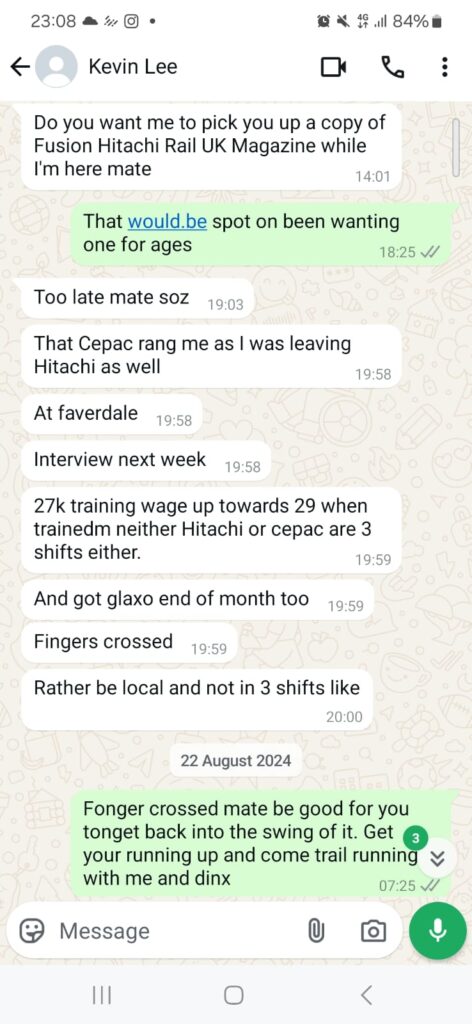
The recipient retained the exchange and later provided a witness statement dated 20 February 2025 confirming its origin and context. Nobody needed a litigation position when I sent it. I had received good news, told a friend and carried on with the day.
Afterward, Page and Cepac replaced the offered interview with an unsuccessful screening exercise. The contemporaneous message did not change. Paperwork has the useful habit of staying sober while the corporate account starts slurring.
Maria Walker Closed The Tab At 09:52
First, at 04:35 on 8 October 2024, I complained directly to Cepac. The email recorded Page’s interview offer, the planned week after the bank holiday, the promised arrangement call, the questions about my work gap and the disclosure that I had received treatment for a mental-health condition.
Then, five hours and seventeen minutes later, Cepac HR Business Partner Maria Walker replied at 09:52. She said Page had completed an initial telephone screening and sent a group of potential candidates’ CVs to Cepac. Walker then supplied the company’s replacement history:
“I can see that your CV was sent to the recruiting manager with a group of potential candidates and unfortunately you were not shortlisted on that occasion.”
Walker maintained that the recruiting manager would not have known about the mental-health information. Her apology concerned Page supposedly failing to tell me that I had not secured an interview. Finally, she promised to send my feedback to the agency “to avoid any future confusion”.
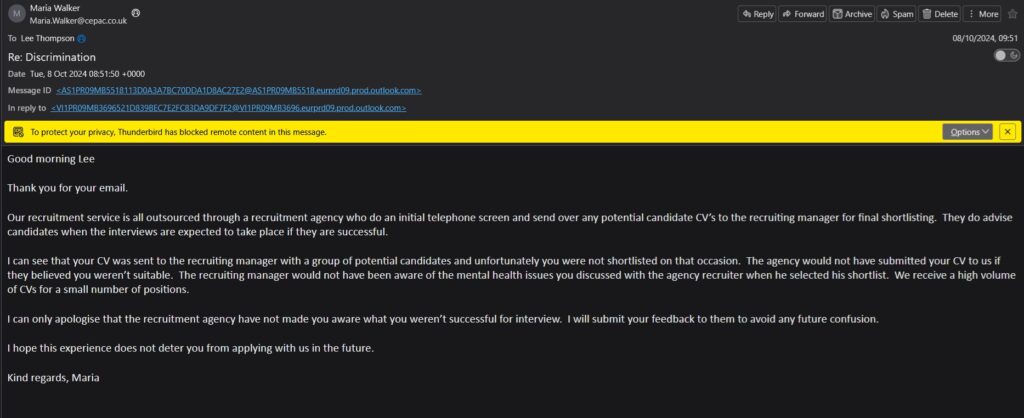
Crucially, Walker had not seen the WhatsApp receipt. Page offered the interview and discussed the money. I disclosed my mental health. The confirmation disappeared. Cepac then converted an offered interview into a failure to shortlist before it knew I had recorded the original outcome that day.
Confusion did not create those timestamps. It merely gave Cepac somewhere polite to pour them away.
The ET3 Put Health Back Into The Glass
Indeed, Cepac’s ET3 later made the account harder to swallow. First, paragraph 12 distances the company from knowledge of my disability. However, paragraph 14 records recruitment information that I had spent around twelve months out of work because of health problems and felt ready to return.
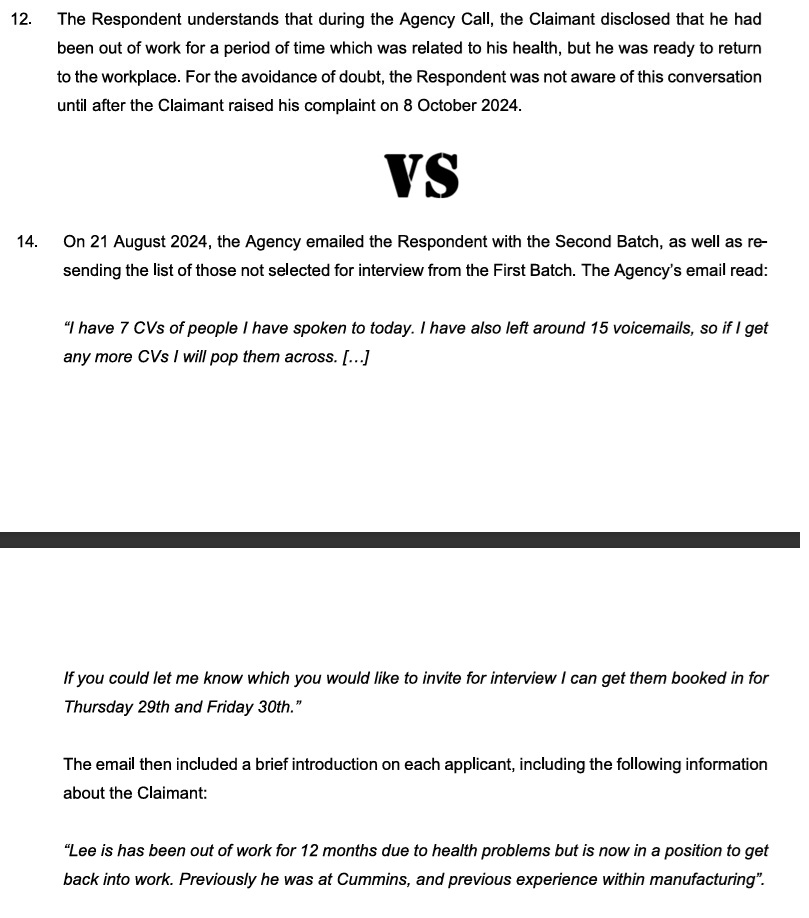
The health information entered the recruitment chain through somebody. Page recorded it, transmitted it or placed it into material that later reached Cepac. Otherwise, Cepac could not have used the information to explain the employment gap inside its own pleaded defence.
Therefore, the ordinary questions remain unanswered. What did Page record during the call? Who could see it? When did the candidate status change? What reached Cepac before Walker answered at 09:52? Where did paragraph 14 come from? Why did the confirmation disappear after Page learned about my mental health?
A merits hearing could have tested each point through disclosure, system records and witnesses. Walker could have explained her review. Page could have produced the call notes and candidate audit trail. Instead, Cepac helped build a route around those questions.
Pernod’s standards require information, risk assessment and investigation. The ET3 supplies a bright red fucking flag with paragraph numbers attached.
Privacy Became Litigation Stock
Moreover, Pernod’s standards require suppliers to respect personal data and privacy rights. Suppliers must follow data-protection law and maintain procedures that demonstrate compliance. By contrast, Cepac’s legal strategy travelled in the opposite direction.
Specifically, I supplied medical evidence to establish disability, document deterioration and explain why safe participation required adjustments. Acting for Cepac, Horsfield Menzies contacted my medical centre, investigated appointment availability and deployed the resulting information against a postponement. The firm maintained that the centre disclosed no private medical information. However, that does not answer why Cepac’s solicitors entered the healthcare relationship at all or why they treated access to treatment as ammunition against moving a hearing.
In addition, Cepac’s side searched my litigation history and collected correspondence, complaints, blog articles and posts on X. Material created while I struggled through documented anxiety, depression and emotional dysregulation under stress became litigation stock. The pressure and medical context then disappeared from the label.
The conversion process was brutally efficient. Apply pressure to a disabled litigant in person. Preserve the distressed response. Remove the disability, vulnerability and institutional failure surrounding it. Present the reaction as free-standing misconduct. Repeat until the claimant appears more dangerous than the evidence he wants tested.
Pernod says privacy rights matter and retaliation is forbidden. Cepac used private medical terrain and disability-related reactions to manufacture an exit from a disability case. The standards and the supplier file could hardly be further apart.
More Than £50,000 For A Legal Attack
In March 2025, Horsfield Menzies estimated Cepac’s costs at £25,000 to £30,000 and offered not to pursue them if the claim disappeared. The recipient was a disabled litigant in person reporting financial hardship, worsening mental health and difficulty participating safely. That was not an invitation to share a convivial drink and discuss continuous improvement. It was a five-figure boot placed beside the claim.
Then the operation expanded. By April 2026, the respondents had assembled roughly 150 communications and blog items plus 181 posts on X around a recruitment dispute that began with one vanished interview. Cepac’s combined costs schedules exceeded £50,000. Meanwhile, the original call, the Walker chronology and the ET3 contradiction remained untested while a 331-item character case occupied the room.
This is where Pernod’s legal-attack clause stops looking theoretical. Cepac did not simply deny discrimination and prepare a conventional merits defence. Through Horsfield Menzies, it pressured me, entered my medical terrain, catalogued the disability-related fallout and used the resulting dossier to argue that no fair hearing could occur.
Ultimately, the strategy worked. As a result, Cepac never had to reconcile the documents in open evidence. It only had to spend enough money turning the person holding them into the procedural emergency.
Pernod prohibits suppliers from contributing to legal attacks against people defending human rights. Cepac supplied the fucking case study and invoiced more than £50,000 for production.
Newcastle Supplied The Escape Route
The institutional machinery appears in full in Newcastle Employment Tribunal : Deep Dive – Deliberate Maladministration, Disability Shaming, Judicial White Knights, Speed-reader Smith And The Horsfield Menzies Feeding Frenzy. Newcastle did not merely make a few administrative mistakes around the edges. It created the conditions in which Cepac’s character case could consume the disability-discrimination claim.
Specifically, the Tribunal directed correspondence to the wrong office, refused to establish an intelligible account of what judges could see and responded to respondent material while claimant applications disappeared into procedural fog. Meanwhile, Employment Judge T. R. Smith said he spent three hours reviewing a 1,941-page file and blamed me as its “principle culprit”. Then, three days before the decisive hearing, Employment Judge Brain refused the postponement required for safe participation.
Finally, Employment Judge James heard the respondents without me on 24 April 2026. He struck out the claims and ordered £20,000 in costs. However, nobody decided whether Page had offered the interview, why the confirmation vanished, what health information moved through the recruitment chain or how Walker’s answer survived the same-day WhatsApp message.
Newcastle supplied the escape lane. Cepac and Horsfield Menzies stocked it with material harvested from a disabled litigant under pressure, then drove the £50,000 legal campaign through before the recruitment evidence reached a merits hearing.
That procedural ending did not clean the supplier file. It demonstrated how effectively the legal attack worked.
Pernod Already Owns The Audit Machinery
Pernod does not need to invent a response. Indeed, its own standards screen supplier profiles, trigger further assessments and permit on-site audits. They require suppliers to notify adverse impacts, assist investigations, provide reasonably requested information and remedy harm fairly and promptly. Consequently, a supplier that refuses prevention or corrective action can lose the business.
First, obtain Page’s call notes, any recording, the candidate-status history and the complete system audit trail. Then obtain everything Walker reviewed before replying at 09:52, the source material behind paragraph 14 and the internal route by which health information travelled through recruitment. Consequently, those records will establish whether the later denial can survive the contemporaneous receipt.
Next, audit the legal attack. Pernod should obtain the medical-centre correspondence, the March 2025 costs threat, the schedules exceeding £50,000 and the material selected for the conduct dossier. It should identify who authorised the strategy, what disability and privacy risks they assessed and whether Cepac ever notified Pernod of the adverse impact or proceedings.
Finally, establish the commercial facts. Which Pernod brands currently use Cepac? What dates cover the work displayed in the 2026 portfolio? Which supplier agreement applies, who completed the risk screening and what did Pernod know when the first article put the ET3 behind the bar on 4 August?
Pernod’s standards promise investigation, information, remedy and consequences. The file is organised. The timestamps are visible. Procurement only needs to stop admiring the displays long enough to open it.
Good Times Need An Answer
The complete sequence now fits on one drinks order. First, Page rang on 21 August 2024, offered an interview, discussed the pay and learned that my employment gap related to my mental health. Then a same-day WhatsApp message preserved the outcome. However, the promised confirmation never came. When I complained, Maria Walker replaced the offer with a failure to shortlist before she knew the receipt existed.
Afterward, Cepac’s ET3 distanced the company from disability knowledge while using health information from the recruitment chain. Horsfield Menzies entered my medical terrain, applied financial and procedural pressure, collected the distressed reactions and helped turn them into the reason nobody should decide the original claim. The respondents’ schedules exceeded £50,000. Newcastle completed the manoeuvre without trying the merits and sent me a £20,000 bill.
Pernod Ricard wrote rules covering disability discrimination in hiring, bullying, retaliation, privacy, adverse-impact reporting, investigation and remedy. Most remarkably, it prohibited suppliers from contributing to legal attacks against human-rights defenders. Cepac appears to have worked through the list like a fucking production schedule.
Meanwhile, Cepac uses Absolut, Jameson, Malibu and Altos work in a portfolio stamped 2026. Pernod’s brands still decorate the supplier’s shop window. The standards now need to enter through the same door.
Pernod can run the audit, publish the conclusion and state the consequence. Otherwise, Good Times from a Good Place is merely another premium label stuck over cheaper contents, while the legal-attack clause sits behind the bar waiting for somebody with the courage to open the bottle.
Lee Thompson – Founder, The Cummins Accountability Project
Source List
- Pernod Ricard : Supplier Standards 2025
- Pernod Ricard : House Of Brands
- Cepac : POS Portfolio 2026
- TCAP : The Cepac Files : Pernod Ricard – Good Times, Dirty Files And Cepac’s Trophy Cabinet
- TCAP : Thirty Trophies, Twelve Pernod Ricard Boxes And Harry Potter’s Missing Fucking Award
- TCAP : The Cepac Files : KFC II – Maria Walker And The Interview Receipt
- TCAP : Newcastle Employment Tribunal : Deep Dive – Deliberate Maladministration
- Employment Tribunal : Thompson v Cepac Limited And Page Outsourcing UK Limited
- TCAP case file: WhatsApp record dated 21 August 2024; email exchange between Lee Thompson and Cepac HR Business Partner Maria Walker dated 8 October 2024; supporting witness statement dated 20 February 2025; Cepac ET3 Grounds of Resistance; respondent costs schedules, submissions and medical-information correspondence.