
Somewhere in corporate Britain, a human resources department has mistaken an uncomfortable opinion for a chemical weapons incident. Somebody has written something objectionable on Facebook. A member of the public has complained. The reputation-management sirens begin screaming, managers abandon their sandwiches and an employment lawyer materialises from the smoke carrying a disciplinary policy like a priest approaching the possessed with a bucket of holy water.
By lunchtime, everybody has agreed that something must be done. Come teatime, somebody may have lost their livelihood. The organisation will naturally describe the operation as protecting its values, which sounds considerably better than admitting that a complaint has frightened the fucking furniture.
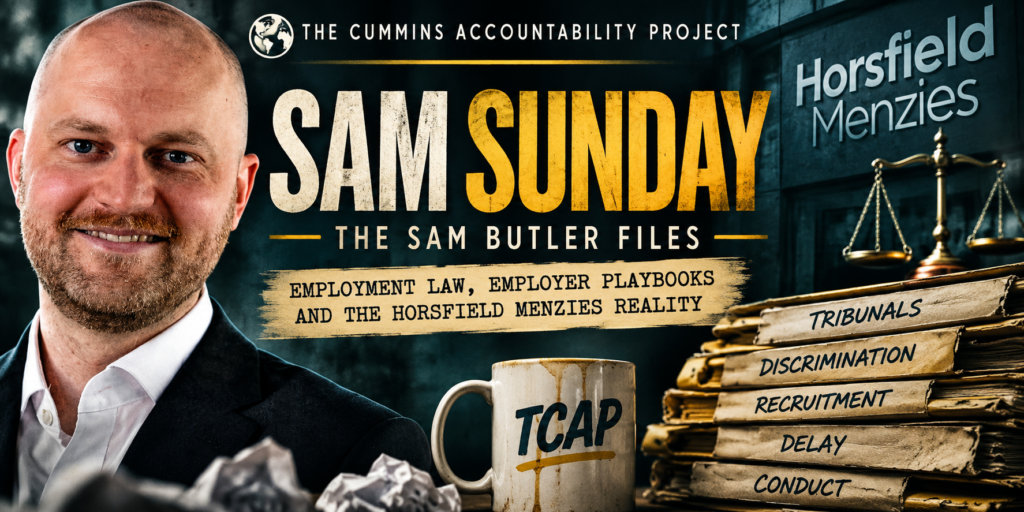
Welcome to Sam Sunday, where we examine the remarkable distance between what employment lawyers publish and what the law actually says. Today’s specimen is Sam Butler, Senior Associate at Horsfield Menzies, whose article Freedom Of Belief In The Workplace appeared on 27 February 2025. Butler examines the Court of Appeal’s decision in Higgs v Farmor’s School, a landmark judgment about religious belief, freedom of expression, dismissal and an employer’s fear of reputational damage.
At first glance, the article looks reassuringly competent. It identifies the successful appeal, recognises the importance of proportionality and tells employers to approach controversial expression carefully. The usual professional apparatus stands around the text: measured language, practical recommendations and enough concern for organisational reputation to make an insurance underwriter achieve spontaneous arousal.
Then somebody opens the judgment.
The Newsletter Meets The Autopsy
What follows is an altogether less comfortable spectacle. Butler’s account muddles an important stage of the appeal, reduces the court’s detailed treatment of reputational risk to an over-simple evidential requirement and introduces an oddly permissive word when explaining whether employers can dismiss people merely for expressing protected beliefs.
The underlying judgment is considerably sharper than the newsletter. It concerns an employee who spent six years working without relevant complaint, posted controversial material on her personal Facebook account and lost her job after one parent objected. Three Court of Appeal judges subsequently agreed that the school had unlawfully discriminated against her by dismissing her.
English employment law survived. The employment relationship did not. Somewhere between those two events, corporate reputation acquired a ceremonial blade and somebody decided to test it on a human neck.
The Panic Room Has Its Own HR Department
Kristie Higgs worked as a pastoral administrator and work experience manager at Farmor’s School in Gloucestershire. In October 2018, she shared Facebook material criticising the teaching of same-sex relationships and gender fluidity in schools. Her views arose from religious convictions, and the posts included language that many readers would reasonably find offensive.
Some of the material contained inflammatory claims about educational programmes and the promotion of certain ideas concerning sex and gender. Higgs reposted material from other writers and supplied additional words of her own. A parent who knew her connection with Farmor’s School complained to the headteacher.
School management investigated the complaint. Higgs faced disciplinary proceedings and, on 7 January 2019, lost her job for gross misconduct.
Any serious examination of this case must distinguish three things: the beliefs themselves, the language in which somebody expresses them and the way that person actually treats others. They are connected, but they are not interchangeable. Holding a protected belief does not provide immunity from employment law, safeguarding responsibilities or the rights of colleagues and pupils. Equally, expressing a controversial belief does not automatically establish that somebody will discriminate against another human being.
When Offence Becomes An Industrial Emergency
That distinction should sit at the centre of any serious account of this case. Instead, much of the surrounding professional debate resembles a malfunctioning airport security system. The machine detects something uncomfortable, an alarm sounds and everybody starts treating the passenger as though they arrived carrying an unexploded fucking artillery shell.
The Court of Appeal’s task was not to decide whether Higgs possessed fashionable opinions. Its responsibility was to determine whether the school could lawfully dismiss her in the actual circumstances.
Those circumstances turned out to matter rather more than the institution’s collective nervous breakdown.
Six Years Of Work Versus One Complaint
Higgs had worked at the school for approximately six years without complaints about the way she treated pupils or staff. Investigators uncovered no evidence that she had promoted her disputed views at work or discriminated against gay or transgender pupils. She maintained that she would treat everybody fairly, regardless of her religious beliefs.
Those facts do not make her Facebook language admirable. The Court of Appeal itself recognised the provocative and objectionable nature of parts of the material. However, an employment decision requires evidence about the employee, the conduct, the context and the actual consequences or foreseeable risks.
Management knew that one parent had complained. Investigators did not establish that Higgs had treated pupils improperly or that her personal opinions had contaminated her professional duties. Nor did the school identify a wider wave of community outrage surrounding the posts.
One complaint can justify an investigation. Depending on the circumstances, it may reveal genuinely serious misconduct. But a complaint does not automatically justify the most severe sanction an employer possesses.
The Public Complaints Guillotine
Otherwise, every organisation would effectively operate a public complaints guillotine. Supply one sufficiently indignant email, pull the cord and watch somebody’s employment contract disappear into the wicker basket. The HR department could then celebrate its commitment to safeguarding, equality and professional standards while somebody from payroll cleaned the fucking blade.
That is not how proportionality works.
The Court of Appeal recognised a distinction between legitimate concern and disproportionate punishment. Farmor’s School was entitled to investigate what had happened. It could not justify dismissal merely by combining offensive wording, speculative reputational concerns and an assumption about how Higgs might behave.
Its evidence required more than a nervous executive pointing towards the internet and shouting that the company’s reputation might catch something unpleasant.
Sam Butler’s Peculiar History Of An Appeal
Before examining the central legal principles, we should deal with something wonderfully avoidable in Butler’s article: his account of the appeal process.
He writes that the Employment Appeal Tribunal granted Higgs permission to appeal in 2023, then describes the case returning to the original Tribunal rather than proceeding on all grounds. There is a problem here, and it has nothing to do with competing philosophical interpretations of religious freedom.
In June 2023, the Employment Appeal Tribunal allowed her appeal. It identified an error in the original Tribunal’s legal approach and ordered the case back for reconsideration on the appropriate basis.
That is materially different from merely granting permission to appeal.
Permission allows an appeal to proceed. Allowing an appeal means the appellate court or tribunal has actually determined that the challenge succeeds, wholly or in part. These are not interchangeable procedural decorations that an employment solicitor can casually throw into a sentence because they both contain the word appeal.
The distinction becomes even more embarrassing when one examines the subsequent chronology. After the successful 2023 EAT appeal, Higgs argued that the EAT should have gone further and determined the discrimination issue itself. She obtained permission to appeal to the Court of Appeal, which ultimately agreed with her in February 2025.
Butler’s article therefore blurs the successful EAT decision with an earlier procedural gateway, while leaving the reader with an unnecessarily muddy account of what the higher courts actually decided.
Perhaps the legal profession should introduce colour-coded labels. Green for permission. Blue for success. Yellow for remittal. A large fucking flashing beacon for occasions when an appellate judgment actually changes the legal result.
The Difference Between Winning And Being Sent Back
The sequence matters because Higgs did not simply involve a succession of courts giving the employee another opportunity to argue her case. In 2023, the EAT identified a legal error but proposed sending the matter back for reconsideration. Two years later, the Court of Appeal decided that another hearing was unnecessary to determine the unlawfulness of the dismissal.
That final distinction is central to the judgment.
The Court of Appeal substituted its own finding of unlawful discrimination in respect of dismissal. The issue of remedy still required resolution, and other elements of the original proceedings had a different procedural status. But the central liability question had received an answer.
This was not merely a recommendation that employers have a thoughtful conversation about social-media policies over a tray of ethically sourced biscuits. The court determined that the school’s treatment of Higgs breached the law.
Butler acknowledges that conclusion. His piece is not a denial of her victory. Nevertheless, reducing the appellate history to a muddled account of permission and rehearing deprives the reader of the actual progression through which the courts corrected the original decision.
An employment lawyer discussing a landmark appeal should be able to explain which appeal succeeded, which court ordered remittal and which court ultimately decided liability.
That is not an impossibly demanding standard. It is the fucking chronology.
The Magical Word: Rarely
Now comes one of the more interesting pieces of language in Butler’s article.
His advice tells employers that dismissing somebody solely for expressing personal beliefs will rarely be justified. As a general warning against rash disciplinary action, the sentiment points in the right direction. But within the context of legally protected religious or philosophical beliefs, the wording is softer than the Court of Appeal’s central proposition.
The judgment establishes that dismissal merely because an employee expresses a protected belief to which the employer or a third party objects constitutes unlawful direct discrimination. A proportionate dismissal may be lawful where the employer responds to an objectively objectionable feature of the expression rather than the protected belief itself.
That distinction matters enormously.
If the reason for dismissal is simply the protected belief or its expression, without an independently justifiable objection to the manner or circumstances, the employer does not possess a mysterious residual entitlement to sack somebody on an exceptional Tuesday.
This case is not about whether employment lawyers feel that particular views deserve an indulgent exception. It concerns whether the employer can establish a legally sufficient reason for its action and demonstrate proportionality where necessary.
The word rarely risks leaving readers with the impression that an employer may occasionally dismiss somebody solely for expressing a protected belief without needing to identify and justify anything objectionable beyond that expression.
No such free-floating exception emerges from Higgs.
It is a small linguistic softening, perhaps only a few keystrokes, but legal advice lives or dies by precisely those distinctions. Otherwise, legislation becomes a box of assorted permissions from which employers can select whichever flavour best suits the immediate emergency.
Belief Is Protected. Conduct Requires An Actual Argument.
The law distinguishes holding a belief from manifesting or expressing it. Articles 9 and 10 of the European Convention on Human Rights protect freedom of religion or belief and freedom of expression, but the rights of expression and manifestation carry qualifications. Restrictions can be lawful where they meet the relevant requirements, including necessity and proportionality.
An employer therefore retains legitimate responsibilities. It can address harassment, discriminatory treatment, threats, intimidation and genuinely unacceptable conduct. Schools must safeguard pupils and maintain an environment in which children can participate without unlawful discrimination.
What an employer cannot do is skip the difficult legal analysis by announcing that somebody’s views conflict with organisational values.
Values are not magical statutory exemptions.
A workplace may genuinely value inclusion, dignity and equal treatment. Those commitments matter. However, a manager still needs to establish what the employee actually said or did, how it affected others, which legal rights arose and whether the proposed response goes further than necessary.
The distinction is especially important when an employer claims that the expression of a protected belief itself creates a reputational problem. An employee’s legal protection does not evaporate because the organisation would prefer not to be associated with controversial opinions.
Butler understands the importance of proportionality and mentions the relevant considerations. Unfortunately, his formulation risks making the governing principle appear more discretionary than the judgment allows.
One might have hoped that a professional explanation of a major discrimination decision would reproduce its controlling distinction with surgical precision.
Instead, we get something resembling a legal skeleton assembled by a man who has misplaced one of the fucking knees.
The Great Reputational Haemorrhage That Hadn’t Happened
Butler’s discussion of reputational damage provides another example of a useful observation that he pushes beyond the precise legal conclusion.
He correctly notes that Farmor’s School had no evidence of actual reputational damage. However, his practical advice suggests that employers need tangible evidence rather than theoretical risks when defending action based on reputational concerns.
The Court of Appeal’s reasoning was more nuanced.
It did not establish a universal rule that an employer must wait until actual reputational harm occurs before responding to a risk. The judgment expressly recognised that private Facebook posts can spread beyond their intended audience and that material published outside work may, in principle, affect an employer’s reputation.
A credible future risk can therefore matter. The question involves the seriousness and likelihood of that risk, the employee’s actual conduct and the proportionality of the employer’s response.
Farmor’s School encountered difficulty because of the particular facts. Higgs used a personal account under her maiden name, did not identify the school and had attracted only one known complaint by the time of her disciplinary hearing. No evidence suggested that her work with pupils reflected discriminatory attitudes.
The court regarded the feared wider circulation as speculative in the circumstances. It also considered whether the school could address the concern through a less intrusive measure than dismissal.
That is considerably more sophisticated than a simple rule requiring proof of existing damage.
Reputation: The Invisible Executive With Veto Powers
Corporate reputation has become a peculiar creature in modern management. It possesses no physical body, cannot suffer bruising and has never personally received an offensive email. Yet employers sometimes treat it like an elderly aristocrat with a heart condition, liable to collapse whenever somebody expresses an unpopular opinion within several miles of the organisation.
The slightest possibility of public embarrassment can trigger meetings, investigations, legal advice and enough managerial correspondence to deforest Luxembourg. Nobody knows whether the public has noticed anything, but everybody agrees that Reputation must receive protection before it develops a fucking temperature.
Of course, genuine reputational harm can be serious. A school relies on parental confidence and has responsibilities towards vulnerable pupils. Employers in regulated sectors may face particularly demanding obligations, while public institutions must preserve trust.
The absurdity begins when the possibility of embarrassment becomes a substitute for examining evidence.
What did the employee actually communicate? Who saw it? Could reasonable readers associate the views with the employer? Did the conduct create a credible risk to colleagues, pupils or service users? Would a warning, clarification or other proportionate measure address the problem?
Those questions require factual answers, not a corporate séance in which management gathers around a conference table and attempts to communicate with the wounded spirit of its brand identity.
The Court of Appeal considered such matters in Higgs. Butler’s shorter treatment gives readers part of the picture, but its broad language about tangible evidence risks obscuring the importance of assessing future risk properly.
An employer need not await a reputational catastrophe. It must, however, justify the action it chooses.
A Private Facebook Account Is Not An Underground Bunker
Higgs published the relevant posts on her personal Facebook account, under her maiden name, to a limited audience. The profile contained no indication that she represented Farmor’s School. Those facts influenced the Court of Appeal’s analysis because they reduced the apparent extent of any reputational risk.
They did not create an absolute right to publish anything without employment consequences.
Butler’s article correctly identifies the personal nature of the posts, although his treatment of private expression could leave readers wanting a fuller explanation of why privacy mattered.
The Court of Appeal expressly refused to treat a personal Facebook account as a complete answer to an employer’s concerns. Information can escape its intended audience, and people who see a private post may know where the author works.
A closed audience does not create a legal force field. Nor does placing the word personal beside a social-media account magically sever every connection between an employee and their professional responsibilities.
The issue requires context.
If somebody makes threatening statements, harasses colleagues or reveals confidential information, the employer may have legitimate grounds to act even when the material appears outside working hours. Conversely, private discussion of a protected belief does not become gross misconduct merely because a third party takes offence.
Farmor’s School had to establish why its particular response was necessary. Its decision failed that test.
The distinction should interest anybody writing employment-law guidance. Unfortunately, nuanced legal analysis tends to photograph rather badly beside a dramatic headline and a convenient four-point checklist.
The fucking law refuses to fit on a motivational coaster.
The Court Wasn’t Holding A Referendum On Gender
The Higgs judgment arose from profoundly contested questions about religion, sex, gender and education. That context matters because the litigation attracted organisations representing different perspectives, including religious bodies, free-expression advocates and the Equality and Human Rights Commission.
The Court of Appeal did not settle those wider cultural disagreements. Nor did it endorse every proposition contained in Higgs’s Facebook posts.
Its job was narrower and legally more demanding: to decide whether an employer’s response to the manifestation of protected beliefs amounted to unlawful discrimination.
That distinction should protect everyone involved. People with religious convictions have legal rights, while gay and transgender people also possess rights to dignity, safety and freedom from unlawful discrimination. Schools cannot simply ignore the welfare of pupils because an employee invokes freedom of belief.
But the reverse proposition matters equally. An employer cannot treat the possibility of offence as conclusive evidence that an employee will discriminate against somebody.
The Court of Appeal looked for an evidential connection between the Facebook material and Higgs’s actual professional conduct. It found no record of discriminatory treatment, no relevant complaint about her work and no persuasive basis for concluding that her views would affect how she treated pupils.
That did not make every word in the posts harmless. Instead, it meant the school could not justify dismissing her on the facts available.
One would think an employment-law profession so thoroughly devoted to balancing rights might appreciate the difference between an argument that offends somebody and conduct that unlawfully harms them.
Apparently, that distinction still requires occasional excavation with a fucking industrial digger.
The Employee Refused To Kiss The Ring
One of the judgment’s more revealing passages concerns the school’s belief that Higgs lacked sufficient insight into the consequences of her posts.
During the disciplinary process, she acknowledged that certain expressions were inappropriate or poorly chosen. However, she did not agree that the underlying beliefs were wrong, and she remained unwilling to condemn every aspect of what she had published.
Management treated that attitude as relevant to the decision to dismiss.
An employer may legitimately consider whether an employee understands serious misconduct or presents a risk of repeating harmful behaviour. But the Court of Appeal warned against turning a refusal to renounce deeply held beliefs into an additional reason for imposing a severe sanction.
The point is significant.
A disciplinary investigation should determine whether misconduct occurred and what response the circumstances justify. It should not automatically become a ceremony of ideological submission in which the employee must confess sufficient moral wrongdoing to satisfy management.
Imagine the arrangement: the employee sits beneath a fluorescent light while three managers examine the minutes. Somebody asks whether she now understands the seriousness of expressing a belief they dislike. She acknowledges the problematic language but declines to abandon her underlying conviction.
A silence follows. The HR representative makes a note. Somewhere in the building, a little brass bell rings to announce that the defendant has failed the fucking repentance examination.
The Court of Appeal recognised that context matters. Refusal to acknowledge wrongdoing may justify concern in some cases, but it cannot mechanically transform an otherwise disproportionate dismissal into a lawful one.
That is a much more demanding principle than simply instructing managers to undertake training and exercise professional judgement.
The Apology Factory Has A Production Problem
Corporate disciplinary culture sometimes treats contrition as evidence of rehabilitation. An employee who apologises appears cooperative, reflective and manageable. Somebody who challenges the premises of the allegation can appear defiant, even where the dispute concerns a genuinely protected belief.
That creates an obvious danger.
An employer might start evaluating the employee’s willingness to agree with management rather than the actual seriousness of the conduct. A person who expresses regret about language while maintaining their beliefs can find that the distinction counts against them.
In Higgs, the Court of Appeal examined precisely that difficulty. Lord Justice Underhill accepted that lack of insight can matter in an appropriate case. However, he refused to let the school use it as a universal mechanism for increasing the seriousness of the alleged misconduct.
This deserves more attention than it receives in Butler’s briefing because it addresses a common feature of workplace disputes: the tendency to confuse disagreement with dangerous intransigence.
A manager does not become an infallible moral authority merely because the disciplinary invitation carries the company’s logo. Employees may be mistaken, offensive, unreasonable or stubborn. Those qualities do not automatically make dismissal lawful.
The legal test remains the legal test.
Otherwise, the entire disciplinary process becomes a compulsory confession booth in which workers can preserve their employment only by admitting that the institution was right all along.
That may prove wonderfully efficient for management. It is also the sort of arrangement that makes an industrial tribunal look suspiciously like a fucking ecclesiastical torture chamber.
The Lesser Sanctions Nobody Could Be Bothered To Love
The Court of Appeal also considered what the school could have done instead of dismissal. One possibility involved issuing a statement explaining that the school had confidence in Higgs’s treatment of pupils, notwithstanding the beliefs she expressed privately.
That matters because proportionality is not an ornamental legal principle. It requires serious consideration of whether a less intrusive response can achieve the employer’s legitimate objective.
Where misconduct genuinely justifies dismissal, the law does not require employers to invent ineffective alternatives. However, the severity of the response must bear a defensible relationship to the conduct and the risks involved.
In this case, the Court of Appeal concluded that dismissal went far beyond what the circumstances could justify.
Farmor’s School had legitimate grounds to investigate the complaint. It could examine whether Higgs had behaved improperly towards pupils, whether the posts created genuine risks and whether intervention was necessary. But the evidence did not support summary dismissal.
Proportionality Is Not An HR Decoration
One might imagine a professional briefing placing that distinction in enormous letters above the employer’s practical recommendations.
An investigation is not a conviction, and reputational anxiety is not a substitute for proportionality.
Instead, Butler’s article offers employers a familiar set of suggestions concerning policies, proportionality, reputational concerns and training.
Those suggestions are not worthless. They simply fail to explore one of the judgment’s darkest institutional lessons: an employer can convince itself that dismissal protects its values while failing to establish why a lesser measure would not suffice.
That is how a managerial concern acquires the shape of a sentence. The organisation fears something might happen, finds the employee insufficiently repentant and reaches for the sharpest fucking instrument available.
Four Questions The Guillotine Cannot Answer
The judgment engages with the proportionality principles familiar from Bank Mellat. They require a decision-maker to examine the importance of the objective, the connection between the measure and that objective, the availability of less intrusive measures and the overall balance between the competing interests.
Those are not four optional reflections to consider while the disciplinary panel waits for its sandwiches.
They provide the structure through which serious restrictions on protected expression must receive scrutiny. An employer cannot justify a severe outcome merely by identifying a legitimate concern and then announcing that dismissal was the most convenient solution.
Consider the difference between an employee whose conduct creates a demonstrated safeguarding problem and somebody whose private expression makes one person uncomfortable. Both situations may warrant examination, but they do not automatically justify identical consequences.
Similarly, a genuinely widespread reputational crisis differs from a speculative concern about what people might think if a private post reaches them.
The facts matter. So does the risk. Crucially, the proposed response must also withstand scrutiny.
Butler recognises proportionality in general terms, yet his article does little to explain the disciplined analysis through which the Court of Appeal reached its conclusion.
That omission does not turn every sentence of his guidance into nonsense. It does, however, make the advice considerably less useful than the underlying judgment for anybody trying to understand the boundaries of lawful disciplinary action.
Employers are left with familiar phrases about tone, context and reputation. The person facing dismissal receives a cheerful reminder that all the relevant factors should receive consideration.
Wonderful. The firing squad has completed its diversity training and somebody has remembered to balance the fucking paperwork.
A Landmark Judgment Reduced To A Management Memo
The strange thing about Butler’s article is that its central conclusion points broadly in the correct direction. He recognises that the school acted disproportionately and that employers must respect legally protected beliefs.
Yet several details weaken the usefulness of the explanation.
The appeal history contains a material procedural error. His wording about dismissal for belief alone softens an otherwise categorical protection in the relevant circumstances. Meanwhile, the discussion of reputational evidence risks presenting an oversimplified rule where the Court of Appeal undertook a detailed assessment of credibility, likelihood and proportionality.
Individually, these issues may look small. Collectively, they illustrate the limitations of compressing a major appellate judgment into a short employer-facing newsletter.
Legal accuracy does not depend solely on reaching the correct headline outcome. It also requires preserving the distinctions that explain why the court reached that outcome.
Otherwise, the reader learns that Higgs won, that employers should be cautious and that reputation must receive appropriate consideration. The actual machinery of the judgment disappears beneath a thick coating of agreeable management advice.
There is a certain professional genius in making an important civil-rights decision sound like a reminder to review the staff handbook.
A woman lost her livelihood. The first Tribunal rejected her claim. Appellate courts then spent years examining the legal principles before the Court of Appeal established that her dismissal constituted unlawful discrimination.
Horsfield Menzies managed to turn that history into another opportunity to recommend manager training.
The fucking PowerPoint must be magnificent.
The Supreme Court Eventually Closed The Gate
There is one subsequent development that Butler could not have included when he published his article in February 2025.
Farmor’s School sought permission to challenge the Court of Appeal’s decision before the Supreme Court. On 4 June 2025, the Supreme Court refused permission. It lacked jurisdiction to entertain the first three proposed grounds, and the fourth raised no arguable question of law.
That refusal did not constitute a fresh Supreme Court judgment endorsing every detail of the Court of Appeal’s reasoning. Permission decisions have a different legal status. Nevertheless, the refusal left the Court of Appeal’s ruling intact.
The central finding of unlawful discrimination therefore survived the school’s attempt to obtain a further appeal.
That matters for anyone revisiting the case now. It is no longer merely a recent decision whose future might depend on whether another appellate court chooses to intervene. The legal outcome on the dismissal issue remains established, although any separate remedy proceedings require their own consideration.
Butler cannot reasonably face criticism for omitting a decision that had not yet happened. The relevant point is what readers can establish today by following the official record.
And the record is awkwardly clear.
The employer invoked reputational concerns, defended its dismissal and lost on the central discrimination issue. The Court of Appeal rejected the proportionality of the sanction. A subsequent attempt to take the matter to the Supreme Court failed at the permission stage.
That is a considerably less comfortable conclusion than another general reminder to review social-media policies.
Sam Sunday: The Reputation Guillotine
There is a magnificent contradiction at the heart of modern corporate reputation management. Institutions spend fortunes persuading the world that they believe in tolerance, inclusion, dignity and freedom of expression. Then an employee expresses something controversial, somebody complains and management begins searching the stationery cupboard for a disciplinary weapon.
The organisation does not necessarily intend to suppress a protected belief. It may sincerely fear harm to colleagues, service users or its reputation. Those concerns can be legitimate, and serious misconduct deserves an appropriate response.
But sincerity is not proportionality.
A manager can believe absolutely that dismissal represents the responsible course while the law establishes that the punishment exceeds anything the evidence justifies. That is why courts exist. Somebody has to examine the facts after management finishes admiring the moral splendour of its own reflection.
The Higgs judgment demonstrates the importance of that scrutiny. It protects the legal distinction between a person’s beliefs, their expression of those beliefs and conduct to which an employer can justifiably object. It also insists that employers examine the actual circumstances before reaching for the most severe sanction.
Sam Butler’s article recognises much of this. Unfortunately, its procedural mistake and over-simplified legal lessons leave several of the judgment’s sharpest edges beneath the table.
The Newsletter That Misplaced The Blade
An employment solicitor has every right to publish a short, accessible summary. Readers should not expect a complete appellate textbook every time a firm updates its website. But accessibility does not require misdescribing a successful appeal, blurring a categorical protection or turning a nuanced reputational assessment into an excessively rigid rule.
The details are the fucking law.
There is a difference between simplifying a complicated judgment and removing distinctions that materially affect its meaning. One helps readers understand the decision. The other risks leaving them with a conveniently rounded version of something the judges took considerable care to explain.
A professional newsletter need not reproduce every paragraph, authority or procedural development. It should, however, preserve the essential facts, identify the controlling principles and avoid overstating what the judgment requires.
Otherwise, what exactly are readers receiving? A legal explanation or an attractively packaged approximation, complete with a reassuring suggestion that somebody should update the employee handbook?
The difference matters because disciplinary decisions have consequences far beyond the administrative convenience of the people making them.
The Blade Comes Down On The Wrong Argument
The greatest danger in cases like Higgs is not that employers will suddenly abandon their safeguarding obligations or permit employees to behave however they wish. Those duties remain, and the courts have not abolished the consequences of genuinely unlawful or harmful conduct.
Instead, the danger is that employers may confuse disagreement, offence and reputational anxiety with sufficient grounds for disciplinary punishment.
When that happens, managers stop investigating what somebody has actually done and begin investigating what somebody else might think about it. The employee’s professional record becomes secondary. Speculative future embarrassment acquires greater weight than demonstrated behaviour. A refusal to confess ideological wrongdoing starts looking like an additional disciplinary offence.
Eventually, the employer concludes that dismissal will protect the institution from an uncertain future catastrophe.
The guillotine drops. Corporate reputation survives. Years later, the Court of Appeal arrives with the unpleasant news that the mechanism was unlawful.
The Verdict Nobody Could Fit On A PowerPoint
That is the story Butler’s article ought to make impossible to misunderstand.
Instead, we find ourselves examining professional commentary that reaches the right broad conclusion while fumbling parts of the reasoning that make the decision important.
Perhaps the next Horsfield Menzies briefing should begin with a modest suggestion: before explaining how employers must interpret landmark cases, make absolutely certain the fucking appellate history is correct.
Then read the paragraphs about what the court actually required, rather than settling for the headline, the management-friendly summary or the comforting fragments that fit neatly into a newsletter.
The judgment matters because a person’s livelihood is not a disposable accessory to somebody else’s reputation, and the Equality Act does not contain an emergency exception for organisations experiencing an attack of the corporate vapours.
Judges examined the evidence. The school’s dismissal failed. Nobody needed to establish that Higgs possessed popular opinions before recognising the legal protection available to her.
And Sam Butler, having informed employers that freedom of belief matters, left several of the reasons why it matters in need of an editorial rescue operation.
What a fucking sermon.
SAM SUNDAY. THE REPUTATION SURVIVED. THE DISMISSAL DIDN’T.
Lee Thompson – Founder, The Cummins Accountability Project
Sources
- Horsfield Menzies – Sam Butler: Freedom Of Belief In The Workplace
- The National Archives – Higgs v Farmor’s School, [2025] EWCA Civ 109, full Court of Appeal judgment
- UK Supreme Court – Higgs v Farmor’s School, permission to appeal refused
- Equality Act 2010 – Section 13: Direct Discrimination
- Equality Act 2010 – Section 10: Religion Or Belief
- Bates Wells – Navigating The Expression Of Protected Beliefs And Social Media Use