
Somewhere inside the employment-law industry, beneath the motivational slogans, artificial plants and professionally laminated expressions of concern, there exists a magnificent machine for turning human misery into corporate enlightenment. Feed it an exhausted worker and out comes a wellbeing strategy. Introduce somebody struggling with disability and the machine produces a diversity statement. Supply an applicant who believes a promised interview vanished after disclosing a mental-health condition, and the resulting litigation can acquire enough paperwork to suffocate a fucking rhinoceros.
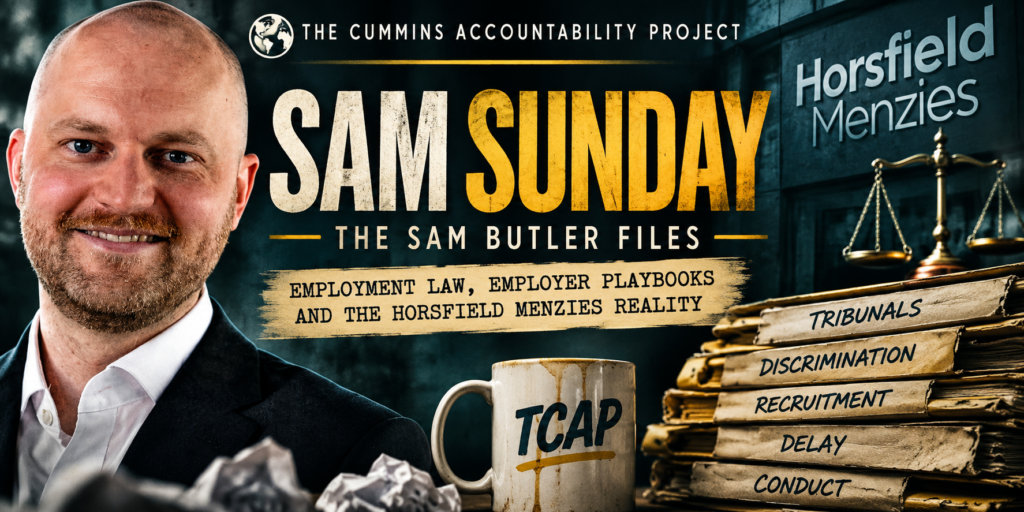
Welcome back to Sam Sunday. Today’s attraction is Sam Butler of Horsfield Menzies, who has discovered that employees increasingly value flexibility, autonomy and decent treatment. His article The Great Trade-Off: Are Employees Choosing Balance Over Pay?, published on 24 March 2026, offers employers a cheerful examination of changing workplace expectations. Apparently, modern workers want more than money. They also want employers to communicate properly, support their wellbeing and treat them as human beings rather than disposable fittings in the corporate machinery.
Revolutionary stuff. Next week, Sam may investigate whether applicants enjoy being telephoned when somebody promises to telephone them.
The problem for Butler is that his professional writing now shares an internet connection with the Cepac Employment Tribunal record. One explains the importance of transparent recruitment. The other concerns a disputed interview offer, a contemporaneous WhatsApp message, a disclosure about mental health and a recruitment process that never produced the expected confirmation. Horsfield Menzies represented Cepac in the resulting proceedings.
Nobody needs to invent a contradiction between those two worlds. The contrast sits there, grinning like a corpse somebody has forgotten to remove from the staff wellbeing seminar.
The Great Trade-Off Arrives Wearing A Lovely Suit
Butler opens with a statistic supplied by CharityJob. According to its research involving more than 2,800 jobseekers, 87% of respondents would consider accepting less pay in exchange for better work-life balance and flexibility. From this, Sam develops an argument about changing employee expectations, hybrid working, autonomy, recruitment communication and the importance of building workplaces people actually want to join.
Much of the underlying argument makes sense. Employees have lives beyond work, burnout damages people and employers cannot expect to retain everybody merely by waving a salary figure above a permanently understaffed department. Flexible working can improve retention and wellbeing, while poor management can turn even an attractive job into a dreary exercise in institutional self-harm.
Unfortunately, the employment-law brochure never seems quite as enchanting once actual human beings start arriving with inconvenient circumstances.
Butler’s article operates in the beautifully sanitised environment of professional HR commentary. Here, employers possess the ability to develop enlightened policies, managers eagerly embrace autonomy and applicants glide between opportunities according to their lifestyle preferences. Everybody has a choice. Everybody has an opinion about hybrid working. Somewhere in the background, a perfectly balanced workforce floats through a sunlit office while a diversity officer waters the fucking peace lilies.
It is an agreeable little universe. The trouble begins when somebody asks what happens to applicants who need more than an attractive workplace proposition.
Eighty-Seven Per Cent And The Missing Small Print
Before we examine recruitment, there is an important statistical distinction worth extracting from Butler’s opening argument. His cited figure concerns people who said they would consider a lower-paying job in exchange for greater flexibility. That does not establish that 87% actually accepted a pay reduction, nor does it demonstrate that salary has ceased to matter to most British workers.
The survey comes from CharityJob, a specialist recruitment platform serving the charity sector. Its findings deserve attention, but they do not automatically represent every occupation or industry in Britain. A charity-sector applicant considering hybrid working occupies a different employment market from somebody applying for a production job at a packaging factory. Shift work, physical duties and operational requirements can place entirely different constraints on what flexibility means in practice.
Yet the professional commentary quickly expands towards sweeping conclusions about modern employees and the relative importance of salary. A hypothetical preference becomes evidence of a transformed labour market, and a specific sample starts doing the rhetorical work of the entire British workforce.
This is not some catastrophic mathematical fraud. It is the familiar little trick by which consultancy prose acquires authority: introduce a large percentage, remove a few inconvenient qualifications and let the fucking number march into the boardroom wearing a general’s uniform.
The better question is not whether people enjoy flexibility. Of course they do. It is whether employers genuinely understand the needs of different applicants, particularly when those needs arise from disability rather than lifestyle preference.
That question leads somewhere considerably less comfortable for Horsfield Menzies.
The Number Sam Didn’t Put In The Shop Window
CharityJob’s underlying research contains another finding worth examining. Its published analysis identifies a respectful and inclusive workplace as the leading consideration for many applicants, with 72% selecting it as important when considering a role. Positive management and employee autonomy also feature prominently, while the research discusses how communication and workplace culture influence people’s decisions.
Now that is interesting.
Butler chose to build his article around the commercial implications of flexibility, balance and employee expectations. There is nothing inherently improper about that editorial choice. Nevertheless, the underlying research also provides a powerful argument about respect, inclusion and the quality of an employer’s dealings with potential recruits.
For an employment lawyer, those considerations should be familiar territory. They are not merely decorative additions to a recruitment brochure. Fair treatment matters before somebody becomes an employee, before payroll processes their details and before the welcome pack arrives with its complimentary ballpoint pen and inspirational bullshit.
An applicant’s experience begins with the recruitment process itself. That process includes communication, accurate information, clear expectations and compliance with discrimination law.
It is possible to offer magnificent flexible-working arrangements and still treat an applicant badly before they ever receive the opportunity to discuss them. A company can possess the most enlightened wellbeing policy in the county while its recruitment practices produce unanswered questions about disability, candidate selection and the handling of sensitive information.
The brochure describes the hotel. The applicant experiences the reception desk.
If the receptionist sends you towards a room that doesn’t exist, the fucking pillow menu becomes rather less important.
Page Outsourcing Offered Me A Different Kind Of Trade
On 21 August 2024, Page Outsourcing telephoned me concerning a production position at Cepac. During that conversation, I say the recruiter offered me an interview for the week after the August bank holiday. We discussed a training salary of approximately £27,000, progressing towards £29,000, and the recruiter asked about the substantial gap in my employment history.
I explained that the gap related to treatment for my mental health.
The recruiter indicated that my details would go forward and that somebody would telephone again to confirm an exact, mutually agreeable interview time. Nothing about the exchange suggested that I had entered a competition for the most elaborate employment-law dispute in northern England. I believed I had progressed towards an interview for a job.
A contemporaneous WhatsApp conversation recorded my understanding of what had happened. On 21 August, I told somebody “Interview next week” and “27k training wage up towards 29”. The recipient subsequently provided a witness statement confirming the conversation’s origin and context.
That WhatsApp record does not contain an audio recording of Page’s telephone call. It does, however, establish that I communicated my understanding of the interview and salary on the very day the conversation occurred, before any complaint, ACAS process or Tribunal claim existed.
The expected confirmation never arrived.
What followed was not a discussion about remote working, flexible shifts or whether I fancied sacrificing a little salary for an additional afternoon in the garden. The process simply stopped progressing in the way I had understood the recruiter to describe.
That was my great trade-off. I supplied my employment history, disclosed a sensitive personal circumstance and waited for the interview confirmation. In return, I received precisely fuck-all.
Recruitment Transparency, Now With A Trapdoor
Butler’s March 2026 article acknowledges that some employers fail to communicate effectively during recruitment. He describes that failure as “a major barrier in recruitment” and encourages organisations to think carefully about how they explain working arrangements to candidates.
He is discussing flexibility rather than every conceivable form of recruitment correspondence. That distinction matters. However, the wider principle of clear communication does not stop being relevant because somebody has moved beyond the subject of hybrid working.
Consider what an applicant reasonably needs to know. Has the employer shortlisted them? Has somebody offered an interview? Who will confirm the arrangements? Does an agency speak for the employer, or merely recommend candidates? What happens when the agency and candidate subsequently give different accounts of the conversation?
These are not questions requiring artificial intelligence, advanced behavioural psychology or a £900-a-day management consultant. They form the basic plumbing of a functioning recruitment process.
Yet my experience produced a disputed interview offer and a missing confirmation. Page and Cepac later denied that an interview had been offered. I maintained that it had, and the same-day WhatsApp supplied independent documentary support for my account of what I understood at the time.
A proper examination could have compared Page’s notes, candidate records, communications and witness evidence. Instead, the disagreement eventually became part of litigation that never reached a completed merits hearing.
Butler wants employers to communicate their attractive working arrangements effectively. Splendid. Some applicants would appreciate establishing whether they have an interview in the first fucking place.
Maria Walker Enters The Recruitment Showroom
On 8 October 2024, I contacted Cepac directly to complain about what had happened. My email explained that Page had offered an interview after the August bank holiday, discussed the gap in my employment history and learned about my mental-health treatment. I described the missing follow-up and raised concerns about disability discrimination.
Cepac HR Business Partner Maria Walker replied that morning. She explained that Page conducted the initial telephone screening before forwarding suitable candidates to Cepac. According to her account, my CV had reached the recruiting manager, but I had not made the shortlist.
Walker said the manager had not known about the mental-health information I had discussed with Page. She also apologised because the agency had apparently failed to tell me that I had not secured an interview.
There it was: a complete alternative explanation, presented before the company had seen the contemporaneous WhatsApp record.
From Cepac’s perspective, the process had not involved a promised interview that subsequently disappeared. It had involved an unsuccessful applicant whom Page had failed to notify appropriately. Those are materially different accounts, and the difference goes directly to the recruitment dispute.
Perhaps Page communicated ambiguously. Perhaps the recruiter anticipated an interview that Cepac had not yet authorised. Alternatively, the conversation happened as I described and the later response failed to account for it.
An evidential hearing could have tested those possibilities.
Butler’s glossy world of recruitment communication suddenly encounters a rather ugly administrative problem: the candidate and employer cannot even agree on which stage of the process the candidate reached.
That is not a minor disagreement about the quality of the office biscuits. It is the fucking foundation of the recruitment record.
The Follow-Up Wasn’t The Only Thing Missing
Maria Walker’s response also raises an obvious question about the handling of information. Page had learned about my mental-health-related employment gap. Cepac later maintained that the recruiting manager lacked the relevant knowledge. The evidence therefore needed to establish what Page recorded, what it passed onwards and precisely who could access the information.
The answer matters because recruitment agencies do not operate in some magical jurisdiction where information loses all legal significance the moment somebody forwards a CV. Employers and agencies have responsibilities under discrimination law, and the recruitment arrangements themselves can form part of an unlawful discriminatory process.
That does not mean an employer becomes automatically liable whenever an agency makes a mistake. Nor does disclosure of a health condition establish discrimination simply because the applicant subsequently receives disappointing news.
It means the chronology deserves proper investigation.
What did Page record during the screening call? Did the recruiter distinguish an interview offer from a recommendation for shortlisting? Who made the relevant selection decision? What information accompanied the candidate introduction? When did the employer receive it?
One might imagine that an organisation operating a recruitment process would consider those records reasonably important.
Apparently, however, the legal profession can produce several hundred pages concerning the personality of an unsuccessful applicant while the original telephone conversation remains an unresolved fucking archaeological site.
The contrast would be funny if the underlying issue had not consumed so much time, money and procedural energy.
Paragraph Twelve Meets Paragraph Fourteen
Cepac’s Grounds of Resistance created a further documentary question. Paragraph 12 sought to distance the company from knowledge of the relevant health-related conversation before my October complaint. Yet paragraph 14 described candidate information that Page had sent Cepac on 21 August 2024.
That introduction referred to my period outside employment because of health problems and indicated that I felt ready to return to work.
The distinction needs careful handling. General knowledge that somebody had experienced health problems does not necessarily establish knowledge of a legally recognised disability, much less prove discriminatory intent. Furthermore, a later legal pleading may contain information that a particular recruiting manager did not personally review before making a decision.
Nevertheless, the two paragraphs identify an evidential problem that deserves an answer.
Page’s August introduction placed health-related information somewhere inside the recruitment chain. Cepac’s later position sought to limit what the company knew and when it knew it. The relevant records could establish who received the introduction, who accessed it and what information reached the person responsible for shortlisting.
That is not a question about whether everybody involved was sufficiently nice. It concerns dates, recipients, records and knowledge.
Butler’s professional article talks about the importance of clarity in recruitment. The Cepac documentation presents a route of information that remains worth examining long after the recruitment decision itself.
Somewhere between paragraph 12 and paragraph 14 sits the unglamorous work of establishing exactly what happened.
No scented wellbeing candle is going to do that fucking job.
The Law Doesn’t Offer Disability Rights As A Salary Upgrade
There is a deeper weakness in the commercial framing of workplace flexibility. Butler presents flexibility primarily as something employees increasingly value and employers can offer to attract and retain talent.
That makes sense when discussing optional working arrangements, subject to the practical requirements of particular roles. However, disability-related accessibility occupies a different legal territory. Reasonable adjustments are not simply benefits that employers may offer in exchange for a competitive advantage or a lower salary.
The Equality Act 2010 places duties on employers and provides protection against discrimination during recruitment. Section 39 addresses discrimination in the arrangements for deciding whom to employ, while section 60 restricts pre-employment enquiries about disability and health, subject to specific exceptions.
An ordinary question about an employment gap does not automatically breach section 60. Whether subsequent health-related enquiries were permissible depends on the actual questions, their purpose and the circumstances. My case also required evidence about what Page knew, what Cepac knew and how the information affected the process, if at all.
Nevertheless, the law recognises something that recruitment marketing can conveniently obscure: disabled applicants are not merely consumers expressing preferences about the quality of their prospective workplace.
They possess enforceable rights.
An employer cannot answer a properly established discrimination allegation by pointing proudly towards its flexible-working policy, any more than a restaurant can excuse food poisoning by boasting about the fucking wallpaper.
The decorative elements do not replace the legal obligations.
When Flexibility Stops Being A Lifestyle Choice
The distinction becomes clearer when we consider why different people seek flexibility. One applicant might prefer home working because they enjoy avoiding a commute. Another may need an adjustment because a disability makes conventional working arrangements substantially disadvantageous. Both could benefit from flexibility, but their circumstances engage different considerations.
A worker balancing childcare responsibilities, an employee managing a long-term condition and somebody simply wanting Friday afternoons free may all welcome changes to working hours. Their preferences, legal protections and practical needs do not necessarily operate on identical terms.
Butler’s article explores the attraction and retention advantages of understanding those needs. However, the harder question involves an employer’s treatment of applicants whose circumstances make recruitment inconvenient before they even join the payroll.
Such applicants cannot always package their difficulties as attractive lifestyle choices. Their needs may fluctuate, their employment histories may contain gaps and their explanations may involve matters they would prefer to keep private.
That is when an inclusive recruitment culture has to do something more demanding than display the word wellbeing above a photograph of a woman laughing at a laptop.
It has to function.
In my case, the disclosed information concerned mental-health treatment, and the dispute arose before anybody reached the stage of negotiating practical working arrangements. I was not bargaining away salary in exchange for an additional afternoon at home.
I was trying to obtain the interview I believed somebody had offered.
The distinction is rather fucking enormous.
The Employment Brand And The Reality Beneath It
Butler tells employers that organisations offering genuine flexibility, wellbeing support and autonomy can strengthen engagement, retention and their reputation in the recruitment market. Again, there is a coherent commercial argument behind the prose. Treat people well and they may want to work for you. A revelation of such intellectual magnitude that one almost expects somebody to notify the Nobel committee.
Yet an employer brand does not exist independently of the employer’s actual conduct.
Recruitment advertisements, policy statements and professional commentary establish expectations. Applicants then test those expectations against what happens when they encounter the organisation. If the published promises and the practical experience diverge, the marketing department cannot resolve that difference by increasing the font size.
Consider the original Cepac recruitment dispute from that perspective. Page supplied a screening process, Cepac supplied the vacancy and the applicant supplied the relevant personal information. The parties subsequently disputed what the recruiter had promised and what information the company possessed.
That sequence does not prove unlawful discrimination. It does, however, expose the importance of the very communication and recruitment integrity Butler discusses.
A genuinely transparent process should be capable of explaining its decisions through records and coherent accounts. Where the parties disagree, it should provide evidence that allows somebody independent to determine which version is correct.
Instead, the Cepac dispute eventually generated a sprawling procedural contest that ended without the recruitment allegations receiving a completed merits determination.
The employer brand survived. The factual question remained.
What a marvellous return on the fucking marketing investment.
The Applicant Became The Problem
The subsequent litigation took the dispute into considerably darker territory. Medical evidence, procedural disagreement, costs pressure, extensive correspondence and public commentary all became increasingly prominent. By March 2026, a judge referred to a Tribunal file containing approximately 1,941 pages.
The original recruitment event had occupied a single telephone conversation.
That difference matters because the longer litigation continued, the more the parties argued about my conduct, correspondence, hearing participation and publications. The original question about the Page recruitment process remained important, but increasingly found itself competing with a growing collection of disputes about what I had said and done after bringing the claim.
On 24 April 2026, the Tribunal proceeded with the decisive hearing in my absence. Employment Judge James subsequently struck out the claims and awarded £20,000 in costs to Cepac. The judgment concluded that my conduct made a fair hearing impossible. I dispute that conclusion and the procedural circumstances surrounding it.
The respondents were entitled to raise legitimate concerns about conduct and seek remedies available under the Tribunal rules. The judgment also made serious findings against me. Those matters cannot simply vanish because I disagree with them.
But the ruling did not determine whether Page had offered the interview, whether the recruitment process involved disability discrimination or exactly what information reached the relevant decision-makers in August 2024.
That is the procedural distinction beneath the spectacle.
The applicant became the central subject of the litigation, while the underlying recruitment dispute never received the completed factual examination it required.
Butler’s article presents recruitment as a process through which employers should understand people better.
The Cepac proceedings ended with far more judicial discussion about the applicant’s behaviour than about the disputed interview itself.
Somewhere in that transformation, the fucking job disappeared entirely.
The Choice Nobody Offered
The great trade-off imagined by Butler assumes a degree of choice. An employee considers money, flexibility, autonomy, wellbeing and career prospects, then decides which combination best suits their circumstances.
For many people, that is a reasonable description of how employment decisions work. But choice depends on access to opportunity. Somebody who never reaches a disputed interview stage cannot meaningfully negotiate their preferred working arrangements. A candidate who believes an interview vanished after a health disclosure may instead find themselves asking whether the recruitment process treated them lawfully.
That is a fundamentally different question.
The CharityJob research also makes the wider picture rather more interesting than a simple salary-versus-flexibility contest. Respondents expressed strong preferences for respect, inclusion, good management and communication. Those priorities concern how organisations treat people, not merely which benefits accompany their employment contracts.
By extracting the salary and flexibility theme, Butler identifies an employer-friendly commercial opportunity. Organisations that understand changing preferences may recruit more effectively and improve retention.
Fine. Let the employers enjoy their competitive advantages. Nobody objects to companies becoming better places to work.
But the moral test does not arrive when a comfortable applicant chooses between two attractive offers. It arrives when the person standing at the recruitment desk has something inconvenient to disclose, a gap in their work history or a condition that does not fit neatly into the brochure.
A company that genuinely values inclusion must deal fairly with that person too.
Otherwise, the great trade-off becomes rather simple: the applicant supplies their vulnerability, the company retains its discretion and the professional advisers explain why everybody should concentrate on the benefits of a happier workforce.
The fucking applicant can apparently take their chances.
Sam Butler’s Missing Interview Department
It would be unfair to suggest that Butler personally conducted my August 2024 recruitment call. He did not. Page Outsourcing handled that conversation, and Cepac was the prospective employer. His March 2026 article also appeared well after the underlying recruitment events.
The comparison concerns his published professional principles and the conduct of a dispute in which his firm represented Cepac. That is the foundation of this instalment, not an invented allegation that Butler personally made the recruitment decision.
Indeed, the distinction makes the editorial comparison considerably stronger. An employment solicitor can give sound general advice while defending a client whose conduct somebody disputes. Representation does not establish personal responsibility for everything a client may have done.
But neither does it place the solicitor’s professional commentary beyond examination.
When Horsfield Menzies publishes advice about clearer recruitment communication and better employee wellbeing, readers are entitled to compare those principles with the firm’s approach to disputes involving precisely those subjects.
The legal profession is not a monastery whose sacred teachings become immune from scrutiny whenever a paying client enters the confessional.
The brochures are public. The articles carry names. The litigation record exists. TCAP is perfectly entitled to bring the material together and ask what the contrast reveals.
And what a contrast.
On one side stands a polished discussion of attractive employment practices, informed by research into flexibility and workplace values. On the other sits an actual candidate, a disputed interview offer, a documented contemporaneous expectation, sensitive health information and a legal process that ended without determining the underlying recruitment allegations.
Perhaps the people preparing the next Horsfield Menzies recruitment newsletter could spare a little space for that.
A small sidebar would do.
HOW TO COMMUNICATE WITH APPLICANTS: FIRST, ACTUALLY FUCKING COMMUNICATE.
The Most Expensive Non-Interview In The Room
There is something grotesquely disproportionate about the eventual result. A recruitment dispute involving an expected interview and a training salary of approximately £27,000 developed into litigation through which Cepac eventually obtained a £20,000 costs order.
That figure does not establish that the employer acted unlawfully or that its defence lacked merit. Nor does the cost of litigation prove that the parties should have resolved the case through a particular procedure. Employment disputes can become expensive for reasons unrelated to the strength of the underlying claim.
Nevertheless, the comparison reveals the extraordinary distance between the original recruitment event and the final procedural outcome.
One telephone conversation. One expected interview. A disputed explanation about shortlisting. Health information entering the recruitment chain. Years later, the argument had expanded into medical evidence, extensive bundles, public commentary, witness concerns, conduct findings and a substantial costs award.
The original question remained without a merits determination.
Butler’s article concerns employers attracting people through a better understanding of what candidates value. My dispute concerned something rather more basic: understanding what the recruiter actually said, what the employer subsequently knew and why the anticipated interview arrangements never materialised.
The machinery eventually produced a judgment. It did not produce the answer to those recruitment questions.
One might call that an unfortunate outcome. TCAP prefers to note that the British employment-law industry has apparently discovered how to turn a vanished interview into an administrative monument large enough to blot out the fucking sun.
The Great Trade-Off Was Never About The Money
Butler ends his article by arguing that organisations that respond to changing employee expectations can attract stronger candidates, improve engagement and retain people they cannot afford to lose.
It is an attractive conclusion. Respect people, communicate properly, support wellbeing and create working arrangements that recognise employees have lives outside the workplace. A genuinely decent employer should not need an expensive consultancy exercise to discover these principles, but nobody ever went bankrupt selling obvious truths to people in expensive suits.
The difficulty emerges when corporate enlightenment encounters an individual whose circumstances require actual care.
It is easy to celebrate employee autonomy when the employee is hypothetical. Simple enough to praise inclusive recruitment when the applicant exists only as a demographic category. Beautifully convenient to discuss wellbeing when nobody has to examine a disputed conversation involving disclosure of a mental-health condition.
Real people complicate the sales pitch. They bring evidence, ask questions, challenge decisions and occasionally refuse to accept an explanation that conflicts with their recollection and contemporaneous records.
My Cepac dispute raised precisely those uncomfortable questions. The WhatsApp record supports the account I gave at the time. Maria Walker supplied a different explanation in October 2024. Cepac’s subsequent pleading introduced further questions about the route of health information through the recruitment process.
None of those documents, individually or collectively, automatically proves discrimination. Together, they establish a factual dispute that deserved examination.
The Tribunal never completed that examination.
Sam Butler can write another thousand words about recruitment expectations. Horsfield Menzies can publish a hundred more articles about workplace values. Employers can commission surveys, redesign benefits packages and produce enough wellbeing graphics to wallpaper the entire fucking country.
The original question will remain stubbornly uncomplicated.
What happened to the interview?
Sam Sunday: The Final Trade-Off
There is a special kind of darkness in an industry that knows precisely how to describe human dignity while remaining comfortable with the commercial machinery surrounding its disputes. The language is immaculate. The values are reassuring. Every paragraph smells faintly of fresh coffee, ergonomic furniture and the desperate need to reassure paying clients that the future of work remains an exciting opportunity.
Then somebody opens the underlying case file.
Suddenly, the soft furnishings disappear. There is no attractive lifestyle package, no discussion of employee autonomy and no opportunity to negotiate flexibility. Just a recruitment conversation whose meaning the parties dispute, a mental-health disclosure, a missing confirmation and an unresolved question that litigation never answered.
Butler is entitled to defend the profession’s role in advising employers. His client was entitled to contest the allegations. The Tribunal reached its own conclusions about my conduct, and those conclusions form part of the public record.
None of that prevents TCAP examining the distance between the principles Horsfield Menzies publishes and the questions its litigation left unanswered.
The irony is not that Sam Butler believes flexibility and inclusion matter. On those general principles, he may be perfectly right.
It is that the professional commentary presents a world in which employers increasingly compete to accommodate human needs, while my own experience of the recruitment and litigation process raises a much colder question about whether those needs received fair consideration at all.
The great trade-off was never simply about salary.
It was about what happens when somebody enters a recruitment process carrying information the employer may find inconvenient, then tries to establish what happened after disclosing it.
I wanted an interview. Page and Cepac disputed whether anybody had offered one. The documentary record contains questions that a completed merits hearing could have addressed.
Instead, the case ended through strike-out, and I left the process with a £20,000 costs order.
Meanwhile, Sam Butler was busy explaining how employers could attract people by recognising their expectations and communicating properly.
What a beautifully fucked-up little arrangement.
The applicant wanted a chance to work. The legal process generated an enormous fight over his conduct. The recruitment allegations remained undecided, and the employment-law commentary continued floating above the wreckage like a corporate air freshener over an industrial waste pit.
SAM SUNDAY. FLEXIBILITY FOR THE BROCHURE. SILENCE AT THE RECRUITMENT DESK.
Lee Thompson – Founder, The Cummins Accountability Project
Sources
- Horsfield Menzies – Sam Butler: The Great Trade-Off – Are Employees Choosing Balance Over Pay?
- CharityJob – Expectations And Values At Work: A Generational View 2026
- CharityJob – What Each Generation Wants From Work
- Equality Act 2010 – Section 39: Employees And Applicants
- Equality Act 2010 – Section 60: Enquiries About Disability And Health
- ACAS – Following Discrimination Law During Recruitment
- ACAS – Reasonable Adjustments In Recruitment
- TCAP – Horsfield Menzies: Sam Butler And The Equality Clock
- TCAP – KFC, Cepac, The WhatsApp Evidence And Maria Walker’s Interview Denial
- TCAP – Natures Aid, Cepac And STADA’s Supplier Care Test
- TCAP – Daniel Rubin: Recruitment Ethics Expire At The Client Door