
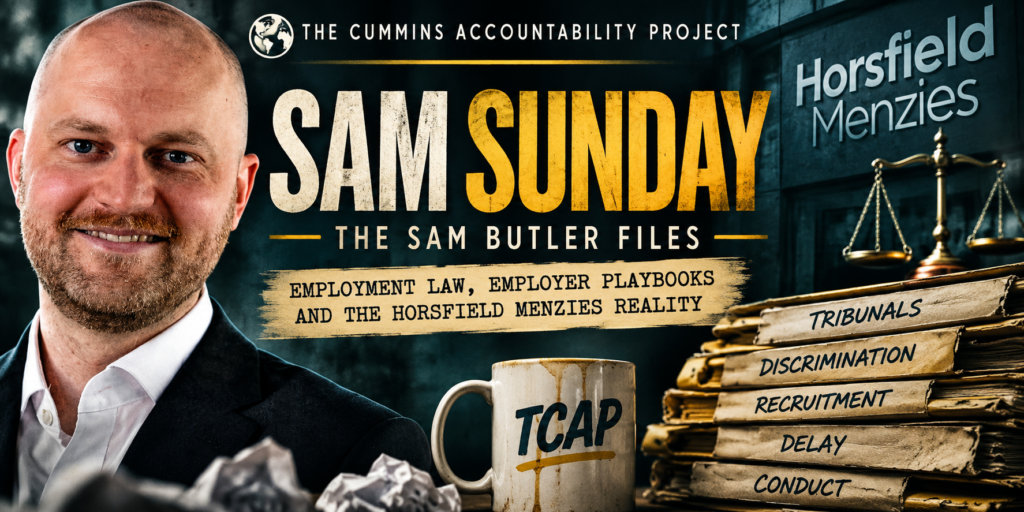
There is a particular species of professional optimism that only flourishes around institutional decay. Hospitals run out of beds, schools run out of teachers, courts run out of judges, and somewhere in the wreckage a consultant discovers an exciting new opportunity to improve operational efficiency. The building is on fire, the occupants are coughing up their lungs, and some enterprising bastard is measuring the space for a coffee franchise. Welcome to Sam Sunday, where the Sunday sermon comes from Horsfield Menzies and the congregation gets to admire the commercial possibilities of a justice system slowly choking on its own paperwork.
Our inaugural preacher is Sam Butler, Senior Associate at Horsfield Menzies, whose article Backlogged And Breaking Point appeared on 30 May 2025. The subject was the Employment Tribunal crisis: enormous backlogs, overstretched courts, disappearing judicial capacity and the extraordinary length of time ordinary people must wait to have their employment disputes determined. Butler recognised the human cost. He acknowledged that claimants were withdrawing under emotional and financial pressure. Then he turned towards the employers, opened another section of his article and discovered something rather more encouraging.
He called it “Strategic Opportunity”. Well, fuck me sideways. The Tribunal is apparently a morgue with a business-development department.
The Casualty Figures Look Excellent From Here
Butler begins with a numerical autopsy. He reports approximately 49,800 outstanding Employment Tribunal cases, comprising 43,000 individual claims and 6,800 lead multiple claims. Hearings may take 12 to 18 months, sometimes substantially longer. Judges are scarce, administrative capacity is stretched and the machinery of workplace justice has acquired the operational reliability of a Victorian sewage pump during a cholera outbreak. There is no shortage of people seeking justice; the institution simply struggles to process them.
Those figures broadly correspond to the Ministry of Justice’s published position at the end of December 2024. The backlog was real. Nobody needs to manufacture a crisis when the Government has already supplied one, complete with spreadsheets, administrative misery and the lingering smell of a public service slowly starving for oxygen.
Then comes Butler’s most revealing observation. Among his numerical highlights, he identifies “withdrawal rates increasing due to emotional and financial strain on claimants”. His article offers no supporting analysis establishing that particular causal explanation. Withdrawal can follow settlement, changed circumstances or numerous other developments. Nevertheless, the distinction is secondary to the astonishing sequence he has chosen to publish: claimants are suffering badly enough to abandon proceedings, and employers should consider what the prolonged timetable means for them.
The Claimant Is Tired. Excellent News For The Spreadsheet.
There is an entire social history buried inside that transition. A claimant may have lost their livelihood, exhausted their savings, developed health problems or spent months trying to understand procedural correspondence written by people who apparently regard clarity as a contagious disease. Meanwhile, their opponent may have an HR department, a legal budget, retained solicitors and the reassuring knowledge that everybody involved will still receive their salary on Friday.
One party experiences the delay as a personal emergency. The other can place it in a quarterly risk review beside fleet maintenance and the price of printer toner. That imbalance doesn’t automatically make the employer dishonest or its solicitor unethical. It does, however, make the choice of language rather fucking important.
Sam understands the distinction. His own article establishes it. The interesting question is what happens when professional analysis stops treating that imbalance as a human catastrophe and starts examining the useful things an employer can do while the claimant remains trapped inside it.
Somewhere in this charming little exercise, human suffering completes its journey through the corporate digestive tract and emerges as a management consideration. Nobody has to celebrate the claimant’s exhaustion openly. An accountant can simply give the consequences a heading, attach a few bullet points and let the commercial arithmetic do the dirty work.
On The Flip Side Of The Coffin Lid
Butler does not literally recommend that employers manufacture delay. That would be an allegation his article does not support. Indeed, much of his advice concerns legitimate activities such as preserving documents, preparing witnesses and exploring settlement. The obscenity is more subtle, and considerably more interesting: the comfortable ease with which a failing justice system becomes something to exploit for practical advantage.
Under his heading Strategic Opportunity, Butler explains that delay gives employers additional time to gather evidence, prepare witnesses and consider alternative dispute resolution. Immediately afterwards, he discusses the deterioration of witness evidence as memories fade and employees leave organisations. The problem has thus completed its transformation. What began as a national access-to-justice crisis has become a question of managing an employer’s evidential position.
Imagine applying that intellectual framework to a burning hospital. Patients are waiting outside, their conditions are deteriorating and the operating theatres are unavailable. Somebody from management thoughtfully observes that the delay provides additional time to review the insurance arrangements and prepare staff for the eventual inquiry. Technically, none of this advice is necessarily wrong. That is precisely what makes the spectacle so bloody grotesque.
Opportunity Knocks. Justice Can Fucking Wait.
The moral issue is not that employers should neglect their evidence. Of course they should preserve it. Nor is settlement inherently sinister. Properly conducted mediation can spare both parties years of expense and distress. Instead, the problem lies in the language of opportunity that Butler applies to a system whose human casualties he has just acknowledged.
A decent description of practical precautions need not make institutional paralysis sound like a commercial advantage offered with complimentary parking. Yet that is where Butler’s article takes us. Claimant distress appears in the statistics. Employer preparation appears in the recommendations. Between them lies the invisible accounting convention that makes one person’s suffering an operational condition for somebody else’s strategy.
Nobody needs to accuse Butler of designing the backlog to recognise the extraordinary optics of the arrangement. When the legal system develops a haemorrhage, his employer-facing analysis identifies the opportunities that arise while the patient continues bleeding. The advice may be conventional, but the framing deserves every ounce of scrutiny it receives.
Horsfield Menzies has not discovered a new legal principle here. It has merely demonstrated how beautifully the English language can accommodate a fucking moral vacuum.
The Supreme Court Already Removed The Admission Charge
There is another detail in Butler’s account that deserves a fairly powerful light directed towards its face. Discussing the causes of the backlog, he relays Financial Times reporting linking increased claims to the abolition of Employment Tribunal fees in 2017. On one level, that is a legitimate historical observation. Removing a financial barrier can increase the number of people using a service. However, the missing constitutional context matters enormously.
Those fees did not disappear because somebody in Government suddenly developed a charitable affection for workers. The Supreme Court quashed the fees regime in R (UNISON) v Lord Chancellor because it unlawfully impeded access to justice. That distinction is fundamental. Workers possessed statutory rights but faced financial barriers capable of preventing them from enforcing those rights.
In 2017, the country’s highest court recognised that justice cannot operate properly when the price of entering the building prevents people from getting through the fucking door.
Without that context, restoring access can begin to look like the source of an administrative inconvenience. The peasants have returned to the courthouse, the waiting room is crowded and everybody is terribly concerned about the resulting strain on public resources. How unfortunate that legal rights continue to generate people wishing to exercise them.
A Rather Inconvenient Constitutional Detail
Butler does identify judicial and staffing shortages, so his account cannot fairly be reduced to blaming claimants for the backlog. Nevertheless, his discussion of the fees decision leaves out the constitutional history. The difference between excessive demand and inadequate provision matters.
A justice system that struggles because people can finally exercise their rights faces a different problem from one that struggles because those responsible for funding it have failed to provide sufficient capacity. Reducing access may improve the statistics without improving justice. Employers might appreciate fewer claims, but Parliament did not create employment rights merely to decorate the legislation.gov.uk website.
Otherwise, we could solve the entire fucking crisis by locking the doors again. No claimants, no backlog, no unpleasant allegations of discrimination and absolutely magnificent customer-satisfaction statistics among the employers who remain inside.
What a triumph of administrative efficiency. The courts would look immaculate, the waiting lists would disappear and the Ministry of Justice could spend the savings on a commemorative plaque explaining that nobody needed justice badly enough to justify the inconvenience.
An elegant solution, provided nobody asks what the building was supposed to be for.
Preserve The Witnesses, Embalm The Evidence
Butler’s article becomes particularly interesting when he turns from general delay to witness evidence. Memories fade, employees leave and businesses can lose access to people whose testimony might matter years later. His proposed response is to record important evidence promptly and consider contractual arrangements that help secure future cooperation where appropriate.
This is perfectly recognisable litigation advice. It also sounds rather wonderful when translated into the atmosphere of Sam Sunday. Imagine the Horsfield Menzies evidential preservation department: brass cabinets, formaldehyde, laminated recollections and a solicitor wandering between refrigeration units checking that everybody’s memories remain contractually available until further notice. Nobody leaves the building without signing the appropriate documentation. The witnesses are immaculate, the paperwork is pristine and the fucking hearing still hasn’t happened.
Beneath the black comedy sits a genuinely serious point. Butler identifies witness fragility as a foreseeable problem requiring early, deliberate management. His article recognises that the passage of time can undermine a fair hearing.
That recognition supplies a useful standard against which any employer’s actual preparation deserves examination. What evidence did the employer secure? When did it record the relevant accounts? Which witness difficulties did the legal team anticipate? What practical alternatives remained available when problems emerged?
A solicitor who advises businesses about preventing evidential deterioration cannot reasonably expect questions about evidential preparation to evaporate the moment somebody examines an actual case.
The Witness Problem Comes Home
Those questions become especially interesting in the Cepac proceedings, where Horsfield Menzies represented the First Respondent. By April 2026, the respondents’ arguments against allowing my discrimination claim to continue included concerns about a Cepac witness who reportedly felt reluctant to participate because of my public commentary.
Counsel’s withdrawal and difficulties obtaining replacement representation also formed part of the wider argument that a fair hearing had become impossible. These circumstances mattered because the Tribunal ultimately accepted that the proceedings could no longer continue fairly.
Witness reluctance is not the same thing as a fading memory. Nor does Butler’s article establish that anybody at Horsfield Menzies caused, manufactured or encouraged that reluctance. Nevertheless, the contrast deserves scrutiny. The professional literature explains the importance of anticipating difficulties and preserving participation. Subsequent litigation presented problems involving participation as factors supporting the extinction of the claim itself.
At what point had ordinary case-management possibilities supposedly become inadequate? Which protective arrangements could realistically have addressed the concerns? What practical safeguards did the parties and Tribunal examine before accepting that continuation was impossible?
These are questions about proportionality and procedural fairness, not inventions about anybody’s private motives. A functioning justice system should be able to investigate them without having a collective fucking coronary because somebody published an unflattering article about a solicitor.
Meanwhile, Inside The Cepac File
The underlying dispute began in August 2024, when I applied for work through Page Outsourcing in connection with a position at Cepac. I maintain that an interviewer offered me an interview during a telephone conversation in which I disclosed the mental-health-related reason for a gap in my employment history. A contemporaneous WhatsApp message recorded the expectation of an interview the following week. The expected confirmation never arrived, and Cepac subsequently disputed that anybody had offered an interview.
That created a factual dispute suitable for evidence, witnesses and determination. Nobody needed a philosophical treatise on whether I was sufficiently delightful company to deserve employment-law protection.
By the time Butler published his analysis of the Tribunal backlog in May 2025, the Cepac proceedings had already become entangled in medical evidence, hearing attendance, disclosure, costs pressure and procedural disagreement.
The litigation subsequently expanded into an enormous documentary exercise. Employment Judge T. R. Smith reported reviewing a file of approximately 1,941 pages in March 2026, while the respondents’ strike-out case incorporated substantial material concerning my correspondence, complaints and public writing.
TCAP has examined that expansion extensively elsewhere, including Rachel Yorke’s later commentary on the struggling Tribunal system and Angus Menzies’s earlier discussion of litigation attrition. I have no intention of reheating the same corpse indefinitely merely because Sam Butler has supplied another convenient headstone.
This instalment concerns his own published categorisation of delay as an opportunity, alongside his explicit recognition of claimant withdrawal and the dangers surrounding witness evidence.
The Hearing That Never Tested The Claim
On 24 April 2026, the Tribunal proceeded with the decisive hearing in my absence. I had sought postponement, raising medical participation difficulties and disputes over late material, protective directions and uncertainty about what material the Tribunal actually held.
The respondents advanced their conduct-based case. Employment Judge James subsequently struck out my claims and ordered me to pay Cepac £20,000 in costs. His judgment found my conduct unreasonable, scandalous and vexatious, and concluded that a fair hearing could no longer take place.
I dispute that conclusion and the fairness of the procedural circumstances in which the Tribunal reached it. What remains beyond dispute is that the underlying recruitment allegations never received a completed merits determination.
I did not lose a trial in which the recruitment evidence established that no discrimination occurred. Instead, the Tribunal terminated my claims on procedural and conduct grounds before finally deciding that factual question.
That is a rather important fucking distinction, particularly when a solicitor representing the successful respondent has written publicly about the advantages and evidential problems of prolonged Tribunal proceedings.
The case ended. The recruitment dispute did not receive a merits judgment. Anyone confusing those two propositions has either misunderstood the procedural history or developed an unusually convenient case of selective literacy.
Rule Three: The Clause Nobody Should Bury
The Employment Tribunal Procedure Rules 2024 contain something worth remembering while everybody admires opportunities in the wreckage. Rule 3 establishes an overriding objective concerned with fairness, proportionality, equal footing, flexibility, avoiding unnecessary delay and saving expense. It also requires parties and their representatives to assist the Tribunal in furthering that objective and to cooperate generally.
These are not decorative principles printed on the back of a ceremonial napkin. They exist because the legal process should provide a workable route towards resolving disputes. Parliament did not design Employment Tribunals as endurance competitions in which the wealthiest participant simply maintains professional representation until everybody else becomes too exhausted to remain standing.
Of course, respondents have every right to defend proceedings robustly. They may challenge evidence, raise legitimate objections and seek strike-out where the legal grounds justify that outcome. Nothing in Butler’s article removes those rights.
Equally, an employer’s entitlement to defend itself does not answer every concern about the proportionality, burden or consequences of the procedural course its representatives actually pursue.
The overriding objective requires more than an impressive collection of procedural victories. It demands attention to whether the process serves the fair resolution of the dispute. That question becomes particularly uncomfortable when litigation grows into a sprawling argument about conduct while the substantive allegations remain untouched.
The Difference Between Defence And Extinction
There is an ugly difference between using time to prepare a fair hearing and participating in litigation whose growing complexity helps prevent that hearing from happening at all. Nobody can settle that distinction merely by pointing towards a successful costs application and announcing that everything must therefore have been wonderful.
An employer may legitimately seek strike-out. A Tribunal may lawfully grant it. Neither proposition makes scrutiny of the surrounding procedure irrelevant, especially when disability-related participation difficulties, disputed disclosure arrangements and protective directions form part of the factual background.
The eventual outcome matters, but so does the road that led there. Courts routinely examine proportionality because the law recognises that the most severe available remedy does not automatically become appropriate whenever misconduct occurs.
Butler’s own analysis of Tribunal delay supplies the wider setting. He recognises that time affects evidence, witnesses and participation. Those concerns do not become less important merely because they appear in a case where his firm represented the respondent.
A funeral director also finishes the day with a completed transaction. Nobody mistakes the invoice for proof that the patient received excellent fucking treatment.
What An Opportunity Actually Costs
An employer experiencing Tribunal delay may face genuine financial and reputational uncertainty. Butler addresses those concerns, including the possibility that businesses might settle claims to avoid the disruption of continued litigation. That side of his analysis exists and should not disappear from the discussion.
Indeed, the strongest criticism comes from acknowledging it, because the underlying inequality does not require employers to experience no hardship whatsoever. It requires recognising that hardship is not distributed evenly.
A company may spend substantial sums defending itself and still possess the financial capacity to continue trading, retain professional advisers and manage its commercial affairs. An unemployed claimant can experience the same passage of time as a collapse of income, health, personal stability and confidence in the possibility of justice.
For somebody whose disability makes stressful participation particularly difficult, procedural uncertainty can create an additional barrier rather than a neutral inconvenience.
Now return to Butler’s sequence. He acknowledges emotional and financial attrition. He identifies additional preparation time as an opportunity. Next, he warns about the consequences for witness evidence and recommends practical safeguards.
All those observations can be individually defensible. Together, however, they expose the unsettling commercial grammar through which employment litigation sometimes enters professional discussion.#
The Human Being Disappears From The Balance Sheet
The claimant becomes a risk of withdrawal. Witnesses become assets requiring preservation. Delay becomes usable time. A final hearing turns into a distant operational event, something to manage alongside reputational exposure and legal expenditure.
Somewhere beneath this cold professional taxonomy lies the stubbornly inconvenient possibility that the person bringing the claim might actually have suffered unlawful discrimination.
What an absolute bastard of a complication.
The Tribunal exists to investigate that possibility. Its purpose does not end with calculating the respondent’s exposure, protecting the integrity of the company’s witness evidence or helping a legal adviser recommend a commercially sensible settlement.
Those activities can contribute to fair dispute resolution. They cannot replace it.
A claimant who abandons valid proceedings because the system has exhausted their resources has not necessarily obtained justice. Equally, an employer that successfully defeats a claim on procedural grounds has not thereby established that every underlying allegation lacked merit.
This distinction becomes particularly important when public commentary treats the movement of cases through the system as though it were simply a matter of administrative throughput.
One person’s disposal statistic may represent another person’s last serious attempt to obtain an answer. The process can produce a perfectly respectable-looking result while leaving the central factual dispute untouched.
That is not automatically unlawful. It is, however, a miserable fucking basis for congratulating ourselves on how efficiently the machinery operates.
Sam Sunday: The Sermon From The Morgue
There is something peculiarly British about dressing institutional failure in the language of competent administration. Nobody announces that justice is dying. They identify capacity constraints, recommend proactive documentation and invite interested employers to contact their legal advisers.
The corpse rolls downstairs beneath a clean white sheet while somebody from business development discusses the exciting implications for next quarter’s strategy.
Sam Butler did not create the Employment Tribunal backlog. His article does not prove that he deliberately prolonged the Cepac proceedings. Nor does giving employers practical advice about evidence and settlement amount to wrongdoing.
The criticism concerns something his own published words make readily visible: the speed with which the suffering generated by delay can become an advantage viewed from the employer’s side.
That perspective matters because the law does not exist merely as a system for managing corporate exposure. It should provide remedies when somebody breaches legal rights. A Tribunal backlog is consequently not just an inconvenience, an expense or an interesting development for employment-law newsletters. It creates a growing obstruction between people and the protections Parliament has given them.
For TCAP, the irony is impossible to ignore. I brought a discrimination claim after a recruitment process I believed had treated me unlawfully. Horsfield Menzies represented the employer. The surrounding litigation grew, financial pressure intensified and the final dispute centred on whether my conduct made a hearing impossible.
The Tribunal ended the claim without determining its merits and imposed a £20,000 costs order against me. Meanwhile, an article bearing Sam Butler’s name sat on the firm’s website discussing the Tribunal backlog, claimant withdrawal, employer preparation and strategic opportunity.
No Absolution. Just The Receipts.
I am not presenting Butler’s article as a confession. That would be bullshit, and TCAP has no need to manufacture evidence when the original publication supplies such an extraordinary contrast.
Instead, it offers something considerably more useful: a published statement of professional perspective, which readers can examine alongside the litigation record and judge according to what it actually says.
The words are his. The chronology is documented. My conclusions remain my own.
A functioning justice system should not need to become a crematorium before somebody notices that the people waiting outside are suffering from the process itself. Yet when the machinery starts swallowing claimants, somebody will always emerge from the smoke with a beautifully prepared risk assessment and an opinion about the commercial implications.
And there, beneath the stained-glass windows of the Horsfield Menzies Tribunal Morgue, stands Sam Butler, explaining the opportunities presented by delay. The organ is playing, the bills are mounting and the judge has gone home. Somewhere in the building, the last member of staff switches off the lights and checks the invoice ledger.
The fucking claimant never reached the witness box. His solicitor’s opponent has an article about strategic opportunities, the employer has a costs judgment and the central recruitment dispute remains without a merits determination.
Perhaps that is the darkest joke of all. Everybody can point towards a completed procedure, while the question that started the entire miserable enterprise remains unanswered.
SAM SUNDAY. NO ABSOLUTION. JUST THE RECEIPTS.
Lee Thompson – Founder, The Cummins Accountability Project
Sources
- Horsfield Menzies – Sam Butler: Backlogged And Breaking Point
- Ministry of Justice – Tribunal Statistics Quarterly: October To December 2024
- UK Supreme Court – R (UNISON) v Lord Chancellor, 2017
- Employment Tribunal Procedure Rules 2024 – Rule 3: Overriding Objective
- Employment Tribunal Procedure Rules 2024 – Rule 38: Striking Out
- TCAP – Horsfield Menzies: They Knew The System Was Buckling
- TCAP – Angus Menzies Wrote The Fucking Playbook
- TCAP – Newcastle Employment Tribunal: Deliberate Maladministration
- TCAP – Employment Judge T. R. Smith’s March 2026 Correspondence And Response