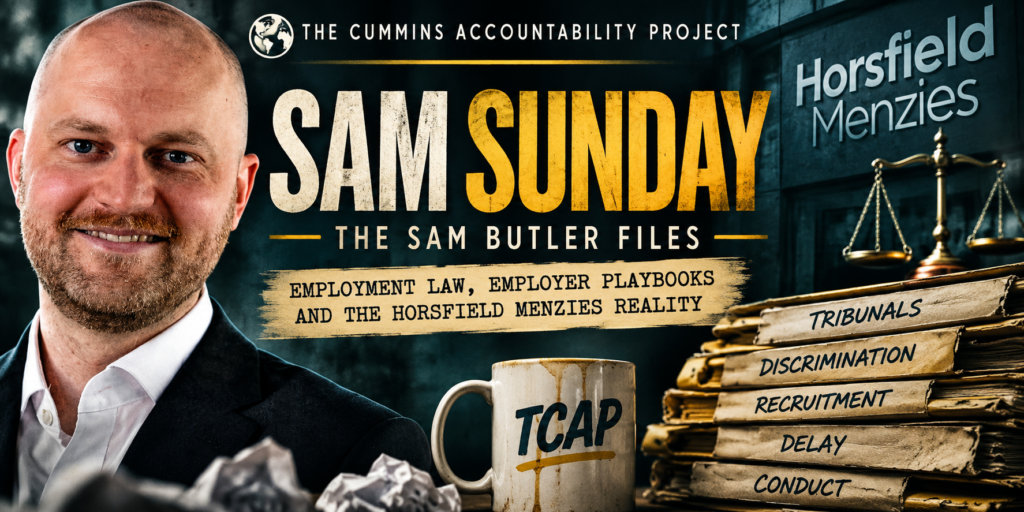
Sam Butler’s second 29 October birthday present concerned employment rights. It arrived with the manners of a newsletter and the priorities of a debt collector assessing the furniture. Fuck the candles; somebody has lit a warning lamp on the balance sheet. A person may qualify for protection. Somewhere, a business may have to meet the obligation. Our generous host has identified the worrying part and packaged it for the organisation that might have to pay.
The Horsfield Menzies article is called Only The Beginning?. It discusses further employment reforms, including a consultation on the status of people working through different contractual arrangements. Butler expressly recognises that status controls access to fundamental employment rights. Then he explains the potential effect on “workforce liabilities”. The movement between those two ideas deserves a proper look. A person’s protection has crossed the desk and acquired a minus sign.
The Staff Entrance Has A Tollbooth
Employment status can decide whether somebody gets paid holidays, minimum-wage protection and other workplace rights. In Great Britain, employees have the broadest employment protections, with eligibility conditions for particular rights. The wider worker category carries important rights of its own. Genuine self-employment involves running an independent business for clients or customers. Those distinctions determine obligations that can make a substantial difference to somebody’s income and security.
Before a person can challenge a breach, therefore, they may have to establish which protections apply to the relationship. The fucking entrance examination comes before the complaint. Someone can spend years doing useful work and still find the legal argument beginning with their classification. Their labour has been easy enough to identify when a customer needs serving. Suddenly, when a right needs honouring, the poor bugger requires extensive supporting documentation.
Sam Finds The Right And Reaches For A Calculator
Butler understands the significance. That makes his next move more revealing. He acknowledges the importance of employment rights, then translates possible reform into its effect on the organisation’s liabilities. Within a few lines, the person seeking protection has become something the business must price. For fuck’s sake, Sam, you had just located the human purpose of the law. Then the employer’s obligations occupy the foreground, and the benefits to the worker disappear behind the costing exercise.
There is a particular poverty in that perspective. Paid leave means somebody can stop working for a period without losing the income attached to that entitlement. Minimum-wage protection places a floor beneath pay. These rights affect food, rest and the ability to meet bills. Christ, the benefits are hardly obscure. Yet the professional account approaches them from the side of the organisation’s potential exposure, like a man examining a lifeboat principally for its effect on the ship’s storage capacity. The drowning can wait; this thing takes up a bastard of a lot of room.
The Law Has Already Met This Bollocks
The government’s employer checklist is blunt about classification. A business cannot simply choose the status it would prefer somebody to have. The facts of the working relationship determine the answer. Calling a person self-employed does not settle the question, and a business model cannot legitimately exclude entitlements merely by attaching a convenient label. The work itself keeps getting a vote, which must be terribly irritating for anyone hoping the heading on the contract would do all the heavy lifting.
Consequently, the real questions concern control, obligations, personal service and whether somebody is genuinely operating a business of their own. A title can describe independence; it cannot manufacture the underlying facts. This is where the bullshit has to meet the working day. Who sets the terms? How much freedom exists in practice? What happens when instructions are refused? The answers matter more than the reassuring elegance of a document somebody else drafted. A gold-plated label still cannot drive the van.
Uber Took The Argument Upstairs
In Uber BV v Aslam, the Supreme Court unanimously upheld the finding that the two test claimants were workers. Uber had argued that drivers were independent contractors working for passengers through its technology and booking arrangements. The court examined the practical relationship. Uber set fares, imposed contractual terms and exercised substantial control through its app, performance systems and restrictions on customer relationships. The independence described in the argument did not displace the conditions under which the work happened.
The court also explained why the statutory purpose mattered. Employment legislation protects people whose dependence and weaker bargaining position leave them exposed to control over pay and working conditions. Allowing the stronger party’s paperwork to dictate access to those protections would undermine that purpose. The judgment puts the person doing the work at the centre of the inquiry. Fancy that: the law looks through the commercial arrangement far enough to find the poor sod expected to carry it out.
That is the concrete issue behind discussions of organisational exposure. Rights can become expensive when a business has treated the people providing its service as falling outside them. Recognising an obligation changes the accounts because somebody must meet it. The alternative may leave the individual carrying the consequences. A balance sheet that improves when another person goes without protection deserves scrutiny. The accounts department’s relief is a piss-poor measure of whether the arrangement is fair.
Personal Service And The Disappearing Person
The October consultation considers placing less emphasis on personal service when determining worker status. It also explores a presumption of worker status, stronger enforcement and additional protections for self-employed people. Their direction is significant because they examine the boundary through which people gain access to rights. The government is asking whether the framework needs to recognise and protect more of the people supplying the work. It is a little difficult to celebrate that prospect while checking whether the company might have to open its bloody wallet.
Personal service asks whether someone must perform the work themselves. Substitution arrangements can affect that assessment, but their substance matters. Official guidance explains that an occasional or restricted ability to send another person can coexist with worker status. A substitution clause that fails to reflect the real arrangement cannot settle matters by waving from the page. Otherwise, a few lines of drafting could make the worker disappear while leaving the business perfectly able to locate them for the next sodding shift.
The Person Is Not A Drafting Defect
Against that background, Butler’s emphasis on liabilities reveals the limits of his professional imagination. The consultation asks how protection should work. His commercial translation asks employers to consider what changes will mean for their workforce arrangements. The person’s entitlement becomes the organisation’s adjustment problem. The clever cunt can identify a fundamental right and still make the employer’s inconvenience the interesting part. Someone has gained a potential route to protection, and Sam is already measuring the disturbance to the furniture.
The wider proposals also include written statements and protections concerning blacklisting and health and safety for genuinely self-employed people. That deserves attention because independent work still involves relationships in which someone else can cause harm. Getting shafted by a customer hardly becomes a delightful entrepreneurial perk because you send an invoice. A decent account could ask how those protections improve working life. Instead, the reader receives another tour of the employer’s approaching administrative headache. The patient can wait while Sam takes the temperature of the filing cabinet.
Please Keep The Brochure Comfortable
Sam ends by urging HR teams to think across workforce models, policies, contracts and processes as the law changes. The practical question is what those arrangements are meant to achieve. A sound model should recognise the obligations created by the work it depends upon. If stronger enforcement exposes a gap, the worker did not cause the problem by acquiring a route to challenge it. The people supplying the labour have been there all along, keeping the bloody operation running.
So thank you for the second birthday present, Sam. Your article managed to recognise the importance of employment rights and still return the conversation to the business’s exposure. I find that a mean little way to look at working people. Behind each potential obligation sits somebody whose time, pay and security help sustain the enterprise. Give that person the same attention you give the organisation’s liabilities. An accounts package can calculate the cost. It takes a special kind of professional emptiness to make that the most interesting thing about the person doing the work.
Lee Thompson – Founder, The Cummins Accountability Project
Sources
- Sam Butler, Horsfield Menzies: Only The Beginning?, 29 October 2026
- Government: employment status reform and protections for the self-employed, October 2026 consultation
- Government: employment status and rights checklist for employers and other engagers
- Government: detailed employment status guidance, including personal service and substitution
- Supreme Court: Uber BV and others v Aslam and others [2021] UKSC 5