
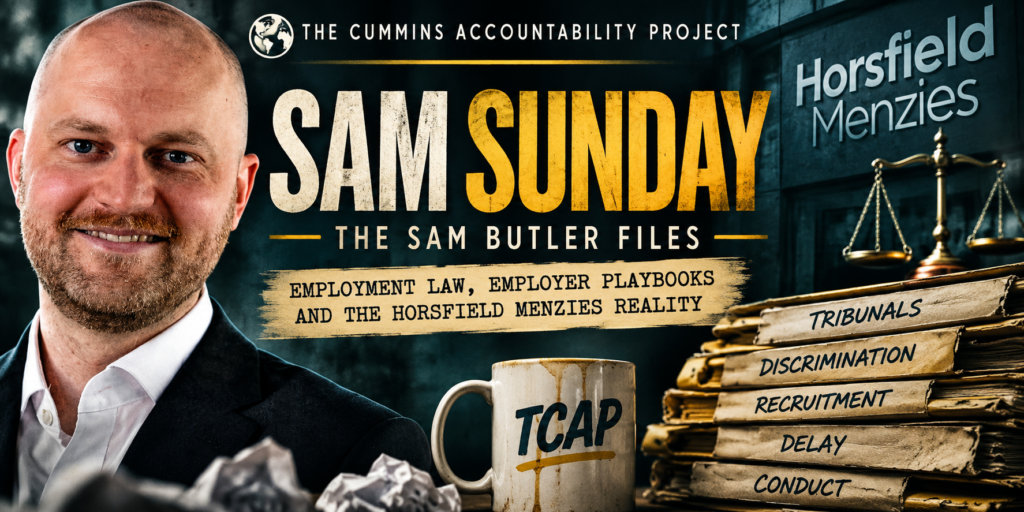
Sam Butler published two articles on 29 October, my birthday. The first included a little lesson on fire and rehire. What a thoughtful bastard. Most people manage a card, perhaps a bottle, or a message promising a pint they will never buy. Sam discussed delayed worker protections and described the extra time from the employer’s side of the table. Thanks, Sam. Nothing says many happy returns quite like discovering whose returns matter when somebody else’s employment contract is on the chopping block.
His first present is called ERA Roadmap Moves Again. The Horsfield Menzies solicitor explains that stronger fire and rehire protections are now scheduled for March 2027, having previously been expected in January. Beneath the timetable sits the useful bit: his description of the delay as “a little more breathing room”. Somewhere, a worker contemplating worse terms might appreciate a little air too. Unfortunately, the ventilation in this particular establishment appears to serve the management suite.
Sam Butler Opens The Bar
Butler also tells businesses contemplating contractual changes that they “should not waste it”. There is the commercial instruction, neatly positioned beneath the delayed protection. The employer has acquired time to review its plans and prepare. Meanwhile, the employee has acquired a longer wait for the stronger rules. Both experiences occupy the same calendar. Only one receives the reassuring hospitality of Sam’s little newsletter.
Fuck me, the choice of perspective is immaculate. A government delay enters the room carrying consequences for both parties and leaves dressed as an employer amenity. The business gets a useful interval; the person whose terms may change barely gets a seat. Sam has installed a drinks trolley in the gap between Parliament’s promise and its implementation. The smug bastard knows precisely which end carries the glasses.
The Contract Returns With Its Pockets Turned Out
Fire and rehire can put a brutally simple proposition before an employee: accept the changed terms or face dismissal and an offer to return under a different contract. The work may continue. So may the need for somebody to perform it. However, the person doing it must decide whether keeping the job requires surrendering something previously agreed. Calling that a contractual exercise gives the procedure an administrative dignity its household consequences rarely enjoy.
Picture the same workplace on Monday morning. The machinery still needs operating, the deliveries still need shifting and the customers still expect service. Yet the worker is examining a revised offer while calculating what a smaller income would do to the mortgage. The shit has landed in somebody’s kitchen. Up at professional-advice altitude, meanwhile, the interesting question concerns how much time the organisation has to manage the change. The arsehole who invented weather reports exclusively for the people indoors would recognise the technique.
The Calendar Has A Class System
The government’s October consultation response brings the human stakes into focus. Its planned restrictions will cover changes between day and night working, and between weekday and weekend working. It aims to introduce those regulations alongside the new fire and rehire protections in March 2027. A shift pattern determines when somebody sleeps, collects a child, provides care or sees their partner. Move it and an entire household may need rebuilding around the employer’s decision.
Consequently, extra preparation time has a value on both sides. An employer can use it to consult, budget and organise. Workers must keep arranging their lives while stronger protection remains ahead of them. A parent cannot download another Saturday from the HR portal. Nor can a carer tell an elderly relative that the bastards in scheduling have discovered a more efficient definition of evening. All that pious boardroom shite about valuing people becomes rather less impressive when the diary only records one side’s inconvenience.
Tesco Discovered What Permanent Meant
Existing contractual rights already have teeth, as Tesco discovered in the Supreme Court in 2024. Employees had received retained pay as an incentive to relocate during a distribution restructuring. Their contracts made that entitlement permanent, subject to specified qualifications. In 2021, Tesco proposed removing it. Employees who refused would face dismissal and an offer of re-engagement without the retained pay. Usdaw and affected workers challenged the plan, eventually taking the dispute to the country’s highest court.
The Supreme Court unanimously restored an injunction. It held that the contracts contained an implied restriction preventing dismissal for the purpose of stripping out that permanent entitlement. Otherwise, the promise could be defeated by terminating the contract that contained it. What a splendid piece of commercial ambition: persuade people to move by promising continuing pay, then try to remove the promise through the dismissal machinery. The court required the word permanent to survive contact with the fucking payroll department.
Bloody hell, that history belongs beside every soothing discussion of contractual change. A benefit can represent a decision somebody made years earlier, involving travel, family and a commitment to a particular employer. Removing it can unravel the bargain that secured the worker’s agreement. The paperwork records an obligation. Behind it sits a life already organised around the business keeping its word. A solicitor explaining the timetable should be able to see that far beyond the stationery.
A Rescue Plan Has To Face The Evidence
The new regime is intended to make dismissal over specified core changes automatically unfair, with a narrow route involving severe financial difficulties and further conditions. That structure recognises the difference between an organisation confronting severe trouble and an employer simply wanting a more convenient bargain. Business decisions require scrutiny because the power to end somebody’s employment makes an apparently voluntary choice considerably less comfortable. Agreeing with a dismissal notice hovering nearby is a peculiar fucking form of enthusiasm.
For that reason, the useful preparation involves examining alternatives, explaining the problem and listening to those expected to absorb the consequences. If management needs different terms, it should be able to account for that need. Employees already account for their performance, attendance and time. A board asking them to surrender part of a bargain can endure some questions about its own arithmetic. Being pissed off with a labour cost does bugger all to establish that cutting it is necessary.
Whose Uncertainty Gets A Cushion?
Butler opens his article with the government changing the timetable again. The frustration is recognisable: businesses need to know when new obligations will apply. However, employers’ uncertainty is only half the story. Someone facing possible changes also needs reliable information, enough time to respond and confidence that existing promises count for something. The organisation does not hold an exclusive licence to find instability a pain in the arse.
Nevertheless, Sam’s chosen emphasis wraps the extra interval around the employer like a warm coat. The worker remains outside, waiting for March. That is the professional posture worth examining. His description makes the business’s room to manoeuvre immediately visible, while the employee’s continued exposure requires somebody else to bring it into the conversation. What a magnificently selective pair of spectacles. The prick can read a commencement date from across the office and still leave the person affected standing beyond the frame.
Last Orders, Then The Bill
Put the lesson on a birthday card and the sentiment becomes clearer. Congratulations on another year; management has a little longer before stronger restrictions arrive. Inside, a tasteful illustration could show an employee holding a revised contract while somebody behind the bar rings the bell. What a miserable fucking party. The business gets time to prepare its next move. The employee gets to wonder what that move will mean for the wages and hours holding their household together.
Sam Butler has given that imbalance a wonderfully comfortable description. I find the comfort contemptible. Stronger protection has been delayed, and the professional advice foregrounds what the employer can do with the interval. So here is the birthday return, Sam: put the worker back into your timetable. Account for the promises, the pressure and the lives organised around those terms. Then tell us who is supposed to thank you for keeping the bar open. The people carrying the bill have already had quite enough of this bollocks.
Lee Thompson – Founder, The Cummins Accountability Project
Sources
- Sam Butler, Horsfield Menzies: ERA Roadmap Moves Again, 29 October 2026
- Government consultation response: fire and rehire, expenses, benefits and shift patterns, updated 22 October 2026
- Government: Plan to Make Work Pay and Employment Rights Act timeline update
- Government: consultation on the revised dismissal and re-engagement code
- Supreme Court: Tesco Stores Ltd v Usdaw and others [2024] UKSC 28