IRN-BRU is difficult to miss. The drink looks capable of illuminating a stairwell during a power cut, and Cepac has built the same volume into the cardboard.
Its POS Portfolio 2026 places IRN-BRU across two prominent examples in the “Theatrical Displays” section. One is a blue wall of cans. The other turns Burns Night into an orange retail monument. Cepac is using AG Barr’s flagship brand to show prospective customers what Cepac can do.
Meanwhile, the AG Barr supplier code promises standards on worker treatment, legal compliance and non-discrimination. The company says it monitors suppliers through approval checks and audits.
Good. There is something worth checking.
The file now includes an October 2024 denial from Cepac HR Business Partner Maria Walker, issued before she knew that the same-day WhatsApp record existed.
IRN-BRU Is Back On The Stand
The first AG Barr Customer Corner article followed a 2022 POPAI award for Cepac’s “Tastes Magic” display. That established the commercial link. It also asked why a famous customer should enjoy the polished work without examining the conduct of the company behind it.
This is not that article reheated and poured into another can.
Cepac has now brought IRN-BRU forward again in a portfolio carrying the year 2026. The brand is not buried in a client list or trapped inside an old awards archive. It occupies prime space in the document Cepac uses to advertise itself now.
The arrangement works beautifully for Cepac. IRN-BRU supplies the colour, recognition and retail theatre. Cepac borrows the brand equity. Everyone admires the display and nobody looks behind the stand.
TCAP looked.
Page Rang And Offered The Interview
On 21 August 2024, Page Outsourcing rang me about a role at Cepac and offered me an interview for the week after the bank holiday. We discussed the pay. I disclosed that my employment gap was connected to my mental health.
Page would pass my details on. I would then receive another call to confirm an exact mutually agreeable time.
I am still waiting for that call.
The contemporaneous record made on 21 August follows.
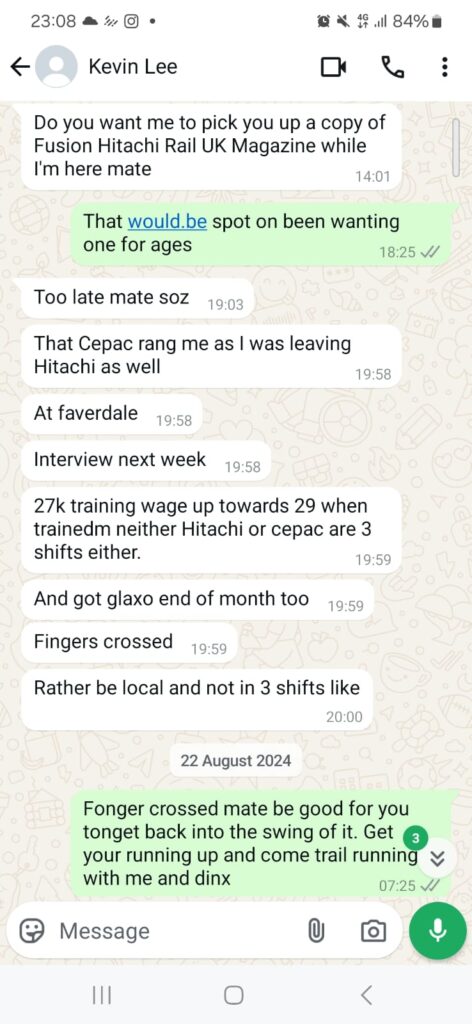
Two short messages preserve the outcome of the call: “Interview next week” and “27k training wage up towards 29”. A friend replied the following day. The recipient retained the conversation and later provided a witness statement confirming its origin and context.
No Employment Tribunal claim existed. No TCAP article existed. Nobody had assembled a litigation position. Page had offered the interview, and I recorded the news at the time.
Page and Cepac later denied that Page offered it. Their later position therefore collides with a record created before either company needed a defence.
Maria Walker Denied It Before Seeing The Receipt
On 8 October 2024, I complained directly to Cepac. The complaint could hardly have been clearer:
“I was called and offered an interview. I was told this would be after the August bank holiday and that they would call me the following week to arrange a suitable time.”
I also explained that Page had asked about my employment gap, that I had disclosed treatment for a mental-health condition and that nobody called me back.
Maria Walker, Cepac’s HR Business Partner, answered that morning. She said Page conducted the initial telephone screening before sending potential candidates to Cepac. According to her response, my CV reached the recruiting manager but I “was not shortlisted on that occasion”. She added that the manager would not have known about the mental-health information discussed with Page.
Walker then apologised because Page had supposedly failed to tell me that I had not secured an interview. She promised to send my feedback to the agency “to avoid any future confusion”.
That was Cepac’s first answer. No interview offer. No vanished confirmation. Just an unsuccessful candidate whom the agency had apparently forgotten to reject.
Maria Walker had not seen the contemporaneous WhatsApp message when she gave that answer.
The timing matters. Walker’s response shows that Cepac adopted the no-interview position when confronted directly, but before it knew that the outcome of the August call had been recorded on the day. Her answer relied on the later shortlist position to overwrite what Page had already told me.
I replied at 12:13 that Page had stated “without any room for misinterpretation” that I had been selected for interview. I also told Cepac that the only material change had been the disclosure of my disability and that I would begin ACAS proceedings.
The WhatsApp record did not emerge from some later attempt to improve the claim. It existed before Maria Walker’s denial, before the complaint to Cepac and before ACAS. Cepac simply did not know it existed when it chose its explanation.
Paragraph 12 Meets Paragraph 14
Cepac’s own ET3 adds another problem.
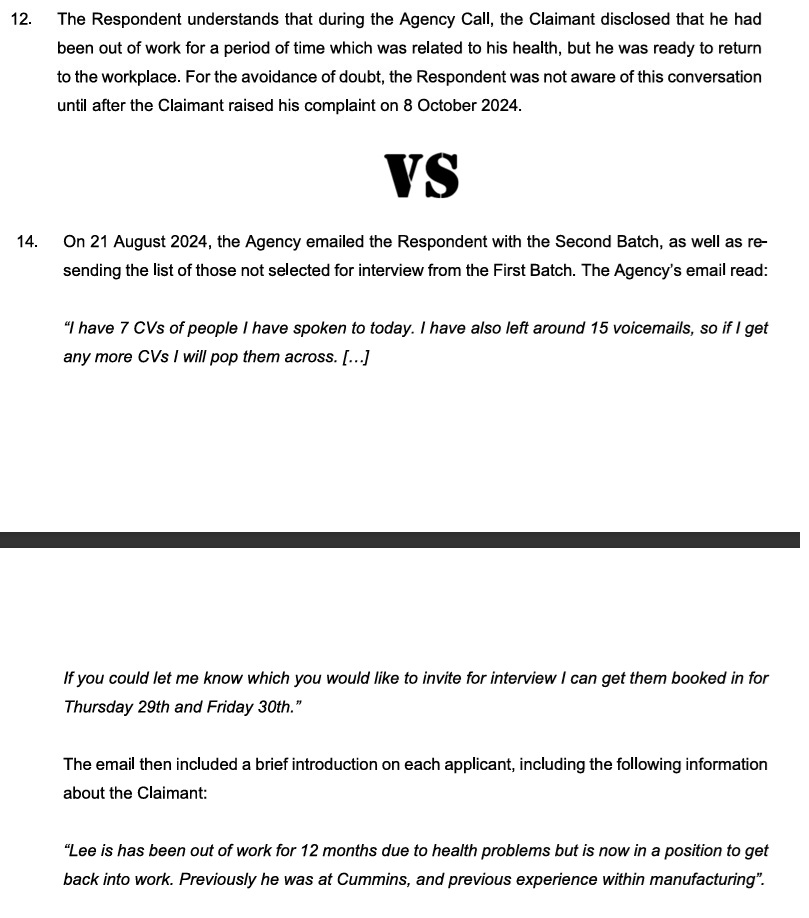
Paragraph 12 distances Cepac from knowledge of my disability. Paragraph 14 refers to recruitment information recording that health problems sat behind my absence from employment.
That information did not arrive by carrier pigeon. It entered the recruitment chain through somebody, travelled through a system and appeared in Cepac’s pleaded response.
The questions are brutally ordinary. What did Page record during the call? Who could see it? What reached Cepac? Where did the paragraph 14 information come from? Why did the promised confirmation disappear after the disclosure? How can the interview denial survive the same-day WhatsApp record?
Those questions required disclosure, witnesses and findings. They never received them.
The Evidence Stacked Up. The Pressure Escalated
By then, the clean corporate explanation was becoming harder to keep upright.
The October complaint recorded the interview offer and mental-health disclosure in precise terms. Maria Walker’s answer proved that Cepac had adopted the no-interview position before seeing the contemporaneous WhatsApp record. That message had recorded “Interview next week” on the day Page rang. Its recipient later supplied a witness statement. Cepac’s ET3 then placed its denial of disability knowledge beside recruitment information about my health.
Each new document pushed the dispute back towards the same dangerous place: the merits.
Witnesses could have been questioned. Page’s notes and system history could have been examined. Maria Walker’s answer could have been tested against what Page said during the call. Paragraphs 12 and 14 could have been reconciled, or not. A Tribunal could have decided why the interview confirmation vanished after Page learned about my mental health.
The desperate, deliberate and increasingly expensive attempt to provoke me, catalogue the reactions and drag the case away from those merits was driven by this evidence stacking up.
Horsfield Menzies applied the pressure for Cepac. In March 2025, the firm put Cepac’s estimated costs at £25,000 to £30,000 and offered not to pursue them if the claim disappeared. It contacted my healthcare provider, investigated appointment availability and used the resulting information to oppose a postponement. Meanwhile, my correspondence, complaints, publications and distressed reactions were preserved for later use. Sam Butler pushed for public hearings on no less than five occasions after receipt of my medical files, which disclosed a severe anxiety disorder. He made zero requests before receiving the medical files. He also commenced incorrect speculation about the material in them. GDPR regulations restrict the use of data to being used for the means for which they were supplied. In my case, this was to prove disability. Not invite speculation or calls to my medical centre.
The mechanism was filthy but effective. Apply pressure to a disabled litigant in person. Turn the predictable reaction into fresh evidence. Place that evidence before a Tribunal already failing to surface the medical and procedural context. Then insist that the reaction, rather than the vanished interview, had become the case.
By April 2026, Cepac’s combined costs schedules exceeded £50,000. Horsfield Menzies and Cepac had spent a fucking fortune constructing a route around a recruitment dispute that could have been tested through a call record, a handful of witnesses and the documents sitting behind two contradictory ET3 paragraphs.
The expense makes sense when viewed against the evidence. They were not merely defending Cepac’s account. They were building a procedural reason why nobody would ever have to decide whether that account survived contact with the record.
Newcastle Manufactured It. Cepac Helped Build It
Newcastle Employment Tribunal manufactured a conduct case, aided by Cepac through Horsfield Menzies, and used it to avoid the recruitment evidence.
Its administration obscured what judges could see, misrouted correspondence to Leeds and refused to establish the contents of a file approaching two thousand pages. Respondent correspondence received rapid attention. Claimant applications, medical context and repeated questions about the judicial file disappeared into institutional fog.
Horsfield Menzies, acting for Cepac, harvested the fallout it had helped intensify. Provoking me and weaponising the disability-related dysregulated reaction. The firm assembled around 150 communications and blog items plus 181 posts on X. A claim about one vanished interview became a 331-item character dossier, curated by Cepac’s solicitors and placed before the institution whose own administration had helped produce it. The court only considered conduct on one side at the hearing. My complaints all went ignored. However they still sit with the SRA and BSB.
Employment Judge T. R. Smith recorded spending three hours on the 1,941-page file and blamed me as its “principle culprit”. Three days before the decisive hearing, Employment Judge Brain refused the postponement needed for safe participation. Employment Judge James then heard the respondents without me on 24 April 2026.
The Tribunal struck out the claims and ordered £20,000 in costs. Cepac’s combined costs schedules had exceeded £50,000.
None of that decided whether Page offered the interview. It did not reconcile paragraphs 12 and 14. It did not test the recruitment records or explain the vanished confirmation call.
Newcastle created the administrative conditions and stripped the reactions from their medical and procedural context. Cepac, through Horsfield Menzies, applied pressure, collected the reactions, arranged them into a conduct case and sold them back to the Tribunal as proof that no fair hearing could happen. Newcastle then accepted the product of that combined process and used it to destroy the underlying claim.
This was not a Tribunal acting alone, nor a respondent merely collecting an accidental benefit. Newcastle manufactured the conditions. Cepac, through Horsfield Menzies, intensified the pressure and supplied the dossier and argument. The evidence on the merits stacked up; their machinery dragged the case in the opposite direction. Together, they made the escape route.
The AG Barr Supplier Code Meets Cepac
AG Barr’s current policy page says it has high expectations of its partners, suppliers and itself. Its 2026 modern-slavery statement gives the machinery more detail.
The group worked with more than 150 direct material suppliers during the reporting period. It also used several hundred indirect material and service providers. AG Barr says its Supplier Code of Conduct covers worker treatment, legal compliance, non-discrimination, health and safety and other standards. New direct suppliers must accept the code as a condition of trading.
AG Barr also describes a formal supplier approval process, periodic audits and risk-based monitoring. Its procurement team uses EcoVadis to screen supplier performance around human rights and labour standards.
This is not a company lacking policies, processes or people who understand supply chains. It has a code, questionnaires, screening, monitoring and auditors. The cupboard is fucking full.
What remains publicly absent is any application of that apparatus to the evidence attached to Cepac.
Either the code is a working control or it is expensive wallpaper for the responsibility section. The distinction appears when an awkward file lands on the desk.
Does AG Barr classify Cepac as a direct supplier, an indirect supplier, a service provider or a former commercial partner? Which standards govern the relationship? Did anybody examine the Page call, WhatsApp record, supporting statement or ET3 contradiction? Has procurement requested the original system notes and unredacted recruitment material?
A supplier code that stops at the display stand is not governance. It is point-of-sale ethics.
The Questions Fit On One Can
AG Barr does not need another brand workshop. It needs answers.
- Does Cepac currently provide AG Barr or IRN-BRU with packaging, displays or related services?
- What dates cover the IRN-BRU work shown in Cepac’s POS Portfolio 2026?
- How has AG Barr classified Cepac under its supplier approval and monitoring system?
- After the contemporaneous WhatsApp record emerged, who reviewed Maria Walker’s 8 October 2024 denial, the Page call account, supporting witness statement and Cepac ET3?
- Did AG Barr obtain Page’s call notes, system history and the source material behind paragraph 14?
- How does the company apply its non-discrimination standard when a supplier, acting through Horsfield Menzies, helps Newcastle Employment Tribunal build the conduct case that prevents a merits judgment?
The answers require dates, records and decisions. Nobody needs a campaign slogan or another fucking photograph of a cardboard tower.
It’s Only IRN-BRU Again
IRN-BRU is here again because Cepac put it here again.
The May article dealt with the old award and the older public record. Cepac’s 2026 portfolio created the new hook. AG Barr’s 2026 statement supplied the rulebook. The recruitment evidence supplies the test.
Page rang me, offered the interview, discussed the pay and learned that my employment gap related to my mental health. The exact confirmation never arrived. A same-day message preserved the interview before the dispute existed. When I complained directly, Maria Walker denied the offer without knowing that message existed. Cepac later maintained the denial while its own ET3 referred to health information inside the recruitment chain.
Newcastle Employment Tribunal never resolved that conflict. It manufactured a conduct case with the assistance of Cepac through Horsfield Menzies. Cepac’s solicitors assembled the character dossier, Newcastle accepted it, and the Tribunal held the decisive hearing in my absence, killed the claims and issued a £20,000 bill. Cepac walked away without a merits finding and placed IRN-BRU back in the shop window.
AG Barr now has its brand on the display and its supplier standards on the website. It can connect the two.
Otherwise, the code stops exactly where the title says it does: at the display stand, beneath a wall of orange cans, performing responsibility for passing shoppers.
The drink is supposed to be difficult to ignore.
So is this.
Lee Thompson – Founder, The Cummins Accountability Project
Source List
- Cepac, POS Portfolio 2026
- AG Barr, Responsibility Policies and Statements
- AG Barr, Modern Slavery Statement 2026
- AG Barr, Acting With Integrity
- Employment Tribunal judgment, Thompson v Cepac Limited and Page Outsourcing UK Limited, 6019060/2024
- Employment Tribunal reconsideration judgment, Thompson v Cepac Limited and Page Outsourcing UK Limited, 6019060/2024
- TCAP, Newcastle Employment Tribunal: Deliberate Maladministration
- TCAP, Page Partners: Cepac Limited, Redactions, Panic Calls And The Disabled Candidate They Googled
- TCAP, HSA Group Ce-UnPAC’d: Cepac Ltd Customer Corner, AG Barr
- TCAP case file: email exchange between Lee Thompson and Cepac HR Business Partner Maria Walker, 8 October 2024; Cepac ET3 Grounds of Resistance; WhatsApp image; supporting witness statement dated 20 February 2025; respondent costs schedules and submissions.