
Asda’s July 2026 supplier standards prohibit using screening to exclude candidates because of health conditions or medical history. They also prohibit disability discrimination, bullying, victimisation and threatening behaviour in grievance processes across every tier of the supply chain. The last independent public trail put Cepac in Asda’s packaging orbit through C&D Foods. Now the ET3 contradiction, Maria Walker’s denial, the same-day WhatsApp receipt and Cepac’s £50,000 campaign to escape a merits hearing are waiting at the till.
Part Two Reopens The Till
Part One, The Cepac Files : Asda And The Inclusion Checkout, followed the public route from Cepac to C&D Foods and from C&D Foods to Asda. It put Asda’s inclusion language beside Cepac’s ET3, the disability-discrimination case and the legal expenditure already swallowing the substance of the dispute. It asked whether Asda’s idea of responsible sourcing reached the cardboard underneath the product, or stopped at whatever looked cleanest under supermarket lighting.
That article landed on 27 May 2026. Since then, the evidential picture has filled out and Asda has supplied a much sharper rulebook. Its revised Standards for Suppliers, updated on 21 July 2026, do not merely gesture towards dignity from a safe corporate distance. They address recruitment decisions, medical history, bullying, victimisation, grievance handling, legal issues, record access, remediation and every tier of the supply chain. Asda has written a code that reads as though somebody measured the Cepac file first.
So this is not Part One warmed up and pushed back under the heat lamp. The first article established the problem. Part Two brings the interview receipt, Maria Walker’s denial, the contradiction inside Cepac’s own pleaded defence and the current Asda clauses that leave procurement nowhere respectable to hide.
The Commercial Trail Needs A Current Receipt
The independent public evidence that brought Asda into The Cepac Files remains clear. On 11 September 2023, Prolific North reported that Cepac’s clients included C&D Foods Group and that C&D Foods’ customers included Aldi, Tesco, Morrisons and Asda. That was not TCAP inventing a relationship from a photograph or guessing from a box in a warehouse. It was a third-party trade publication identifying the route in plain English: Cepac, C&D Foods, Asda.
What the public record does not presently supply is a later independent confirmation that the route continued, changed or ended. That is not an invitation for Cepac to crawl into the evidential gap and call itself clean. It is a demand for the companies holding the commercial records to produce the current answer. If the route ended, Asda and C&D Foods can state when. Where it remains live, they can identify the relevant facilities, contracts and tier. Should Cepac now reach Asda by another route, Asda’s own mapping should find it before the cardboard has finished moving through the depot.
Asda Knows Where The Box Went
Asda says transparency is central to its human-rights programme. It says it maps its supply chains through Sedex and Open Supply Hub, monitors and investigates issues, looks for root causes and works towards remediation. Open Supply Hub says Asda has uploaded more than 2,900 supplier names and addresses. A retailer boasting that level of visibility does not get to become mysteriously short-sighted when one packaging company arrives with an ET3 contradiction and a £50,000 legal convoy behind it.
The current commercial status therefore needs a documentary answer. Cepac’s conduct does not. Cepac chose to bully me, invade my privacy, weaponise my reactions by turning them into “conduct”, and spend more than £50,000 doing it to avoid a merits hearing. Whether Asda’s route remained live is a supplier-record question. What Cepac did to escape the discrimination evidence is the fucking record.
Asda Wrote The Cepac Test
Asda calls its Standards for Suppliers the cornerstone of its Responsible Sourcing and Human Rights programmes. The document applies to every tier, including suppliers of goods and services, agents, contractors and providers of components or raw materials. Signing an agreement, accepting a purchase order or supplying the goods counts as acceptance. Asda reserves the right to inspect facilities, audit books and records, demand corrective action and terminate business where standards are not met.
Then the code becomes almost embarrassingly specific. Employment decisions must rest on ability, qualifications and merit. Suppliers must not tolerate discrimination, harassment, victimisation or bullying. Harsh treatment and threatening behaviour are prohibited, including during grievance processes. Screening must not exclude candidates because of health conditions or medical history, and health assessment must not form part of recruitment unless the law or a genuine occupational requirement makes it necessary.
The document also requires suppliers to communicate incidents, concerns and allegations through the chain. They must promptly tell Asda about allegations, investigations or legal issues involving human rights, labour practices, ethical misconduct or regulatory compliance at current or proposed production locations. Workers must have accessible grievance routes and access to remedy. Root causes must be addressed, rights holders must remain central and the standards must be cascaded and monitored below the first contractual handshake.
That is not vague ESG custard. It is a fucking checklist. Medical history in recruitment. Disability discrimination. Bullying. Victimisation. A grievance process turned against the complainant. Legal proceedings concerning labour practices. Records that can be audited. Harm that requires remedy. The only thing Asda’s code does not include is Maria Walker’s name and a little box marked “open the WhatsApp”.
The ET3 Does Not Balance
Cepac’s own ET3 carries the knowledge problem that Part One identified but did not fully connect to the later evidence. Paragraph 12 distances Cepac from knowledge of my disability. Paragraph 14 then records recruitment information that I had been out of work for around twelve months because of health problems and was ready to return. The defence wants the health information present for one purpose and absent for the purpose that matters.
That information entered the recruitment chain through somebody. It sat in a system, travelled between people or appeared in material from which Cepac drafted its pleaded case. The questions are ordinary enough for any competent investigator: what did Page Outsourcing record during the call, who could access it, what reached Cepac, when did it arrive and where did the paragraph 14 wording come from? Asda’s current code gives it the right to demand records. Cepac’s ET3 gives it the reason.
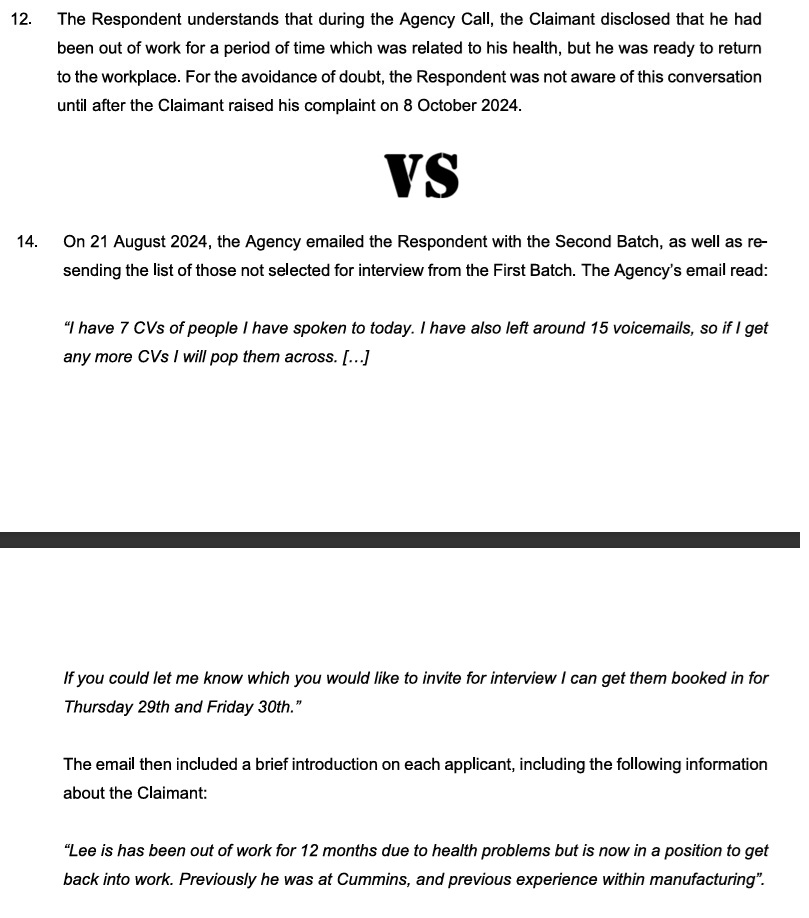
Those paragraphs were never reconciled at a merits hearing. No witness was required to explain the route taken by the health information. No decision was made about why the promised interview confirmation disappeared after the disclosure. Strike-out did not make the contradiction balance. It simply closed the checkout before anybody counted the change.
Maria Walker Meets The Same-Day WhatsApp
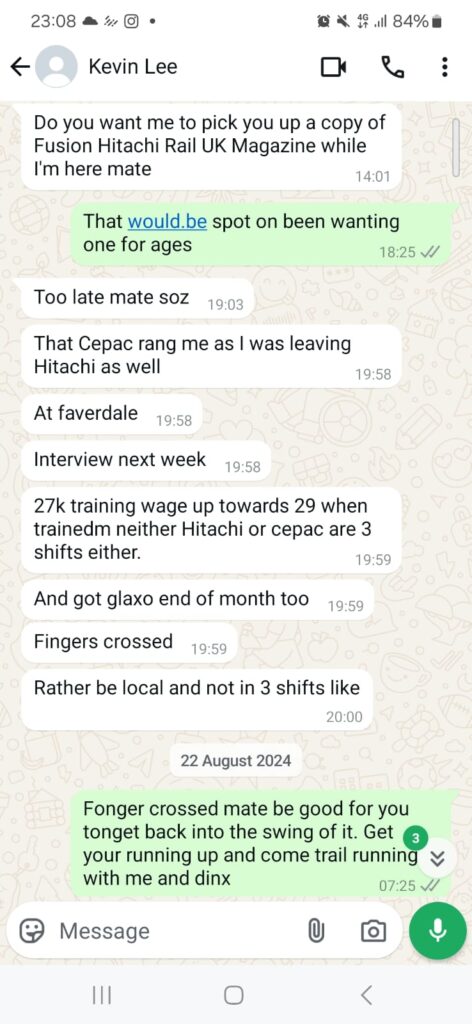
On 21 August 2024, Page Outsourcing called me about the Cepac role and offered an interview for the week after the bank holiday. We discussed the salary. During that call, I explained that the gap in my employment was connected to my mental health. Page said my details would be passed on and that another call would confirm an exact, mutually agreeable interview time. That confirmation never came.
A WhatsApp message made on the same day recorded the outcome before there was a complaint, an ACAS notification, an Employment Tribunal claim or a TCAP article. It said “Interview next week” and “27k training wage up towards 29”. The recipient retained the exchange and later provided a witness statement confirming its origin and context. This was not a recollection assembled after lawyers entered the room. It was the small, casual message people send when something has just happened.
The Denial Arrives At 09:52
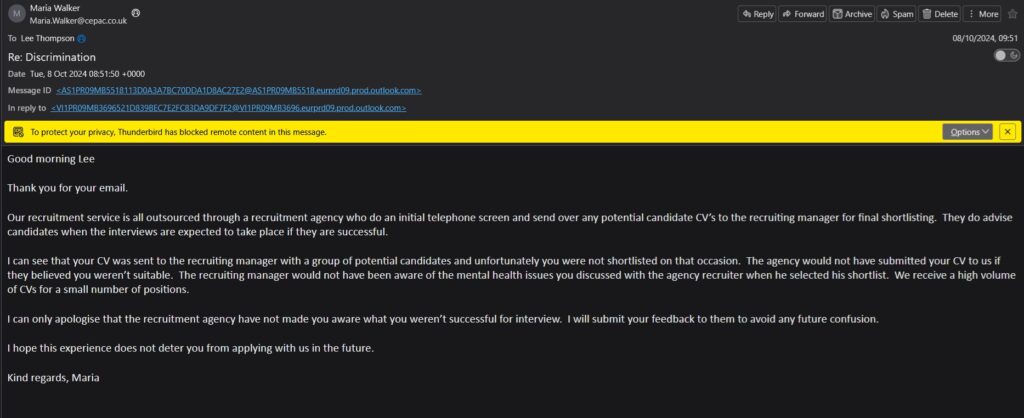
At 04:35 on 8 October 2024, I complained directly to Cepac. The email set out the offer, the planned timing after the bank holiday, the promised confirmation call, the questions about my employment gap and the mental-health disclosure. Maria Walker, Cepac’s HR Business Partner, replied at 09:52. She said my CV had been sent to the recruiting manager but that I “was not shortlisted on that occasion”. She maintained that the manager would not have known about the mental-health information and apologised because Page had supposedly failed to explain that I had not secured an interview. My account of an offered interview was reduced to “confusion”.
Walker had not seen the WhatsApp record when she supplied that answer. The sequence is brutal. Page offered the interview and discussed the money. A same-day message recorded both. The confirmation vanished after the health disclosure. When challenged, Cepac replaced the offer with a failure to shortlist and placed the discrepancy in the corporate waste bin labelled confusion.
Asda’s code says recruitment must not exclude people because of health conditions or medical history. It says allegations and legal issues must be communicated, records must be available and root causes must be examined. Fine. Ask Page for the call notes, candidate-status history, audit trail and any recording. Ask Cepac when the status changed and what Walker reviewed before answering. Compare the result with the WhatsApp, the witness statement and paragraphs 12 and 14. This is not detective work. It is basic fucking stock control for facts.
Cepac Spent £50,000 Buying An Exit
Let the central fact stand without the legal cotton wool Cepac bought in bulk. Cepac chose to bully me. It chose to invade my privacy. The company chose to provoke and catalogue disability-related reactions, strip away the pressure and medical context that produced them, rename them “conduct” and feed them to the Tribunal. Finally, it chose to spend more than £50,000 doing that because the strategy offered something a merits hearing did not: an exit before the recruitment evidence could be tested.
Horsfield Menzies applied the pressure for Cepac. The firm contacted my medical centre, investigated appointment availability and used the resulting information to oppose a postponement. My medical evidence had been supplied to establish disability, not to give Cepac’s solicitors a guided tour of my healthcare arrangements. The intrusion was then followed by the great corporate harvest: correspondence, complaints, blog material and posts on X gathered into a character dossier while the vanished interview waited unanswered underneath it.
Cepac and Horsfield Menzies understood the conversion process. Apply pressure to a disabled litigant in person. Preserve the distressed response. Remove the disability, vulnerability and procedural failure surrounding it. Present the reaction as free-standing misconduct. Repeat until the person complaining about discrimination has become more controversial than the discrimination evidence itself.
The Bill Reached £50,000
Cepac’s combined costs schedules exceeded £50,000. On 24 April 2026, Newcastle Employment Tribunal proceeded without me, struck out the claims and later ordered £20,000 in costs. The Tribunal never decided whether Page offered the interview, why the confirmation disappeared, what health information travelled through the recruitment chain or whether disability influenced the outcome. Cepac was not vindicated on the merits. It bought and built the route by which the merits disappeared.
That is why Asda’s prohibition on bullying, victimisation and abusive grievance handling matters. Cepac did not face the complaint and clear its conduct through evidence. It turned the complainant into the product, wrapped him in a conduct label and spent a fucking fortune persuading the Tribunal to reject the package without looking inside.
Newcastle Supplied The Escape Lane
The institutional machinery Cepac exploited is set out in full in Newcastle Employment Tribunal : Deep Dive : Deliberate Maladministration, Disability Shaming, Judicial White Knights, Speed-reader Smith And The Horsfield Menzies Feeding Frenzy. The short version is that the Tribunal did not merely fail around the edges. Its administration and case management created the conditions in which a conduct case could replace the disability-discrimination claim.
Correspondence was directed to the wrong tribunal office. The contents and visibility of a file approaching two thousand pages remained opaque. Respondent correspondence received rapid attention while claimant applications, medical context and complaints sank into administrative fog. Employment Judge T. R. Smith said he had spent three hours reviewing a 1,941-page file and blamed me as its “principle culprit”. Three days before the decisive hearing, Employment Judge Brain refused the postponement required for safe participation. Employment Judge James then heard the respondents without me and delivered the outcome Cepac had spent so heavily constructing.
Cepac, acting through Horsfield Menzies, read that institutional appetite perfectly. Newcastle wanted conduct stripped of cause; Cepac supplied it by the pallet. The Tribunal foregrounded professional discomfort and claimant language while the WhatsApp, Maria Walker chronology, ET3 contradiction, medical deterioration and privacy complaints remained outside the decisive frame. Newcastle manufactured the conditions. Cepac intensified them, harvested the reactions and sold the result back as the reason a fair merits hearing could not happen.
This was the justice system’s version of self-service. The institution broke the process, the respondent stocked the shelves with the fallout and the disabled claimant received the bill. Cepac now gets to point at a strike-out as though it answers the recruitment case. It does not. It records the success of the escape route.
Asda Can Scan It Or Own It
Asda does not need a values workshop. It needs to identify the present commercial relationship between Asda, C&D Foods and Cepac, including the dates, facilities, contracts and supply-chain tier. It needs to say whether Cepac or C&D Foods disclosed the discrimination proceedings, the ET3 knowledge conflict, the Maria Walker complaint, the WhatsApp evidence or the legal issues created by Cepac’s conduct. If no relationship remains, Asda can give the end date. If one does, its July 2026 standards already describe the investigation.
Asda can ask who reviewed the 21 August call and what the Page system recorded. It can establish when the interview status changed, where the health information in paragraph 14 came from and what Maria Walker relied upon at 09:52 on 8 October. It can inspect the records behind Cepac’s £50,000 costs campaign, the medical-centre contact and the dossier used to replace the merits. Then it can explain what remedy, corrective action or commercial consequence follows under a code that reserves the right to audit and terminate.
The Second Scan
Part One asked whether Asda’s inclusion checkout reached the packaging chain. Part Two supplies the itemised receipt. An interview was offered. Mental health was disclosed. The confirmation vanished. A contemporaneous message preserved what Page had said. Maria Walker denied the offer before she knew that message existed. Cepac’s ET3 put health information inside the recruitment chain while distancing the company from disability knowledge. Cepac then bullied me, invaded my privacy, weaponised the reactions and spent more than £50,000 turning them into “conduct” so it could avoid a merits hearing.
Asda wrote a supplier code covering all of it. Its only remaining task is to decide whether the code operates beyond the PDF. The scanner is already screaming. If Asda keeps waving Cepac’s box through, the failure is no longer hidden somewhere in the supply chain. Once the receipt is in Asda’s hand, silence is not due diligence. It is approval with the logo left off.
Lee Thompson – Founder, The Cummins Accountability Project
Sources
- Asda : Standards For Suppliers 2026 v.2.3
- Asda : Responsible Sourcing And Human Rights
- Open Supply Hub : Asda’s Human Rights Team Seeks Actionable And Engaging Transparency
- Prolific North : Unite Union Threatens Legal Action In Pay Dispute At Greggs And Asda Packaging Supplier
- TCAP: The Cepac Files: Asda And The Inclusion Checkout
- TCAP: The Cepac Files : KFC II: Maria Walker And The Interview Receipt
- TCAP: Newcastle Employment Tribunal: Deep Dive – Deliberate Maladministration
- Employment Tribunal: Thompson v Cepac Limited And Page Outsourcing UK Limited
- TCAP case file: WhatsApp record dated 21 August 2024; email exchange between Lee Thompson and Cepac HR Business Partner Maria Walker dated 8 October 2024; supporting witness statement dated 20 February 2025; Cepac ET3 Grounds of Resistance; respondent costs schedules, submissions and medical-information correspondence. All held by TCAP.