
Sainsbury’s June 2025 Ethical Sourcing Policy required suppliers to report suspected or confirmed breaches. Its June 2026 Human Rights Policy sharpened the alarm: identify human-rights concerns, notify Sainsbury’s within 48 hours, oversee labour providers, prohibit disability discrimination in hiring, protect complainants from retaliation and reject legal attacks against human-rights defenders. In 2023, Unite named Sainsbury’s as a Cepac customer. Now the checkout gets Page Outsourcing’s interview offer, the same-day WhatsApp receipt, Maria Walker’s later denial, Cepac’s ET3 contradiction and a legal campaign costing more than £50,000. Somebody forgot to scan the fucking breach.
Part One Left The New Rulebook Unopened
Part One, The Cepac Files : Sainsbury’s, Disability Disasters And The Cardboard Chain, put Cepac’s ET3 on the checkout and followed the public customer trail from the Darlington packaging company to Sainsbury’s. Moreover, it examined Sainsbury’s own disability findings, equal-pay litigation, facial-recognition embarrassment and the ethical-sourcing language glowing above the loading bay.
That file does not need another trolley tour. Consequently, Part One established the commercial receipt and showed the contradiction between paragraphs 12 and 14 of Cepac’s pleaded defence. However, it did not contain the WhatsApp message created on the day Page Outsourcing offered me an interview. Nor did it place that record beside the email in which Cepac HR Business Partner Maria Walker later said I had never been shortlisted.
More importantly, Sainsbury’s has since published a much sharper Human Rights Policy. The June 2026 document does not merely ask suppliers to behave nicely. Instead, it sets a 48-hour notification clock, creates an incident-management route, demands fair recruitment and protects people raising concerns from retaliation. It also says commercial relationships may be affected where cases are intentionally hidden or a supplier refuses to remediate.
Part Two therefore has one disciplined job. Put the missing evidence through the system Sainsbury’s says it operates.
The Customer Receipt Is Still Dated 2023
The independent public trail remains straightforward. In 2023, Unite named Sainsbury’s among Cepac’s customers while reporting on industrial action at the company’s Darlington operation. Moreover, the same report identified Mars, Carlsberg, Innocent Drinks, Pernod, Lidl and Diageo. This was not TCAP identifying a logo from a fuzzy pallet photograph. Instead, a major trade union put Sainsbury’s name inside Cepac’s customer list.
That evidence establishes the relationship in 2023. However, it does not independently reveal whether Sainsbury’s continued buying from Cepac, moved the work elsewhere or ended the arrangement. Sainsbury’s and Cepac hold the purchase orders, supplier approvals, invoices and termination dates, so the present position should require considerably less effort than tracing a Nectar point.
If the relationship ended, Sainsbury’s can provide the date and identify what review preceded the decision. If it remains active, Procurement can state the relevant packaging, facilities, contracts and supplier classification. Where Cepac supplies through an intermediary, the retailer’s mapping and due-diligence systems should trace the route.
Ultimately, the date is not a hiding place. It is the first field on the supplier form.
Sainsbury’s Built A Better Alarm
Sainsbury’s June 2025 Ethical Sourcing Policy applied across Food, General Merchandise and Goods and Services Not for Resale. Moreover, it prohibited disability discrimination in hiring, barred harassment and intimidation, required regular audits of labour agencies and told suppliers to disclose suspected or confirmed breaches of its Code of Conduct. Procurement and the Human Rights team had named responsibilities.
Then the June 2026 Human Rights Policy tightened the machinery. It applies to branded suppliers and suppliers of Goods and Services Not for Resale. Consequently, direct suppliers must accept it, keep records and provide data. Sainsbury’s says it monitors compliance through risk assessments, audits, visits, worker-voice programmes and dialogue with suppliers.
The incident rule is brutally clear. Suppliers must identify human-rights concerns or incidents, maintain a response plan and notify Sainsbury’s within 48 hours of discovery or occurrence. Afterward, Sainsbury’s assesses the risk, investigates, mitigates the impact, provides remedy and monitors the remediation plan.
Meanwhile, discrimination in hiring because of disability remains expressly prohibited. Fair recruitment, accessibility, bullying, retaliation, grievance handling and oversight of third-party labour providers all sit inside the same policy.
Consequently, this is no longer an orange cloud of values drifting above the supermarket roof. It is an alarm with owners, inputs, a deadline and a consequence.
Now feed it the evidence.
Page Left The First Receipt
On 21 August 2024, Page Outsourcing called me about a production role at Cepac. During that conversation, Page offered an interview for the week after the bank holiday and discussed a £27,000 training wage rising towards £29,000. Meanwhile, I explained that treatment for my mental health accounted for the lengthy gap in my employment history.
Page said my details would go forward and another call would settle the exact, mutually agreeable interview time. That confirmation never arrived. However, the original conversation left a record before any complaint, ACAS notification, Tribunal claim or TCAP article existed.
Consequently, a WhatsApp message created on 21 August preserved two short lines: “Interview next week” and “27k training wage up towards 29”.
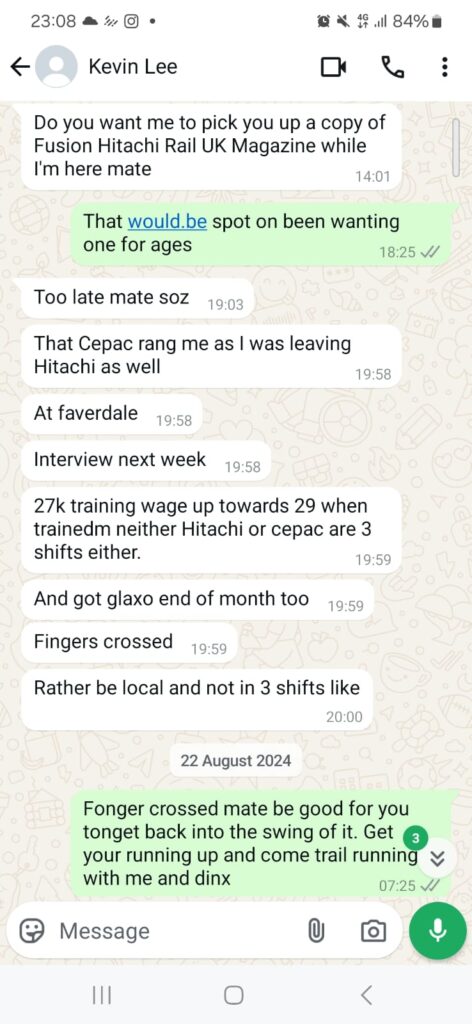
Caption : The same-day message recorded Page’s interview offer and wage discussion before any dispute or litigation existed.
Moreover, the recipient retained the exchange and later supplied a witness statement dated 20 February 2025 confirming its origin and context. Nobody was manufacturing evidence for a future case. I had received good news and told somebody about it.
Therefore, that ordinary message is why the later corporate history does not scan. Page discussed the interview and money. Meanwhile, mental health entered the conversation. The promised callback disappeared, but the first outcome remained on the phone.
Walker Scanned A Different Outcome
At 04:35 on 8 October 2024, I complained directly to Cepac. Specifically, the email described Page’s interview offer, the proposed timing after the bank holiday, the promised confirmation call, the questions about my employment gap and my disclosure that I had received treatment for a mental-health condition.
Five hours and seventeen minutes later, Maria Walker replied. First, she said Page had completed an initial telephone screening and sent several potential candidates’ CVs to Cepac. Walker then supplied the company’s replacement account: “I can see that your CV was sent to the recruiting manager with a group of potential candidates and unfortunately you were not shortlisted on that occasion.”
Moreover, she maintained that the recruiting manager would not have known about the mental-health information. Her apology concerned Page supposedly failing to explain that I had not secured an interview. Finally, Walker said my feedback would go to the agency “to avoid any future confusion”.
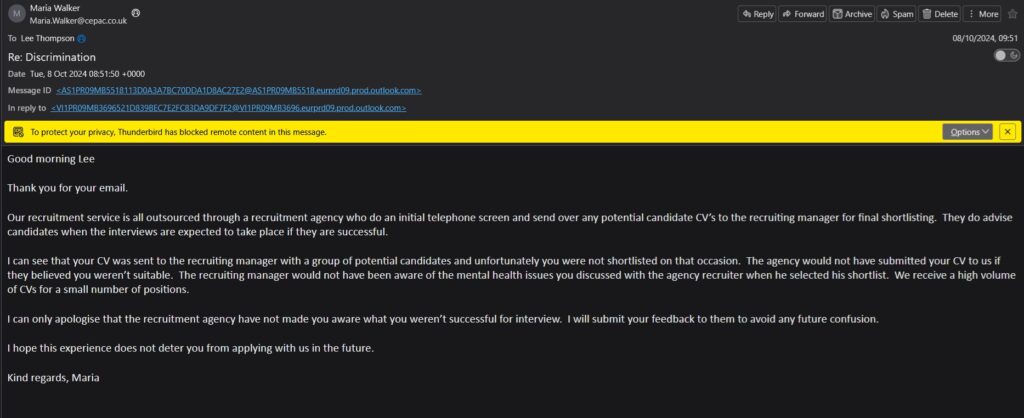
Crucially, Walker had not seen the WhatsApp receipt. Page offered the interview and discussed the salary. I disclosed my mental health. Afterward, the callback vanished. Cepac then changed the item from “interview offered” to “not shortlisted” before it knew the original outcome had been recorded that day.
Ultimately, confusion did not create two histories. It merely gave the second one a softer label.
The ET3 Put Health Back On The Belt
Cepac’s ET3 made Walker’s account harder to contain. Paragraph 12 distances the company from knowledge of my disability. However, paragraph 14 records recruitment information that I had spent around twelve months out of work because of health problems and felt ready to return.
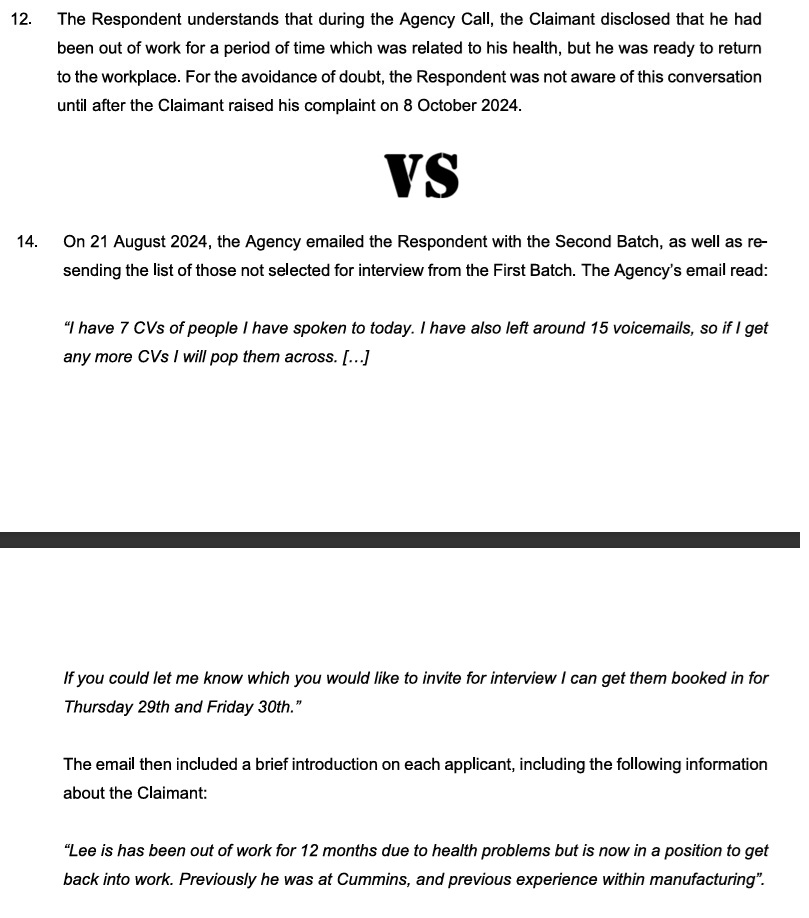
Caption : Paragraph 12 distances Cepac from disability knowledge while paragraph 14 places health-related work-gap information inside the recruitment account.
Consequently, the health information entered the chain through somebody. Page recorded it, transmitted it or placed it into material that later reached Cepac. Otherwise, Cepac could not have used that health-related account inside its own pleaded explanation.
Sainsbury’s policy supplies the audit list. First, obtain Page’s call notes, any recording, candidate-status history, access logs and communications with Cepac. Then establish what Walker reviewed before replying at 09:52. Finally, identify the source material behind paragraph 14 and compare it with the same-day message.
No merits hearing performed that exercise. Nobody questioned Page about the offer, required Walker to explain her evidence or established how health information crossed the recruitment chain. Instead, strike-out removed the hearing. It did not balance the fucking ET3.
The Suspected-Breach Clause Was Already Live
Sainsbury’s did not require a final court judgment before a supplier opened the reporting channel. Its June 2025 Ethical Sourcing Policy told suppliers to inform the retailer of challenges in adhering to the policy, including suspected or confirmed breaches of the Code of Conduct. Moreover, suppliers were expected to approach Sainsbury’s before concerns became risks.
By then, the allegation was hardly hiding in an unopened envelope. Cepac had received the complaint in October 2024. Walker had answered it. Meanwhile, the Employment Tribunal claim was live. Cepac had pleaded the health-information contradiction into its defence. The same-day WhatsApp and supporting witness statement were in the case.
The policy language matters because companies adore pretending due diligence begins only after somebody else has produced a final adverse judgment. However, Sainsbury’s wrote the opposite. Consequently, suspected breaches enter the system while they remain suspected, precisely because an investigation is supposed to establish what happened.
So did Cepac report the allegation while the 2025 policy operated? Did it disclose Walker’s answer, the WhatsApp record and the ET3 conflict? Did Sainsbury’s ask Page for the recruitment audit trail? If not, who decided that a live disability-discrimination case involving a named packaging company fell below the supplier-risk threshold?
The policy did not ask for certainty. It asked for the fucking alert.
Page Is Why The Agency Rule Exists
Sainsbury’s current policy recognises that third-party involvement increases recruitment risk. Therefore, it expects suppliers to use lawful recruitment agencies, cover those relationships through compliant service-level agreements and maintain effective oversight and due diligence over labour providers.
That clause lands directly on the Page-Cepac corridor. Page conducted the call, discussed the role and salary, received the health explanation and promised the confirmation. Afterward, Cepac adopted an account in which no interview had been secured. Nevertheless, the health-related work gap appeared inside Cepac’s ET3.
Therefore, this is exactly why a customer does not simply ask its direct supplier whether everything went well and tick “yes”. It examines the labour provider, the data route and the point at which candidate status changed. An agency arrangement does not dissolve responsibility. Instead, it creates another handover to audit.
Sainsbury’s can request the service agreement, recruitment standards, Page notes, candidate timeline and escalation record. Moreover, it can ask whether Cepac reviewed the agency after my complaint and whether Walker’s promised feedback produced any corrective action. Finally, it can compare those records with the WhatsApp evidence Walker had not seen.
The agency clause is already on the shelf. Open it.
The Grievance Route Became The Punishment
Sainsbury’s says concerns must be handled confidentially, promptly and without fear of retaliation. Moreover, it prohibits victimisation for raising a concern in good faith. Suppliers must investigate grievances, resolve root causes, centre the rightsholder and avoid obstructing access to judicial or non-judicial remedies.
Instead, Cepac chose the opposite route. It bullied me, entered my medical terrain and turned disability-related reactions into litigation stock. Acting for Cepac, Horsfield Menzies contacted my medical centre, investigated appointment availability and used the resulting information to oppose postponing a hearing. Consequently, medical evidence supplied to establish disability became a route into the practical details of accessing treatment.
Meanwhile, the respondents gathered roughly 150 communications and blog items plus 181 posts on X into a character case around one vanished interview. Pressure produced reactions. The reactions lost their medical and procedural context. Then they returned to the Tribunal labelled “conduct”.
Consequently, that is retaliation engineered through process. The complainant raised disability discrimination. Instead of resolving the recruitment contradiction, Cepac and its lawyers made the complainant expensive, distressed and controversial enough to remove.
Sainsbury’s policy says a grievance route must not impede access to remedy. However, Cepac converted the grievance into the reason the remedy never arrived.
Sainsbury’s Also Wrote The Legal-Attack Clause
The June 2026 policy goes further. Neither Sainsbury’s nor its suppliers should tolerate threats, intimidation, punitive action, surveillance or physical or legal attacks against human-rights defenders. Moreover, the protected category expressly includes people exercising freedom of expression or protesting against a business and individuals advocating over human-rights issues.
Cepac’s legal response was the attack. Specifically, the company spent more than £50,000 building a conduct route around a disability-discrimination complaint. Horsfield Menzies entered the healthcare relationship, opposed medical postponement, harvested public criticism and helped turn advocacy about the case into evidence against the person doing the advocating.
Consequently, TCAP exists because the underlying complaint was never answered on its merits. It publishes the recruitment records, supplier policies, procedural failures and corporate responses. Under Sainsbury’s own language, disability-rights advocacy does not lose protection because the company being criticised dislikes the tone or hires solicitors to catalogue it.
The policy does not say legal attacks become acceptable when a supplier calls them case management. Furthermore, it does not exempt punitive action because the target is angry. Nor does it authorise a £50,000 route for converting a human-rights complaint into a character trial.
Ultimately, Sainsbury’s wrote the clause. Cepac supplied the demonstration.
Newcastle Closed The Checkout
The institutional machinery Cepac exploited is documented in Newcastle Employment Tribunal : Deep Dive : Deliberate Maladministration, Disability Shaming, Judicial White Knights, Speed-reader Smith And The Horsfield Menzies Feeding Frenzy. Consequently, administrative failure and case management allowed conduct to replace the underlying disability claim.
Correspondence went to the wrong Tribunal office. The contents and visibility of a 1,941-page file remained unclear. Meanwhile, respondent material received rapid attention while claimant applications and medical context disappeared into procedural fog. Employment Judge T. R. Smith said he spent three hours reviewing that file and called me its “principle culprit”.
Three days before the decisive hearing, Employment Judge Brain refused the postponement required for safe participation. Then Employment Judge James heard the respondents without me on 24 April 2026, struck out the claims and ordered £20,000 in costs.
However, that outcome did not verify Walker’s answer. It did not erase the WhatsApp message, reconcile paragraphs 12 and 14 or establish why the promised confirmation disappeared. Nobody tested the recruitment trail on its merits.
Sainsbury’s incident process requires investigation, risk assessment, mitigation and remedy. Therefore, a strike-out obtained without the disabled claimant present is not a substitute for any of them.
Forty-Eight Hours Starts With The Current Answer
The June 2026 wording does not change what happened in 2024. However, it controls what a current supplier must do now. A supplier discovering a human-rights concern or incident must notify Sainsbury’s within 48 hours, while the retailer’s governance process determines escalation and action.
Therefore, Sainsbury’s should identify the present commercial relationship first. If Cepac remains a supplier, the current policy applies and the clock has an obvious input. If the relationship ended, Sainsbury’s can publish the date, the reason and whether any ethical review occurred before exit.
Next, Sainsbury’s should disclose whether Cepac ever reported the disability complaint, the litigation, Walker’s denial, the ET3 contradiction, the medical-centre contact or the allegations of retaliation. It should identify what entered its supplier records, who assessed it and whether Procurement, Technical or Human Rights personnel reviewed the file.
Finally, the retailer should state the remedy. Its policy says commercial relationships may be affected where cases are intentionally hidden, suppliers refuse to remediate or remediation fails to satisfy complainants. It also says decisions and remediation steps must be documented.
Consequently, the customer receipt needs a current date, the incident record needs an owner and the policy needs to leave the PDF.
The Scanner Has Been Fed
Part One put Cepac’s ET3 on the checkout. Now Part Two provides the evidence Sainsbury’s current system says it needs.
Unite placed Sainsbury’s inside Cepac’s customer list. Moreover, Page offered an interview and discussed a £27,000 training wage rising towards £29,000. I disclosed the mental-health reason for my employment gap. A same-day WhatsApp message preserved the offer before any dispute existed. Afterward, the promised callback vanished. Maria Walker then replaced the offered interview with a failure to shortlist before she knew that message existed. Finally, Cepac’s ET3 carried health information into the recruitment account while distancing the company from disability knowledge.
The complaint should have produced an investigation. Instead, Cepac spent more than £50,000 constructing a legal attack around the person who raised it. Horsfield Menzies entered my healthcare terrain. Newcastle proceeded without me. The recruitment evidence escaped a merits hearing.
Ultimately, Sainsbury’s has written every relevant rule itself: disability discrimination in hiring, oversight of agencies, confidential grievances, no retaliation, supplier incident reporting, a 48-hour deadline, remediation and no legal attacks against human-rights defenders. Its policy even identifies intentional concealment as conduct capable of affecting a commercial relationship.
Consequently, the checkout is no longer waiting for an item. The scanner has been fed.
Therefore, if the alarm stays silent now, the failure does not belong to a missing policy. It belongs to the people choosing not to operate it.
Lee Thompson – Founder, The Cummins Accountability Project
Source List
- Sainsbury’s : Human Rights Policy – June 2026
- Sainsbury’s : Ethical Sourcing Policy – June 2025
- Sainsbury’s : Modern Slavery Statement 2025-26
- Unite Live : Cepac Print Workers To Strike
- TCAP : The Cepac Files : Sainsbury’s, Disability Disasters And The Cardboard Chain
- TCAP : The Cepac Files : KFC II – Maria Walker And The Interview Receipt
- TCAP : Newcastle Employment Tribunal : Deep Dive : Deliberate Maladministration
- Employment Tribunal : Thompson v Cepac Limited And Page Outsourcing UK Limited
- TCAP case file: WhatsApp record dated 21 August 2024; email exchange between Lee Thompson and Cepac HR Business Partner Maria Walker dated 8 October 2024; supporting witness statement dated 20 February 2025; Cepac ET3 Grounds of Resistance; respondent costs schedules, submissions and medical-information correspondence.