The Swizzels Cepac supplier link sits inside Cepac’s own 2026 portfolio: a full Drumstick display on the shop floor. Meanwhile, Swizzels’ latest transparency statement says packaging suppliers identified as high risk must confirm compliance with its Supplier Code of Conduct every year. That code prohibits disability discrimination in hiring, harassment, verbal abuse and intimidation. Now the risk test meets Page Outsourcing’s interview offer, the mental-health disclosure, Maria Walker’s denial, the same-day WhatsApp receipt, Cepac’s ET3 contradiction and a legal campaign costing more than £50,000. Therefore, Swizzels can classify the supplier, retrieve the confirmation and show its work. Ultimately, the file could use a fucking Refresher.
The Swizzels Cepac Supplier Receipt Is A Drumstick Stand
First, Cepac published its POS Portfolio 2026 to advertise the retail displays it designs and manufactures. Indeed, page three carries a full Swizzels unit in the floor-standing display section. The Swizzels logo sits across the top while Drumstick and other familiar sweets fill the shelves below it.
Moreover, this is not a brand name recovered from a stale press cutting or an anonymous box spotted behind a warehouse. Instead, Cepac selected the finished work, photographed it and placed it inside its current portfolio. The Swizzels Cepac supplier receipt comes directly from the company seeking more display business.
Meanwhile, Swizzels calls itself the UK’s leading family-owned sugar-confectionery manufacturer. Its public history reaches back to 1928, while Drumstick, Love Hearts, Parma Violets and Refreshers form part of its modern brand cabinet. The company says respect, integrity, teamwork and positivity sit among its values.
Fine. Cepac has supplied the physical stand. By contrast, TCAP is supplying the evidential one.
Until now, Swizzels had never received a dedicated Cepac Files article. Therefore, it gets the complete recruitment and litigation chronology in its first bag: Page’s call, two WhatsApp lines, Walker’s denial, paragraphs 12 and 14, the medical-centre intrusion, the conduct dossier and the £50,000-plus route around a merits hearing.
The Headline Repeats Because The Failure Does
By now, part of this headline should feel familiar. Maria Walker. Two WhatsApp lines. Another customer policy waiting for the same evidence. However, that repetition is not a shortage of ideas. It is the fucking point.
Cepac keeps presenting branded packaging work while customer after customer publishes rules against disability discrimination, abusive treatment and supplier misconduct. For example, open a new code and the same recruitment file fits inside it. Change the sweets, change the display and change the procurement department. Nevertheless, the contradiction does not move.
Moreover, the repeated format gives every customer the same fair opportunity. Nobody needs to adopt TCAP’s language or accept a pre-written conclusion. Instead, each business can collect the underlying records, test the competing accounts and apply the standard it chose to publish.
Swizzels receives an especially clean version of that test. Its policy does not merely celebrate diversity in a general paragraph. Clause 7.1 names disability and hiring. Clause 9.1 names harassment, verbal abuse and intimidation. Its latest modern-slavery statement then places high-risk packaging suppliers inside an annual confirmation process.
Consequently, the question is no longer whether Swizzels has a policy. The question is whether its purchasing machinery can recognise a supplier problem when the Drumstick stand arrives carrying one.
Swizzels Wrote The High-Risk Branch
First, Swizzels says the greatest modern-slavery risk in its business sits within purchasing supply chains because those operations fall outside its direct control. Its due-diligence process therefore focuses on suppliers in high-risk areas and countries with lower social and environmental standards than the United Kingdom.
Then the statement narrows the mechanism. Specifically, packaging and food-ingredient suppliers identified as high risk must confirm compliance with the Swizzels Supplier Code of Conduct annually. That code includes no discrimination or harassment. Moreover, Swizzels says it will terminate contracts and stop doing business with suppliers that fail to comply.
Consequently, the wording creates two branches, and Cepac belongs on one of them. If Swizzels classified Cepac as high risk, it can produce the annual confirmations, the questions asked and the records supporting acceptance. Alternatively, if procurement treated Cepac as low risk, it can explain whether geography carried more weight than actual conduct.
That distinction matters. A UK postcode may reduce exposure to some supply-chain abuses. However, it does not answer a documented disability-discrimination dispute, contradictory recruitment information, medical-centre contact or allegations that a supplier turned disability-related reactions into litigation ammunition.
Therefore, TCAP is not pretending that Swizzels already labelled Cepac high risk. TCAP is asking whether a risk process built around location can see the fucking risk standing in front of it.
The Code Arrived Between The Call And The Denial
First, the current Swizzels Supplier Code carries an issue date of 10 September 2024 and an effective date of 12 September. That places it three weeks after the Page Outsourcing call and nearly four weeks before Maria Walker answered my complaint.
Accordingly, the code did not travel backwards and regulate the original conversation on 21 August. It did, however, exist before Cepac supplied its formal October explanation. More importantly, it remained in force throughout the ensuing Tribunal defence, the costs pressure, the conduct dossier, the medical-centre intrusion and the strike-out campaign.
Moreover, its approval trail is unusually concrete. Technical Services Manager Lynda Hallam originated the document. Next, Purchasing Director Jonathan Dee approved it. Head of Operations Paul Harvey authorised it. The code therefore did not drift onto the website from an anonymous ESG department. Instead, named operational and purchasing figures put it into effect.
Later, Managing Director Jeremy Dee signed the transparency statement for the financial year ending 31 December 2025. That statement repeated the annual-confirmation mechanism and the promise to terminate non-compliant suppliers.
So Swizzels cannot dismiss the policy as a vintage document from before the problem. Indeed, the code arrived while the chronology was still unfolding, and its latest board-approved statement carried the same mechanism into 2026.
The question is what procurement did with it.
Clause 7.1 Names Disability In Hiring
Specifically, clause 7.1 could hardly fit the underlying allegation more precisely. Swizzels requires no discrimination in hiring, compensation, training, promotion, termination or retirement on grounds including disability.
Hiring. Disability. Two words printed next to each other inside the supplier code.
Meanwhile, Page Outsourcing occupied the recruitment corridor between me and Cepac. On 21 August 2024, Page called about a production role, offered an interview for the week after the bank holiday and discussed a £27,000 training wage rising towards £29,000. During the same conversation, I explained that mental-health treatment accounted for the lengthy gap in my employment.
Next, Page said my information would go forward and another call would confirm an exact, mutually agreeable interview time. That confirmation never arrived. Cepac later replaced the offered interview with a failure to shortlist.
Consequently, Swizzels does not need to solve an abstract question about inclusive culture. It can request Page’s call notes, candidate-status history, internal messages and audit trail. It can establish what Page recorded, what travelled to Cepac, when the status changed and why the promised callback disappeared after the health disclosure.
Ultimately, the supplier code supplies the standard. Page and Cepac hold the records. Clause 7.1 only needs somebody at Swizzels to connect the fucking ingredients.
Two Lines Before Anybody Needed A Case
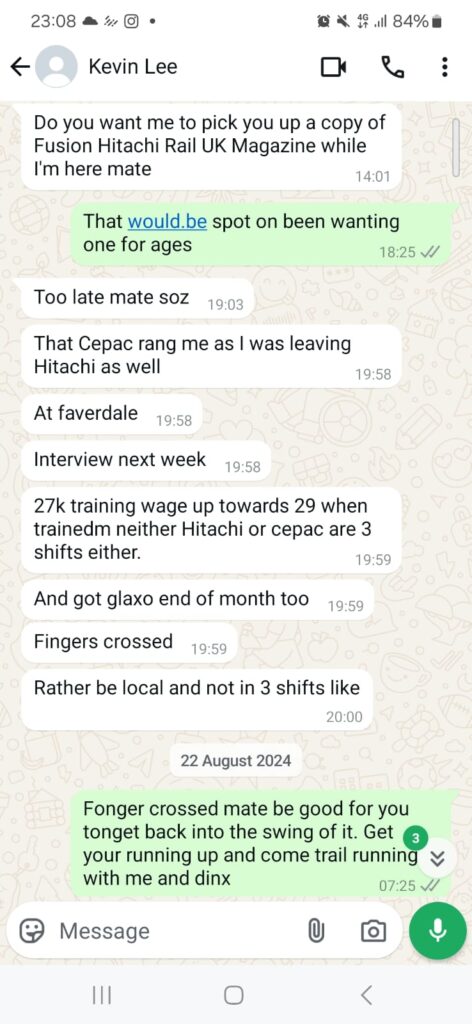
Later on 21 August, I sent a WhatsApp message recording the news from Page:
“Interview next week”
“27k training wage up towards 29”
Moreover, the recipient retained that conversation and later supplied a witness statement dated 20 February 2025 confirming its origin and context. Crucially, the message predates my complaint to Cepac, the ACAS process, the Tribunal claim and TCAP itself.
Nobody was preparing litigation that afternoon. Nor did anybody expect Maria Walker to deny the offer seven weeks later. I had received good news, so I told somebody about it in the ordinary language people use when an interview and wage have just been discussed.
Consequently, that timing gives the record its force. The message did not emerge after the dispute and reshape itself around a legal theory. Instead, it existed before there was any reason to manufacture one.
Accordingly, Swizzels can place those two lines beside Page’s system data. If the supplier and agency records tell a different story, procurement can ask why the contemporaneous message got there first.
Maria Walker Changed The Mix At 09:52
First, at 04:35 on 8 October 2024, I complained directly to Cepac. The email described the offered interview, its expected timing after the bank holiday, the promised confirmation call, the discussion about my employment gap and the mental-health disclosure.
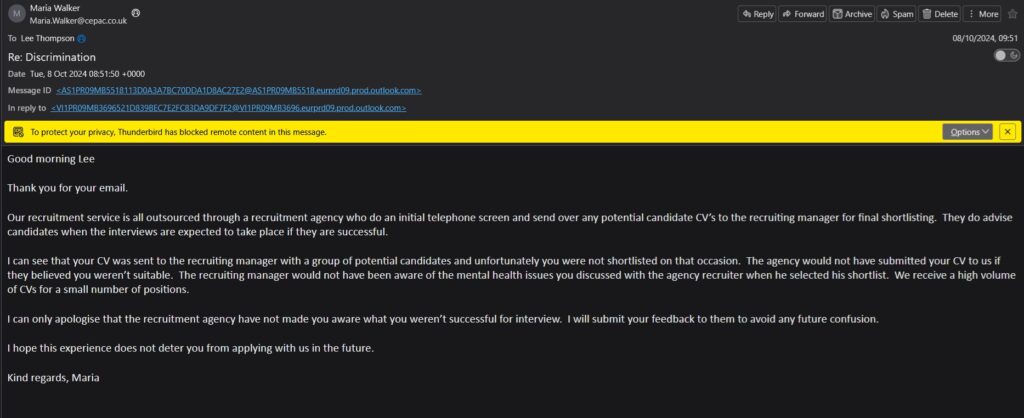
Next, Cepac HR Business Partner Maria Walker replied at 09:52, five hours and seventeen minutes later. She said Page had screened potential candidates and sent CVs to Cepac. Then she supplied a different outcome:
“I can see that your CV was sent to the recruiting manager with a group of potential candidates and unfortunately you were not shortlisted on that occasion.”
Walker maintained that the recruiting manager would not have known about the mental-health information. Moreover, she apologised because Page had supposedly failed to explain that I had not secured an interview. The clash between an offered interview and no shortlist became “confusion”.
Yet Walker had not seen the WhatsApp record when she answered. Therefore, the sequence stays stubbornly simple: Page offered the interview, I disclosed my mental health, the confirmation vanished and Cepac denied the offer before it knew the original account had survived in writing.
Swizzels asks suppliers to prevent disability discrimination in hiring. It can start by asking what Walker reviewed before 09:52.
Paragraph 14 Is The Missing Ingredient
Later, Cepac’s ET3 tried to distance the company from disability knowledge. Paragraph 12 forms that part of the defence. However, paragraph 14 records recruitment information that I had spent around twelve months out of work because of health problems and felt ready to return.
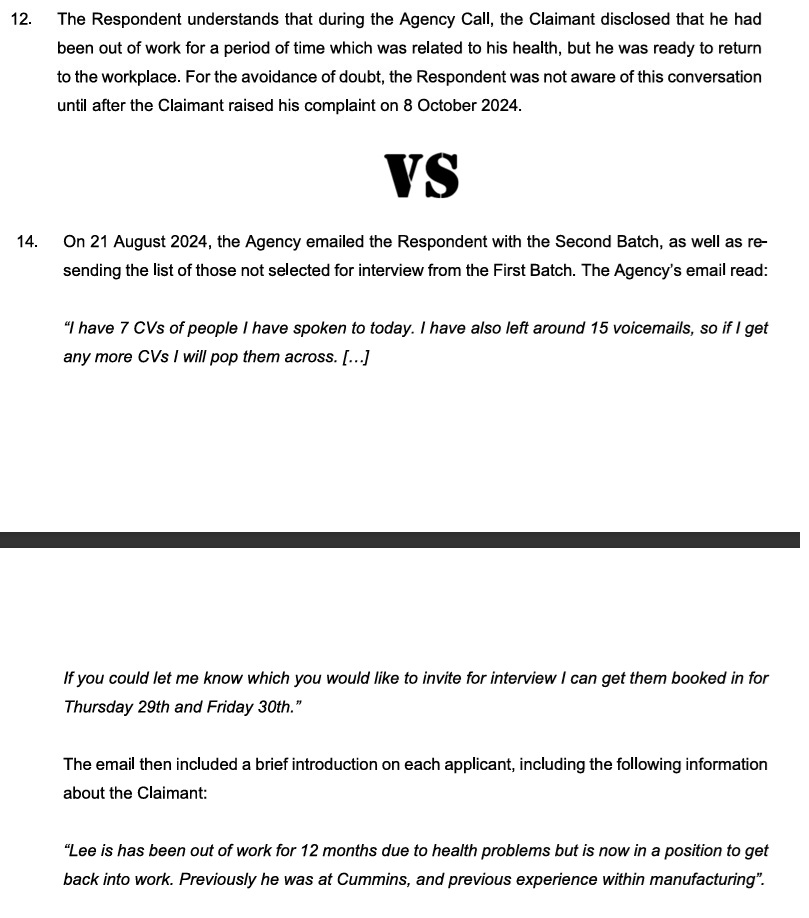
Crucially, health information did not walk into the pleading alone. Somebody recorded it, transmitted it or placed it inside material later used by Cepac and its lawyers. Otherwise, paragraph 14 could not deploy the information while paragraph 12 kept the relevant knowledge at arm’s length.
Therefore, the recruitment audit has four basic questions. What did Page record during the call? Who could access it? What reached Cepac before Walker replied? Where did the wording in paragraph 14 originate?
Ultimately, those questions should have reached disclosure, witnesses and cross-examination at a merits hearing. Instead, Cepac spent more than £50,000 building another route through the case.
Swizzels’ code says no disability discrimination in hiring. Paragraphs 12 and 14 are the quality-control sample sitting at the end of that sentence.
Clause 9.1 Meets The Pressure Campaign
However, Swizzels did not stop at recruitment. Clause 9.1 prohibits physical abuse, threats, harassment, verbal abuse and other forms of intimidation. The wording matters because Cepac’s response to the complaint became a campaign against the complainant.
For example, in March 2025, Horsfield Menzies estimated Cepac’s costs at £25,000 to £30,000 and offered not to pursue them if the discrimination claim disappeared. The firm directed that pressure at a disabled litigant in person who had already explained financial hardship, worsening mental health and serious participation difficulties.
Next, Cepac gathered correspondence, complaints, TCAP articles and posts on X into a 191-page conduct dossier. Its lawyers detached my reactions from the disability, pressure and procedural failures surrounding them. Afterwards, they presented those reactions as free-standing misconduct and argued that the original discrimination claim should never receive a merits hearing.
Ultimately, Cepac chose to bully me, weaponise my disability-related responses and turn the grievance inside out. The recruitment evidence moved towards the back of the bag. My reaction to the process became the product displayed at the front.
Consequently, Swizzels has another direct compliance question. When its code prohibits harassment and intimidation, does that prohibition reach a supplier’s treatment of a disabled complainant, or does it expire as soon as solicitors put the pressure on headed paper?
The Medical Centre Was Not A Pick And Mix
Moreover, Horsfield Menzies contacted my medical centre for Cepac, investigated appointment availability and used the result to oppose a postponement. I supplied medical evidence to establish disability and explain why safe participation required an adjustment. That disclosure did not turn my healthcare relationship into a pick and mix counter for opposing solicitors.
The firm maintained that the medical centre disclosed no private medical information. However, that answer steps around the conduct. Indeed, Cepac’s representatives contacted a healthcare provider because they wanted information capable of defeating a disability-related request.
Meanwhile, the broader strategy followed a consistent recipe. Use medical evidence when acknowledging disability serves the procedural case. Investigate access to treatment when additional pressure may help. Then remove disability and medical deterioration from the reactions eventually shown to the Tribunal.
Swizzels’ code does not contain a bespoke candidate-privacy clause. Nevertheless, it prohibits intimidation and inhumane treatment, while the company’s wider statement promises ethical conduct throughout its business relationships. Therefore, the medical-centre correspondence belongs in any honest assessment of those commitments.
Accordingly, Swizzels can request every instruction, email, attendance note and submission connected with that contact. It can ask who authorised the step, what assessment occurred and why Cepac considered it appropriate.
Ultimately, that is due diligence. Everything else is sugar coating.
More Than £50,000 Bought The Detour
Eventually, Cepac’s combined costs schedules exceeded £50,000. Yet nobody cross-examined Page about the interview offer. Nobody required Walker to reconcile her denial with the same-day message. Nor did the proceedings produce a tested explanation for the health information inside paragraph 14.
Instead, the money followed the conduct strategy. Lawyers collected material, opposed adjustments, entered my medical terrain and built an argument for ending the claim before witnesses addressed the recruitment facts. Pressure produced reactions. Cepac preserved those reactions, stripped away their context and sold the edited version back to the Tribunal as the reason a fair hearing could not take place.
Ultimately, on 24 April 2026, Newcastle Employment Tribunal proceeded without me, struck out the claims and later ordered £20,000 in costs. It never decided whether Page offered the interview, why the callback vanished, what health information travelled through the recruitment chain or whether disability influenced the outcome.
Therefore, resources were never the problem. Cepac chose where to spend them. A fraction of the legal budget could have obtained Page’s audit trail and tested Walker’s answer. Instead, more than £50,000 helped build the detour around both.
Apparently, the sweetest result was the one that never reached the fucking recipe.
Newcastle Never Tested The Recipe
Meanwhile, the institutional machinery appears in Newcastle Employment Tribunal : Deep Dive : Deliberate Maladministration, Disability Shaming, Judicial White Knights, Speed-reader Smith And The Horsfield Menzies Feeding Frenzy. Newcastle’s administration and case management created the conditions in which Cepac’s conduct dossier displaced the recruitment evidence.
For example, correspondence went to the wrong Tribunal office, while the contents and visibility of a file approaching two thousand pages remained unclear. Respondent material received prompt attention. Meanwhile, claimant applications, medical context and complaints disappeared into procedural fog.
Furthermore, Employment Judge T. R. Smith said he spent three hours reviewing a 1,941-page file and called me its “principle culprit”. Three days before the decisive hearing, Employment Judge Brain refused the postponement required for safe participation. Employment Judge James then heard the respondents without me.
However, strike-out did not authenticate Walker’s version. It did not reconcile paragraphs 12 and 14 or erase a message sent on the day of the Page call. Newcastle ended the case before anybody tested the centre of it.
Consequently, Swizzels cannot outsource its supplier assessment to that procedural result. Its own code demands a separate answer about discrimination in hiring and intimidation. The Tribunal never supplied one.
Three Names Signed The Supplier Code
Finally, Swizzels’ policy document ends with three named lines. Lynda Hallam originated it. Jonathan Dee approved it. Paul Harvey authorised it. Jeremy Dee later signed the annual transparency statement on behalf of the board.
Consequently, those signatures turn the current problem into an organisational question. Who owns the assessment when public evidence raises an issue about a packaging supplier? Is the code reviewed by purchasing, operations, technical services or the board? More importantly, which function retrieves the annual confirmation and tests it against later information?
The document requires suppliers to provide proof on environmental matters when Swizzels asks. Its modern-slavery statement also describes supplier confirmation and termination. Therefore, the company plainly understands how to demand records and attach commercial consequences.
Accordingly, Cepac’s file needs the same seriousness. Obtain the recruitment audit trail. Compare the WhatsApp evidence with Walker’s denial. Trace the health information used in paragraph 14. Inspect the medical-centre contact, conduct dossier and costs schedules. Then decide whether any supplier confirmation remains accurate.
Ultimately, this is not a request for Swizzels to accept TCAP’s conclusion by return email. It is a demand that the people named around the policy use the machinery they signed.
Otherwise, three signatures become three decorative sweets stuck to the outside of an empty fucking box.
Classify Cepac And Show Your Work
The next steps fit comfortably on one purchasing file. First, Swizzels should identify every current relationship with Cepac, including the relevant contract, facility, product, dates and supply-chain tier. Cepac’s 2026 portfolio establishes branded work; Swizzels can establish the commercial detail.
Second, procurement should state whether it classified Cepac as high risk. If it did, Swizzels can produce the annual compliance confirmations and explain how it verified them. If it did not, the company can show the criteria used and say whether this evidence triggers reassessment.
Third, investigators should collect Page’s call records, candidate-status history and communications. They can identify what Maria Walker reviewed, trace paragraph 14’s health information and inspect the later legal campaign. Finally, Swizzels can determine whether clauses 7.1 and 9.1 survived contact with the facts.
Moreover, no customer needs a Tribunal judgment on the merits before examining its own supply chain. Commercial due diligence exists precisely because a company may need to understand risk before another institution hands it a tidy final answer.
Therefore, silence is not a classification. A supplier code is not an investigation. Annual confirmation is not verification unless somebody compares the supplier’s promise with the available evidence.
Ultimately, Cepac supplied the display. Swizzels supplied the test. Show us the fucking working.
Give The Supplier File A Refresher
First, the chronology is no more complicated than the ingredients on a sweet wrapper. On 21 August 2024, Page offered an interview and discussed a £27,000 training wage rising towards £29,000. I disclosed that mental-health treatment explained my work gap. A same-day WhatsApp message recorded the interview and money before any dispute existed.
Then the promised confirmation vanished. Maria Walker denied that I had secured an interview before she knew the contemporaneous record existed. Cepac’s ET3 distanced the company from disability knowledge while placing health information inside its recruitment account.
Afterwards, Cepac bullied me, invaded my medical privacy, assembled a 191-page conduct dossier and spent more than £50,000 turning disability-related reactions into an escape route. Newcastle struck out the claim without deciding the recruitment facts.
Swizzels’ code now sits across that record. Clause 7.1 prohibits disability discrimination in hiring. Clause 9.1 prohibits harassment, verbal abuse and intimidation. Its latest statement requires annual confirmation from packaging suppliers identified as high risk and promises termination for non-compliance.
Meanwhile, Cepac’s own 2026 portfolio displays the Swizzels Drumstick stand. Nobody dragged the brand into this file. Cepac carried it in and photographed the delivery.
Ultimately, Swizzels has spent nearly a century making Refreshers. Procurement can finally use one. Classify the risk, retrieve the confirmation, inspect the evidence and decide whether the supplier code means what it says.
The Love Hearts can keep the slogans. This one only needs four words.
Show your fucking working.
Lee Thompson – Founder, The Cummins Accountability Project
Source List
- Cepac – POS Portfolio 2026
- Swizzels Matlow – Supplier Code Of Conduct
- Swizzels Matlow – Modern Slavery Act Transparency Statement For The Financial Year Ended 31 December 2025
- Swizzels Matlow – About Us
- Swizzels Matlow – Drumstick
- TCAP – The Cepac Files : KFC II – Maria Walker And The Interview Receipt
- TCAP – Newcastle Employment Tribunal : Deep Dive – Deliberate Maladministration
- Employment Tribunal – Thompson v Cepac Limited And Page Outsourcing UK Limited
- TCAP case file: WhatsApp record dated 21 August 2024; email exchange between Lee Thompson and Cepac HR Business Partner Maria Walker dated 8 October 2024; supporting witness statement dated 20 February 2025; Cepac ET3 Grounds of Resistance; respondent costs schedules, submissions and medical-information correspondence.