
McCain’s published supplier code requires responsible recruitment, prohibits disability discrimination in hiring, demands accurate information about wages and work, and lets McCain inspect the records. Its human-rights policy promises prompt investigations and corrective action when adverse impacts arise through business relationships. Cepac’s recruitment trail now includes Page’s same-day WhatsApp receipt, Maria Walker’s 09:52 denial and an ET3 that distances the company from disability knowledge while carrying health information into its defence. McCain wrote the specification. The disputed batch is ready for inspection.
Part One Opened The Freezer
Part One, The Cepac Files : McCain, Cepac And The Disability Discrimination Freezer, put Page Outsourcing’s interview call, the same-day WhatsApp message and Cepac’s ET3 beside McCain’s supplier promises. It also examined McCain’s wider corporate record. However, that work established the context without placing one crucial document inside the freezer.
Consequently, Maria Walker’s email changes the evidential temperature. At 09:52 on 8 October 2024, Cepac’s HR Business Partner said I had never been shortlisted for an interview. She supplied that answer before seeing the WhatsApp record made on the day Page offered it. Her explanation therefore arrived without the one document capable of checking the label Cepac had placed on the recruitment decision.
Therefore, Part Two has a narrower and sharper job. It does not reheat McCain’s historical controversies or repeat every argument from Part One. Instead, it follows one candidate record from Page’s call to Walker’s denial, into Cepac’s pleaded defence and through the legal campaign that prevented a merits hearing.
Meanwhile, McCain’s own code calls this responsible recruitment. It requires professional practice, accurate information, non-discrimination, documentation, verification and immediate corrective action. Fine. Let us run the fucking batch.
The Brand-Partner Receipt Has A Date
The direct public commercial receipt is a Food Chain Magazine video titled Cepac & McCains Brand Partner Video. Specifically, the 2023 publication presents the two companies as brand partners rather than leaving TCAP to infer a relationship from a stray carton or an anonymous display.
However, that receipt proves the relationship at the time of publication. It does not independently establish whether Cepac still supplies McCain in August 2026. The distinction matters because accountability publishing should demand missing commercial facts, not manufacture them. McCain and Cepac hold the purchase orders, supplier approvals and end dates. They can provide the current answer.
If the relationship ended, McCain can state when, why and whether the supplier file received any review. If it continues, the company can identify the relevant contracts, facilities and supply-chain tier. Should Cepac reach McCain indirectly through another business, McCain’s procurement records should trace that route too.
Nevertheless, either answer leaves the historical partnership and supplier-governance question intact. McCain associated its brand with Cepac publicly. The first article then placed the discrimination evidence into that relationship. Now Part Two adds the HR denial and asks whether McCain’s audit promises can move faster than frozen silence.
The packet has a production date. McCain now needs to show the traceability record.
McCain Wrote A Responsible-Recruitment Specification
McCain’s Supplier Code of Conduct contains a section called “Responsible recruitment”. Suppliers must demonstrate professional, ethical, safe, secure and responsible recruitment practices. In addition, they must give candidates accurate details about the nature of the work, wages, benefits and contract duration at recruitment.
The code then defines employment discrimination as a distinction, exclusion or preference affecting recruitment or hiring because of characteristics unrelated to the job. Disability appears expressly in the prohibited list. McCain also says suppliers must avoid abusive or degrading treatment and every form of harassment.
Most importantly for this file, suppliers must maintain documentation proving compliance. Moreover, McCain can demand that proof, visit sites and inspect operations through its own personnel or designated agents. Consequently, a supplier that breaches the code must notify McCain and implement corrective action immediately. McCain reserves the right to terminate the agreement.
Meanwhile, McCain’s Global Human Rights Policy promises targeted internal and external audits. Specifically, it says the company will address adverse impacts arising directly or indirectly through business relationships when somebody brings them to its attention. Complaints submitted through its reporting mechanisms receive prompt investigation and appropriate corrective action.
Therefore, that language produces a simple specification. Recruitment facts go in. Accurate records stay attached. Complaints trigger investigation. Contradictions require correction. The supplier does not get to scrape off the original label, print another one five weeks later and call the difference confusion.
Page Created The Original Batch Record
On 21 August 2024, Page Outsourcing called me about a production role at Cepac. During that conversation, Page offered an interview for the week after the bank holiday and discussed a £27,000 training wage rising towards £29,000. In addition, I explained that treatment for my mental health accounted for the lengthy gap in my employment.
Page said my details would go forward and that another call would confirm an exact, mutually agreeable interview time. The promised confirmation never arrived.
Nevertheless, the first call left a contemporaneous record. Specifically, a WhatsApp exchange made on 21 August, before any complaint, ACAS notification, Employment Tribunal claim or TCAP article existed, preserved two short lines:
“Interview next week”
“27k training wage up towards 29”
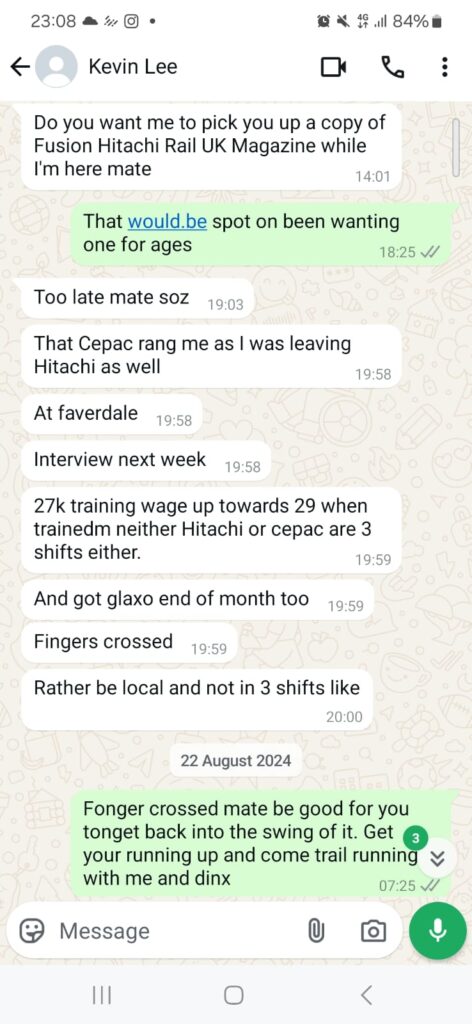
The recipient retained the exchange and later supplied a witness statement dated 20 February 2025 confirming its origin and context. At the time, nobody needed to anticipate a legal dispute. I had received good news and told somebody about it.
That ordinary message became the batch record Cepac could not retrospectively rewrite. Page had discussed the interview and the money. Then it learned about my mental health. Afterward, the promised confirmation disappeared.
Walker Applied A Different Label At 09:52
At 04:35 on 8 October 2024, I complained directly to Cepac. The email described Page’s offer, the planned interview after the bank holiday, the promised arrangement call, the questions about my employment gap and the disclosure that I had received treatment for a mental-health condition.
Five hours and seventeen minutes later, Cepac HR Business Partner Maria Walker replied. She said Page had completed an initial telephone screening and forwarded several potential candidates’ CVs to Cepac. Then she supplied the company’s replacement account:
“I can see that your CV was sent to the recruiting manager with a group of potential candidates and unfortunately you were not shortlisted on that occasion.”
Walker maintained that the recruiting manager would not have known about my mental-health information. Her apology concerned Page supposedly failing to tell me that I had not secured an interview. Finally, she promised to send my feedback to the agency “to avoid any future confusion”.
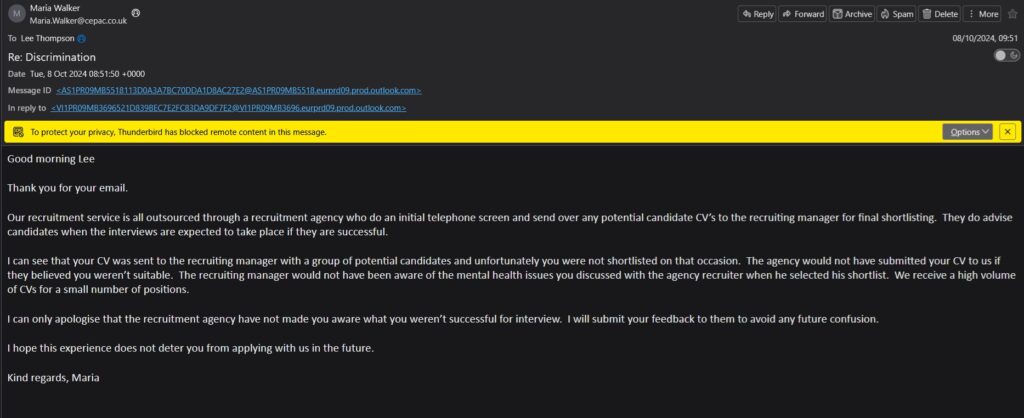
Crucially, Walker had not seen the WhatsApp receipt. Page offered the interview and discussed the salary. I disclosed my mental health. The confirmation vanished. Cepac later relabelled the offer as a failure to shortlist without first accounting for the contemporaneous record.
Therefore, this is not a minor packaging discrepancy. It is the factual centre of the complaint McCain’s code says a responsible supplier must document and investigate.
The ET3 Carries Both Labels
Cepac’s ET3 later deepened the contradiction. Paragraph 12 distances the company from knowledge of my disability. Paragraph 14 then records recruitment information that I had spent around twelve months out of work because of health problems and felt ready to return.
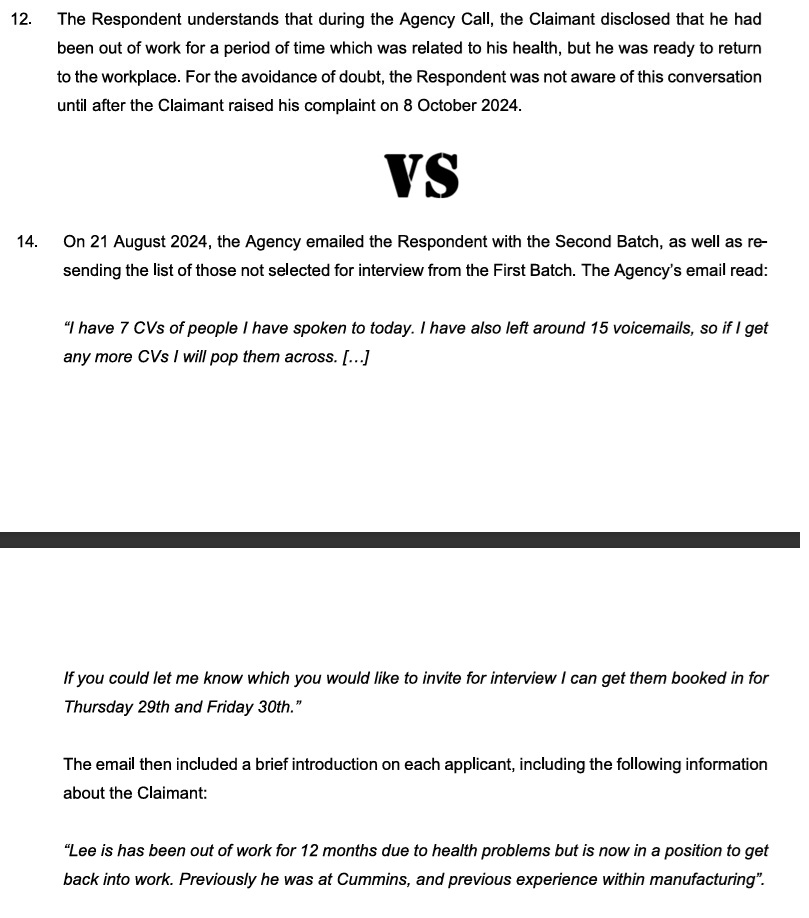
That health information entered the recruitment chain through somebody. Page recorded it, transmitted it or placed it into material that later reached Cepac. Otherwise, Cepac could not have deployed the information inside its own pleaded account of the recruitment process.
The questions are basic traceability. What did Page record during the 21 August call? Who could access it? When did the candidate status change? What reached Cepac before Walker replied at 09:52? Which document or person supplied the wording in paragraph 14? Why did the confirmation disappear after Page learned that my work gap related to mental health?
A merits hearing could have tested every point through disclosure and witness evidence. Walker could have explained what she reviewed. Page could have produced its call notes, status history and audit trail. Instead, the respondents built a procedural route around the recruitment evidence.
Consequently, McCain’s code requires suppliers to preserve compliance records. The ET3 is not the final answer. It is the flashing fault code that tells procurement which records to open next.
McCain Can Demand The Complete Production Record
McCain does not need a speculative inquiry. Its supplier code already authorises a documentary inspection, and the file identifies the precise records required.
First, McCain can obtain Page’s call notes, candidate-status history, any available recording, communications with Cepac and the complete recruitment-system audit trail. Those records should reveal when Page entered the interview, when anybody changed the status and what information travelled with my CV.
Next, McCain can ask Cepac for everything Walker reviewed before replying at 09:52 on 8 October. That includes the material supporting her statement that I had not been shortlisted, the basis for saying the manager lacked the health information and the internal communications generated after my 04:35 complaint.
Then procurement can trace paragraph 14. Cepac should identify the source, author and route of the health-related wording in its ET3. McCain can compare that answer with paragraph 12, Walker’s email, Page’s data and the WhatsApp receipt.
Finally, McCain can establish whether Cepac reported the complaint, the Employment Tribunal proceedings or any possible breach of the supplier code. If the commercial relationship continued, which McCain function monitored it? If the work ended, did the exit follow an ordinary purchasing decision or any assessment of this case?
McCain already requires documentation, proof and verification. This is not a fishing expedition. The lot numbers are written on the fucking evidence.
Human Resources, Procurement And Legal Own The Problem
McCain’s Global Human Rights Policy does something unusually helpful. It names the corporate owners. The Chief Human Resources Officer and Chief Procurement Officer own the policy, consulting the Vice-President for Global External Affairs and Sustainability and the Chief Legal Officer.
That governance map removes the familiar supplier-code fog. Specifically, Human Resources owns the recruitment and disability implications. Procurement owns the supplier relationship and the contractual leverage. Legal owns the complaint route and the integrity of any response. External Affairs owns the gap between McCain’s public values and what happens after somebody presents evidence against a brand partner.
The same policy promises targeted audits and action on adverse impacts connected directly or indirectly to business relationships. It also says all complaints received through McCain’s reporting mechanisms receive prompt investigation and appropriate corrective action. A supplier breach should produce immediate correction, while non-compliance can end the agreement.
Therefore, nobody needs to wait for another department to discover the freezer key. The policy has already allocated it.
Ultimately, the practical test is whether those executives receive the complete evidence or a procurement summary chilled until every sharp edge disappears. Walker’s denial, the WhatsApp receipt and paragraphs 12 and 14 must travel together. Separating them would reproduce the very record failure McCain claims to audit.
This is no longer an abstract values debate. It is a named governance process confronting a dated complaint, three visible documents and a supplier account that does not balance.
Cepac Spent More Than £50,000 Freezing The Merits
The recruitment dispute did not proceed towards an ordinary merits decision. Instead, Cepac and Horsfield Menzies helped transform it into a case about my conduct while the original documents waited outside the decisive frame.
In March 2025, Horsfield Menzies estimated Cepac’s costs at £25,000 to £30,000 and offered not to pursue them if the claim disappeared. The firm addressed that pressure to a disabled litigant in person who had reported financial hardship, deteriorating mental health and difficulty participating safely.
The operation then expanded. Cepac’s side gathered correspondence, complaints, TCAP articles and posts on X into a 191-page conduct dossier. Its combined costs schedules eventually exceeded £50,000. Meanwhile, nobody cross-examined Page about the offered interview, asked Walker to reconcile her denial with the WhatsApp or traced the health information inside paragraph 14.
Horsfield Menzies also contacted my medical centre, investigated appointment availability and used the resulting information to oppose a postponement. The firm said the centre disclosed no private medical information. That answer does not explain why Cepac’s solicitors entered the healthcare relationship or treated access to treatment as ammunition against moving the hearing.
The strategy was commercially effective. Pressure produced reactions. Lawyers collected the reactions, removed the medical and procedural context, labelled them conduct and used the package to seek an exit before the recruitment evidence reached trial.
Moreover, McCain calls for ethical practice and respect for human rights. Cepac spent more than £50,000 making the disabled complainant easier to inspect than its own recruitment records.
Newcastle Broke The Cold Chain
The institutional machinery appears in full in Newcastle Employment Tribunal : Deep Dive : Deliberate Maladministration, Disability Shaming, Judicial White Knights, Speed-reader Smith And The Horsfield Menzies Feeding Frenzy. Administrative and case-management failures created the conditions in which the conduct dossier could displace the disability-discrimination claim.
The Tribunal directed correspondence to the wrong office, left the contents and visibility of a file approaching two thousand pages unclear and responded quickly to respondent material while claimant applications disappeared into procedural fog. Employment Judge T. R. Smith said he spent three hours reviewing a 1,941-page file and called me its “principle culprit”. Three days before the decisive hearing, Employment Judge Brain refused the postponement required for safe participation.
On 24 April 2026, Employment Judge James heard the respondents without me. He struck out the claims and later ordered £20,000 in costs. However, the Tribunal never decided whether Page offered the interview, why the confirmation vanished, what health information moved through the recruitment chain or whether disability influenced the outcome.
Strike-out did not verify Walker’s email or reconcile the ET3. It ended the process before those documents received a merits finding.
Newcastle broke the evidential cold chain. Cepac and Horsfield Menzies filled the gap with a character case, then pointed to the procedural result as though it certified the original recruitment decision. Consequently, McCain’s audit cannot honestly repeat that shortcut.
McCain Can Inspect It Or Keep The Code Frozen
The sequence now fits on one production sheet. Page called on 21 August 2024, offered an interview, discussed the wage and learned that my employment gap related to mental health. A same-day WhatsApp message preserved the offer. The promised confirmation never came. When I complained, Maria Walker replaced the interview with a failure to shortlist before she knew the receipt existed.
Cepac’s ET3 later distanced the company from disability knowledge while using health information from the recruitment chain. Rather than test those facts at trial, the respondents spent more than £50,000 building a conduct case. Horsfield Menzies entered my medical terrain, the Tribunal proceeded without me and the underlying discrimination claim never received a merits decision.
McCain’s published rules cover each stage. Responsible recruitment must be professional and ethical. Hiring must remain free from disability discrimination. Candidates must receive accurate wage and work information. Suppliers must retain documentation, demonstrate compliance and correct breaches immediately. McCain promises targeted audits and prompt investigation when business relationships produce adverse human-rights impacts.
The company can now disclose the current commercial status, inspect the Page and Cepac records, publish its findings and identify the corrective action. If the relationship ended, McCain can still say what it learned and whether its supplier controls worked. If it continues, silence becomes a procurement decision with a timestamp.
McCain built an entire brand around dependable frozen production. Here is the batch it cannot leave in cold storage. Finally, the evidence has thawed, the labels conflict and the audit light is already on.
Lee Thompson – Founder, The Cummins Accountability Project
Sources
- McCain Foods: Supplier Code Of Conduct
- McCain Foods: Global Human Rights Policy
- Food Chain Magazine: Cepac & McCains Brand Partner Video
- TCAP : The Cepac Files: McCain, Cepac And The Disability Discrimination Freezer
- TCAP : Newcastle Employment Tribunal: Deep Dive : Deliberate Maladministration
- Employment Tribunal: Thompson v Cepac Limited And Page Outsourcing UK Limited
- TCAP case file: WhatsApp record dated 21 August 2024; email exchange between Lee Thompson and Cepac HR Business Partner Maria Walker dated 8 October 2024; supporting witness statement dated 20 February 2025; Cepac ET3 Grounds of Resistance; respondent costs schedules, submissions and medical-information correspondence.