
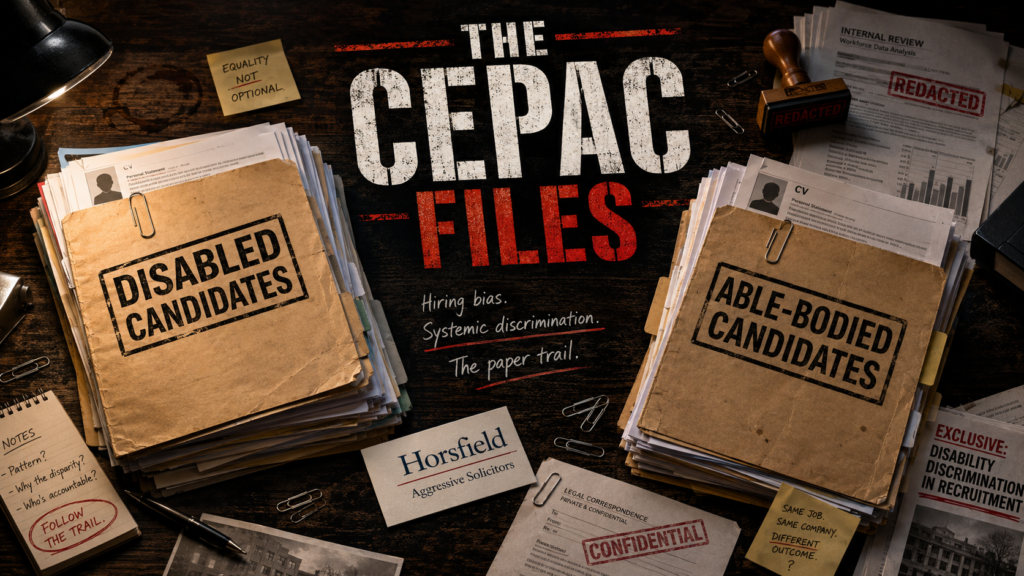
Misfits prohibits disability discrimination, intimidation and misleading information in the use of its website. Meanwhile, Cepac uses Misfits-branded work in its 2026 display portfolio. The Misfits Cepac supplier question therefore writes itself: what comparable standards apply to the businesses behind the cardboard? Page Outsourcing’s recruitment call, a same-day WhatsApp, Maria Walker’s reply and Cepac’s own ET3 supply the evidence to examine. Misfits promises thoughtfully sourced ingredients. How thoughtfully does it source the fucking display?
Misfits Is Already In Cepac’s Display
Page five of Cepac’s 2026 POS Portfolio contains a yellow Misfits display carrying protein bars. The branding includes “Boundary Breaking Snacks”, while the unit sits in the section headed “Parasite”. That is the display format: a small merchandising unit attached to an existing retail fixture. The packaging industry supplied that particular word all by itself.
In fact, Cepac chose to put the photograph in its own sales material. Consequently, the commercial evidence begins with the packaging company presenting Misfits-branded work as part of its offering. Nobody needs to squint at an unidentified box or manufacture a connection from a handful of social-media follows. The bloody thing is on the page.
However, the photograph leaves the contracting details open. Misfits and Cepac can identify who commissioned the display, whether an agency handled the order, when production took place and whether further work followed. After all, a portfolio labelled 2026 does not date every photographed job. Those are straightforward questions for the businesses holding the records.
For now, the documented link gives Misfits a specific reason to examine Cepac’s record and explain its expectations. Its name helps demonstrate what Cepac can make. The next question concerns how that company treats applicants for work in its factories.
Misfits Has Rules At The Digital Door
Meanwhile, Misfits Health’s own website terms provide a useful starting point. Section 12 prohibits using the site or its content for harassment, intimidation and discrimination, expressly including disability. The same section bars false or misleading information and collecting or tracking other people’s personal information. Misfits reserves the right to terminate access for prohibited uses.
However, these are website terms. Their publication does not establish a supplier contract or give Misfits an automatic right to inspect Cepac’s records. Their significance here is the standard of behaviour Misfits is prepared to articulate. The company can describe unacceptable conduct and attach a consequence to it when setting rules for its online service.
So what equivalent expectations accompany its purchasing decisions? Does Misfits require fair treatment in recruitment, reliable explanations when complaints arise and respect for sensitive personal information? In particular, which conditions reach a manufacturer commissioned through a marketing agency? A clear answer would tell customers where those expectations operate beyond the screen.
This is where any corporate bullshit needs to get its coat. Misfits can identify the rules governing the production of its branded displays, explain how it assesses concerns and say who takes responsibility. None of that requires a new flavour, a photoshoot or a motivational workshop.
How Thoughtfully Does It Source The Cardboard?
Elsewhere, Misfits describes its products as “Indulgent AF” and places “Thoughtfully sourced ingredients” beneath “Just The Good Stuff”. Its public pitch is confident, playful and very pleased with what goes into the bar. There is no shortage of personality when the subject is caramel.
The sourcing claim concerns ingredients. Packaging deserves its own answer, because the display also helps sell the product. For example, a buyer approves the design, agrees a price and arranges delivery. Somewhere along that route, somebody selects the business doing the work. That decision has a human dimension as well as a print specification.
Misfits can therefore explain what thought goes into that selection. What information does it seek about recruitment practices and complaints? How does it handle a documented concern involving a manufacturer behind its branded work? If another business placed the order, what expectations does Misfits set for that intermediary?
A brand called Misfits has an especially interesting opportunity to answer those questions. After all, the name gives the story its irony; the documents give it substance. Now open the packet and look at the awkward shit underneath the cheerful design.
The Interview Existed In My Same-Day Message
On 21 August 2024, Page Outsourcing called me about a production role at Cepac’s Darlington factory. During that call, Page offered me an interview for the week after the bank holiday. We also discussed a £27,000 training wage moving towards £29,000. I explained that my employment gap involved treatment for a mental-health condition.
Page said another call would confirm an exact, mutually agreeable interview time. That call never came. However, I had already told a friend about the conversation. My WhatsApp message recorded “Interview next week” and “27k training wage up towards 29”. The recipient retained the exchange and later supplied a witness statement confirming its origin and context.
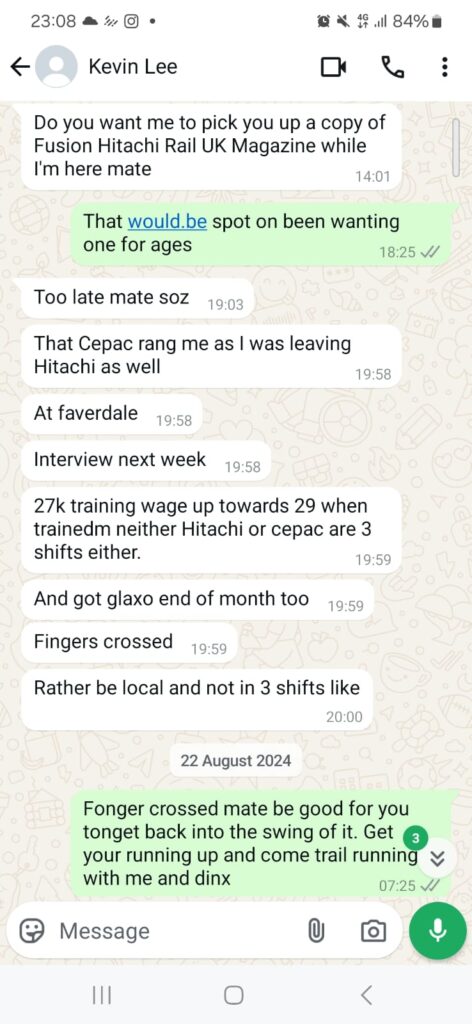
This is my contemporaneous account of the call, rather than a written offer from the recruiter. Its value therefore lies in its timing and detail. Before lawyers, pleadings or arguments about my behaviour, I described an interview and the money. Those details deserve comparison with Page’s own records.
There was a job conversation, a health disclosure and then fuck-all by way of the promised confirmation. The message remains available to anyone willing to examine why my account and Cepac’s later explanation differ.
Maria Walker Called It Confusion
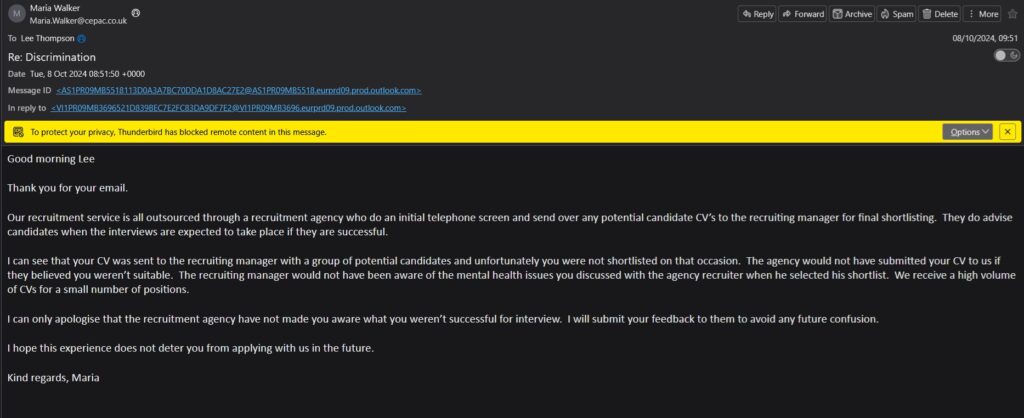
On 8 October 2024, I complained directly to Cepac about the interview, the missing confirmation and the mental-health disclosure. At 09:51 UK time, HR Business Partner Maria Walker replied. Her email said the agency screened candidates and sent CVs to Cepac’s recruiting manager for final shortlisting.
Walker said I was “not shortlisted on that occasion”. She also said the manager would not have known about the mental-health issues discussed with the agency. Her explanation referred to a high volume of CVs for few positions. She apologised that the agency had apparently failed to explain that I had not secured an interview, promising feedback to prevent future “confusion”.
Consequently, that answer requires more than a polite nod. What did Walker review before presenting this explanation? Did anybody check the actual words used during the call, or compare the candidate-status history with the interview account I had supplied?
“Confusion” is doing a hell of a lot of unpaid work in that email. This is precisely where I see corporate arse-covering: a disputed recruitment event becomes a communications problem, while the event itself stays unresolved. My same-day message gives Misfits a concrete reason to ask for a better explanation than that little dollop of HR blancmange.
The ET3 Puts Health Information In August
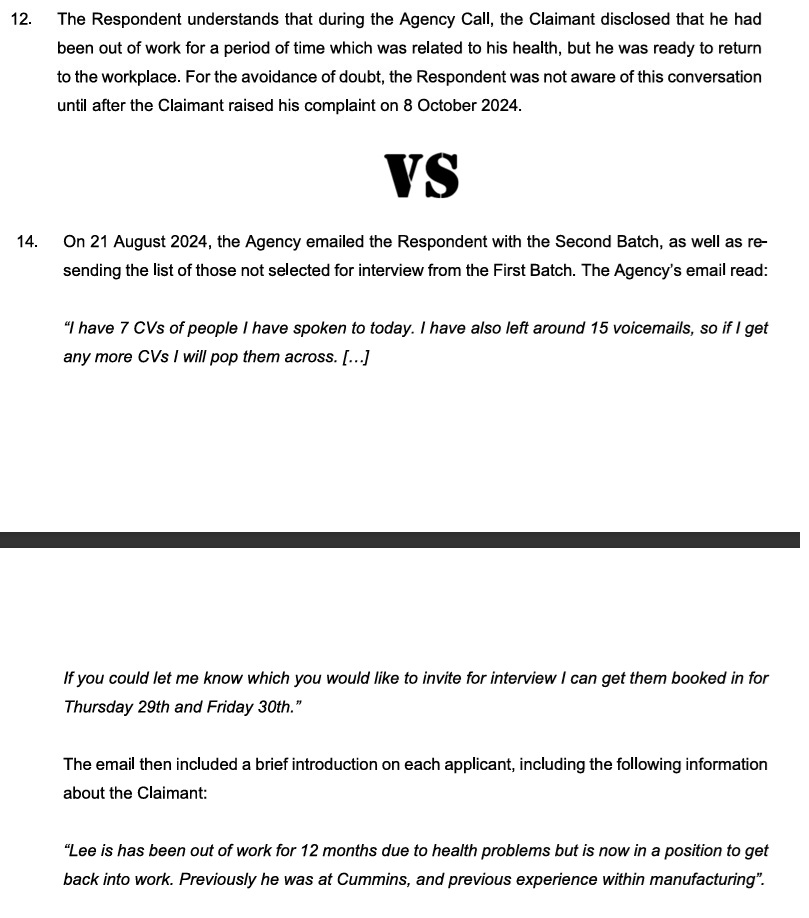
Cepac’s own ET3, its pleaded response to the claim, makes the question more precise. Paragraph 12 says it did not know about the health-related agency conversation until after my complaint on 8 October 2024. However, paragraph 14 reproduces an agency email that Cepac says it received on 21 August.
That email included a candidate introduction explaining that I had spent twelve months out of work because of health problems and now felt able to return. It also identified my previous employment at Cummins and manufacturing experience. According to Cepac’s own pleading, therefore, health-related information travelled from the agency to Cepac during recruitment.
However, knowing about health problems and knowing the full nature of a disability are distinct questions. Cepac still needs to reconcile its account: which information did each person receive, when did the manager read it and what distinction does the company draw between the August email and the October complaint?
Nevertheless, the contradiction warrants investigation on its actual wording. I do not need to invent a secret communication channel; Cepac describes the bloody email itself. Read paragraphs 12 and 14 together, obtain the underlying records and ask whoever drafted the response to explain how the chronology fits.
Michael Page Supplied The Black Squares
Page Outsourcing’s involvement also matters because it held recruitment information and correspondence about the complaint. The group now brings its recruitment and outsourcing services together under the Michael Page brand. A new sign above the door leaves the old candidate file exactly where it was.
My subject access response contained heavily redacted internal correspondence. Page said it had removed third-party personal information; nevertheless, the disclosed material obscured names and routes through the chain I was trying to understand. This marker-pen shitshow made it harder to establish who said what to whom. That is the practical problem with the blackout around the recruitment account.
The fuller DSAR record already appears in TCAP’s Page Partners : Cepac Limited investigation. Here, its relevance is narrow: a buyer examining Cepac’s explanation should also ask what underlying agency records support it. Walker’s email and the ET3 both rely on Page’s part in the process, so the agency remains inside the factual chain.
Misfits can ask Cepac to substantiate that account through the appropriate channels. A useful explanation would connect dates, decisions and documents while protecting unrelated personal data. Otherwise, another round of corporate pass-the-parcel would leave the same questions sitting on the counter.
My Healthcare Became Litigation Material
The dispute subsequently reached into my healthcare arrangements. Acting for Cepac, Horsfield Menzies contacted my medical centre about appointment availability and used the information when opposing a postponement. The contact concerned access to appointments. My objection concerns the intrusion and the use of that enquiry against my attempt to secure medical support for participation.
I regard that as bullying. Cepac’s solicitors were investigating the practical availability of my healthcare while I tried to navigate a disability claim without representation. Set that beside the missing interview confirmation and ask where the business chose to apply its investigative energy.
Meanwhile, Cepac assembled material from my correspondence, blog and X posts for its strike-out application. The published judgment records those collections. My criticism is that the resulting account foregrounded my reactions while stripping away the disability, distress and procedural context I had repeatedly raised. I have set out that criticism in detail in TCAP’s Newcastle maladministration investigation.
These methods therefore deserve scrutiny alongside the recruitment evidence. Lawyers can make applications and a claimant can challenge how they do it. Misfits can also form a commercial view about the treatment described in the records. Professional letterhead does not make every bloody tactic admirable, and a costs schedule does not turn pressure into a corporate virtue.
The Costs Rose And The Merits Went Unheard
Cepac’s combined costs schedules exceeded £50,000. That figure describes the costs it put forward, while the eventual order required me to pay Cepac £20,000. Keeping those numbers distinct matters: the claim for costs and the amount awarded answer different questions.
Newcastle Employment Tribunal heard the applications in my absence on 24 April 2026. Its judgment struck out my claims because it found my conduct of the proceedings unreasonable, scandalous and vexatious. I dispute that assessment and the handling of my medical circumstances. The finding nevertheless exists, and anyone reviewing the file should read it.
Crucially, the Tribunal did not determine the recruitment discrimination allegations at a merits hearing. Its decision therefore leaves the interview account, Walker’s explanation and the ET3 chronology without that examination. A buyer assessing supplier conduct needs to understand what the decision actually resolved.
As a result, Cepac secured an end to the claims without a trial of the recruitment allegations. For me, it produced a £20,000 bill and the same unanswered questions. Dressing that result up as an explanation of the recruitment process would be bollocks. The documents still require somebody to read them together.
The Misfits Cepac Supplier Standards Question
Misfits can begin with the commercial record: identify the route behind the branded display in Cepac’s portfolio and establish whether that route remains active. Where an agency commissioned the work, name the relevant business and explain which standards governed its choice of manufacturer. Where the work ended, give the date.
Next comes the substance of those standards. What does Misfits expect concerning discrimination complaints, accurate recruitment records and treatment of complainants? Which information can it request, what review process can it use and what happens when a supplier refuses to address a documented concern? Those answers would establish the practical reach of its values.
The evidence review then has a manageable starting point. Compare my same-day WhatsApp with Walker’s email. Put the August communication in paragraph 14 beside paragraph 12’s October knowledge statement. Seek the agency records that explain the discrepancy. Finally, consider the conduct of the litigation and the precise scope of the judgment.
Misfits can then publish the standards it applies and explain the conclusions it reaches. Any correction supported by records also belongs in that process. The company has an opportunity to produce something useful here: an answer with more substance than a shrug dipped in chocolate.
Give The Values Some Bite
Misfits Cepac supplier standards are now a public question with an identifiable product display and a defined evidence set behind it. The website rules show what Misfits will put into words. Its purchasing arrangements will show which expectations accompany the money. A responsible answer needs to connect those two parts of the business.
This file concerns a candidate who described an interview on the day of a recruitment call, a later company explanation that he had not secured one, and a pleaded August email containing health information. It also concerns the pressure that followed when I challenged the outcome. Each part has its own evidence and deserves its own answer.
Misfits has built a lively identity around doing things differently. Here is an opportunity to give that identity some practical bite. Establish who supplied the display, examine the documents and explain what acceptable treatment means along that route. After all, this exercise requires curiosity, records and the willingness to ask awkward questions of a business partner.
Leave the slogan on the stand and take the question to whoever approves the supplier: how much thought goes into the people behind the cardboard? Misfits already knows how to sell indulgence. Now let us see how it handles the inconvenient shit that cannot disappear inside a chocolate coating.
Lee Thompson – Founder, The Cummins Accountability Project
Sources
- Cepac: POS Portfolio 2026, page 5
- Misfits Health: Terms and Conditions, section 12
- Misfits: About Us
- TCAP: KFC II, Maria Walker And The Interview Receipt
- TCAP: Page Partners, Cepac Limited, Redactions, Panic Calls And The Disabled Candidate They Googled
- TCAP: Newcastle Employment Tribunal, Deep Dive, Deliberate Maladministration
- Employment Tribunal: Thompson v Cepac Limited and Page Outsourcing UK Limited, judgment following the 24 April 2026 hearing
- Michael Page: July 2026 group rebrand announcement
- TCAP case file: WhatsApp exchange following the 21 August 2024 recruitment call; supporting witness statement dated 20 February 2025; complaint and Maria Walker’s response dated 8 October 2024; Cepac ET3; Page subject access disclosure; respondent costs schedules; correspondence concerning the medical-centre enquiry and postponement.